Category: Elementary

  • What Exactly Is a Sculptor?

    What Exactly Is a Sculptor?

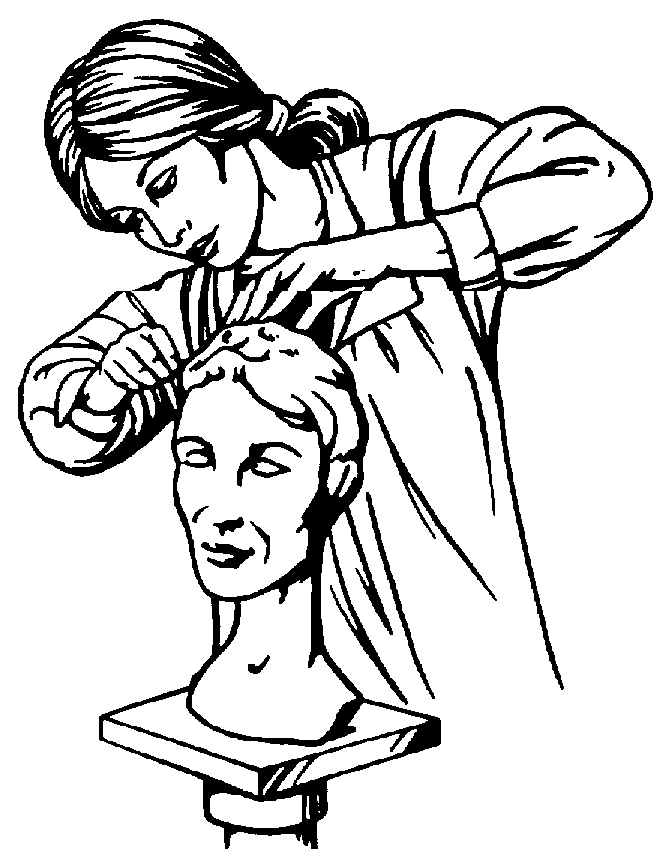
    People come from all over the world to see artwork such as sculptures at places like the Vatican in Rome and Parliament Hill in Ottawa. You might expect to see only work by world famous artists from Paris or New York. However, if you visit these places, you might find the work of a Winnipeg sculptor named Leo Mol. He was born as Leonid Molodozhanyn in Ukraine in 1915 but spent much of his life in Canada. He worked as a sculptor in Manitoba but sold his art to people around the world.

    Sculptors are artists who work with materials like bronze, clay, and stone to make statues of animals, people, or objects. Some sculptors are self-taught and learn their art from books or from many hours of practice. Others work as apprentices with more experienced artists who teach them what they need to know. Some sculptors attend university or art school. One important area of study is art history, which helps people understand the different styles of artwork that people have used in the past. The Canadian Art Foundation also had educational programs for students at many different levels.

    Like many other artists, Leo Mol studied art before he began his career. He first attended classes at the Kunst Akademie in Berlin, Germany, and at the Academy of Art in The Hague, Netherlands. He moved to Canada in 1948 and settled in Winnipeg, where he lived for the rest of his life. Some of his most famous sculptures are busts, which are carvings of people’s heads and necks. He made busts of several popes and cardinals in the Catholic Church and also of a former Canadian Prime Minister, John Diefenbaker. In 1989, he donated much of his artwork to the City of Winnipeg, and the Leo Mol Sculpture Garden opened in Assiniboine Park in 1992.

    Sculptors like Leo Mol can earn a lot of money by selling their work around the world, but their income depends on how much people like the statues. Some sculptors work in museums, schools, or advertising agencies, where they receive a regular salary. Even if they work in the same place as other people, sculptors generally work alone until the piece of art is ready to display. Then they need to work with others to find a place to put the sculptures. Often, sculptors work with commercial or non-profit galleries to display their work. They might sell some pieces to museums or art galleries or they might have art shows where people come to look at their work.

    Art shows are often a large part of a sculptor’s life. These shows give the artist a chance to meet others and to talk about the process of creating art. They also give people the chance to see the artistic works and possibly to buy some pieces. Are you artistic? Do you like to work with clay and other materials? If you are good with your hands and you enjoy creating art, you could consider becoming a sculptor.


  • Succeeding In High School

    Succeeding In High School

    Whenever we are facing a life change, we are worried that there may be new challenges that we may have difficulty with. This is natural and is actually adaptive for your survival as a human being. By thinking about what high school might be like, you are helping yourself to be prepared for what may lie ahead. Try thinking of yourself as an explorer entering the jungle on an expedition. Would it be smart for that explorer to enter the jungle without first having thought through the possible outcomes of their expedition? The answer is no. The explorer must prepare themselves for what lies ahead in order to stay out of danger and ensure their success on their expedition. As you enter high school, you are like the explorer – in need of some preparation for what lies ahead. Be sure to think through some of the challenges you may encounter and try as best you can to prepare for these, such as buying appropriate school supplies and being open to learning new things.

    It’s important to keep in mind that a positive attitude is your best friend wherever you go, especially when you are facing new challenges that may intimidate you and challenge you to change yourself in some ways. Being positive will help you to overcome situations that are unpleasant or uncomfortable and to help you remember what it is that you do have, as opposed to focusing on what you don’t have, what you lack, or what is negative.

    That being said, it is equally important to have your own goals and ambitions that surpass your desire and need to be better than others. Remember that you are your highest competitor, and that you can most satisfactorily achieve your goals by competing with YOUR goals and only YOUR goals. Set goals for yourself using the SMART formula: Specific, Measurable, Achievable, Realistic, Timed (Wikipedia, 2013) and make your own success. You will have more work in high school than you’ve had before, so it’s important to set your goals and work to achieve them!

    Overall, being prepared, having a positive attitude, believing in yourself and setting goals for yourself is the way to success in high school. Good luck and, above all, have fun!

  • Why Gossiping is Bad for You

    Why Gossiping is Bad for You

    Gossip is something that is very prevalent in high school, generally due to all of the changes that people are going through. With any luck, gossiping will diminish as you grow up and move on with your life. It is a type of conversation that is not very productive in terms of creating positive change in communities, and in fact is often the source of a lot of unnecessary harm and pain.

    An interesting quote I read recently said: “Great minds discuss ideas, average minds discuss events, and small minds gossip about people. Life is much too short to be lived talking about people, gossiping, and stirring up trouble that has no substance. If you don’t understand someone, ask questions. If you don’t agree with them, tell them. But don’t judge them behind their back to everyone else” –Entrepreneur Secrets 2012.

    This quote draws attention to the fact that there are often conversations that you would rather avoid, because they are nothing but mean-spirited and a waste of time. I disagree with the quote because I think that there is a time and a place for gossip. Often talking about other people is a way of understanding the social world that we live in, which is just as important as understanding anything else. Sometimes not talking about other people is a mistake because you don’t have an opportunity to digest what another person is about. People are interesting, and talking about them is not always a waste of time. The linchpin is the intention that you have when talking about other people. If you are attacking someone out of mean-spiritedness and to gain power over that individual, you must be bored or looking to “stir trouble” like the quote above says.

    I agree with the above mentioned quote in how they draw attention to the fact that not understanding someone should bring you to asking more questions. This is really true, because most of the time other people are misunderstood simply for lack of information. This is not something to capitalize on with gossip, but rather an opportunity to learn more about something that you don’t understand. A popular old adage states “don’t hate what you don’t understand”.

    In school and work situations, there will always be times when people will say or do things that you don’t agree with. It is during these situations that it is healthy to vent about the outcome of a certain conversation or event. The distinction to be made, however, is between attacking someone’s character and attacking their words or behaviours. There are relevant points and there are irrelevant points when talking about other people. If you are trying to capture them as an individual with pros and cons, this is usually a better approach than trying to twist them into a character with only cons. Most people are not evil, so spreading rumors and creating a monster out of someone else is simply mean and counter-productive.

  • Dream Job: Voice-Over Artist

    Dream Job: Voice-Over Artist

    Ever wonder who does those silly voices for cartoons like The Simpsons, Family Guy and Bob’s Burgers? Voice-over artists. These behind the scene artists spend hours perfecting their craft. They may have one character or multiple characters to voice, from cartoons to computer games to voice prompts. Voices over artists are quite present behind the scenes.

    Now, don’t let the simplicity of vocalizing into a microphone fool you. Voice-over acting requires great effort and perseverance. As veteran voice over artist Sarah Krieger puts it, “You have to be able to get a point across, relate a feeling, and nail it the first time. It’s being able to act on a mic.” Regardless of how distinct your voice is, you still need to provide a demo tape and find a talent agent much like an actor or singer would. Don’t be discouraged, because voice-over acting is a promising career if sought with enough passion and diligence.

    Voice-over artists are employed in a variety of fields, from TV and radio commercials to cartoons. They are expected to read scripts with a clear and concise tone and deliver multiple types of vocal tones to convey messages to their audience. They may even have to read multiple scripts at once and multi-task in a variety of ways.

    If you enjoy reading and acting, this might be the career for you. It is a challenging start with promising rewards. On average, the entry-level voice over artist makes between $20-30 an hour.

  • Keeping a Journal

    Keeping a Journal

    Keeping a journal is a great way to find clarity in your thoughts and to express yourself. Maybe there are issues you are going through in your personal life such as family problems,  issues with your friends or maybe the passing of a loved one.

    Writing daily or weekly in a journal/diary is a great way to let your emotions and feelings out. It can prove to be very therapeutic.

    Getting started is very simple. Grab a notebook or diary from the dollar store, write the date and just start writing. It would be helpful to write alone in your room or outside in quiet area that you may find peaceful. Write about anything that comes to mind and don’t over think it. There’s no right or wrong. Write about what you did that day. Where did you go? Who did you see? What did you accomplish? What do you feel during that moment? Are you sad about something? Are you happy? Are you stressed?

    You can even write about your short-term or long-term goals. What steps do you need to take to get there? Write them down. By writing down your dreams and goals, you are making more of a concrete commitment to them instead of just thinking about them. By writing them down and seeing them, you are more likely to act upon them later.

    Keeping a journal is not about just writing in it. It’s a great way to reflect as well by reading past entries. Maybe as the days go on and you read what you wrote before, you’ll realize that life isn’t so bad after all. You may feel better about a particular issue you were having before or maybe you changed something in your life for the better. You will see progress in your life. Maybe you accomplished some of your goals. Knowing that you achieved something that you wrote down from before is a great feeling in itself.

    As you get older, you will be glad that you kept a journal to see how your life was like in your younger days and how your life is different now. It’s a great way to keep track of memories and important moments in your life that you may forget otherwise if you didn’t write them down.

    Overall, keeping a journal is a great tool that serves many purposes. Happy writing!

  • Dream Job: Sports Coach

    Dream Job: Sports Coach

    Many people dream of becoming great hockey players or tennis stars. A few of them manage to fulfill their dreams and to play in the sport they love. However, the career of an athlete is usually fairly short. Depending on the sport, athletes might be finished by the time they are twenty-five or thirty years old. What can they do after that?  Some of them get into an entirely different type of work, like teaching or accounting. Others, however, stay in their sports through becoming coaches. That was the case for Michel Therrien, coach of the Montreal Canadiens hockey team.

    If you play on a sports team at school or a community centre, you probably know a bit about what coaches do. Basically, they help the athletes in the sport to play better than before. They might help players improve a certain part of their style, such as how they hold a hockey stick, or they might just generally encourage them to keep on practicing. Often, being a coach involves making decisions about who will play and for how long. Being a coach involves an ability to deal with people calmly and to make good decisions quickly.

    Normally, coaches work in sports that they also have played in the past. Michel Therrien, for example, used to be a player for the Montreal Canadiens hockey team. Now he is the team’s coach. His experience as a player is useful in helping him understand how players can improve their hockey skills. He also knows how to advise the players on the best way to play their game. For example, he might see how a really fast skater can help someone who is slower but very good at getting goals. He can see when a player is working well with the others and when someone needs help. Michel Therrien has experience with both the Montreal Canadiens and the Pittsburgh Penguins, and everything he has learned has helped him to become a better coach.

    The requirements for being a coach can vary a lot. Coaches for school teams are usually teachers with degrees in education, and many coaches take courses to become certified in their area. Through these programs, they learn different coaching techniques and ways of dealing with people. Experience, however, is often the most important way to learn the work. Many people start out as assistant coaches and learn from someone who has been doing the job for a long time. Michel Therrien started his coaching career in the Quebec Major Junior Hockey League, where he coached two teams before becoming a professional hockey player.

    If you love sports and dream of playing them for the rest of your life, becoming a coach just might be the job of a lifetime!

  • The Road to Self-Acceptance

    The Road to Self-Acceptance

    How’s your self-esteem doing? If you’re like me, you tend to see the best in others—and the absolute worst in yourself. Self-acceptance can be a difficult concept to wrap your head around when you’re constantly beating yourself up for every little mistake. There’s good news, though; you aren’t alone by a long shot. By considering your lapses in self-acceptance, you might start to find that the people around you are in the exact same predicament.

    Maybe you’re hung up over your poor marks in Spanish, or you think you look “fat” today. Maybe you couldn’t run the ten-minute mile, or your shirt doesn’t match your shoes. Well, odds are – and it’s kind of funny if you think about it – the people around you probably won’t even notice. It’s not that people don’t care. But did you ever stop to wonder that you aren’t the only one who’s preoccupied with your own flaws? Just as you can’t stop thinking about what you’ve done wrong, the people around you are too busy wrapped up in their own shortcomings to really identify yours. Here’s what ends up happening: each individual person sees themselves as the odd one out, when in actuality, everyone is in the same boat.

    You’ve probably heard the (albeit cliché) phrase, “Nobody’s perfect.” Everyone has flaws, weaknesses, spots for improvement—but there’s no need to focus on those. The next time you find yourself hung up over your lesser traits, try redirecting your thoughts to something you actually like about yourself. “Maybe I’m not great at sports, but I have straight A’s in math.” “Maybe I’m a little shy, but I’m excellent at reading people.” It is important to acknowledge your shortcomings, but it is much more important to remember all the great things you have to offer. And when you’re trying out this little mental compromise, your good traits should always win out.

    You must realize, by this point, how damaging it is to sell yourself short. Time passes, things change, life goes on—basically, you are the only constant force in your life. Why not respect yourself for who you are? It’s normal to feel conflicted at times, but you should never feel like you don’t matter, and by obsessing over every little flaw, you’re doing yourself a serious disservice. The next time something goes wrong, instead of attacking yourself, focus on what you’re doing right. If you start to wean yourself off self-criticism, slowly but surely, those negative feelings will start to go away.

    As for myself? Well, I’m a work-in-progress too. But I know that I deserve more than to be constantly criticized and mistreated – even if it’s coming from my own head. The road to self-acceptance is a rewarding process, and in order to become stronger people we all have to overcome our insecurities. The self-hate stops now.

  • Using Kids Help Phone

    Using Kids Help Phone

    Everyone has those days where they may be feeling a little down or are dealing with something scary or sad. Sometimes, on days like those, you just need someone to talk to! On the other hand, you may have questions that you just feel too embarrassed to ask your parents or friends. It is good to know that there is a place you can go to – whether it’s picking up a phone or going online.

    Kids Help Phone (1-800-668-6868) is a free service for all youth up to the age of 20. The phone lines are open 24/7 and you can remain anonymous and discuss anything you wish to in complete confidentiality. The agency does not have caller ID display and you do not have to leave your name. If you are hesitant to call in, they also offer advice via their website – www.kidshelpphone.ca. Ask your question online!

    The website provides valuable information on topics such as dating, bullying, family, friends, school, mental health, violence, abuse, money and so much more. I looked up the topic “Bullying” on their website and it listed many different types (physical, emotional, social, cyber-bullying, etc.). I also learned that if you are victim of bullying, you should always tell someone, whether it be your teacher, parents, friends or even someone at Kids Help Phone. The next important tip I read on this topic was to make sure that I stay safe by taking the necessary steps to protect myself as much as I can. If the bully is targeting you when you are alone, try to walk with friends and keep in the company of others when at school. Try to avoid the person and, again, reporting this person is the best course of action to take.

    Take a look at the website and browse the topics which offer so much advice and reading material on the daily issues that may be a part of your life right now. There is also a forum in which you can see other readers’ questions and posts under any topic. The best part is that a counsellor from Kids Help Phone responds to the posts, so you know you will be getting great advice. This may help you if you are going through a similar life event or situation. Just remember that this service exists for a reason – to help kids know that there is someone out there who cares and wants to listen. Even if you feel that you don’t need to call this number right now, it is helpful to keep the number handy by putting it in your cell phone or writing it down somewhere. No question or concern is too little, so feel welcome to use Kids Help Phone at any time!

  • It’s OK to Be a Guy and Love Dancing!

    It’s OK to Be a Guy and Love Dancing!

    The dance industry is not only for females. Over recent years, male dancers have been making a name for themselves and some have even become household names. Dancer/Choreographer turned singer Blake McGrath is a prime example. He was a finalist in the first season of the reality show dance competition So You Think You Can Dance and later starred in the reality show Dance Life following his dance career. He has made a name for himself in Hollywood and has danced for such celebrities as Madonna, Janet Jackson and Britney Spears and has even starred in some TV commercials. He is now a judge and choreographer for So You Think You Can Dance Canada.

    Let’s not forget about Fred Astaire and Gene Kelly. Both were famous dancers and choreographers who are pioneers of the dance world – and being male was not a barrier for them.

    There are various dance styles that males have pursued and excelled in, including ballet, hip-hop, jazz, Latin and ballroom. There are many male dancers seen in danced-based reality shows such as Dancing with the Stars, America’s Got Talent and America’s Best Dance Crew, among various others.

    Bellydancing, which is usually a dance genre that is female-dominated, has now seen many males breaking into the industry while taking a masculine approach to this art form. There was a documentary that aired on OMNI Television called Bellydance Man: From Canada to Cairo which followed Edmonton-based bellydancer Viraj Wanigasekera along his journey and the obstacles he faced pursuing a career as a male bellydancer in a female-dominated industry. With his persistence and his talent, he gained respect among peers in the bellydance world as well as from audiences worldwide. He has performed in Toronto, London, Los Angeles, Cairo and Istanbul.

    Gender does not play a role in the dance world. As long as you have the passion, dedication, talent and drive to become a dancer, that’s all that matters. Dance is an art form that can be enjoyed by all.

  • Cultural Pressures

    Cultural Pressures

    From birth, North Americans are subjected to a lot of advertisements and messages that teach our cultural values and tell us what our dreams should be. Whether you are female or male, you will experience pressure throughout your lifetime to behave and make choices that are strongly influenced by cultural values. Girls experience a lot of pressure from the media to be thin, have a perfectly proportioned body, have perfect skin, have thick hair and to generally conform to our cultural ideals of beauty. Boys equally feel this pressure to fit into a predetermined shape of what it is to be a man, including pressure to maintain fitness and muscular tone throughout each stage of life, to have thick hair, to be tanned and to be the embodiment of strength.

    This conditioning is extremely harmful to people who do not or cannot fit the “ideal” shape of cultural beauty. The way a person develops can be made or broken by how one feels they measure up to society’s expectations and the cultural standards for beauty. Unconsciously and consciously, there is a need to fit in. This pressure is especially felt when we are young. Going through changes during adolescence involves growth both physically and mentally. There are so many pressures growing up that we face, including excelling in school and sports, that adding the pressure to fit in with the North American ideals of beauty can be exhausting.

    As you become a young adult, you will notice that you will develop a sense of self and hopefully a sense of purpose. It is important to remember that there is no one else like you on Earth. Celebrate the fact that you are unique and embrace who you are. If you are having trouble with self-esteem, reach out and talk to a friend, parent or even use a resource like Kids Help Phone. Being yourself is the best option!