
Category: Scholarships

  • Scholarship Application Tips

    Scholarship Application Tips

    Like getting a ton of free money? Of course you do!

    Those lines might sound like the beginning of an un-reputable online advertisement but the truth is there are plenty of scholarships aiming to do just that; hand you free money to support your education.

    So how do you score some of this free cash? Start by applying to any and all scholarships you can.  The more you apply to, the higher your odds of receiving an award.

    If you’re not sure of your eligibility for a scholarship, apply anyway.  Many scholarships are not given out due to lack of applicants. Even if your eligibility is hazy you may be the lucky winner by default.  This was the case when Sandro Rocco, Niagara College Photonics alumni, applied to the Walker Technology Grant.

    “I wasn’t entirely sure if I qualified but I thought why not give it a shot, a lot of people don’t bother,” he commented.

    “Turned out I was the only person to apply for the scholarship so I won. The award was really helpful and got applied directly to my tuition” Sandro continued.

    Some students shy away from scholarship applications because they feel their grades aren’t high enough. However, plenty of scholarships are handed out as a result of achievement in other areas including extra curricular involvement, athletics or charity work. Financial aid and area of interest are also taken into consideration when handing out scholarships.

    Lara Muldoon, Relationship Manager with StudentAwards.com noted, “There are scholarships available that have nothing to do with academic performance or volunteer experience.  We have awards for everyone, from people of specific ethnicities to people that are tall ”.

    Take time out of your schedule to make great applications. Prioritize and spend time on scholarships that are most applicable to your skills and experiences.

    When asked what differentiates a successful candidate from an unsuccessful one Lara responded, “the number one thing is to be really passionate about your subject, pick applications that really speak to you, most providers are looking for students not with great marks necessarily but with a path in life that they are really passionate about”.

    Remember that scholarship application is not limited to your first year of studies.  Many students stop applying after their first year thinking that the majority of scholarship funding is reserved for new students.  This is not the case; many awards are reserved for students in their second, third and fourth year of studies.  StudentAwards.com commented that while the majority of their application pool stems from grade 12 students, their user demographic spans between 13 and 30 years of age.

    Students are sometimes intimidated by the amount of work involved in applying to scholarships, but by using an incremental approach and developing decent time management (yes, it is possible) you will be able to handle the stress and hopefully reap the benefits of scholarship application.

    Many online scholarships allow you to save your work in their own word processors, making it easy to finish one or two parts of the application at a time.

    Having a stock application template done in advance is another easy way to save time and minimize stress while scholarship hunting.

    Have a thorough list of your skills, past experiences, awards and academic achievements on hand as part of your application template.  This go-to list will make a world of difference in the quickness of your application process.

    Also, prepare a general, but flexible essay that highlights your personal qualifications and can be tweaked to fit specific scholarship criteria.

    Keep your audience in mind when filling out applications.

    If you are applying to an academic scholarship be sure to use academic language and keep the tone of your writing as professional as possible.

    In contrast, some scholarship review panels are looking to see a more personal response.  For these, don’t be afraid to use a less formal language and be sure to highlight your own opinion, giving judges a better understanding of your personality.

    Just like that summer job, it is never too early to start the search for scholarships! So good luck and happy applying!
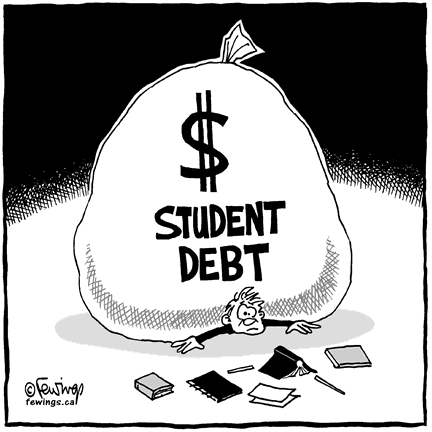

  • Making Peace with Debt

    Making Peace with Debt

    Debt is a four letter word that should not be feared.

    Students who learn how to manage debt during university are paying themselves a great investment. You may be hearing horror stories of friends of friends who are paying off student loans years after graduation. Even the media pitches in and tells tales of students with debt so large that it seems unlikely they will ever pay off.

    No one wants to start out in life saddled with debt, but this could really be the best thing you do for yourself.

    Good Debt vs. Bad Debt

    A $1000 handbag or watch from your favourite designer is bad debt. $1000 towards books and supplies is good debt. Debt that goes towards something that will benefit you in the future is fine. Using borrowed money to earn your degree will only guarantee yourself a chance to earn much more than someone without a degree or diploma.

    Dr. Richard Settersten and Barbara E. Ray’s book Not Quite Adults highlights this fact, “taking on a little debt for a bigger payoff down the road is smart”. Settersten and Ray also shared Nobel laureate, Milton Friedman’s advice: people should borrow the most early on when their earnings are the smallest, save a lot when they are in their highest earning years in midlife, and then start spending all those savings after they retire.

    Be Realistic

    BMO Financial Group surveyed students across Canada and found that half believe that they will graduate with zero or less than $10,000 debt. This doesn’t quite match up with the findings from Statistics Canada, which states the average student graduates with $18,800. Be realistic when you’re borrowing money and always know how much you’ve taken out and how much you’re spending.

    Be Strategic

    Arthur Chan, who took out Canada Student Loans for fives years at Carleton University to complete his engineering degree, graduated with a debt of $21,000. He wasn’t able to find a job in his field until 8 months after graduation. Now, 2 years in a full time position with the government of Canada, that massive loan is all but a distant memory. How did he do it?

    Just because you’re able to borrow a large amount of money, doesn’t mean you have to spend all of it. Arthur lived at home during university and took public transportation everyday to keep costs low. He also worked part time retail jobs during summer vacations. When he wasn’t able to find a job right away, he applied for interest relief on his student loans. Once he was able to secure a job, he used his earnings to get rid of the debt as quickly as possible. The key is to learn how to save as much as you’re able to borrow.

    With tuition costs rising across Canada, sometimes adding everything up really discourages prospective students. Don’t let debt deter you from getting the education you want. Remember: education is a right, not a privilege.

  • Scholarships and Bursaries for Aboriginal Students

    Scholarships and Bursaries for Aboriginal Students

    Bursaries and Scholarships
    The Aboriginal Financial Officers Association of Canada is dedicated to helping Aboriginals reach the highest standard of excellence in finance and management. AFOA’s initiatives in the development of Awards and Scholarships are examples of that commitment.

    See link below for scholarships and bursaries.
    http://www.metisnation.org/programs/education–training/education/bursaries–scholarships

  • January Scholarships of the Month – Apply Now!

    January Scholarships of the Month – Apply Now!

    If you’re entering college or university in 2014, now is the time to get your applications in for scholarships and bursaries. The turning of the calendar to a new year heralds many new scholarship opportunities that you will not want to miss out on! Recently, the Canadian government announced plans for scholarships to honour Nelson Mandela – as soon as we have more information on these, we will pass them on to you. Until then, check out these great scholarships and bursaries that we have found for you this month:

    1. From Failure to Promise Essay Contest – Open to students across Canada who meet GPA criteria. Amount: $500 – $1500. Deadline: July 31, 2014.

    2. Fraser Institute Student Essay Contest – Open to students across Canada. Amount: $500 – $1500. Deadline: May 30, 2014.

    3. Tronia Systems Scholarship – Open to students across Canada enrolled in an Agribusiness program. Amount: $1000. Deadline: October 4, 2014.

    4. CBC Literary Prizes – Open to students across Canada who submit a 2500 word essay. Amount: Up to $6000. Deadline: February 1, 2014.

    5. AEF Edcuational Scholarship – Intended for students interested in pursuing an equine-related post-secondary education. Amount: Varies. Deadline: April 25, 2014.

    6. Joseph W. Atkinson Scholarship for Excellence in Teacher Education – Open to students in Ontario enrolled in a teacher’s college. Amount: $2000. Deadline: July 13, 2015.

    7. Farm Credit Canada Support Grant – Open to students who are members of 4-H in 2013/2014. Amount: 30 grants worth $500 each. Deadline: January 31, 2014.

    8. Industrial Undergraduate Student Research Awards – Open to students registered in a university bachelor’s degree program in natural sciences or engineering. Amount: $6500. Deadline: February 28, 2014.

  • How to Nail a Scholarship Interview

    How to Nail a Scholarship Interview

    Discovering that you have been chosen from a pool of applicants for a scholarship interview is an exhilarating moment. However, many students quickly find themselves getting anxious as they start to prepare for the big interview. It’s normal to feel this way, especially when you have great sums of money on the line. The following is a list of tips and tricks that can help you get ready for the big day:

    1. You’ve probably heard this from your parents and teachers already, but it’s important that you appear relaxed and confident. If you display confidence in yourself, the interviewers are far more likely to have confidence in you, too!
    2. Keep in mind that the interviewers have to sit through several students for hours, who often respond to the same questions with the same answers. If you want to stand out, provide memorable answers that will stick in their minds for the rest of the day. However, this doesn’t mean that you should give ridiculous responses either. You need to find a healthy balance between appropriate and creative. You can also make your responses stand out by sharing something personal about yourself. It might be a brief story or it might be a personal goal that you’ve held for years.  Just make sure it’s not too random and that it fits within the context of the question being asked.
    3. You need to present yourself as a worthy investment. Interviewers don’t just want to hear why you want or need the money; they want to know how you plan to use it to better your future. Try to prepare some ideas beforehand about how this scholarship money can change your life in the long-run.
    4. Your attitude can differentiate you from the pack as well. Try your best not to be monotone and boring. Speak conversationally with your interviewers because it will make the atmosphere far more relaxed. This will be like a breath of fresh air for the people interviewing you!  Remember that they have probably been sitting stationary for a while so they could use something to wake them up.
    5. There are several “little things” that you can also do to bring yourself to the top of that list. These little things are often forgotten by most so keep them in mind: Shake hands with your interviewer.  When they ask you how your day was, return the question. Thank your interviewers for even considering you for the scholarship. Believe it or not, these simple and polite gestures will increase your chances of being remembered!
    6. At the end of the interview, most interviewers ask if you have any questions.  Use this as an opportunity to extend the conversation beyond the standard questions that they ask everyone. A cool technique is to ask a question about the organization that is offering the scholarship. This gives the interviewers a bit more time to talk about themselves, which will be a welcome change from a long day of asking questions!

    You now have a bag full of tricks to get you through your big interview. Keep your head held high and remember to show off that sparkling personality!

  • How to Survive Without A Salary

    How to Survive Without A Salary

    Today my grandmother gave me a thick antiquated book entitled “How to Survive Without a Salary”, by Charles Long, circa 1981. The truth is that I’m employed, as a writer and a barista at a coffee shop. My grandmother is aware of both those facts. So I do in fact earn summer salaries, but with her infinite wisdom my loving old granny felt the need to bestow the book upon me nonetheless. With a career as a student and jobs that pivot around an education’s schedule, it’s pretty much impossible to predict long term income or complete financial stability anyway. My grandmother knows that despite the state of a person’s finances, tips on how to adopt what Long calls the “conserver lifestyle” are always good to consider.

    So let’s consider them. Long defines the term conserver lifestyle as “a means of coping better with what (one) already has.” Chapter one of his novel deals with internal factors preventing you from finding success in that regard. For interest’s sake, let’s pretend we don’t have any of those. But chapter two is ‘Assessing Yourself: Making a Budget,’ which is definitely worth a look. You never want to be spending more than your wallet can handle, especially when, as students, there are some costs that can’t be evaded.

    According to Statistics Canada, Canadian student tuition fees alone averaged at $5,777 in 2008-09, with Quebec’s $2,488 average the lowest and Ontario the highest, at $8,797. But there are also “ancillary fees,” those compulsory extra charges over and above tuition to cover things like athletic programs, health services and student associations. These fees added an average of $695 more to the demands on a full-time Canadian undergrad in 2008-09, ranging from a low of $423 in New Brunswick to a high of $827 in Nova Scotia. Ancillary fees are usually unregulated, but you can often look into them on school websites and find opportunities to opt out of what you don’t need.

    We can all survive without a salary while we are students if we keep watch on costs and budget ourselves accordingly. Long claims that “costs are always more important than earnings…there is nearly always more advantage in reducing costs than in increasing earnings.”

    In order to be able to sustain yourself while you get an education with an unstable salary and all of these subsidiary costs to student life, several banks like RBC and TD Canada Trust have places for you to create your own budget lists on their websites. At the time the book was written, without widespread use of the Internet it was a bit tougher to budget, but today many student budget list templates can be found online as well. The Office of the Superintendent of Bankruptcy Canada’s student budget section is a good resource, at http://www.ic.gc.ca/eic/site/bsf-osb.nsf/eng/br01399.html.

    After the section on budgeting, Long gives eleven more chapters of detailed analyses on financial strategies, many of them useful. He says, “A penny saved is not a penny earned. A penny saved is a hell of a lot more than a penny earned today.” We know that simply by keeping our savings in the bank, they grow with interest. That can apply to scholarship money or bursaries that may be extractable for personal holding (OSAP, for example).

    Chapter six on ‘The Second-Hand Market’ is my personal favourite, advocating the benefits of getting everything and anything used or pre-owned. Shopping in thrift stores doesn’t only help your wallet, but choosing to reuse can help our planet too.

    I’m glad to have been given this book, and prepared to become more money-conscious. With sky high tuition costs and the absence of established careers at this point in our lives, it’s smart to consider advice from anyone, outdated or otherwise, especially a published professional. And where did my grandmother find this yellowing treasure? At Value Village, naturally.

  • Scholarships for Aboriginal Canadians

    Scholarships for Aboriginal Canadians

    Bursaries and Scholarships
    The Aboriginal Financial Officers Association of Canada is dedicated to helping Aboriginals reach the highest standard of excellence in finance and management. AFOA’s initiatives in the development of Awards and Scholarships are examples of that commitment.

    See link below for scholarships and bursaries.
    http://www.metisnation.org/programs/education–training/education/bursaries–scholarships

  • December Scholarships of the Month – Apply Now!

    December Scholarships of the Month – Apply Now!

    With December upon us and exams in full-swing, the last thing on your mind might be how you’ll fund your post-secondary education next year. As you settle in for your holiday break in a few weeks, take some time to check out the scholarships we have sourced for you this month. Getting your applications in now can help grab that free money that you otherwise would not have. Take a look at the application criteria for each scholarship – you may be only a few clicks of your mouse away from getting help with your post-secondary tuition!

    1. Equals6 Top-Talent Scholarship – Open to all students across Canada attending high school full-time. Amount: $250. Deadline: December 31, 2013.

    2. Industrial Undergraduate Student Research Awards (I-USRA) – Open to students registered in a university bachelor’s degree program in natural sciences or engineering. Amount: $6500. Deadline: February 28, 2014.

    3. Simplycast Jutla Scholarship – Open to all students across Canada entering any field of study. Amount: $450. Deadline: February 28, 2014.

    4. Simplycast Scobey Scholarship – Open to all students across Canada entering any field of study. Amount: $450. Deadline: February 28, 2014.

    5. From Failure to Promise Essay Contest – Open to all students across Canada who write a 1000 word essay on a specific topic. Amount: $500 – $1500. Deadline: July 31, 2014.

    6. Canadian Society for the Study of Religion Undergraduate Student Essay Contest – Open to all students enrolled in undergraduate studies at a Canadian university or college who write a 2500 word essay on a specific topic. Amount: $100 – $300. Deadline: April 18, 2014.

    7. Fraser Institute Student Essay Contest – Open to all students enrolled in high school or an undergraduate studies program across Canada who write a 1000 word essay on a specific topic. Amount: $500 – $1500. Deadline: May 30, 2014.

    8. Terry Fox Humanitarian Award – Open to all students across Canada who demonstrate community service and volunteerism. Amount: 20 awards worth $7000. Deadline: February 1, 2014.

  • Money Management

    Money Management

    If you are anything like me, you will often find yourself thinking, “Just one more small purchase won’t matter.” And if you’re even more like me, you will soon realize that maybe that small purchase did matter when you discover that your bank account is now empty. It would be silly to think that one small coffee made you broke, but when you figure out that maybe having one every day is a little excessive, you have the first step toward money management down: awareness.

    Take stock of your funds. Figure out how much you will earn each month, and write it down. Next, find a little notebook and start keeping track of everything you buy. Write down where you bought it, on which date, and how much you spent. This serves the purpose of telling you where all the money goes. It might even serve the extra purpose of telling you that you have a caffeine addiction, and maybe you should cut back a little. Starbucks four days in a row, five dollars each time? There are twenty dollars, gone. Kind of scary, isn’t it?

    Keep that spending diary for three months so that you can get a good idea for the average you spend on each kind of purchase. Doing so will then assist you to start making changes in your lifestyle: this is where you have to start limiting yourself and have self-control.

    Trust me; I know it is not easy to break a spending habit. When you do something so often that it becomes routine, breaking that routine throws off the rest of your day. That being said, it is now time to break out a coloured pen or highlighter. Circle or highlight every habitual purchase you made in the last three months, and calculate the total cost. Then think of how many hours it took to earn that money. A little sobering, right? Once you realize that your time equals money, it becomes a lot easier to make good decisions regarding your spending.

    Now that you have figured out what you can cut back on, it is time to make a budget. Figure out the main categories your purchases fall under. For some, those might be their cell phone bill, car payments and gas, entertainment such as movies, music, and video games, going out to eat, savings, and so on. Certain bills will always remain the same, such as car payments and your cell phone bill. Some put 10% of their entire paycheque into a savings account which they do not use under any circumstances. With everything else, though, allocate a certain percentage of your remaining funds to each category.

    For example: let’s say that you make $750 per month. 10% of that is $75 which goes into your savings. Your car insurance payment costs $100, so now you have $575. Your cell phone bill costs $50, and the remainder is $525. Now you can assign a percent to everything else. You may calculate it so that you have extra money left over for emergencies or unexpected nights out. As long as you never go over your allotted limits for each category, then you won’t find yourself with an unexpectedly empty bank account again.

  • Comparing Tuition Fees in Canadian Schools

    Comparing Tuition Fees in Canadian Schools

    When children are young, their parents sometimes begin to set aside money for different purposes. Sometimes they start special bank accounts so that their sons or daughters will have some money to spend when they get a bit older. They might also start an education fund to start to save money for a university or college program in the future. Why would they do that? They know that post-high school education can be expensive, but saving money for their children can help make it possible to continue studying. When the time comes to choose a post-secondary school, students can also help by comparing costs and seeing where they can get the best value for their tuition money.

    Tuition refers to the fees students pay for being able to go to classes and to earn degrees, diplomas, or certificates. Normally, the cost of books and other supplies are not included in the tuition, which covers salaries, maintaining the buildings, and other basic costs. Tuition fees have been rising quickly almost everywhere in Canada, much faster than the cost of food, clothes, and other daily needs. In some places, the fees have almost doubled in the past five years, and in other places, they are almost four times as much as they were. One exception is the province of Newfoundland and Labrador, where tuition has been kept at the same level as it was in 2004. Ontario generally has the highest tuition fees, followed by Saskatchewan. Quebec and Newfoundland and Labrador generally have the lowest fees.

    Even within each province, tuition fees can vary a lot. In Saskatchewan, for example, there is only about a $200 difference in tuition between the most and least expensive university tuitions. In British Columbia, however, the most expensive university costs seven times as much as the lowest-priced. This difference can add up to a large amount of money for a four-year program, which could cost almost $55,000 by 2023. Unless students can live rent-free with their parents, they also have the expenses of rent, food, and other necessities of life. This can add up to a lot of money. Cost is an important factor in choosing your program after high school, but it is only one part of the decision.

    When the time comes for you to choose a post-secondary program, money should not be your only consideration. Sometimes, the best programs with the most support for job searching are also the most expensive. An expensive institution might also offer extra benefits, such as music or sports programs, volunteer opportunities, or a selection of courses not offered elsewhere. If these benefits are important to you, a high-priced school can be a good option. If not, a lower-cost program might be best. Beside these factors, being close to family or friends, being in a big city or small town, or other personal considerations should influence your decision. If you research your options well, you can find a program that combines good economic value with a useful education for your future.