What is Architecture all about?
Architecture is the art, the science and the business of building.
Architects create homes, office towers, schools and churches. They are talented people with a flair for design, an awareness of social trends, keen business sense, solid engineering skills and an understanding of the law. The word “versatile” may have been invented to describe Architects!
Today’s Architect may practice alone or be part of a small, medium or large firm. Some Architects are self-employed. Others may be on salary, as employees of government, real estate developers or large corporations.
“Clients” are the people who use the services of Architects. A client may be a family, a school board, a company, a housing authority, a government department or a building contractor.
Why does Architecture matter?
There’s no place like home
The design or re-design of a home is one of the most fascinating and important things an Architect can do. Homes house the daily activities of families and individuals. Sometimes they offer privacy and shelter. On festive occasions, they are places of open hospitality. Rural or urban, row house or apartment, the home may be used year-round or only for vacations. Beyond our homes, the community takes shape.
Keeping the past alive
Old buildings add variety to city streets and remind us of our links to the past. Public interest in restoring old buildings is as strong as the economic pressure to re-use them. The result ? Architects are using modern techniques and ideas to renew historic buildings across Canada.
Inside the home and office
Respected Architects have designed chairs, tables, cabinets and fabrics–objects that lend comfort and pleasure to people’s homes and work spaces. When the desire to create something “organic” or whole, is strong, Architects design not only a building and the space around a building, they will also shape the space inside the building.
Mirrors of time
Great civilizations leave behind great architecture. Think of the pyramids of Egypt, the columns of Greece and Rome, the great Gothic cathedrals. Architecture reflects the religious, political and social values of the day. Today’s buildings express our society’s common purposes and will tell our story long after we are gone.
Where is Architecture going?
Big and sleek
In giant cities, the voices of commerce, finance, business and government call out for giant buildings. Big buildings can cause big problems, such as increased traffic flow. They also create a need for parking, water, sewer and fire-fighting access. Putting large buildings into a city involves balancing the technical, planning and aesthetic problems posed by size. Architects with special design skills are needed to tackle these big jobs.
Designing the city
Cities are where the action is. The social and economic character of a city is often expressed in urban design. Many Architects serve on planning boards or help people who live in urban neighbourhoods shape the city around them. Sometimes Architects get involved in restoring parts of a city, developing housing projects or industrial parks, or designing shopping centres.
What do Architects do?
It all starts with a commission–or contract–from a client. The commission may involve the design of a single building or a group of buildings and the spaces between them. The client may be a person, a board of directors, a government department or a business.
Usually, the Architect leads a team of specialists including structural, mechanical and electrical engineers, as well as others. The Architect must also understand and deal with building codes and bylaws set out by municipal, provincial and federal governments.
The Architect keeps everyone on time and on budget. Technical knowledge, good people skills and no-nonsense business sense are all important to this task.
What’s the bottom line? Architecture is a business. Being creative and designing something beautiful are only the first steps in making a vision come to life.
What is a typical day?
Such a thing may not exist. But on any given day, an Architect may have to:
- Meet with clients.
- Win contracts.
- Solve problems.
- Estimate costs.
- Meet with consultants.
- Produce drawings.
- Present at public hearings.
- Draw up specifications.
- Call tenders (bids).
- Visit construction sites.
It can be a real challenge to juggle all the aspects of this demanding job.
What do Architects do?
They Draw
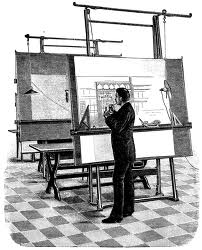
Simple diagrams show the link between spaces or activities. Detailed working drawings show every last detail. Contractors and sub-contractors estimate the cost of the work based on the working drawings of an Architect. When the time to build comes, these drawings will be the building plan.
Taking a drawing off the page and onto the computer screen through 3-D computer modeling can bring an Architect’s design to life, in living colour! Scale models or animated videos that help the viewer “see” the project from start to finish are other ways Architects present ideas to the public or clients.
They Write
Architects must
- Write business letters.
- Document all aspects of a project.
- Develop charts and tables to analyse the project.
- Develop specifications which define the building.
- Prepare articles for professional journals and magazines.
They Speak
Being able to think on your feet and communicate clearly is a big part of being an Architect. Explaining, discussing, teaching and persuading are tools of an Architect’s trade.
Architects are often called upon to:
- Make presentations to clients.
- Outline concepts, discuss options and offer creative solutions to problems.
- Appear before public bodies as an expert.
They Calculate
It has to add up! Architects must be able to prepare accurate construction and office budgets. They also have to understand structural analysis, heat loads, electrical distribution and traffic flow.
They Take Responsibility
When an Architect “signs-off” on a certificate, it means that part of the job has been completed to the Architect’s satisfaction. Several certificates are signed-off during a contract.
They Manage
Architects often manage their own offices and businesses. They must also manage projects from the first spark of an idea to the ribbon cutting at a new building. During the construction phase, Architects manage contract administration, oversee drawings and specifications, handle problems that arise on the job site and monitor work in progress.
What does it take to be an Architect?
Ask yourself these questions:
- Do details matter to me?
- Do I understand and get along with people?
- Do I truly value the things I see?
- Can I analyze what I see?
- Am I a creative thinker?
- Do I think in a logical and orderly way?
Spend some time in an Architect’s office. Ask questions. Read all you can about architecture. (Your local library can help you find books on the subject). Look at professional magazines. Visit the Schools of Architecture.
How can I become an Architect?
To be a licensed Architect, you will need
- Education
- Experience, and
- a passing grade on an Examination.
Education
The vast majority of Architects complete a bachelor’s or master’s degree in architecture from a university program approved by the Canadian Architectural Certification Board (CACB).
An alternative way to become an Architect is through the “apprenticeship” offered through the RAIC Syllabus Program.
Experience
To get experience, you must complete the Internship in Architecture Program. This program is offered through the associations of architects in each province. If you are accepted into the program, you will require a “Mentor” (a licensed Architect) who will guide your work over a period of time, according to the rules of the Internship in Architecture Program. Usually, interns or intern architects complete the program in about 3 years.
Examination
In all provinces, passing a computerized exam is one of the final steps in becoming a licensed Architect. Architects in Canada are licensed at the provincial or territorial level.
Some provincial or territorial associations may have additional requirements before licensing or registration.
Why must Architects be licensed?
Architects are professionals. The public must be sure that people who call themselves Architects are qualified to practice in their field. So, all across Canada, Architects are licensed by provincial or territorial associations of architects. The goals of the associations are:
- to encourage members to improve their skills and knowledge, and
- to maintain high standards in the practice of architecture.
Like other professionals, such as doctors and lawyers, Architects are legally responsible for the decisions they make. In some provinces, all licensed Architects must have professional liability insurance if they wish to practice architecture. This insurance protects both the public and the Architect. As well, each province and territory has an “Architects Act” which regulates the practice of architecture. It is against the law for anyone who is not licensed to use the title “Architect”.
What courses should I take in high school?
It’s hard to say which courses are best, because Schools of Architecture vary greatly in what they offer students at the university level. It is a good idea to find out now what is required for admittance to a university you would like to attend.
Mature students (people who are not recent high school graduates) are also welcomed by most Schools of Architecture.
As well, there is an important place in architecture for people who do not wish to pursue a university degree. You could take courses at a technical school, community college or university to become:
- an architectural technologist,
- an architectural technician, or
- a draftsperson or CAD (computer assisted drafting) technician.
What other work is available for Architects?
Here are some job titles that tell you the kind of work Architects can do :
- Architectural Critic
- Graphic Designer
- Architectural Photographer
- Heritage Planner
- Architectural Programmer
- Illustrator
- Architectural Renderer
- Industrial Designer
- Builder Inspector
- Interior Designer
- Building Envelope Scientist
- Landscape Architect
- CAD Coordinator
- Market Researcher
- Campus Planner
- Model Maker
- Carpenter
- Municipal Architect
- Cartographer
- Museum Curator
- Computer Presentation Designer
- Printmaker
- Computer Systems Analyst
- Professor
- Conservator
- Property Assessor
- Construction Inspector
- Publisher
- Construction Manager
- Real Estate Agent
- Contractor
- Real Estate Project Manager
- Corporate Consultant
- Researcher
- Design/Build Team Manager
- Set Designer
- Developer
- Structural Engineer
- Document Designer
- Technical Writer
- Environmental Planner
- TV/Film Producer
- Furniture Designer
- Urban Planner