Tag: bicycle

  • Bike Riding Across Canada

    Bike Riding Across Canada

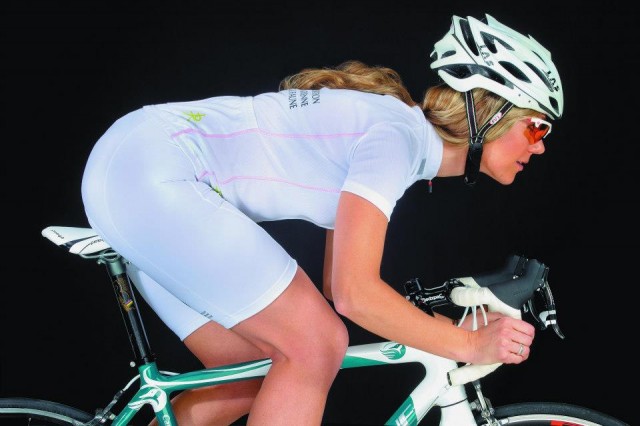
    Starting on her bike ride this month, Angella will be travelling through one of Canada’s smaller ecozones. This region, called the Pacific Maritime ecozone, covers approximately 196 000 km2, approximately the size of the country of Senegal. It spans the whole length of British Columbia’s western edge, which also includes Vancouver Island and the Queen Charlotte Islands. The close proximity to the Pacific Ocean means that winters are mild with temperatures ranging from 4°C to 6°C, while summers are cooler with an average temperature of 12°C to 18°C.

    The Pacific Maritime region is mountainous, and by the end of the week Angella will have travelled 369 kilometres over land, but also, more than 750 metres (2470 feet) up. Her climb in elevation between Victoria and Princeton will be equal to climbing almost to the top of the world’s tallest building, the Burj Khalifa, at 2700 feet.

    As Angella passes through this region, she’ll notice that the Pacific Maritime ecozone is home to the tallest trees in Canada. These trees are found in the forests that occupy 45% of the region’s land mass and cover approximately 10 million hectares. Five different forests make up this region: the Western Hemlock forest, Mountain Hemlock forest, Douglas fir forest, Arbutus and Garry Oak forest, and the famous Temperate Rainforest. Each one consists of various coniferous trees.

    Angella may see a large diversity of wildlife on her ride. Woodland animals are common throughout the region, and include Black and Grizzly Bears, Moose, and Cougar. Much less common, and unique to this ecozone, is the Vancouver Island Marmot, a highly endangered animal found only on Vancouver Island.
  • Bike-sharing: An Idea for City Cycling

    Bike-sharing: An Idea for City Cycling

    How good are you at sharing with others? Do you ever let your friends use your bicycle? How would you like to share it with hundreds of other people? You might not want to do that with your own bicycle, but what if you and your friends could use public bicycles like taxis or buses? If you had to go somewhere, you could pick one up near your house, drop it off at your destination and then get another one for the return trip. Then someone else could use it for their own ride. That way, you could experience the benefits of cycling even if you didn’t own a bicycle.

    The idea of a public bicycle system began in the 1965 in Amsterdam, Netherlands. The White Bikes (Witte Fietsen in Dutch) were intended to be used for a short trip and then left for the next rider to pick up, but it didn’t work out that way. There was no way to know who had taken the bikes, and many of them were damaged or stolen. The program ended after only a few days, and bicycle-sharing seemed to be finished. Then in 1991 and 1993, four small bicycle-sharing programs began in Denmark. The largest of these was in Copenhagen, where bicycles were available at certain stations throughout the city for a coin deposit. The bicycles were much better built than the White Bikes of Amsterdam, but they were still often abandoned or stolen. The organizers needed a new way of keeping track of the customers who borrowed the bikes. Eventually, technology helped to provide a solution to the problem.

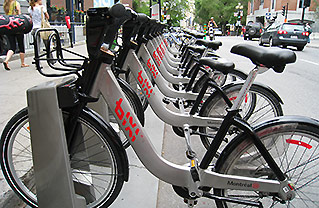
    The main trouble with previous systems was that there was no way of knowing who had the bicycles or where they went. In 1996, the Bikeabout program at Portsmouth University in England helped provide an answer with electronically-controlled bike racks and magnetic stripe cards for borrowing a bicycle. By 2005, the idea of bike-sharing was spreading around Europe. The city of Lyon, France bought 1500 bicycles for shared use, and the government of Paris started its own program called Vélib (from the French words for “bicycle” and “free”) in 2007. The program began with 7000 bikes but has now expanded to 23,600 around the city. In 2008, similar programs began outside Europe in places like Brazil and New Zealand. In 2009, the Bixi (“bicycle taxi”) program began in Montreal with 5000 bikes at 400 stations.

    The idea behind bicycle sharing is quite simple. People can buy daily, weekly or yearly passes. When they want to ride, they use their credit cards to release the bicycles from the racks. The first half hour of the ride is free, and after that they start to pay a rental fee for extra time. Bicycle repair people pick up damaged bikes, fix them, and return them to the racks.

    This system is especially good for people who use bicycles for short trips, such as riding to work or school. It saves the trouble of finding parking spaces for their cars, not to mention giving people a chance to exercise and to avoid adding to pollution in the air. If bicycle-sharing continues to grow, it could change the way people travel in the world’s cities.