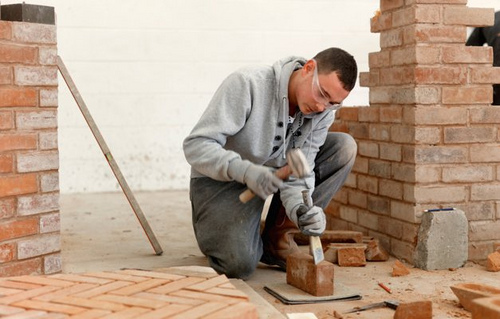
Tag: career profile: bricklayer

  • Trade Career Profile: Bricklayer

    Trade Career Profile: Bricklayer

    If you are good with your hands and can work with precision using tools, being a bricklayer, also known as a stonemason, may be the career for you.

    Description

    Bricklayers build and repair a variety of different things from building floors to fireplaces to chimneys. They use a variety of different materials such as bricks, blocks, stones, mortar, and more. They use levels to measure for accuracy and to keep everything in line. It is said, “A good bricklayer can lay around 750 bricks in a single day.” (careersinconstruction.ca).

    Typical working day

    Like most other careers, bricklayers work 40 hours a week. They work 8 hours a day, 5 days a week. However, depending on the season, there may be the requirement to work overtime. This career is mostly outdoors, dependent on the project. This includes hot summers and cold winters where there are protective enclosures or heaters used to continue working despite the weather conditions. This career is physically demanding and requires team-work as a group even when working on a single project. Luckily, people in this career are properly trained and must wear personal protective equipment (PPE) because of the potential danger on the job.

    Education and Training

    Unlike common schooling where you go to school to study, bricklaying does not require this type of education. Rather, you must go through an apprenticeship. This includes being both in the classroom and working under supervision. As you go through apprenticeship, you earn money while working. You begin earning 50% of what your journeyperson (supervisor) earns per hour; your rate increases as you work until you reach the full wage. To enter an apprenticeship, you must be at least 16 and have your grade 10 education. Some provinces and territories offer apprenticeship programs to allow you to work towards your career.

    The apprenticeship program is usually three, twelve-month periods but it varies across Canada. As well, you must achieve at least 1,600 hours of training, three, eight-week blocks of technical training and a final certification exam. You must complete the apprenticeship program and the requirements to become a certified bricklayer.

    Salary

    The salary for a bricklayer depends on a variety of different factors such as experience-level, contract, company and location, to name a few. Salary can be anywhere between $32,000 and $75,000.

    Overall

    A career as a bricklayer is physically-demanding but with a good outlook for jobs of 15% growth rate between 2014 and 2024. If this job appeals to you, it is an excellent career to consider.

  • Career Profile: Bricklayer

    Career Profile: Bricklayer

    When you were younger, you probably played with bricks made of plastic or wood. Many children enjoy building with toys, but sometimes that interest carries on into adulthood. One way to continue to work in this kind of area is to become a bricklayer.

    Constructing a building takes many different people doing various, important tasks. Some people pour the concrete for the basement and others put the roof on at the end of the process. Bricklayers work with skilled tradespeople like brick masons or tile setters to put brick and stone together in many different kinds of buildings, such as houses, schools, and factories. Often this means working outside, and sometimes the work can be limited by the weather. However, many construction sites are now winterized so that people can continue to work, even in the snow and cold.

    Depending on their level of skill and the other people on the job, bricklayers might work in different parts of the construction process. Often, they assist the masons by carrying the building materials to the right spot and making sure that the right tools are available. At the end of the job, they might be the ones to clean up the area and put the equipment away. However, some bricklayers become specialists in certain areas such as installing bricks around furnaces or other high-temperature areas. Learning to do the work on their own can help bricklayers advance in their field.

    The best way to become a bricklayer is to learn on the job. However, the majority of bricklayers finish high school, and some continue on to college or university. Some mathematical skills are useful, as well as the ability to think logically and so solve problems. Bricklayers should be good with their hands and be able to use machines and small tools. They need to be able to lift heavy materials and manage work that can be physically demanding and sometimes high off the ground. This is not a good job for anyone who is afraid of heights.

    Like many of the trades, job prospects for bricklayers can vary according to the rest of the economy. When most people are doing well, they spend money on new houses and other buildings, but when they are doing badly, they might cut back on any new construction. However, the bricklayers can increase their chances of getting work by learning new skills and getting additional training. Salaries generally start at about $38,000 per year, but they can grow to twice that much as bricklayers gain experience and new skills.

    When you see a building under construction, do you wonder how all of the parts fit together? If so, you might want to think of becoming a bricklayer.

    Bibliography:

    Careers.org. “Career Occupational Profile for: Bricklayer.” http://www.careers.org/occupations/25471/bricklayer.

    Payscale.com. “Bricklayer Salary (Canada).” http://www.payscale.com/research/CA/Job=Bricklayer/Hourly_Rate.

    TradesInfo.ca. “Bricklayer Description.” https://bc.tradesinfo.ca/trade-information/bricklayer/description.

    Wikipedia.org. “Bricklayer.” https://en.wikipedia.org/wiki/Bricklayer.