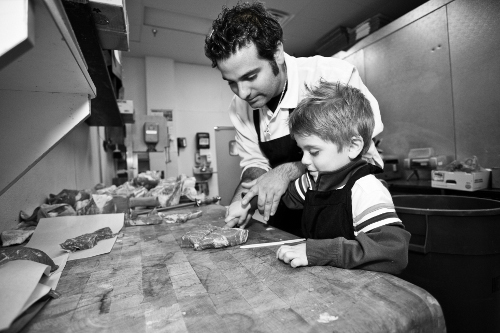
Tag: career profile: meat cutter

  • Career Profile: Meat Cutter

    Career Profile: Meat Cutter

    One of the easiest lunches to make is a sandwich with sliced meat. Many people have meat at least once or twice a day, but they might not think of how it comes to them. Retail meat cutters, also known as butchers, are the tradespeople who help to make these meals possible.

    Almost seventy-five percent of meat cutters work in grocery stores, and others work in processing plants or places like restaurants. Many of them work long hours, often early in the morning. They sharpen and adjust cutting equipment, cut or grind meat and take out the bones, and sometimes prepare special requests from customers. Meat cutters need enough physical strength and stamina to deal with heavy pieces of meat and to get through bones with their tools. They have to know how to store meats and clean the equipment to avoid spreading diseases. Meat cutters also work with packaging, pricing, and displaying meat in stores.

    Many meat cutters need to know how to deal with customers but also how to work alone. Some of them might work at a meat counter at a grocery store where they deal with customers all day, or they might work at a processing plant and see only their coworkers.

    Meat cutters need a certain amount of manual dexterity to deal with the machines, and they should be able to work in cold conditions. Even though they normally work indoors, they need to be able to handle the cool temperatures necessary to keep meat from going bad. Often, they go in and out of meat freezers where they have to wear special gloves to protect their hands. Meat cutters also need to be able to deal with the sight of blood and the inner organs of animals, as well as other things that they might find unpleasant.

    Depending on where they work and how much experience they have, retail meat cutters can earn between $29,000 and $48,000 per year. Normally, jobs in this trade require a high school education with courses in mathematics, English, and science, and also an apprenticeship of at least four thousand hours. However, you can already get started on your career by learning as much as possible about different types of meat.

    Being a retail meat cutter requires a special set of skills that might not easily transfer to other work, but people in this field can normally find work even when they are older and not very strong. Having special abilities such as cutting meat according to Jewish or Muslim religious guidelines can also help people find work, since not everyone would know how to do this. A wide set of skills can be very helpful for people in this trade.

    As long as people eat meat, they will need meat cutters, but large cities are more likely than small towns to have work in this field. If you prefer to work with a few people, a small deli or butcher’s shop might be a good place to go. However, if you like lots of activity, a large grocery store might be better. Wherever you go, people will appreciate your work at mealtime.

    Bibliography:

    Apprentice Search.com. “What Does a Retail Meat Cutter Do?” http://www.apprenticesearch.com/AboutTrades/GetTradeDetails?tradeId=60&TradeName=retail-meat-cutter.

    Government of Alberta. “Occupational Profile: Meat Cutter.” https://alis.alberta.ca/occinfo/occupations-in-alberta/occupation-profiles/meat-cutter/.

    Payscale.com. “Meat Cutter, Retail Salary (Canada).”

    https://www.payscale.com/research/CA/Job=Meat_Cutter%2c_Retail/Hourly_Rate.

    Truity.com. “Butcher or Meat Cutter.” https://www.truity.com/career-profile/butcher-or-meat-cutter.

  • Career Profile: Meat Cutter

    Career Profile: Meat Cutter

    If you eat lunch meat like bologna or salami, you might notice that it sometimes comes already sliced and sometimes not. Have you ever thought about who cuts the meat? In small shops, it might be the same person who sells the meat to you and your family. In many places, however, the job of meat cutter is a special one that requires a lot of skill and experience.

    Working as a meat cutter requires no special education other than a high school diploma. However, people in this trade need to know about mathematics to be able to weigh and measure the meat and to calculate prices. They need to be able to work with other people in the store or factory and to be skillful in dealing with customers. Depending on where they work, they might spend a lot of their time dealing with people or almost none at all.

    One of the most important aspects of being a meat cutter is to know a lot about the product. Sometimes, this might include knowing about the nutrition in a piece of sausage. At other times, this might include knowing about the different cuts of meat and how they are used. Do you know the different kind of steak or what kind of meat is best for using in soup? How long should a turkey be in the oven before it is done? These are the kinds of questions that a meat cutter might have to answer.

    Jobs for meat cutters can vary. They can work in processing plants, butcher shops, small grocery stores, large supermarkets, or anywhere else that deals with meat. Some of them might spend their days cutting up large chunks of meat in factories or feeding it into grinders to make sausages. Others might work in restaurants or small shops where they cut small amounts of meat for sandwiches.

    The special skills that meat cutters need and the working conditions depend a lot on the specific job. People working in factories or slaughterhouses might have to deal with very harsh conditions as they work with cold freezers, sharp tools, and heavy animals. However, people who work in small shops might be very busy dealing with customers but have much more comfortable working conditions. Wages vary from about $14 to about $30 per hour, depending on experience and the difficulty of the work.

    Like many other tradespeople, meat cutters have a special organization to help members. The Canadian Professional Meat Cutters Association Helps members develop their skills and to deal with any problems that they encounter. Becoming a member of an organization like this can help people find others in the same trade and can help with education and apprenticeships. If you are interested in becoming a meat cutter, you should find out about what the trade association is doing in your area.

    Do you like working with food? Maybe you should consider becoming a meat cutter.

    Bibliography:

    BC Tourism. “Meatcutter Program.” https://www.go2hr.ca/training/meatcutter-program.

    Canadian Professional Meat Cutters Association. Training & Education http://meatforce.ca/training-education/.

    Payscale.com. “Meat Cutter Salary (Canada).” http://www.payscale.com/research/CA/Job=Meat_Cutter/Hourly_Rate

    Sample Job Descriptions. “Meat Cutter Job Description.” http://www.samplejobdescriptions.org/meat-cutter.html.