Tag: degree

  • Is An Arts Degree Worth the Money?

    Is An Arts Degree Worth the Money?

    Pursuing an arts degree offers you a wide range of opportunities to study in different areas, including languages, visual arts, theatrical arts, Canadian studies, film studies, aboriginal studies, English, environmental studies, geography, history, music and philosophy, among many others. Arts degrees are chosen by students who range from having solid career plans once they graduate to students who go to university to explore an area of interest and see where it leads them. While arts degrees are often criticized as not leading to any job in particular, they are not a waste of money. Arts degrees help to develop critical thinking skills, can lead to a myriad of different careers and provide a solid foundation for further studies.

    My personal experience with getting an arts degree has been fairly rewarding. During my time at the University of Ottawa I took advantage of opportunities outside of my homework, an aspect of getting a university degree that is just as important as doing the school work itself. I was provided with many opportunities for networking with others in my field and I took on a leadership position as committee leader and also started a subgroup within sustainability in the university residences.

    If you are concerned about money when you are heading off to university, be sure that you are choosing a degree that makes sense to you. Try making a pros and cons list to elucidate your reasons for going. Look over your list with people who matter to you including your family, supportive friends and any other relevant people like teachers and career counselors. The more you assert your reasons for spending the money, the more you will come to believe in yourself and the first step in your career.

    I recommend connecting your area of interest to companies and organizations that will be of use to you while pursuing your studies. For example, if you are going to study music, what organizations are available for you to get in touch with in order to stay current with job opportunities? Looking into the job market to find out what can be done with an arts degree is something that is not explored by enough students, but it’s the perfect way to ensure you are making the right decision for yourself. Good luck!

  • What Graduates Earn Over Their Lifetime

    What Graduates Earn Over Their Lifetime

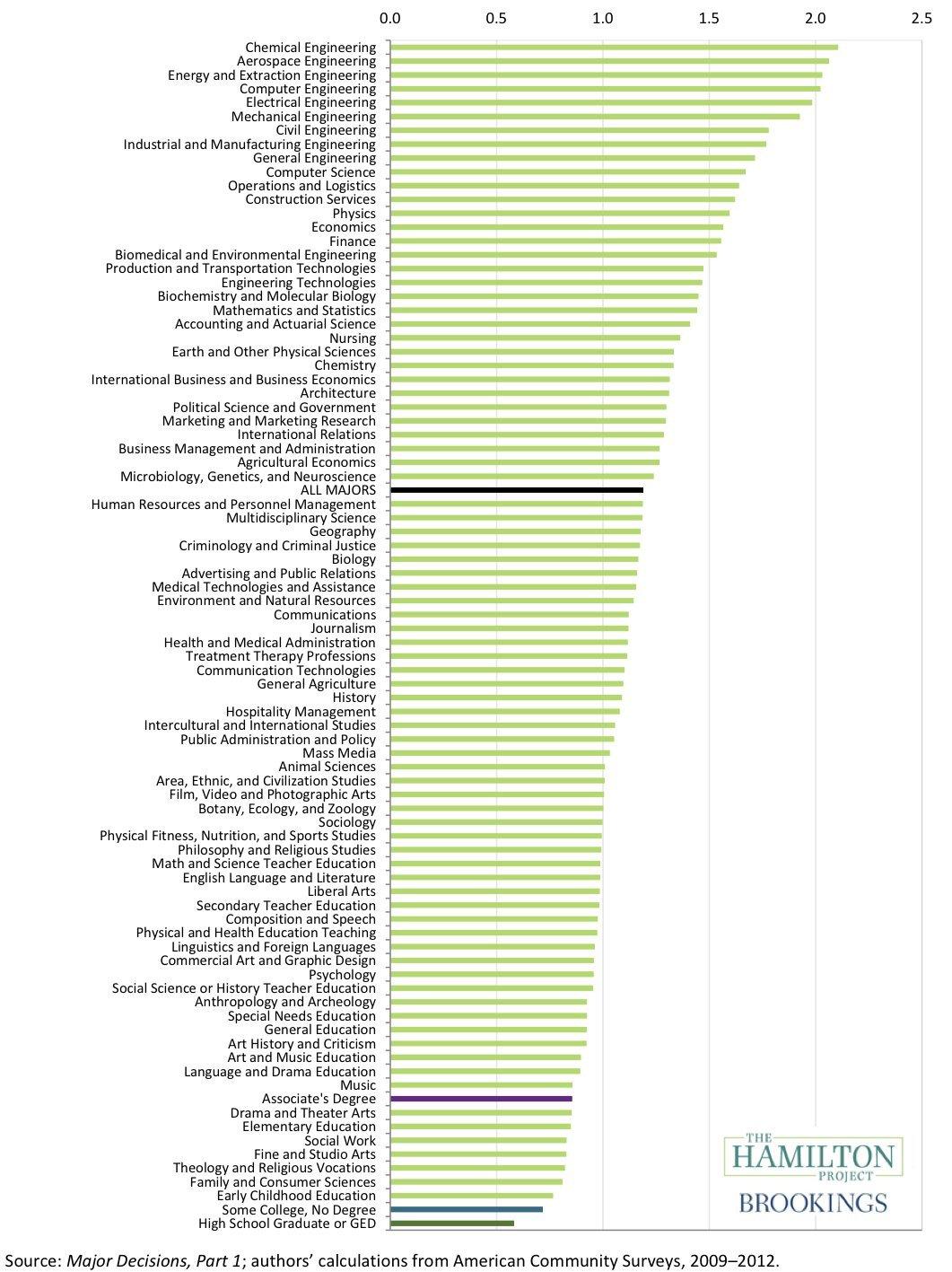
    A study released by the Hamilton Project in September of this year shows just how important a degree when it comes to earning money. A bachelor’s degree in ANY field has proven to unleash your earning potential exponentially. As the study’s authors noted, median earnings of bachelor’s degree graduates are higher than median earnings of high school graduates for all 80 majors studied. This is true at career entry, mid-career, and end of career.

    You can read the entire interesting study on the Hamilton Project website (link above). In the meantime, take a look at this chart that details which degrees earn you the most over your lifetime – and which earns you the least.

    Note: Unfortunately, this study is currently not available in French.

    HamiltonProject


  • The Difference Between a Bachelor’s and a Master’s Degree

    The Difference Between a Bachelor’s and a Master’s Degree

    Many people say that an education is the key to a good job, a high income and a good life. That might not always be true, but earning a bachelor’s or a master’s degree is a good idea for anyone who wants to work in professions like education or law. Sometimes a bachelor’s degree is enough, but sometimes a master’s degree is necessary. How can you know how much education to get? Knowing the difference between a bachelor’s and master’s degree can get you started on making a decision.

    How much education you need for your chosen profession depends very much on what level of work you want to do. A Bachelor of Education, for example, is all that most teachers need to work in the classroom. If they want to work as supervisors or school principals, however, they might need to work towards a master’s degree. In fields like English literature, psychology or sociology, a bachelor’s degree is usually only the first step towards further training and rarely leads directly to a job. In programs such as nursing, however, a bachelor’s degree is considered a high level of education. Each field has somewhat different requirements and job possibilities.

    Despite all of these differences, most bachelor’s or master’s programs have some elements in common. Bachelor’s degrees are general introductions to the field and cover a wide variety of topics. Usually, students in these programs take some classes outside their chosen field, at least in the first year or two. A science student might be required to take an English literature or history class, for example, and an English literature student might be required to take a science class.

    Bachelor’s programs might be three years or four years long. Completing these programs normally involves relatively small assignments like research papers, tests, experiments and exams. Students get the information they need mainly through lectures the professor gives during class and through reading the textbooks and other materials, with an occasional student presentation to give others a chance to teach.

    At the master’s level, things begin to change. Most master’s classes use a seminar style, with students giving longer presentations and participating in discussions on each day’s topic. Class size is usually much smaller than at the bachelor’s level, but the assignments are more difficult. One of the biggest assignments is usually the thesis, which is a long paper of anywhere from about thirty to a hundred pages on a topic that the student chooses. Sometimes students can complete another major assignment instead of a thesis, but both choices involve a lot of work.

    If you find studying and research very difficult, a master’s degree might not be right for you. If your chosen career has few job prospects, you might need to consider your options carefully. However, if you are willing to do a lot of hard work, a bachelor’s or master’s degree might be good choices for you.

  • What is a PhD?

    What is a PhD?

    When you meet people who are called “doctor,” you expect them to be able to help cure illnesses and fix broken bones. Sometimes, however, doctors can be researchers, fundraisers or consultants. These people are not medical doctors but instead have doctorates (PhDs) in a field such as literature, philosophy, chemistry or business.

    In many cases, a PhD or doctorate is the highest level of education that people can get. Students start by studying for three or four years to get a Bachelor’s degree. If they want to go on to further education, they take another year or two to get a Master’s degree. Usually, this degree involves writing a long paper called a thesis. Many people stop their studies at this point, but sometimes they continue on to get a doctorate or PhD.

    Basically, the two degrees are the same. Both of them require the student to take classes and to do research on a subject that they choose. When they finish their research they write a long essay called a dissertation. Usually, dissertations for PhD degrees tend to focus on theory but dissertations for doctorates tend to be more practical. A PhD dissertation, for example, might be about the theory of how languages are related to each other. A doctoral dissertation might be about how the theories of language relate to teaching English to speakers of other languages.

    When do people need to get a PhD or doctorate? It depends on where they are working and what they want to do with their careers. Because of the theoretical focus of most PhD programs, the connection with specific jobs is not always clear. However, many PhD graduates can find work in research or teaching. In many universities, professors are required to have PhDs or doctorates in order to get a job. A PhD is also very useful for researchers since it helps them develop the skills they need to do their work and to record and write about the results.

    Before you decide to get a PhD or a doctorate, you need to decide if the degree is right for you. Are you ready for years of studying after high school? For many people, getting Bachelor’s, Master’s, and PhD degrees takes ten years or more. University courses can be expensive, and all of those years of study can leave people in debt. Job opportunities can also be limited, especially in university teaching positions. However, options are also open in many other fields. Graduates of PhD and doctoral programs work in government departments, business, finance, community development, education and technology.


  • How Does a Teacher Become a Teacher?

    How Does a Teacher Become a Teacher?

    Have you ever been sitting in class wondering exactly how your teacher became your teacher?

    Well, most public school teachers obtain a Bachelor of Education degree (BEd) from a university. Some specialize in one subject matter, such as Art, Health, Science, Drama, Math, Music, Social Studies, Physical Education and Guidance and Counseling. Some train in a specific grade level, like early-childhood education, elementary school (including kindergarten) and middle or high school. Most teachers experience a wide range of subject matter (usually referred to as “teachable” subjects.)

    Teachers also need to obtain a teaching certificate from the province they are teaching in to certify they are qualified to do so.

    The University of New Brunswick in Fredericton, for example, offers an education program that requires students to already have a Bachelor’s degree in order to get accepted. The education program lasts 11 months and consists of taking classes and completing a work study program – meaning that, in order to complete the program, all students need to work in a classroom as a student teacher.

    The minimum passing letter grade at UNB is a C. All teachers who graduate from UNB need to have a C or higher average, and a GPA (Grade Point Average) of at least 2.7.

    Aside from education and on the job training, it is also necessary for teachers to possess certain qualities in order to be successful. Teachers should be sensitive to the needs of students. They have to be trustworthy and patient (as all students learn at their own pace). They need to be organized and good at time management. They need to be on-time every day, creative, motivational and good communicators.

    So, the next time you are sitting in class wondering how your teacher is qualified to teach you, remember they have studied and worked for many years to get the skills and training needed to do so.

  • The Value of a College Graduate

    The Value of a College Graduate

    Let’s face it; the professional world is incredibly fast paced. Because of this, employers are looking for new ways to keep up. One resource they are turning to is the infinite pool of recent college graduates. Mass amounts of qualified graduates hunt for entry level jobs that they can begin immediately following graduation. Employers are finding that young college grads can bring specific skills to the table that some experienced veterans can’t.

    Young people fresh out of college are hungry for success. They have spent years absorbing the knowledge and skills they need for their specific career path, and they can’t wait to put what they learned to use. The eagerness and enthusiasm of a young graduate could possibly outshine the experience of someone who has been in the professional world for a few years. In interview situations, sometimes personality and attitude determine whether or not a company will hire a candidate. Experience is good to have under your belt, but most college grads are trying to land their first big job, and therefore lack the professional experience the position may be requiring. In the competitive professional world, it is important to show employers all of your best attributes, which includes your personality, and make a good first impression.

    Another positive skill that new graduates have is their ability to grasp and apply new information. While in school, students are constantly learning, processing, and logging new information. Because graduates have just left that environment, they will carry on those skills to their new place of employment. This means that as new employees, graduates will be able to learn quickly and shorten a company’s valuable time spent training a new employee. Also, because of a new graduate’s professional blank slate, they can be molded to the company’s specific policies and standards. They don’t come with any bad habits or negative baggage from another company that needs to be changed.

    Of course big companies may not want to admit it, but many new and innovative ideas come from recent college graduates. This concept makes sense because graduates have been taught the most updated information, and they are used to using critical thinking skills. Their motivation to succeed eliminates their fear of speaking up, and they are eager to contribute their ideas. Seasoned veterans of a company may be so used to current procedures that they are unable to think outside of the box and contribute new ideas. This is where the fresh new ideas of recent college graduates come into play.

    Employers that utilize the talents of new graduates are setting their companies up for success. Companies who are willing to hire and fine-tune graduates are companies worth working for. The enthusiasm of a young employee can’t be beat, and has been proven to contribute to company success and growth. The potential and value of a person with a college degree, even those who are fresh out of college, should never be underestimated.

  • Career Profile: Psychiatrist

    Career Profile: Psychiatrist

    Psychiatry is a specialization that is chosen after taking medical school. Being a psychiatrist means working in a clinic, a hospital, or a professional organization that caters to the mentally ill. A psychiatrist distinguishes him or herself from a psychologist in a few very important ways, namely being able to prescribe medication and being the primary authority for persons with a brain chemical imbalance. There are many overlaps between psychiatrists and psychologists, particularly in the counselling services that are offered by both of these professional viewpoints.

    In order to become a psychiatrist, one must graduate high school with grades that allow them to get into an undergraduate degree and, particularly, a scientific degree. At the high school level, you might have to take at least one or a few of the following courses: chemistry, biology, physics and calculus. Once at the undergraduate level, you have several options on which major to choose to be best equipped for medical school. You could choose psychological science, pre-medical science, biochemisty or biophsyics. There are options that will allow you to choose what fits with your strengths and weaknesses. In undergrad, you will be required to receive high grades that will open the doors for the next step: medical school.

    There are different requirements for different schools and you will have to become aware of these through visiting the school, visiting the website or making a phone call to the schools you are interested in. Once you’ve selected a school and are aware of the requirements, you will have to go through the MCAT (Medical College Admissions Test) if that is a requirement. Once you’re into medical school, you have four years ahead of you before you get into your specialization. During these four years you will have practical classes that allow for hands on experiences in a hospital or clinic, and you will also have classes that are more theoretical in nature. Both of these types of classes are important for your overall success as a practicing physician.

    Becoming a specialist enters you into the next four year phase of your degree, and you will need to have obtained a relatively high average throughout med school to be able to get into your chosen specialization. The exact requirements will vary per school, and this is something that you will want to look into before starting medical school to ensure that you will be able to achieve the targets set out by each.

    As a psychiatrist, you can look forward to having a very comfortable salary around the $150,000 per year range (according to About.com). You also have the option to choose your work setting, whether that be in your own private clinic, in a hospital or in public organization.

  • What is a PhD and How Do I Get One?

    What is a PhD and How Do I Get One?

    What is a PhD?
    Getting a PhD can seem like an overwhelming undertaking, only pursued by the most ambitious and smartest of people. In Canada, a PhD or Doctor of Philosophy is synonymous with a doctorate degree in many fields of study. It signifies the highest form of academic achievement.

    As the title suggests, the PhD was originally awarded to academic scholars pursuing an in-depth study of Philosophy. Now, it is a research centric nomination, awarded to those who demonstrate the ability to apply the knowledge they’ve accumulated over the course of their university education in the real world. In Dr. Frank Gannon’s discussion of the PhD, he offers an appropriate summation of the experience. “In essence, my PhD showed that I developed from a dependent student into an independent scientist”.

    Getting a PhD
    A PhD candidate or a person in the process of completing his/her degree is responsible for demonstrating specific subject matter expertise on his/her chosen topic. Obtaining a PhD opens the door to becoming a researcher or a professor.

    To qualify for a PhD in Canada, most universities will only accept applicants who have already completed a Bachelor’s degree and a Master’s degree. Exceptions to the rule may be considered for special cases where an applicant already has substantial practical experience in the topic area.

    Application requirements at different universities can vary. Generally, applicants are required to provide full transcripts for every year of post-secondary education completed up until that point. Professional and academic reference letters will also be required, as well as a detailed proposal of what the applicant intends to study. Admission to the PhD program is ultimately decided by the supervising professor.

    How Long Does it Take?
    The time it takes to obtain a PhD varies. It can take anywhere from 3-8 years to complete depending on the candidate and the nature of the research. By the end of his/her PhD, the candidate will have produced a thesis to be presented before a PhD board for approval.

    Tuition
    Many universities offer financial awards to encourage graduate students to pursue doctoral studies. The research done by PhD candidates benefits the research progress achieved by the university. Most students are able to conduct their research through grants and living allowances awarded by the university.

    Along with compiling a thesis, PhD students may also be required to serve as teaching assistants (TA) for their supervising professors. TA’s can be expected to instruct intro level classes for undergraduate degree students and assist in marking students’ coursework, like research papers and exams.
    Once a candidate has successful completed his/her degree, they may choose to go by the salutation “Doctor”.

  • Diploma vs. Degree – What’s Best For Me?

    Diploma vs. Degree – What’s Best For Me?

    Deciding where to continue your educational journey after high school can be difficult.

    With countless options available, including different credentials, areas of study and employment prospects, it may feel like there’s no right choice. Proper research, knowledge, and contemplation can ease insecurities by guiding you toward your best option.

    One of the first decisions to make regarding post-secondary education is whether to pursue a diploma, degree, or both. It’s important to first understand the difference between the two credentials.

    In Ontario, for example, there are two types of diplomas – a two-year Ontario College diploma and a three-year Ontario College Advanced Diploma. A diploma program helps develop the foundational knowledge and skills required for success in a variety of applied positions by utilizing hands-on, real-world experiences.

    Diploma programs cover a wide-range of subject areas including Dental Hygiene, Broadcasting, Human Resources, Computer Programming, Web Development, Lab Technician, Culinary Management, and more.

    Colleges also offer apprenticeship certificates, one-year introductory or general certificates, and graduate certificates, which offer accelerated hands-on learning for applicants with previous education or significant work experience.

    Universities offer a variety of undergraduate degree-completion opportunities for students entering direct from high school, including a Bachelor degree, three years, and an Honours Bachelor Degree, four years.

    A three-year Bachelor degree helps develop a broad theoretical knowledge in at least one area of study. An Honours degree, four years in length, allows students to build a more specialized knowledge which can be applied toward research studies and final papers and projects.

    Examples of university programs include Kinesiology, Business Administration, Engineering, Veterinary Medicine, Anthropology, Astronomy, Psychology, and more.

    Following completion of a Bachelor Degree, students can enter the work force or continue to earn a Master or Doctoral degree.

    Some colleges also offer Bachelor Degrees, but they are generally offered in more applied areas that a university does not typically offer programming in, such as Interior Design, Advertising and Fashion.

    Most areas of study can be offered at both a college and university level. To investigate the best option for you, research career prospects and investigate what credentials are required for your desired career. You can also visit job boards and fairs or speak with people in the industry.

    One of the biggest differences between post-secondary studies at a college or university level is cost. Tuition typically ranges from $3000 to $4000 per year in a college compared to $5000 to $8000 per year at a university.

    To overcome the obstacle of finances and stand above the competition in the job market, many students pursue both a diploma and degree through established agreements developed between colleges and universities. This means transferring their completed diploma to receive advanced standing with a university, ranging from several courses to more than a year. This allows you to earn both a diploma and degree in less time than normal and at less cost.

    There is no generic right answer. To choose whether a diploma or degree is best for you, research the options available and know that you’re never stuck. You can always pursue further credentials.

  • A Five Year Degree – The Financial Benefit

    A Five Year Degree – The Financial Benefit

    Many people believe that gaining a degree should take four years. Most programs at colleges and universities are designed as four year programs, often with students moving together in cohorts, or with higher level classes being offered only in alternating years. This is a system that is overdue to change, as there are several advantages to taking an extra year for studies.

    The first benefit is financial. Colleges and universities are expensive, and even with bursaries, scholarships and grants, it can be hard to make ends meet. By spreading the fees over five years, they become slightly more manageable, though the resulting extra year of living expenses must be weighed. As well, taking fewer classes per year allows for availability for a part time job, so that students may graduate with less of a debt load.

    Another benefit is a little more breathing room in the schedule, more time to focus on each class and not face quite as much pressure. Moving to a five year schedule, students can go from five classes a term to four or even take fewer during the school year and do some over the summer, at the school or through an online university. This allows for a better life balance, with more time for other activities, be they work, fitness, social or simply having more time to study for the classes one is taking. If the program is one that makes use of cohorts, it may be impossible to spread the education out in the final years of school, but this model still works for most students.

    So why not investigate the possibility of stretching your degree out to five years? You may find that it is the perfect circumstance for you! You’ll save money and reduce your stress level.