Tag: dream jobs

  • What Exactly Is a Sculptor?

    What Exactly Is a Sculptor?

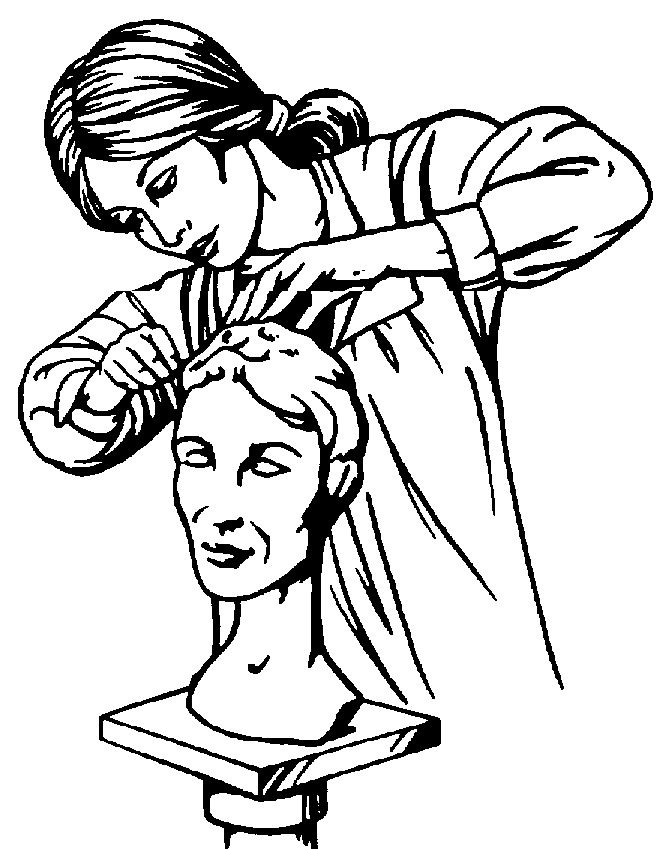
    People come from all over the world to see artwork such as sculptures at places like the Vatican in Rome and Parliament Hill in Ottawa. You might expect to see only work by world famous artists from Paris or New York. However, if you visit these places, you might find the work of a Winnipeg sculptor named Leo Mol. He was born as Leonid Molodozhanyn in Ukraine in 1915 but spent much of his life in Canada. He worked as a sculptor in Manitoba but sold his art to people around the world.

    Sculptors are artists who work with materials like bronze, clay, and stone to make statues of animals, people, or objects. Some sculptors are self-taught and learn their art from books or from many hours of practice. Others work as apprentices with more experienced artists who teach them what they need to know. Some sculptors attend university or art school. One important area of study is art history, which helps people understand the different styles of artwork that people have used in the past. The Canadian Art Foundation also had educational programs for students at many different levels.

    Like many other artists, Leo Mol studied art before he began his career. He first attended classes at the Kunst Akademie in Berlin, Germany, and at the Academy of Art in The Hague, Netherlands. He moved to Canada in 1948 and settled in Winnipeg, where he lived for the rest of his life. Some of his most famous sculptures are busts, which are carvings of people’s heads and necks. He made busts of several popes and cardinals in the Catholic Church and also of a former Canadian Prime Minister, John Diefenbaker. In 1989, he donated much of his artwork to the City of Winnipeg, and the Leo Mol Sculpture Garden opened in Assiniboine Park in 1992.

    Sculptors like Leo Mol can earn a lot of money by selling their work around the world, but their income depends on how much people like the statues. Some sculptors work in museums, schools, or advertising agencies, where they receive a regular salary. Even if they work in the same place as other people, sculptors generally work alone until the piece of art is ready to display. Then they need to work with others to find a place to put the sculptures. Often, sculptors work with commercial or non-profit galleries to display their work. They might sell some pieces to museums or art galleries or they might have art shows where people come to look at their work.

    Art shows are often a large part of a sculptor’s life. These shows give the artist a chance to meet others and to talk about the process of creating art. They also give people the chance to see the artistic works and possibly to buy some pieces. Are you artistic? Do you like to work with clay and other materials? If you are good with your hands and you enjoy creating art, you could consider becoming a sculptor.


  • Don’t Stress, Just Follow Your Heart

    Don’t Stress, Just Follow Your Heart

    Maybe you’re in your first year of high school or maybe you’re going to be graduating this year.  At whatever stage you are in, choosing a career path is probably on your mind. While some people know exactly what their whole future is going to look like, that is not always the case. Either way, a lot of us are plagued by uncertainty and fear when it comes to figuring out what kind of career we want to pursue in the future. Don’t worry – chances are a lot of your fellow classmates are in the same boat and feel the same way.

    Choosing a career path can seem like you’re choosing the tone for your whole life.  There are so many factors to consider when choosing the career that is just right for you. Questions that may cross your mind are: will this make me happy? Will I have financial security in this field? However, people get caught up in considering so many angles that the one factor they forget to consider is simply following their heart. This may sound a bit cheesy, but isn’t your heart always right?

    Sometimes parents will put pressure on you to choose a certain career path. Maybe they want you to follow in their footsteps and choose the same profession they’re in. Also, it may seem like a lot of your friends are choosing a particular career and it seems like it would be safe to go along with whatever they are choosing. Yet, if you are choosing a career based on what your parents want or what your friends want then you are not taking the time to figure out what is really important to you.

    You may also wish to seek the help of a guidance counselor. They may suggest career paths that they think will be suitable for you. However, remember that it is you that will be in this field one day and not them. So really consider what they are saying and if that career will make you happy.

    Don’t let choosing a career become stressful or a burden in your life. It is something that you will determine as you continue school. You will take different classes that you will either enjoy –  or you won’t. You will also explore different interests which will expand your horizons. Some of these classes and interests will appeal to you more than others. Through this process you will probably gravitate towards a certain career field. Your heart will lead you in the right direction.

  • Jobs with Animals: Dog Groomer

    Jobs with Animals: Dog Groomer

    I interviewed Kelly Booth, a local dog groomer. We talked about dog grooming as a career, some challenges she faces at work, and what she enjoys about her job.

    M: Being a dog groomer isn’t a typical occupation. When and how did you decide to pursue it as a career?
    K: I knew I wanted to work with animals, so I just started applying to pet stores and veterinary clinics. I dropped off my resume at PetSmart where the manager explained the process of becoming a groomer. I would start as a bather and, if I showed potential, they would send me to the grooming “academy” which is run by PetSmart. So this is what I did, and I’ve been doing it for about three years now.

    M: What kind of schooling is required, and how long does it take?
    K: The training I received was pretty basic. I just went to an “academy certified” PetSmart store where I was trained how to groom. This lasted about a month and we learned how to do the different cuts on the main breeds of dogs.

    M: What are some typical challenges that you face at work?
    K: As you can imagine, working with dogs is not always easy. They can be temperamental and unpredictable. The most common challenge I face is grooming dogs that are just generally uncooperative, i.e.: pulling their legs when I’m trying to brush them or groom them, not standing, squirming when I’m trying to do their nails, etc. I get bit and scratched quite a lot. It can be frustrating and scary because I’m dealing with sharp objects and it can be dangerous.

    It’s also really hard on your body. A lot of groomers end up getting carpal tunnel and back and leg problems.

    M: What is the career path for someone who has just completed their schooling?
    K: I started as a bather/brusher, which is basically just bathing and brushing out the dogs, clipping their toenails, and cleaning their ears. After about six months, I started my training. After that, I had to do a 100-dog “apprenticeship”, in which I had to groom twenty shave-downs, twenty sporting dogs, twenty short-legged terriers, twenty long-legged terriers, and twenty hand-scissor cuts. When I was finished that, I became a commissioned groomer.

    M: What are the typical earnings per dog?
    K: The earnings vary depending on the cut that the pet parent wants. For example, a simple shave down ranges from $55-$65 or $80-$90 for a hand-scissored poodle. Some larger dogs, like a Newfoundlander or an Old English Sheepdog, can be $100-$120. Commissions are typically 50-70%.

    M: What is your favourite thing about your job?
    K: I love working with animals. Sometimes we get dogs that like to give hugs and kisses. And the little puppies are always so much fun! I also really like being able to use my hands to create something. Helping the dogs feel better after being all matted is really rewarding.

  • What Do You Want to Be When You Grow Up?

    What Do You Want to Be When You Grow Up?

    “What do you want to be when you grow up?”

    It’s the classic question that every kid has heard at some point, usually before they are finished kindergarten. You’ve probably heard it at every birthday, every get-together, every parent-teacher night you’ve ever been to. And you may or may not be able to answer it. That’s okay – it’s difficult to know what you want to do when you grow up. What most kids don’t know is that they don’t need to choose just one thing.

    In today’s world, many jobs require a wide variety of skills, and it is becoming more and more common for adults to do several different jobs rather than just one. The best thing that you can do is figure out what you like to do, then work on getting good at it – even if you don’t know what kind of job you want to do. That way, you’ll be ready for anything.

    You might enjoy video editing, computer programming and writing. You might start off with a job in programming, and then decide later that you’d prefer to work in video editing. Maybe you’ll write for a magazine in your spare time. It’s always possible to change careers, or to take on a side-job in order to do everything that you enjoy.

    Never limit yourself to only one option – if you have a wide variety of interests and skills, you’ll have a wide variety of job opportunities by the time you’re old enough to choose one (or two, or three)!

  • How Do I Know What to Be?

    How Do I Know What to Be?

    Are you confused about what job you want to do in the future? Do you feel like there’s nothing out there that you actually want to do? If you answered yes to either of these questions then you’ll definitely want to keep reading this article. Believe it or not, but most people don’t actually know what career they want to pursue even after they’ve graduated elementary school and high school. There are even some university and college students who are still unsure, so don’t panic! You’re certainly not alone. It’s important to recognize that you have plenty of time to decide. Your friends may already know what they want but that doesn’t mean you have to know, too. It’s completely normal to be unsure of which job seems right for you.

    Even though you have plenty of time to make a decision, it doesn’t hurt to get a head start. This way, you’ll be able to steer yourself in a more specific direction. Now this brings us back to the original question, “How do I know what I want to be?” A good place to start with this question is thinking about the things you love to do best. Draw up a list of things that you can spend hours doing without even realizing so much time has passed. Think about activities or tasks that you love doing in your spare time. Some of these may relate to career! Once you have your list, think of different ways that you can turn that activity into a career.

    It’s also important to talk to people who know you best, like your family or close friends. They may see your potential to do well in career that you may have never considered. But don’t stop there. Also take a moment to consider your personality. Are you the type of person who needs to be active? How do you feel about working with people? Do you like being creative? Once you’ve thought long and hard about your personality, you may be able to cross some careers off your list and perhaps even identify one that suits your personality best.

    Just keep in mind that once you choose a career you’re never “stuck”.  You can always change your mind later and steer yourself in a new direction. For example, up until the 12th grade, I was committed to being a doctor. I took all of the science and math courses that my school offered. I remember thinking to myself one day, “Is this really want to do with my life?” As it turned out, the answer to that question was no. Less than a year later, I found myself accepting an offer of admission to a Canadian business school. It might happen that quickly for you too. You might suddenly stumble upon a career that seems much more appealing to you, even though you’ve already begun training for another. The most important thing to do is cater to your happiness and choose whichever job is going to make you get up and going to work with a smile on your face every day.

  • Strange Jobs: Escape Artist

    Strange Jobs: Escape Artist

    Try to think of a job where you get handcuffed, locked in a box, and thrown in a river. Can you imagine anything like that? Most people work in offices, hospitals, factories, or schools. Escape artists, however, work in coffins, burning buildings, steel boxes, and many other unusual places. People such as Dean Gunnarson of Winnipeg use their skills with chains and locks to entertain people in circuses and private performances.

    Escape artists are part of a profession called escapology. The practice of trying to escape from restraints like handcuffs or chains has been around for a long time. In the 1800’s, people began to perform escapes as part of circus acts. The most famous escapologist was Harry Houdini, who could escape from locked boxes while wearing handcuffs and perform all kinds of other amazing feats. He earned a living by doing his escapes in front of people as part of circus acts or on his own.

    A Canadian escapologist is now becoming almost as famous as Harry Houdini. Dean Gunnarson grew up in Winnipeg and began practicing to become an escapologist while he was still a teenager. His success really began after he took part in a television program in which he performed one of Harry Houdini’s old tricks by escaping from a large can that was filled with water. That program made him famous, and soon the hosts of other television programs were talking about him. Soon, he was doing stunts that even Houdini had never done. He has received several awards and world records, including the “World’s Most Daring Escape Artist” from Ripley’s Believe it or Not in 2013.

    Dean Gunnarson earns money from his work as an escapologist, but he also gives a lot of performances for charity. Instead of taking the money for himself, he often performs at events for groups like the Cancer Society or the Variety Club. He has performed in many different countries, including China, Italy, and Venezuela, and his escapes have been shown on television around the world.

    Working as an escape artist can take people to many different places and types of work. Some escape artists work in circuses, where their basic living costs are covered, but they frequently have to move from one city to another. Others manage to get regular performances in places like concert halls and theatres. Some escape artists work at other jobs, such as teaching or library work, while they prepare for a few months per year of travelling around the world with their acts. Working in a circus provides the most reliable income for escape artists, but skilled escapologists can often earn a good living on their own.

    There is no specialized education for becoming an escape artist, but practicing and studying the methods of famous escapologists can help to improve anyone’s skills. Having a flexible body, being physically healthy, and being unafraid of small, dark spaces are some of the main things an escape artist needs. For the right person, escapology can be an exciting and rewarding career.

  • What Do You Want to Be When You Grow  Up?

    What Do You Want to Be When You Grow Up?

    “What do you want to be when you grow up?”

    It’s the classic question that every kid has heard at some point, usually before they are finished kindergarten. You’ve probably heard it at every birthday, every get-together, every parent-teacher night you’ve ever been to. And you may or may not be able to answer it. That’s okay – it’s difficult to know what you want to do when you grow up. What most kids don’t know is that they don’t need to choose just one thing.

    In today’s world, many jobs require a wide variety of skills, and it is becoming more and more common for adults to do several different jobs rather than just one. The best thing that you can do is figure out what you like to do, then work on getting good at it – even if you don’t know what kind of job you want to do. That way, you’ll be ready for anything.

    You might enjoy video editing, computer programming and writing. You might start off with a job in programming, and then decide later that you’d prefer to work in video editing. Maybe you’ll write for a magazine in your spare time. It’s always possible to change careers, or to take on a side-job in order to do everything that you enjoy.

    Never limit yourself to only one option – if you have a wide variety of interests and skills, you’ll have a wide variety of job opportunities by the time you’re old enough to choose one (or two, or three)!