Tag: exercise

  • Let’s Celebrate the Gifts of Winter (French version available)

    Let’s Celebrate the Gifts of Winter (French version available)

    We Canadians have a special relationship with snow and ice. We ski in it, skate on it, play in it, shovel it, drive through it, sometimes even bicycle through it and suffer through it for many months of the year — some of us more than others, depending on what part of the country we call home. But how much do we know about it?

    Do Inuit really have dozens of words for snow and ice? Are snowflakes always six-sided? Can two ever be alike? Why is snow white? Is it a mineral? What makes frozen water so important to us? Some of the answers are more complicated than you might imagine.

    Even though English-speaking skiers and snowboarders use multiple adjectives to more accurately describe different types of snow, such as powder, corn and champagne, some say the claim of numerous Inuit words for snow and ice is a myth. But is it?

    According to the Canadian Encyclopedia, “the few basic words used by the Inuit to refer to different types of snow or ice do not translate everything they can say about these two natural elements.” In Inuktitut, words consist of a foundational element that provides basic meaning, along with other elements “to clarify and/or modify the basic meaning. New words can therefore easily be created from another term.” For example, the word siku refers to ice in general, and sikuaq (“small ice”) refers to “the first layer of thin ice that forms on puddles in the fall.” Sikuliaq (“made ice”) refers to “the new ice appearing on the sea or on rock surfaces.” Some words also have broader meanings, depending on the context. The word maujaq, for example, means “soft ground”, but when referring to snow, it means “the snow in which one sinks.”

    So, “the total number of terms referring to the various aspects of snow and ice goes far beyond ten or a dozen,” allowing Inuit to “draw very subtle distinctions between a very high number of snow or ice types.”

    When it accumulates on the ground, snow appears white because, unlike many natural materials, it reflects most light rather than absorbing it, and visible light is white. And although snowflakes form in near-infinite patterns and shapes depending on temperature, wind, humidity and even pollution, each single crystal is always hexagonal, or six-sided, because of the complex way water molecules bond. When a frozen droplet or crystal falls from a cloud, it grows as it absorbs and freezes water from the air around it, forming a six-sided prism. The almost infinite variables mean it’s unlikely, although not impossible, for two snowflakes to be exactly alike.

    And yes, snow can be classified as a mineral. According to the U.S. National Snow and Ice Data Center, “A mineral is a naturally occurring homogeneous solid, inorganically formed, with a definite chemical composition and an ordered atomic arrangement.” Frozen water fits that description.

    Snow and ice are important to life on Earth for many reasons. Both are part of the cryosphere, which includes “portions of the earth where water is in solid form, including snow cover, floating ice, glaciers, ice caps, ice sheets, seasonally frozen ground and perennially frozen ground (permafrost),” according to the Snow and Ice Data Center. It covers 46 million square kilometres of the planet’s surface, mostly in the Northern Hemisphere, and helps regulate the planet’s surface temperature. Changes in the cryosphere can affect climate and water availability, with corresponding effects on everything from winter sports to agriculture.

    By reflecting 80 to 90 per cent of incoming sunlight back into the atmosphere, snow cover cools the Earth. Losing that reflective protection, as is happening in the Arctic, upsets the energy balance and accelerates global warming. Snow also insulates parts of the Earth’s surface, holding heat in and keeping moisture from evaporating. When soil freezes, it prevents greenhouse gases like carbon and methane from escaping into the atmosphere. When snow melts, it fills rivers and lakes.

    Instead of complaining about the dark and cold of winter, we should celebrate snow and ice. The cryosphere is an important piece of the intricate, interconnected puzzle that keeps us alive. So, build a snowperson, play some hockey, get out on the slopes and enjoy the gifts that winter brings.

  • How to Stay Healthy in University

    How to Stay Healthy in University

    University is a great experience, but it can really take a toll on your health. You hear horror stories about the terrible cafeteria food, the late-night cramming (and snacking) sessions, and above all, the dreaded  “Freshman 15”. Unfortunately, many students find themselves in a bit of a health predicament when they begin post-secondary, particularly if they’re living on campus. Not only is it difficult to make time for healthy habits, but if you aren’t motivating yourself to stay healthy, you’re going to wind up eating ramen noodles for the rest of your life.

    It’s crucial to keep your health in check, especially in such a stressful and demanding environment. Even by implementing just a few basic steps into your (admittedly, already-busy) schedule, you could vastly improve the way you feel every day. That positive attitude is something that will further translate into your academic and personal life.

    Here are some tips for staying healthy in university:

    Drink lots of water. Long days at the library can leave you parched. Keep a bottle in your bag and refill it as often as you can. (This is also a good way to save money by not buying juice or bottled water, and calories by forgoing the fizzy soda.)

    Take advantage of the facilities. Many post-secondary institutions include gym memberships in their student fees. Even if you’re not very athletic to begin with, look into the programs offered at the athletics facilities and see if you might be interested in a drop-in session or two.

    Alternatively, take a walk. University campuses can be beautiful! For a quick bit of exercise on a busy day, explore on foot. (At larger campuses like the University of Toronto, St. George or York University, crossing the whole campus can actually be quite a workout!)

    Pack healthy snacks. If you’re hungry after class, don’t rush to the nearest food truck—a smarter option is to reach for the granola bar in your backpack. Stocking up on healthy snacks like dried fruit, nuts or (non-sugary) energy bars will keep you going between mealtimes.

    Dine smart. If your meals are typically served buffet-style, make smart choices about what you want to put on your plate. Take advantage of fresh fruit and salad bars, if they’re available. After a whole week of pizza and poutine—believe it or not—you may find yourself actually craving vegetables.

    Get a second opinion. Universities must have some form of health assistance on campus; this can be anything from clinic services to counseling. Check out what your school has to offer and speak to a professional if you’re concerned about your health, or if you just want to take steps towards making it better.

    Staying healthy doesn’t have to be hard. Integrate small healthy habits into your daily university routine, and you’ll be on the path to a healthier lifestyle in no time.

  • Thirst is a Drop in the Cup

    Thirst is a Drop in the Cup

    Forget smoothies and sodas: the best drink comes right from the tap! The human body is composed of up to 60% water, so it makes sense that we’d need to continue drinking it to keep ourselves healthy. Unfortunately, if you’re always on-the-go, you may not be getting the hydration you need. Water is part of the fuel that keeps our bodies running efficiently—and more often than not, we forget to fill up.

    The result of not drinking water is extremely detrimental to our well-being. Constant dehydration can really take a toll on your health, in some cases leading to headaches, dizziness and fatigue. The good news is that you can put yourself on the road to healthy living simply by adding a few of glasses of water to your daily routine. Here are some of the many benefits of drinking water.

    1. It boosts your energy. Your body works best when it’s fully hydrated, and you can start to feel a little sluggish if you haven’t gotten your daily water intake. Your brain is mostly water, too, so nourishing it with a quick drink will really help your focus.

    2. It helps you eat healthy. You may be confusing constant snack cravings with your body’s cry of thirst: drinking water reduces overeating and hunger by filling your body up with the nourishment it needs. Water also contributes to the proper functioning of your digestive system, which helps process the vitamins and nutrients in your healthy diet.

    3. It can ward off sickness. Your immune system greatly benefits from water: drinking your fill could leave you less susceptible to colds and flu. Water helps your body quickly flush out toxins, which reduces the risk of more serious ailments.

    4. It comes with beauty perks. Water is great for your skin—aside from keeping it hydrated, by drinking water you’re flushing out toxins that can leave your complexion dull or irritated. Plus, since it hydrates your body’s cells, it can do wonders for your hair and nails.

    What can you do to make sure you get enough water? Carry a water bottle on you and remind yourself to drink (even when you don’t feel thirsty). There are smartphone apps that can track your progress throughout the day. And don’t forget to account for extraneous variables: if it’s hot out or you’ve been exercising, chances are you’re going to need to drink more water to keep yourself in check.

    With its multitude of health benefits, water can make or break a healthy regimen, and hydration might just be the thing your body is missing. Try to make drinking water part of your daily routine, and you’ll notice a difference. Cheers to that!

  • The Importance of Exercise

    The Importance of Exercise

    We’ve all been there – you wake up to start your day and immediately start thinking of how you can’t wait to get home to go back to bed later. You feel run down and yawn throughout your classes. Your head feels foggy and you have trouble concentrating. All of these signs point to a lack of energy and balance, which can be easily rectified by exercising regularly.

    Maybe you have a full schedule of classes, you work a part-time job and still need time to study on top of that. Don’t worry – you can fit in exercise each day in simple ways! Try walking to and from school each day, if possible. Speed up your normal walking pace slightly to get your heart pumping. You can also jog/run home from school each day to increase the cardiovascular benefits.

    If you have a little more time on your hands, even on weekends, try going to a community centre in your area. Community centres often have exercise equipment you can use for a much lower fee than a regular gym would. Treadmills and elliptical machines are great ways to get in a cardio workout without having to worry about poor weather.

    Many of us feel uncomfortable working out in front of others, so you can even do exercises at home while watching TV or a movie. Try some simple yoga moves, sit-ups or even jumping jacks. There are many great (and free!) websites that offer tips on different at-home workouts you can do that do not require any equipment. You may also want to purchase a workout DVD that combines your interests with exercise. For example, there are DVD’s that involve dance, ballet and even Bollywood moves.

    Another easy option is to play Wii or X-Box Kinect. Many of us own these systems already, so playing a game that involves movement instead of sitting will add up. Many Wii systems come with sports games inside the box, so there is no extra expense incurred. These games will even track your progress and tell you your “exercise age”, which are great motivators.

    Exercising regularly will ensure that you have energy when you need it most. Exercise has also been proven to lower stress and help with anxiety and depression. When you exercise, your body releases endorphins which essentially help you to feel better and calmer. You should aim to exercise for 30 consecutive minutes each day for the maximum benefits. It is also important to not exercise just before you go to bed, as the increased endorphins can prevent you from falling asleep right away. However, exercising regularly does help you to get a deeper sleep more often.

    So make time for yourself each day and get in some exercise. Motivating yourself can be difficult sometimes, so be sure to tell a friend or family member about your goals and they can help to get you moving. Remember – short term pain, long term gain!

  • Get Outside and Exercise!

    Get Outside and Exercise!

    We’ve all been there – you wake up to start your day and immediately start thinking of how you can’t wait to get home to go back to bed later. You feel run down and yawn throughout your classes. Your head feels foggy and you have trouble concentrating. All of these signs point to a lack of energy and balance, which can be easily rectified by exercising regularly.

    Maybe you have a full schedule of classes, you work a part-time job and still need time to study on top of that. Don’t worry – you can fit in exercise each day in simple ways! Try walking to and from school each day, if possible. Speed up your normal walking pace slightly to get your heart pumping. You can also jog/run home from school each day to increase the cardiovascular benefits.

    If you have a little more time on your hands, even on weekends, try going to a community centre in your area. Community centres often have exercise equipment you can use for a much lower fee than a regular gym would. Treadmills and elliptical machines are great ways to get in a cardio workout without having to worry about poor weather.

    Many of us feel uncomfortable working out in front of others, so you can even do exercises at home while watching TV or a movie. Try some simple yoga moves, sit-ups or even jumping jacks. There are many great (and free!) websites that offer tips on different at-home workouts you can do that do not require any equipment. You may also want to purchase a workout DVD that combines your interests with exercise. For example, there are DVD’s that involve dance, ballet and even Bollywood moves.

    Another easy option is to play Wii or X-Box Kinect. Many of us own these systems already, so playing a game that involves movement instead of sitting will add up. Many Wii systems come with sports games inside the box, so there is no extra expense incurred. These games will even track your progress and tell you your “exercise age”, which are great motivators.

    Exercising regularly will ensure that you have energy when you need it most. Exercise has also been proven to lower stress and help with anxiety and depression. When you exercise, your body releases endorphins which essentially help you to feel better and calmer. You should aim to exercise for 30 consecutive minutes each day for the maximum benefits. It is also important to not exercise just before you go to bed, as the increased endorphins can prevent you from falling asleep right away. However, exercising regularly does help you to get a deeper sleep more often.

    So make time for yourself each day and get in some exercise. Motivating yourself can be difficult sometimes, so be sure to tell a friend or family member about your goals and they can help to get you moving. Remember – short term pain, long term gain!

  • What Are C.O.W.S.?

    What Are C.O.W.S.?

    Today’s world is filled with fast and convenient foods which fit in to our busy lifestyles. How many of you have given any thought to how the foods you eat make you feel and their affect our long-term health or appearance?

    At age15, my parents bought a convenience store and suddenly I had access to all of this junk food.

    I was in heaven for a while. Until my pants started getting tight and I felt terrible.

    I made the connection between what I ate and how I felt and looked. Small changes I made way back in high school paved the way for a healthy life.

    Together, let’s explore what today’s experts are saying we should eat to live a long and healthy life. The earlier in life we start, the better. In ‘The PH Miracle’ written by Dr. Robert O. Young and Shelley Redford Young, they talk about an acronym we should all remember COWS.

    C is for chlorophyll.

    “Vegetables are your new best friends,” especially the green ones. Chlorophyll helps the blood cells deliver oxygen, reduces the binding of carcinogens to DNA in our organs and help to neutralize dietary acids in the blood and tissues. They are nutrient dense and rich in antioxidants.

    O is for Oils.

    Know the good from the bad. Saturated fats found primarily in animal protein, partially hydrogenated oils found in processed foods are to be avoided. Good fats contain essential fatty acids. EFAs strengthen immune cells, lubricate joints, insulate the body against heat loss, provide energy, protect us from heart disease, stroke and high blood pressure. It improves asthma, PMS, allergies, skin conditions, some behavioral disorders and brain function. Good sources of oils include fish, seeds, avocados, olives and flax.

    W is for Water.

    In the earliest stages, dehydration can lead to muddled thinking, short-term memory problems, trouble with math and expressing yourself verbally, difficulty focusing on a printed page, cold hands or feet, anxiety, irritability, depression, sugar cravings and cramps too. Water neutralizes acids and literally washes them (and all toxins) out of the body via urine and sweat and the bowels. When you don’t get enough water you will feel tired and weak. About two liters of water a day is generally recommended.

    S is for Salt.

    Salt is as essential as water or air. You cannot consume too much natural, unrefined salt. Processed foods are laden with the bad salts. The salt test: mix a teaspoon of the salt you use in a glass of water and let it sit overnight. If the water is clear in the morning, it’s a natural salt. If you can see salt in the bottom of the glass it’s processed salt. Salt that does not dissolve in a glass of water will not dissolve in your body and will collect in your body organs and tissues. This can lead to heart disease, arthritis, hardening of the arteries and calcium deposits in joints.

    Following COWS is an easy first step to a healthy life.

  • Outdoor Therapy

    Outdoor Therapy

    The benefits of outdoor activity are well known. Whether you’re hiking, biking, swimming, or running, these activities are all great ways to get your heart rate up and stay healthy. However, less physically demanding outdoor activities (such as gardening or washing a car) are also good for your health. Mental health, that is. Sometimes just being outdoors makes you feel good, and it’s no wonder. Fresh air, open space, sunshine, greenery…who doesn’t love these things? Especially after being cooped up in an office or classroom for hours on end every day, being outdoors is a sure-fire way to boost your mood and make you feel more relaxed.

    The positive influence of the outdoors is so great that it is even being recommended as a form of therapy in and of itself.1 Instead of relying on pharmacological intervention, some therapists recommend “outdoor therapy” as an alternative way to help people with affective disorders (such as depression).2 In general, it has been found that people who try outdoor therapy experience “improvements in self-concept, self-acceptance and more realistic self-perceptions, and reduced conflict, depression, and anxiety.”3 These effects have been shown with a variety of individuals of all ages, genders, races, personality types, and mental health statuses.4 Of course anyone can benefit from outdoor therapy, even if you’re simply having a bad day or are feeling a little under-the-weather.

    There’s no one particular activity which is recommended above others as the best form of outdoor therapy; however, it has been noted that a short camping trip (even a mock-camping trip in one’s own backyard!) can be a remarkably effective way to reduce stress, anxiety, or bad mood.5 This may be due to the fact that camping is meant to take you away from the hustle and bustle of everyday life where most of one’s stress originates. When you’re camping you don’t have to worry about studying for an upcoming midterm or fret about that long list of things “to do.” In fact, when you’re camping the only things you really need to worry about are what you’re going to cook for your next meal and keeping ample wood on the fire. I wouldn’t necessarily classify these things under “worries,” however. Even though it may just be for a couple days, camping allows you to relax and rejuvenate, leaving you feeling refreshed and ready to once again tackle all life’s challenges. Granted, not everyone considers giving up all connections to civilization for a weekend foray into the depths of the wilderness to be a relaxing experience. If you don’t like camping, then it probably won’t help to ease your stress or anxiety. Conversely, it will probably increase your bad mood, which would be counter-productive. That’s why outdoor therapy can be tailored to individual preferences. If you’re an athletic person, then maybe going for a run or hiking with some friends will boost your mood. On the other hand, if you just need some time to yourself and prefer something a little more low-key, then just grab a book and head to the local park for a quiet afternoon.

    So next time you’re in a bad mood, feeling stressed out, lonely, overwhelmed, frustrated, or you simply want some alone time- head outside and try some outdoor therapy. Whether you decide to go for a five kilometer run or grab a coffee and read a good book, you’ll be amazed at how much better you feel after stepping outside to clear your mind.

  • Healthy Kids Need Time In Nature

    Healthy Kids Need Time In Nature

    Ontario’s Healthy Kids Panel recently proposed a strategy to help kids get onto a path to health. The problem is that the path doesn’t lead them into nature. Though the report quotes parents’ comments and research showing kids spend dramatically less time outside than ever, it doesn’t encourage time in nature.

    That said, many of the report’s recommendations should be implemented and supported locally, provincially and nationally to reduce the risks of obesity. Encouraging parents and children to be more critical about dietary choices and requiring more information and labelling from restaurants and food producers is long overdue.

    Ontario isn’t the only province working to reduce obesity rates and support parents raising healthy children, particularly in the early years. Alberta released relevant reports in 2011 and Quebec has had a ban on advertising junk food to children since 1980. No one can argue against public awareness and education around the benefits of healthy eating and active living. But a provincial, patchwork approach to addressing these issues isn’t enough. We need a national strategy to get our kids eating healthy foods and being active in nature.

    Although it seems logical that much of the time spent being active will take place outside, the Ontario report acknowledges that “many communities are not designed to encourage kids to move or be physically active…and have few safe green spaces.” One parent in a focus group explains that the parks in his community are either gated or locked up once school is closed. So, even when there is green space, it’s not always accessible.

    Last year, the David Suzuki Foundation conducted a survey with young Canadians and found that 70 per cent spend an hour or less a day outdoors. The 2012 Active Healthy Kids Canada Report Card says they spend almost eight hours a day in front of screens. So it’s not that kids don’t have time to be outside. It’s just not part of their lifestyle.

    Much has been reported about a recommendation by the Ontario panel to ban junk food advertising that targets children under 12. This has worked in Quebec and is being discussed in Alberta. But the approach has invited criticism from those who argue that people should have the right to choose. It’s always tempting to focus on making bad things less accessible, but perhaps policy-makers should be more creative and focus on ways to make good things more accessible.

    Being in nature is good for all of us. People who get outside regularly are less stressed, have more resilient immune systems and are generally happier. And it’s good for our kids. Studies show spending time in nature or green spaces helps reduce the symptoms of ADHD. Even in built playgrounds, kids spend twice as much time playing, use their imaginations more and engage in more aerobic and strengthening activities when the space incorporates natural elements like logs, flowers and small streams, according to research from the University of Tennessee at Knoxville.

    Despite all the obvious health benefits of spending time outside, provincial and federal governments are failing to integrate a daily dose of nature into their policies. It’s also something we as a society are failing to make a priority in the lives of our children. This inexpensive and effective way to make our lives healthier and happier should be an obvious solution.

    We need to make sure our neighbourhoods have green spaces where people can explore their connections with nature. We need to ask teachers and school board representatives to take students outside so that nature becomes a classroom. And we need to stop making the outdoors seem like a scary place for children by helping parents understand that the benefits of playing outside outweigh the risks.

    It will take public education and awareness-building as well as changes to the way we build cities and live in our communities to bring nature back into our lives. Connecting kids to nature every day needs to be a priority policy objective in any strategy for healthy children and could easily have been integrated into the recommendations from the Ontario Healthy Kids Panel. Taking our kids by the hand and spending time outside with them will have the added benefit of making us healthier and happier adults.

  • Staying Awake Without Caffeine

    Staying Awake Without Caffeine

    You’re busy, you’re stressed and you hardly have time to eat let alone get a good night’s sleep. When term projects and exams are weighing you down, your first thought might be to reach for that double shot latte or an energy drink with a slew of unpronounceable ingredients stamped on the side of the can. At eight in the morning right through to midnight, caffeine is our crutch that is guaranteed to keep us awake. However, too much of a good thing, especially when it comes to caffeine, can be problematic. To help you ease off the espressos, here are a few ways to stay alert and awake the caffeine-free way.

    Exercise
    It’s a classic. Doctors have been telling us this for years, but some of us have neglected to heed their advice. Exercise, particularly anything that involves the cardiovascular system, is a great way to get fresh, oxygenated blood pumping through your brain. If you’re short on time, try a flash card routine with some weights or listen to an audio recording of a lecture while going for a run. Even a five minute jumping jacks session between revising chapters can do the trick.

    Break up your meals
    Breakfast, lunch and dinner – it’s a routine to which many of us stay faithful. However, eating larger meals less often can have destructive effects on our energy levels. Digestion requires energy; The larger the meal, the more energy is needed and depleted from your reserves. Breaking up meals into four or six smaller portions can vastly improve your energy levels, keeping you alert and able to studying for longer.

    Cat naps
    Getting sleepy? Take a nap! Sleep cycles aren’t as cut and dry as most people think. Some of the most effective sleep routines involve taking a nap at regular intervals throughout the day to boost productivity. Though intriguing, for a student constant nap taking is probably not an option. But there are some tips to glean from those sleep cycles! When your body needs rest it will let you know and sometimes the only thing left to do is listen to it. A ten minute nap may be all the rest it needs to get back on track. If you choose this option, remember to set an alarm without a snooze button! Ten to twenty minutes should do.

    Apples
    They can do more than just keep the doctor away. If you’re having trouble getting by without a caffeine boost, try snacking on an apple. The dose of natural glucose will help pick you up the same way a chocolate bar or gummy worms might give you a sugar rush. But an apple’s natural sugars and fibre content make it a much healthier option.

  • Cardboard Bicycles: Would YOU Ride One?

    Cardboard Bicycles: Would YOU Ride One?

    Every morning, people around the world get up and take their usual transportation to work or school. But what is their usual transportation? In North America it might be the car, but it’s a different story in many other parts of the world. In most countries, the most common form of transportation is the bicycle. According to National Geographic, people around the planet own 800 million bicycles – which is twice as many as the number of cars. New technology in the bicycle world can affect the lives of millions of people worldwide, just as it did almost two hundred years ago.

    People have dreamed of riding on wheels for centuries. In the 1400’s, the inventor Leonardo da Vinci developed the idea of a machine like our modern bicycles but never made one. In 1840, an inventor from Scotland rode more than sixty kilometres on a two-wheeled machine operated by a foot-powered treadle. Twenty years later, a French inventor developed the idea to include cranks and rotating pedals, much like modern bicycles. In 1860, people first started to use the term “bicycle” for the new machine.

    Air-filled (pneumatic) tires were the next development in the bicycle’s story. Next, people developed different bicycles for all kinds of uses: sleek and lightweight racing bikes, heavy but sturdy all-terrain bikes and much more. The basic structure is the same, however: a metal frame with air-filled rubber tires which help to cushion the rider against bumps in the road. These bikes can be expensive to buy and they need frequent maintenance (especially for punctured tires), but who would think of making them any other way?

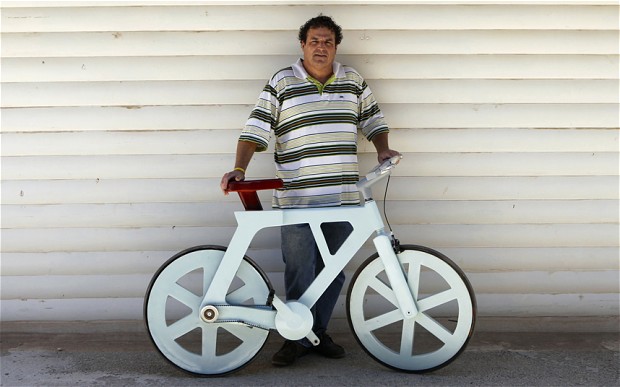
    An Israeli inventor named Izhar Gafni hopes to solve the some of the traditional bicycle’s problems with his new invention: cardboard bicycles with solid rubber tires. The tires, made from recycled rubber car tires, can’t get punctured because they have no air in them. Almost all of the rest of the bicycle is made from recycled cardboard, with a car’s timing belt instead of a chain. The outside of the bicycle is covered with a special coating to make it waterproof and fireproof and is then painted. Each bicycle weighs about nine kilograms instead of the usual fourteen kilograms for metal bicycles.

    The low-cost of the new bicycles could make a huge difference in places like Africa, where people might not be able to afford a traditional bike. Even if the bicycles last only a few years, they could give people the transportation they need to go to school, go to their jobs and maybe even get out of poverty. When these bicycles come into stores, they will likely cost about $20 instead of the hundreds or even thousands of dollars a metal bike can cost.

    If Izhar Gafni’s invention works, it could affect much more than just bicycles. Airplanes or cars made out of cardboard would be much lighter than metal ones and use less fuel, making travel cheaper. It could change the world’s transportation systems forever.