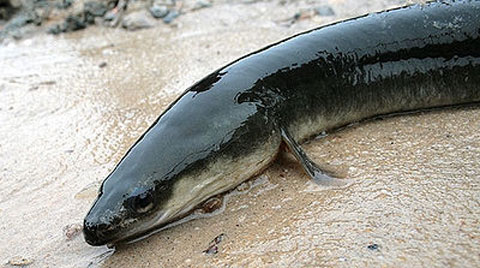
Once extremely abundant throughout all tributaries to Lake Ontario and the St. Lawrence River, the American eel has seen a dramatic population decline. In 2006, the presence of eels in these waters decreased by almost 90 per cent. As of 2007, this species has been listed as Endangered under the Ontario Endangered Species Act.
This dramatic population decline can be attributed to several factors, including the creation of hydroelectric dams, reduced access to habitat imposed by manmade barriers to upstream migration, general habitat destruction and alteration and commercial harvesting. The construction of dams threaten the American eel species in two ways: they result in habitat fragmentation and loss as they make it much more difficult for adult eels to migrate back to the ocean to spawn, and hydroelectric turbines contribute to higher injury and mortality rates of juvenile eels swimming downstream (depending on the size of the eels and the design of the turbines).
The Canadian Wildlife Federation, in collaboration with the Ontario Ministry of Natural Resources, the Algonquins of Ontario and the Arnprior Fish and Game Club, have been tracking and tagging American eels in the Ottawa River since 2007. Previous work has been successful not only in determining which methods and locations are best for capturing eels, but also in documenting movement patterns and collecting data on habitat preferences and downstream migration timing. Currently the project aims to build on the knowledge gained in the first studies of eel movement and use this information to develop strategies for American eel recovery in the Ottawa River.
On a section of the Ottawa River from Chats Falls dam to Chenaux dam, researchers are busily working to tag and track eels to monitor downstream migration patterns, determining if and when eels move past the Chats Falls dam. They are also monitoring upstream migration by installing temporary eel ladders at three barriers on tributaries to the Lac des Chats section of the Ottawa River. These ladders will be fitted with a trap at the upstream end, and eels that migrate up them and are trapped will be tagged and re-released downstream. If the eels are captured often enough, this will confirm to researchers that eels are indeed attempting migration through these routes and can provide important information about the barriers that may prevent later out-migration.
Another important aspect of this project is the public awareness campaign that aims to educate people on the American eel and its importance in the ecology of the Ottawa River. This part of the project will be carried out through activities that increase local knowledge of the American eel, encourage the public to report eel sightings and discourage anglers from killing eels caught accidentally. Members of the public will also be invited to observe eel capture and tagging activities.
The long-term goal is to re-establish a safe migration route for American eels in collaboration with local communities and hydroelectric producers. The ultimate goal is to see a future where the eel population is once again increasing in the Lac des Chats and adjacent sections of the Ottawa River.