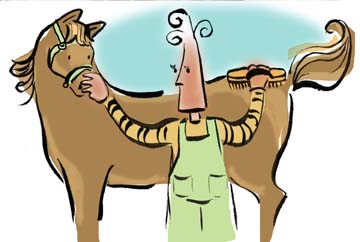
Imagine becoming a doctor who specializes in toenails. Do you think that you would get much work with something that specific? Farriers have the very special job of looking after horses’ hooves, trimming them and putting on shoes if necessary. If you like horses and can manage the demands of the work, this job might be right for you.
How much time do you take every week to trim your toenails or fingernails? Depending on how quickly they grow, you might have to cut them every few days or maybe once every two or three weeks. Horses’ hooves are like nails, and they need to be trimmed regularly. Depending on where they live and what kinds of ground they walk on, horses also often need shoes on their hooves. Farriers work with every aspect of hoof care, including treating any diseases that might develop. They need to know all about cleaning dirt out of hooves, keeping them healthy, and anything else that might affect the horses’ ability to walk comfortably.
Knowing a lot about horses is the first step in becoming a farrier. People who regularly ride horses know how the hooves can collect dirt and small stones which can cause a lot of pain for the horse. They know how to lift one foot up at a time and clean out anything that might cause problems.
That is basically what farriers do. They work with horses to keep the hooves clean and healthy. If necessary, they replace horseshoes with new shoes that they have either bought or made themselves. Farriers need to be able to lift heavy objects and to be able to stand for many hours as they work. They have to be able to work with tools and sometimes also to be able to make horseshoes, nails, and anything else that they need.
Learning to become a farrier involves a combination of education and experience. Many farriers learn through apprenticeships in which they work with other farriers for a year or two. Courses in animal care or blacksmithing can also be helpful, and anything else that might help with understanding horses. However, most of what farriers learn comes on the job in dealing with horses and discovering what works.
Most farriers get paid by the horse instead of receiving an hourly wage. They can often receive $30 or $40 for each time they trim a horse’s hooves, which usually needs to be done about every six weeks. In parts of Canada, farriers earn between about $14,000 and $32,000, although some can earn more. However, they also need to pay for their equipment, insurance, vehicle, and anything else that they need to do their job. It helps to be able to get a job at a ranch or somewhere else with a large number of horses to provide a regular source of income.
Do you love horses? Why not become a farrier?
Bibliography:
Careers.org. “Career Occupational Profile for: Farrier.” http://www.careers.org/occupations/16531/farrier
Kramer, Mary Hope. “Farrier.” http://animalcareers.about.com/od/Careers/a/Farrier.htm.
Legel, Ray. “How Much do you Really Make?” http://www.thefarrierguide.com/employment-guide/how-much-do-you-really-make/.
Salary.com. “Farrier Job Description.” http://swz.salary.com/SalaryWizard/Farrier-Job-Description.aspx.
Salary.com. “Farrier Salaries in Ontario, CA.” http://www1.salary.com/CA/Ontario/Farrier-salary.html.
Young Rider.com. “Horse Care – Friends With the Farrier.” http://www.youngrider.com/horse-care/job-of-a-farrier-3392.aspx.