Tag: jobs of the future

  • Jobs of the Future: What to Expect When You Graduate

    Jobs of the Future: What to Expect When You Graduate

    Graduation is a major event for students; it’s a milestone in your life and an accomplishment that can’t be taken away. After you graduate you’ll be thrown into the adult world of jobs and careers.

    This is a major time of change and can be scary. That’s why it’s important to have a plan for what you want to do and what sort of education you need to do it. The path to personal success is a rough and bumpy ride, sometimes with many twists and turns.

    Don’t have any what you want to do? Don’t freak out. People change college and university programs multiple times. Most people will cycle through several jobs and careers in their lifetime. Education can help you discover what fits with your personality and what career path suits you the most. Working a job you don’t like, especially for many years, is not a fun experience and it’s important to find a comfortable balance between your working time and recreational time. Nobody likes to be stressed out all the time!

    We live in an exciting and rapidly changing world, and the job market reflects this. Many traditional careers are being changed or ended due to constantly evolving technology. This is why its important to research what sort of career path you want to take and keep up with new developments and changes in your chosen field. Statistics on the employability of certain graduates and the availability of jobs can be found in many online resources. In other words, keep informed!

    STEM, or science, technology, engineering and mathematics jobs, are very important. As technology improves so does the need for dedicated workers in these fields. There are a massive variety of STEM jobs, each field containing a huge variety of careers. A few examples include:

    Science: energy conservationist, agricultural worker, and industrial biotechnologist.

    Technology: construction, automotive manufacturing and economics.

    Engineering: civil engineers, structural engineers, and mechanical engineers.

    Mathematics: architect, high school mathematics teacher, and physicist.

    As you can see, STEM jobs are incredibly diverse and it’s up to you to find what suits you best. STEM jobs can be some of the toughest but also some of the most rewarding, both financially and personally. So keep an open mind and stay up to date on the evolving fields. Getting a STEM job isn’t for everyone, but they can be some of the most exciting and important jobs.

  • Choosing To Work In A Trade

    Choosing To Work In A Trade

    Times have changed in the world of jobs. You might have heard from your parents or teachers that the best way to get a high-paid, reliable job is through a university education. Sometimes that still holds true. These days, however, a better choice for both men and women might be a skilled trade, where there are many opportunities for a rewarding career.

    What comes to your mind when you hear the term “trade”? Do you think of low-paid labourers, barely making enough money to pay their bills and never sure how much longer their jobs will last? Many unskilled labourers work under these conditions, but the situation is different for skilled tradespeople. They are often well-educated, with diplomas or certificates in their fields.

    Tradespeople might have as much education as university graduates. Unlike many university programs, however, training in the trades is geared specifically to learning the practical skills needed on the job. Tradespeople might be trained as carpenters, auto mechanics, electricians or any of the other trades. Through practical work and classroom studies, they learn everything they need to know to work in their trades. Another important part of the training process in the trades is an apprenticeship, in which students work together with an experienced person to learn practical skills for the job. For some trades they might also need to get an official license or certificate.

    Becoming qualified in a trade can take from one to three years of classroom education, between two and four years of apprenticeship, and two or three years of on-the-job training. Many university programs are just as long or even longer and more expensive. Graduates can also have trouble finding work in their field. In contrast, tradespeople can usually find work soon after they finish their studies and can easily pay off any loans they received for their school tuition.

    Almost anyone can become qualified to work in a trade. Most tradespeople, about 97 % in 2007, are men. However, more women are joining the trades and becoming qualified to work in carpentry, welding and other skilled trades. Possibly up to 320,000 people in Canada currently working in construction alone will be retiring in the next few years and that could open up good opportunities for both men and women. Becoming a journeyperson (someone with official qualifications in a skilled trade) could be a wise career move.

    How do you know if you could be successful in skilled trade? Natural ability and interest are important places to start. If you love to take things apart to see how they work, you might want to choose to be a mechanic or electrician. If you have a fear of heights, on the other hand, you might not want to choose the construction industry. The best way to decide whether or not a trade would suit you is to research it and to talk with people about it. Then, if you decide to pursue a trade, you’ll have a good basis for a stable and rewarding lifelong career.

  • STEM Jobs of the Future

    STEM Jobs of the Future

    Most of you probably know who Albert Einstein and Thomas Edison were, but you might not have heard of the famous mathematicians, John Nash or the ancient Greek scholar, Archimedes. Do you know what these people have in common? They were all part of a field of work often known as STEM, which includes science, technology, engineering, and mathematics. Work in these fields has always been important, and they are a good choice for anyone with a creative but disciplined mind and the ability to see how far their work can go.

    People like Albert Einstein and Thomas Edison are famous for a very good reason. They knew a lot of theory, but they also helped to change people’s everyday lives. Long winter evenings would be very different without Edison’s light bulb, for example. The value of work that mathematicians do is less obvious, but their discoveries make all kinds of other work possible. Without mathematics, for example, engineering would be impossible. Without engineers, we would have no bridges or tall buildings. Their calculations make it possible to build many of the towers and other structures we now have.

    Training for work in STEM jobs normally involves a high level of education. A minimum of a bachelor’s degree is normally necessary for work in these fields, and usually a master’s degree or PhD is required. The most specialized training is in engineering, where students learn to apply their education to building bridges and other structures. Other STEM fields of study lead to work in areas such as computer sciences, statistics, and agriculture. For many people, this involves further studies beyond a basic bachelor’s degree. With this training, they can become qualified to work in many different areas of society.

    Workplaces for people in STEM jobs can be in offices, universities, and laboratories. They might work with test tubes inside a building or travel around the country, collecting samples of soil or testing the water for anything that might harm the environment. Many people with training in STEM fields also become teachers or university professors, where they pass on their knowledge to others.

    STEM training can help in many areas of life. In biology and biomedical sciences, for example, research results can affect how doctors treat illnesses. Studies in mathematics can lead to work in gathering and analyzing statistical information, which can help people in government and many other fields to plan for the future. With so much variety in workplaces, salaries also vary. Low-level STEM jobs start at about $36,000 per year, but high-paid jobs can reach over $120,000 per year.

    What kinds of people work in STEM jobs? In the past, men tended to take most of the jobs in this field, and that can still often be the case. However, women are starting to become more involved in the work, and many of them are becoming well known in their fields.  Do these kinds of jobs appeal to you? Working towards a career in STEM fields can be a good choice for the future.

  • What Kind of Jobs Are Really Out There?

    What Kind of Jobs Are Really Out There?

    The job market is changing all the time, but there are a few rules to follow that will ensure your survival/success. Firstly, there is the importance of including work and volunteer experience on your list of activities and subsequent job applications, then there is the importance of engaging in some sort of entrepreneurial activity, and then generally accumulating activities, courses, or experiences that show you are progressive and have an opinion on what your field needs to succeed.

    Remember that it is important to build practical experience and community involvement into whatever career path you are building. Even if you don’t know what you want to do, it is important to get experience doing a variety of practical tasks (work/volunteer) or other interesting activities (work/volunteer). When you have work or volunteer experience to supplement your school activities, you are ahead of the game and that much closer to getting a job because you show that you are actively engaged in your world and care about helping your community.

    Recently, the importance of entrepreneurial activities has been brought to the attention of popular media such as CBC Radio 1. They have reported on the importance of having entrepreneurial activities to supplement or even replace education in an unpredictable market like today’s, where an education doesn’t necessarily mean a job. This aspect has been brought to the foreground due to the 13.5% unemployment rate among young people (Career Options, 2013). There are many people who have graduated with university degrees and are left without a job. This situation is not something you would expect when you look at all the advice supporting a university education, so beware and consider initiating or joining some sort of entrepreneurial activity. Consider your interests and search for something well-suited that will teach you new things and increase your hire-ability.

    Also, accumulating some experience that shows that you are aware of current issues in your field of interest is important for getting jobs that are really out there, like the trades. If you need to take an environmental studies course to show your employer that you are aware of the realities of a changing climate and an emerging “green economy”, do this. It is important to show that you are current and aware of a changing world when you are trying to get the jobs that are out there.

    Remaining a competitive candidate on the job market and getting the jobs that are out there can be assured by accumulating volunteer/work experience in your field of interest, taking on some entrepreneurial activities and taking a few courses relevant to important topics for your field of interest. Good luck!

  • Not Your Typical Welder

    Not Your Typical Welder

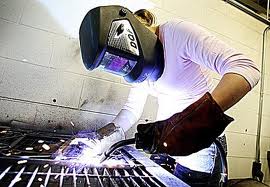
    Let’s be honest- how many of us girls grew up dreaming of being a mechanic or a welder? The answer is probably not many, and if you did you probably didn’t tell anybody because of the possibility of them thinking you were weird. When I was little I first wanted to be a marine biologist, I loved animals and wanted to work with them very badly. Then my life goal changed from a stunt car driver, to a photographer, to a mechanic and finally a welder.

    One of the things I was most excited about going to high school was that I was now able to take the auto mechanics and construction classes. I took them all through high school and loved every minute of it. I learned, fixed and made things that a lot of people didn’t, how many of you can honestly say you are comfortable with changing a flat tire on your own? I can say with all honesty I am and that’s because of my awesome auto teacher. My technology teachers not only gave me the skills and knowledge about their trades but also the courage to love the trades. To not be scared of trying something totally out of my comfort zone and to not care about what people think.

    I got the smart remarks in class “Girls can’t do that” and the classic “Don’t break a nail!” Taking those courses gave me the courage to pick something not many girls pick for a college program, Welding Technician. I knew two things that I wanted for sure out of what I picked for a program, I wanted to be able to get a job and I wanted to make money. I know those are not the best driving reasons for someone to pick a program, but they were honest. I had originally wanted to be a mechanic because of how much I loved my auto class but I soon realized there were a lot of mechanics and not a lot of jobs. So I had cut up an exhaust pipe about two times in auto with an old oxy-acetylene torch and I knew welding was an in demand job, so I decided on being a welder. The only knowledge I had on welding was what I learned from those two experiences using the torch, so not a whole lot.

    I remember showing up for my first welding class and them telling me that I would need safety boots, safety glasses and a welding helmet for tomorrow. The first thing I thought to myself is, “What have I done?! I have gotten myself into something I can’t handle, I know nothing about welding this is a horrible idea”. Then it got worse after I got all my equipment and they asked me to actually weld something, I don’t think I have ever sweated that much for a school assignment and it wasn’t from the heat of my torch. But with practice, some really great teachers and perseverance I got the hang of it and now I am actually a good welder. I am able to weld in shielded metal arc welding in flat, horizontal and vertical positions. I can use gas metal arc and flux core arc welding machines and I am learning tungsten arc welding at the moment.

    For those of you out there wondering what kind of woman I am, I would say I am not your typical looking welder, but then again isn’t that what we are trying to change? The notion of what the “typical” welder looks like? So this is what the typical welder looks like, a petite 19 year old woman, who stands at five feet and 2 inches, has a boyfriend and loves to go shopping just as much as anyone. The moral of the story is look at trades when you are deciding on college programs, any trade, believe me it’s a rewarding experience, that is challenging.

    If I can do it, you can do it.

  • Joining the Trades: What Can I Be?

    Joining the Trades: What Can I Be?

    Are you wondering what types of careers are available to you in the trades sector? There is literally thousands to choose from. Check out just a few of the careers we found on CareersInTrades.ca!

    Construction
    Construction and Maintenance is the best known skilled trades sector. These jobs are available across Canada in both urban and rural areas. Some of its apprenticeable trades are:
    – Bricklayer
    – Heavy equipment operator
    – Painter and decorator
    – Ironworker
    – Mechanic
    – Plumber
    – Welder

    Transportation
    Transportation trades cover vehicles ranging from automobiles and motorcycles to airplanes and cranes. These jobs are anywhere vehicles can be found, which can be a farm, an airport, a harbour or any street! Some of the apprenticeship trades include:
    – Agricultural Equipment Technician
    – Aircraft Maintenance Mechanic
    – Auto Body Repairer
    – Motorcycle Mechanic
    – Transport Trailer Technician

    Manufacturing
    Manufacturing trades can lead to careers in many different sectors, including cars, textiles and even food production. These careers can secure a job in many manufacturers and bring you to the root of product development. Some of the apprenticeable trades include:
    – Automotive Machinist
    – Graphic Arts (Pre-Press, Press and Bindery)
    – Industrial Electrician
    – Power System Operator
    – Sawfiler/Fitter
    – Tool and Die Maker

    Service
    The service sector offers jobs for those interested in working more closely with the public. From chefs to hairstyling, this sector offers many career opportunities. Some of the apprenticeable trades include:
    – Arboriculturist
    – Baker
    – Barber
    – Graphic Arts Technician
    – Hairstylist
    – Jeweler and Goldsmith
    – Upholsterer