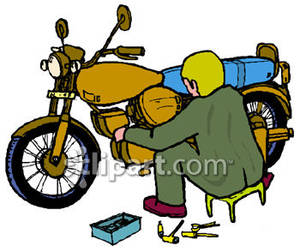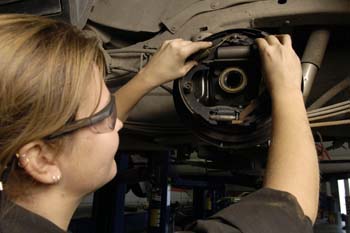
If you go out to the street where you live, you are likely to see several different methods of transportation. Cars and bicycles are two popular choices, but many people prefer to ride something that is halfway in between, like a motorcycle. Have you ever heard of a job called a small engine mechanic? People sometimes refer to motorcycle mechanics by that term because most other mechanics work with much larger machines, such as cars or airplanes.
Becoming a motorcycle mechanic involves putting motorcycles together, maintaining and repairing them, and sometimes restoring old machines. Some mechanics might also work with other small vehicles, such as all-terrain vehicles (ATVs). Anything other than bicycles that has controls in the handlebars can be part of a motorcycle mechanic’s work.
Becoming a motorcycle mechanic takes good physical coordination, a good grasp of details, and the ability to handle small objects. The job is not suitable for people who tend to be clumsy and to drop things, although practice in working with motorcycle parts can help. You can already start to train yourself by taking your bicycle apart and putting it back together, or possibly by working on an old engine that is no longer being used. That way, you can learn about how machines work as early as possible.
Once you finish high school, you can start training to become an official motorcycle mechanic. Training programs are available at several different career colleges in Canada, and some schools also offer distance education programs that allow students to complete their courses at home. Some employers might also require mechanics to complete an apprenticeship program in which they work together with experienced people who can show them what to do; this is highly recommended.
After the training period is over, new mechanics can find work on their own as freelancers or get jobs with repair businesses. In many parts of Canada, the work tends to be seasonal because of the cold winter weather, but there is likely to be at least some work throughout the year. If you want to be a motorcycle mechanic, it is a good idea to find another type of machine to fix during the coldest months of the year.
Salaries for motorcycle mechanics can vary, depending on where and how much they work. The average hourly wage in Canada is almost $21 per hour, and most mechanics earn between $30,000 and $65,000 per year. Knowing about many different types of motorcycles can help, since then the mechanic can work on machines that were made both in North America and in other parts of the world.
If you like motorcycles and working with machinery, this might be the right career for you!
Bibliography:
Alberta Learning Information Service.” Occupational Profile Motorcycle Mechanic.”
Career Opportunities.net. “Motorcycle Mechanic.”
http://www.career-opportunities.net/career_profiles/motorcycle_mechanic.
Enginecycle.ca. “Motorcycle Technical Training Schools—Canada.” http://www.enginecycle.ca/motorcycle-technical-training-schools-directory.
Payscale.com. “Motorcycle Mechanic Salary.” http://www.payscale.com/research/CA/Job=Motorcycle_Mechanic/Hourly_Rate
PCDI.com “Motorcycle Mechanics.”
https://www.pcdi.ca/career-programs/motorcycle-mechanics/job-outlook/.