
Tag: museum

  • Career Profile: Museum Curator

    Career Profile: Museum Curator

    People often say that an interest in history has little relation to any kind of paying work. How can anyone get a job by knowing when King Henry VIII lived or what people ate in the fourteenth century? However, museum curators are different. They get to work with books, papers and objects that show a region’s history and culture. Do you love history? Are you good at organizing things? You might want to consider becoming a museum curator when you finish school.

    Curators work in many different places, from traditional museums and historic sites to zoos and botanical gardens. They might work with ancient Egyptian pottery or with recent videos and DVDs. Sometimes the objects they work with are tiny and light, such as rings and other pieces of jewelery. At other times, the exhibits are massive and heavy, such as ancient coffins or stone monuments.

    What curators do every day depends on where they work. Much of the work requires strong organizational skills as curators take in new exhibits, label them, and decide what to display and what to leave in storage. Sometimes curators have to arrange for travelling shows to come to the museum. If an exhibit of Leonardo Da Vinci’s inventions is moving from place to place, for example, a curator might want to arrange to have it as a temporary exhibit in the local museum.

    Curators have to make sure that items are properly displayed and stored. This is especially important for delicate exhibits that require special treatment, such as climate control or protection from insects. Curators have to be very careful to take good care of museum exhibits that are in their charge.

    Besides taking care of the exhibits, museum curators need to be able to talk to people. They need to keep the people on the museum boards and committees informed about what is happening in the museum. They also need to make sure that members of the public know about which exhibits are being shown. They might help arrange school trips or community visits. If curators do their job well, they help other people become excited about history.

    Most curators need more than just an interest in history to get a job in their field. A master’s degree in history or administration is helpful, but a university degree in museum and curatorial studies is even better. With that education, museum curators can make salaries between about $27,000 and $69,000 per year. Job prospects are often better in a big city than in a town, but a small, local museum might be a good place to gain experience.

    History can come alive when the curators of museums work together with the boards, committees, staff, and the public to display interesting and meaningful exhibits. Do you have an interest in history? Do you love to explain your love of the past to others? You might want to consider pursuing a career as a museum curator.
  • Career Profile:  Archaeologist

    Career Profile: Archaeologist

    When you go to museums, you learn a lot about the past. Some museums have information about the relatively recent past, but others give information about people who lived many centuries ago in countries around the world. How do people in the twenty-first century know about the ancient Romans or even the settlers who came to North America two hundred years ago? Much of what people know about the past comes through the work of archaeologists who try to understand other cultures and people through what they left behind.

    Suppose that you wanted to find out about your great-grandmother’s life. You might ask your parents and grandparents for information, and you might also look at old diaries and maybe some of the things she owned. Archaeology is a lot like that kind of search. The main difference is that archaeologists are usually searching for information on whole communities and cultures instead of just one person. They often work far away from home, trying to learn about ancient people and to understand how they lived.

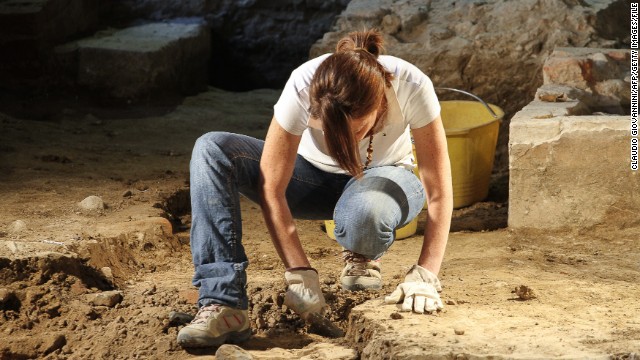
    Part of what archaeologists do is to look for objects that show what life was like in the era they are studying. Some objects might be made of gold or silver, but archaeologists can still learn a lot from even the tiniest beads or other things that the people used. Archaeologists also look for whatever written records they can find, whether they are written on paper, stone, or anything else. Digging for ancient objects, or artifacts, can be slow and difficult work, but it can be very rewarding.

    Before archaeologists get to the point of digging for artifacts, they need to study and learn about what other archaeologists have discovered. They need to learn about ancient civilizations and practice the skills they need for recognizing and preserving artifacts. This process usually involves getting at least a Master’s degree and sometimes a Ph.D. in archaeology at a university. Through this type of program, students learn about fossils, ancient art, museums, and many other topics. They might learn to read Latin and other ancient languages like Egyptian hieroglyphics and find out what people in the past used for medicine and what they ate. A wide range of knowledge can help archaeologists know how to look for artifacts.

    Being able to analyze and interpret what they find is also important for archaeologists. Only a part of their work is digging for artifacts. They also have to analyze and organize what they find, research the history and the objects, and then write about what they discover. For all of this work, they might receive between $55,000 and $60,000 per year, working for a private company, a university, or possibly the government. Working hours can be long when they are out digging, but otherwise, archaeologists usually keep regular office hours. Jobs in the area are limited, but flexibility and a wide range of knowledge can help.

    Do you love history and learning about the past? Why not consider working as an archaeologist?