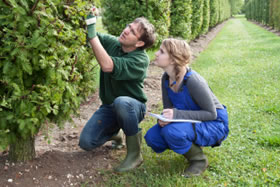
Tag: outside

  • Career Profile: Landscaping Technician

    Career Profile: Landscaping Technician

    Type of Work
    This unit group includes those who survey and assess landscapes; draw sketches and build models of landscape designs; construct and maintain gardens, parks, golf courses and other landscaped environments; advise clients on issues related to horticulture; breed, cultivate and study plants; and treat injured and diseased trees and plants.

    Outlook
    Over the past few years, the number of landscape and horticultural technicians and specialists increased sharply. This increase is mainly attributable to the growth in demand for landscaping and horticultural products and services. Trends are very positive in landscaping and more mixed in horticulture. Since the landscaping industry accounts for the largest number of workers in this occupational group by far, it is expected that the number of landscape and horticultural technicians and specialists will rise sharply over the next few years.

    Demand for Landscaping (non-construction)
    Landscape technicians and specialists work on projects involving public spaces such as urban and regional parks, public squares, highways, recreation areas, parking lots and nature conservation sites, private and public gardens, recreational and sports areas, pedestrian zones and bicycle paths, golf courses, cemeteries, residential, institutional, commercial and industrial sites, and so forth. The good outlook for tourism infrastructure development and increased public pressure for the creation of green spaces in urban environments should provide jobs for landscape technicians and specialists over the next few years. In fact, niches are developing and moving away from projects related directly to construction. Although the protection of cultural heritage sites and environmental conservation will continue to exert a positive influence on jobs in this occupation, landscape development will be added to this trend in a context of increasing competition in the tourism sector, and as a major element in municipal strategies to retain and attract citizens and companies to the area. Added to this are the needs to redevelop contaminated industrial sites and to preserve and restore cultural and historic sites.

    Requirements
    To work in this occupation, candidates must have relevant landscape or horticulture experience, and enjoy working outdoors. They also need to be in good physical condition and have good manual dexterity. Team spirit, autonomy, initiative, attention to detail and reliability are other qualifications sought by employers.

    Education and Training
    Depending on the position, specific training is not necessarily required to enter this occupation. Although a number of employers require that candidates hold a high school diploma (DES), extensive experience in landscaping or horticulture is sufficient in many cases. That being said, more and more employers primarily recruit graduates of the many training programs leading to this occupation. Whether required or not, landscaping and horticulture diplomas are always assets for those seeking to work in this occupation.

    These are the main programs leading to this occupation:
    – Diploma of Vocational Studies (DEP) inArboriculture-élagage ([arboriculture and pruning] offered in French), Ornamental Horticulture or Landscaping Operations.
    – Attestation of Vocational Specialty (ASP) inSpécialités en horticulture ([horticulture specialties] offered in French).
    – Diploma of Collegial Studies (DEC) in Horticulture and Environmental Technology and Paysage or Ornamental Horticulture Landscaping and Marketing.

    Other programs also lead to this occupation, including Attestations of Collegial Studies (AECs) in landscaping and ornamental horticulture. Community organizations also offer school-to-work transition programs in these fields.


  • Get Outside and Exercise!

    Get Outside and Exercise!

    We’ve all been there – you wake up to start your day and immediately start thinking of how you can’t wait to get home to go back to bed later. You feel run down and yawn throughout your classes. Your head feels foggy and you have trouble concentrating. All of these signs point to a lack of energy and balance, which can be easily rectified by exercising regularly.

    Maybe you have a full schedule of classes, you work a part-time job and still need time to study on top of that. Don’t worry – you can fit in exercise each day in simple ways! Try walking to and from school each day, if possible. Speed up your normal walking pace slightly to get your heart pumping. You can also jog/run home from school each day to increase the cardiovascular benefits.

    If you have a little more time on your hands, even on weekends, try going to a community centre in your area. Community centres often have exercise equipment you can use for a much lower fee than a regular gym would. Treadmills and elliptical machines are great ways to get in a cardio workout without having to worry about poor weather.

    Many of us feel uncomfortable working out in front of others, so you can even do exercises at home while watching TV or a movie. Try some simple yoga moves, sit-ups or even jumping jacks. There are many great (and free!) websites that offer tips on different at-home workouts you can do that do not require any equipment. You may also want to purchase a workout DVD that combines your interests with exercise. For example, there are DVD’s that involve dance, ballet and even Bollywood moves.

    Another easy option is to play Wii or X-Box Kinect. Many of us own these systems already, so playing a game that involves movement instead of sitting will add up. Many Wii systems come with sports games inside the box, so there is no extra expense incurred. These games will even track your progress and tell you your “exercise age”, which are great motivators.

    Exercising regularly will ensure that you have energy when you need it most. Exercise has also been proven to lower stress and help with anxiety and depression. When you exercise, your body releases endorphins which essentially help you to feel better and calmer. You should aim to exercise for 30 consecutive minutes each day for the maximum benefits. It is also important to not exercise just before you go to bed, as the increased endorphins can prevent you from falling asleep right away. However, exercising regularly does help you to get a deeper sleep more often.

    So make time for yourself each day and get in some exercise. Motivating yourself can be difficult sometimes, so be sure to tell a friend or family member about your goals and they can help to get you moving. Remember – short term pain, long term gain!

  • Outdoor Therapy

    Outdoor Therapy

    The benefits of outdoor activity are well known. Whether you’re hiking, biking, swimming, or running, these activities are all great ways to get your heart rate up and stay healthy. However, less physically demanding outdoor activities (such as gardening or washing a car) are also good for your health. Mental health, that is. Sometimes just being outdoors makes you feel good, and it’s no wonder. Fresh air, open space, sunshine, greenery…who doesn’t love these things? Especially after being cooped up in an office or classroom for hours on end every day, being outdoors is a sure-fire way to boost your mood and make you feel more relaxed.

    The positive influence of the outdoors is so great that it is even being recommended as a form of therapy in and of itself.1 Instead of relying on pharmacological intervention, some therapists recommend “outdoor therapy” as an alternative way to help people with affective disorders (such as depression).2 In general, it has been found that people who try outdoor therapy experience “improvements in self-concept, self-acceptance and more realistic self-perceptions, and reduced conflict, depression, and anxiety.”3 These effects have been shown with a variety of individuals of all ages, genders, races, personality types, and mental health statuses.4 Of course anyone can benefit from outdoor therapy, even if you’re simply having a bad day or are feeling a little under-the-weather.

    There’s no one particular activity which is recommended above others as the best form of outdoor therapy; however, it has been noted that a short camping trip (even a mock-camping trip in one’s own backyard!) can be a remarkably effective way to reduce stress, anxiety, or bad mood.5 This may be due to the fact that camping is meant to take you away from the hustle and bustle of everyday life where most of one’s stress originates. When you’re camping you don’t have to worry about studying for an upcoming midterm or fret about that long list of things “to do.” In fact, when you’re camping the only things you really need to worry about are what you’re going to cook for your next meal and keeping ample wood on the fire. I wouldn’t necessarily classify these things under “worries,” however. Even though it may just be for a couple days, camping allows you to relax and rejuvenate, leaving you feeling refreshed and ready to once again tackle all life’s challenges. Granted, not everyone considers giving up all connections to civilization for a weekend foray into the depths of the wilderness to be a relaxing experience. If you don’t like camping, then it probably won’t help to ease your stress or anxiety. Conversely, it will probably increase your bad mood, which would be counter-productive. That’s why outdoor therapy can be tailored to individual preferences. If you’re an athletic person, then maybe going for a run or hiking with some friends will boost your mood. On the other hand, if you just need some time to yourself and prefer something a little more low-key, then just grab a book and head to the local park for a quiet afternoon.

    So next time you’re in a bad mood, feeling stressed out, lonely, overwhelmed, frustrated, or you simply want some alone time- head outside and try some outdoor therapy. Whether you decide to go for a five kilometer run or grab a coffee and read a good book, you’ll be amazed at how much better you feel after stepping outside to clear your mind.