The Industrial Revolution saw amazing changes to the world of manufacturing. It also saw many trained, capable people lose their jobs. In a world of automation, self-driving cars, and increasingly complex artificial intelligence, we stand on the cusp of another revolution. In Canada, almost 42% of labourers are at a very high risk of losing work due to these changes within the next two decades. The idea of work and having jobs has been around in human civilization for millennia. What will happen when the very foundation of this concept is shaken to its core?
In the United States, three million people can expect to lose their jobs as self-driving vehicles take care of deliveries and transportation. Fleets of self-driving trucks have already made treks across Europe. The fields of accounting, health care, policing, education, and more are expected to soon utilize artificial intelligence in increasingly significant ways. Unlike the Industrial Revolution, it could be much more difficult for people to simply transition into other lines of work. Despite the dystopian vibes that this future brings about, there is the potential for humans to enter a whole new era of work.
For the first time in human history, it will not be necessary for the vast majority of people to work long hours. One very likely situation, and a possibility already being discussed in Ontario, is to provide a basic income to everyone that would replace all current welfare programs. Some may criticize this simplistic form of welfare as encouraging laziness, but it could do just the opposite. Creative, artistic, and socially-driven jobs will be in high demand. With our basic needs met through a guaranteed income, we will be free to pursue jobs out of passion as opposed to pressure. The need for creators, teachers, and social workers will continue for many years to come.
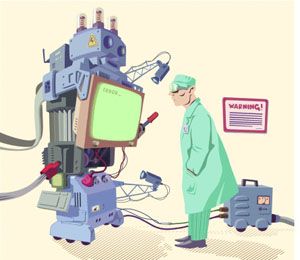
Many other lines of work are not expected to disappear entirely. Instead, humans will work alongside ‘cobots’. These robots will perform the less ideal tasks in many lines of work, including the dull and the dangerous. The work left for humans will be more specialized and far less monotonous. It also allows for more free time outside of one’s career. According to the Canadian Occupation Projection System, high-skilled and low-risk careers are expected to become a significant part of the workforce. Approximately 712,000 new jobs are expected between 2014 and 2024 amongst occupations unlikely to be fully automatized.
The idea of jobs, which was remained essentially the same throughout the history of civilization, could be about to undergo a major shift. This is definitely scary, and there will be those who suffer because of it. However, we are on the verge of creating a world of work driven by passion instead of working just to survive. This would be a world full of specialized jobs, in which we use utilize our strengths as humans to our full potential with the assistance of robots. Jobs people do will never be the same.
Sources:
Cixin, Liu. The Robot Revolution Will Be the Quietest One. The New York Times. http://www.nytimes.com/2016/12/07/opinion/the-robot-revolution-will-be-the-quietest-one.html
Lamb, Creig. The Rise of Robots: Why the Future of Jobs in Canada Isn’t All Doom and Gloom. Brookfield Institute. http://brookfieldinstitute.ca/