Suppose that you saw a long, thin brown rope hanging from a tree and that the rope suddenly started to move. What would you think it was? If you were in the Chocoan forests in the South American country of Ecuador, you might realize that what looked like a rope was really the blunt-headed vine snake, which has only recently been discovered. For scientists and other snake enthusiasts, the discovery is exciting and will likely prompt years of exploration and study.
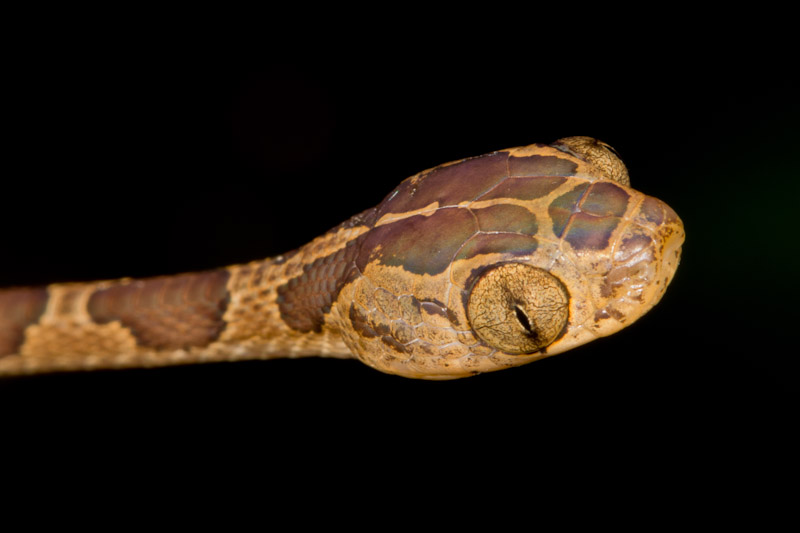
Blunt-headed vine snakes are the seventh known species in a group called Imantodes chocoensis. These snakes live mainly in Mexico and in Central and South America. Blunt-headed vine snakes are long, thin, and normally brown or cream-coloured. They hunt for frogs, lizards, and other small animals at night, hanging from the trees where they live and grabbing animals that pass by the tree. Although they have some poison in their fangs, they are unlikely to do much harm to people with their venom.
The most unusual thing about blunt-headed vine snakes is their appearance. They have long, thin bodies with thin necks which then bulge out to a large head. Sometimes, the head can even be about eight centimetres wide, making it seem very large on such a long, thin body. They have large, bulging eyes which take up more than 25% of their heads. Their stomachs and other internal organs are near the ends of their bodies, close to the tail. Their closest relatives live on the other side of the Andes Mountains in South America.
Although most people have probably never heard of the blunt-headed vine snake, some scientists have known about it for a few years. The snake’s discovery came in April 2007, when a group of zoologists (people who study animals) led by a scientist, Omar Torres-Carvajal from the zoological museum, first found it. After looking closely at it and comparing it with other snakes, they realized that it was a species that no one had identified before. Now they will try to find out how to preserve the snake’s home and to keep it from disappearing.
Finding an unknown snake in Ecuador was an exciting discovery, but possibly not entirely unexpected. Ecuador is known for its many types of animals and the many species that live there. The Amazon River region is home to many different species of plants and animals. The place where researchers found the snake is part of a region called Tumbes-Chocó-Magdalena, which has an area of 274,597 square kilometres. With so much space, there could be many more animals in the area that scientists have not yet discovered.
For some zoologists, it might seem as if all of the world’s species of animals are already known and that there is nothing new to learn. However, the discovery of the blunt-headed vine snake in northwestern Ecuador could give people new enthusiasm to explore the world’s animals. They could also find new ways to keep the snakes safe from threats and to help them to thrive.