Tag: study

  • Are You A Solo Studier, or a Group Studier?

    Are You A Solo Studier, or a Group Studier?

    Effective study skills are essential to learning from your class readings, homework, and lectures. To get the greatest benefit from your study time, it is useful to know which type of studier you are, and how you learn best: solo studying, or group studying.

    You might prefer studying alone if you work best somewhere quiet with minimal distractions or interruptions, so that you can give your full and undivided attention to the topics you are reviewing. You may also learn the material best by thinking things through yourself, and independently researching when you are not sure of the answer.

    If you are a group studier, you likely prefer being able to discuss difficult material, ask questions when you get stumped, and explain things to others, in order feel that you have properly mastered the material at hand. You may also like quizzing each other on material, and being able to take a mental break with occasional moments of non-study socializing.

    Regardless of your methods, your top consideration should always be to study the way you feel you get the best understanding of the material. Whichever way you prefer to study, however, there are benefits to occasionally using the alternate method- mix it up.

    If you find your group study sessions become more about socializing than completing your work, or that everyone in your group wants to focus on material that you have already mastered, some solo study time might be a good idea. One solution is to have everyone in the group get through their own most-required material separately, then rejoin for a group review. This way you can focus independently on what you need to learn, and then later participate in a general review in the more social group setting.

    Conversely, if while studying solo you feel you’re not fully understanding the material, that you have trouble finding the correct answer or method on your own, or if the workload is extremely heavy and starts to feel overwhelming, it may be time for some group study. You can benefit from being able to talk through the difficult material with others, or you can take the opportunity to divide a heavy workload and note-taking tasks with a few trusted friends, then have regular review and note exchange sessions.

    Good study habits in school become good work habits, so learning early on what way you study and learn best will carry forward into any future career.



  • Study Strategies: Tests and Exams

    Study Strategies: Tests and Exams

    Whether you’re going through university exams or are feeling the pressure of evaluations in high school, this is a stressful time of year for all students. If you want to do really well, no doubt you could use all the tips you can get.

    Here are three study strategies to keep in mind when preparing for tests and exams.

    Plan ahead. If you have a test coming up, make the most of your time leading up to it in order to figure out the best way to prepare. Use a calendar and assign yourself small tasks every few days (e.g. “summary notes for Chapter 1”, “review glossary”). This will ensure that the big, scary evaluation worth a chunk of your final grade doesn’t catch you off-guard; as a result, you’ll do better. This is also a good strategy with which to integrate planning tools you may already use (agendas, to-do lists, etc.).

    Tip: For those of you who tend to procrastinate, you can still make good use of this strategy by creating a “Crash Course” list of things to cover in the limited time you have. (That said, procrastination is definitely not a good study strategy, so in the future make sure you leave yourself enough time to study properly.)

    Reformulate. Studying straight out of the textbook will get you nowhere (except maybe remembering a couple of sentences word-for-word). Instead, make notes on the material and organize it in your own way. It’s a good idea to formulate lists of key concepts and important things you need to remember, based on (but not just copying) your full lectures and readings. Don’t be afraid to mix media, too: if you like to organize (or if you really need the help), make yourself a study package of raw notes, summaries, flash cards, and whatever else might come in handy.

    Tip: Tailor this strategy according to the type of evaluation, as well as the course being taught. For example, studying French parts of speech might make good use of those flashcards, but practice tests may be a better strategy if you’re writing an algebra test.

    Study in groups. Before you groan about the horrors of “group-work” assignments (in which one person—maybe even you—winds up doing all the work), consider the fact that group studying can positively influence your test performance. Discussing the material and applying it outside of the classroom will help you remember it better. Plus, study groups offer you an opportunity to help others who don’t know the material as well as you do, which is not just a nice thing to do—if you can teach what you’re doing to someone else, then you probably know what you’re talking about.

    Tip: Study groups can have low turnouts, so hold people accountable. Give everyone a task to perform prior to the session (e.g. to take notes on a specific chapter) and check in with them to make sure they’re still involved.

    With those strategies in your back pocket, hard work, and a little luck, you’re sure to ace your next evaluation!

  • What Graduates Earn Over Their Lifetime

    What Graduates Earn Over Their Lifetime

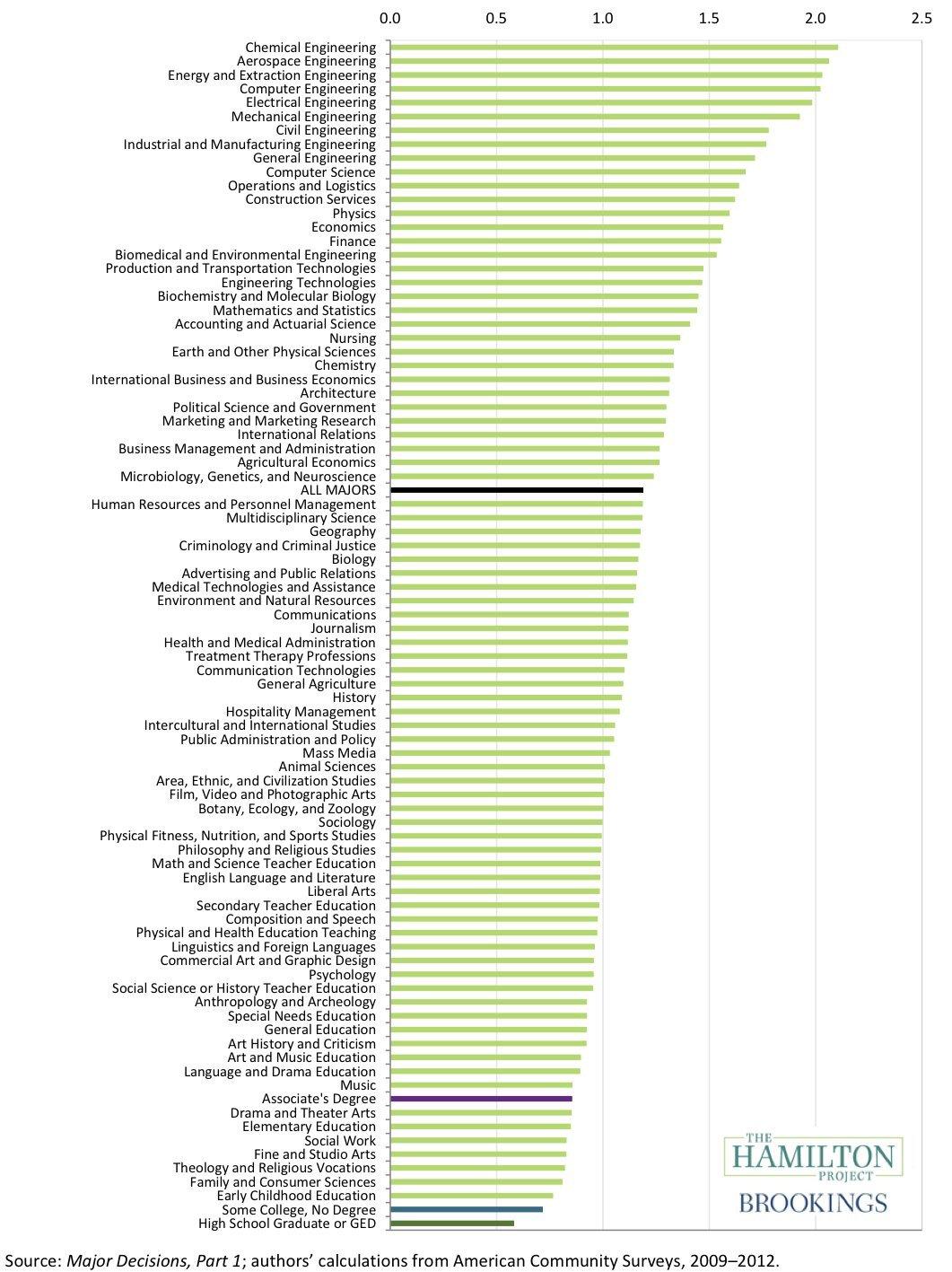
    A study released by the Hamilton Project in September of this year shows just how important a degree when it comes to earning money. A bachelor’s degree in ANY field has proven to unleash your earning potential exponentially. As the study’s authors noted, median earnings of bachelor’s degree graduates are higher than median earnings of high school graduates for all 80 majors studied. This is true at career entry, mid-career, and end of career.

    You can read the entire interesting study on the Hamilton Project website (link above). In the meantime, take a look at this chart that details which degrees earn you the most over your lifetime – and which earns you the least.

    Note: Unfortunately, this study is currently not available in French.

    HamiltonProject


  • Study As You Play

    Study As You Play

    Well here we are again, getting back into the school routine. Early nights, early mornings, lots of studying, and a whole different mindset. Some of us like the busy schedules filled with endless studying, but others like myself would rather be doing many other things then studying for hours a day. If you’re into sports, video games, or your favorite TV shows and movies and would much rather be spending your time with them, let me help you study as you play.

    I’m a sucker for video games-I’m addicted. Studying was nonexistent in my middle school and early high school years, just video games. I would come home from school, grab some food and sit down for hours mashing through games. It’s what I loved to do, and at that point studying never crossed my mind. However, as the years went on and my marks started to fall, I realized I needed to change. The conventional way of sitting at a desk with my head stuck in a book wasn’t going to work for me.  I couldn’t focus, or remember important dates and names that way. So I gave up and went back to my games, and that’s where it hit me.

    I was playing a game called Rock Band (an interactive music game) and found myself saying important history dates to the rhythm of the songs I was playing. Usually I count the notes in my head, but this time I used dates, places and names. This may sound crazy, but it worked. What I started doing was looking over a section of my notes, and replayed it over and over in my head as I played games. I wasn’t able to focus on the work by just sitting there and reading it, but I was able to focus on the material while doing something else.

    This doesn’t just work for video games, this works for TV and movies as well. In English we always had to read books and know all about each characters personality traits. Let’s be honest, some of the books we’ve had to read were just terrible. So what I did was connect the book characters to TV show or movie characters. This will help you remember who each character is, what they do, and their personality.

    These are just my examples, what helped me through the long and important studying process. The main point of this is to tell you that studying doesn’t have to be dreadful. Try to connect or combine it with things you love to do. If you do that, you’re going to be more positive about studying. Make studying a part of your daily schedule, but do it your own way. Every bit of studying will help you, and I can guarantee you’ll see a difference in your school performance. What you have to study, and how much you have to study will only increase, so start making up a routine now-one that works for you. Let’s take this into our own hands, and study as we play.

  • Study Techniques

    Study Techniques

    It’s been a long, tiring Tuesday. Finally the bell rings and you’re set “free,” only to return home to that ever-growing pile of homework that’s waiting for you on your bedroom floor. You know – that pile of assignments that are all due tomorrow, just before the big cumulative math exam. Your mind is exhausted and you don’t want to drink any more disgusting coffee that will surely give your hands the uncontrollable shakes. You wonder how you’ll ever be able to focus into the wee hours of the night.

    Perhaps you could try a study method called the Pomodoro Technique – so named for the tomato timer that helps you balance the amount of time that you spend studying with the amount of time you stop for a break.

    Though it may seem counterintuitive to allow yourself extra breaks in such a “last-minute” crunch, some people who use the technique claim that regular breaks are exactly what you need to improve productivity and concentration.

    Here’s how it works:

    1. Decide on the task to be done. Take one assignment out of your pile of homework and prepare to attack it mentally!
    2. Work on the task for 25 minutes. This is where the timer could come in handy. Proponents of the Pomodoro Technique say the ticking of the timer actually helps you to focus because it makes your desire to complete the task physically present. Similarly, the act of winding the timer up confirms your determination to complete the task.
    3. Break for 3 to 5 minutes. After 25 minutes, the timer will ring to announce a break. Stand up, stretch, do some jumping jacks, breathe deeply, take a bathroom break, have a glass of water, etc.
    4. Then rewind that timer and get back to work for another 25 minutes.
    5. Every four 25-minute phases, (which, including the breaks, will add up to about two hours) you should take a slightly longer break (15-30 minutes) before you start studying again.

    Try to practice the study technique, or your own alternative variation, before you’re buried alive in assignments!

  • The Human Cognition Project

    The Human Cognition Project

    Every day, you use your brain in many different ways. You use it to learn new material at school, to talk with your friends, and even to blink your eyes. Right now you’re using it to read and understand the words of this article. Scientists know that the brain controls the rest of the body, but there are still many mysteries about exactly how it works. How do people really think? Why do their brain functions change as they get older? Researchers working with the Human Cognition Project hope to find answers to questions of human thought.

    The word “cognition” usually refers to the process of thought, including how people get information and what they do with it. Cognition can be conscious, like when you talk with your friends and think about the words everyone is saying. It can also be unconscious, like when you quickly pull your hand away from a hot stove.

    People’s ability to think and process information changes throughout their lives. Young children have to learn the connection between touching hot stoves and burning their fingers, but most people can make connections like these without consciously thinking about them. They learn how to behave in different social situations and begin to develop their own ideas about the world and how it works.

    Cognition changes throughout people’s lives. Accidents, illnesses, stress, or getting older can often affect the brain. Everyone has occasional memory lapses and problems with understanding difficult ideas, but some people have more troubles than others. Some cognition problems are minor and cause few lasting troubles, such as when you forget to do your homework and have to hand it in late. Other problems can be much more serious, such as when people forget their own names and addresses. They could become lost or get into all kinds of other trouble.

    The purpose of the Human Cognition Project is to find out more about what happens when the brain is not working as well as it could. Seven projects are part of the research, covering topics like the connection between what people see and what they remember. Another topic is how this connection relates to witnesses of crimes. Helping people to remember events more accurately could be an important result of the work in this area.

    How people’s brains change as they age is another important part of the Human Cognition Project. When people get older, they often lose their memories or develop other problems with thinking clearly. These problems are often called dementia, and they are an important part of the Human Cognition Project. If scientists could understand exactly why the brain loses so many of its abilities as it ages, they might be able to find a cure for the mental troubles of old age.

    Will all of this study of cognition help people with problems like memory loss or other loss of brain function? It might not provide a cure, but it can at least provide a basis for future research into the human brain.

  • Study Tips for the New Semester!

    Study Tips for the New Semester!

    Now that 2013 and a new semester are upon us, you may have resolved to be more organized or to get higher grades in your classes. We are here to help, with some handy tips on how to better prepare yourself for educational success this year!

    Take Notes on ALL Readings
    This may come as a surprise to some students, but you should be taking notes on your readings. Some people may not see the point of note taking, but it is necessary if you want to do well on your exams. If you haven’t started already, start as soon as possible. Course readings are usually on the exam. Taking notes on each reading will ensure you have a brief summary that will save you from having to read it again come exam time.

    Start Organizing Study Groups
    Starting a study group is a great way to get ready for exams. Try talking to fellow students and sending out e-mails to see who is interested in joining a study group. A study group allows you to share lecture notes, divide up the chapters and share these notes amongst yourselves, get new perspectives on the material (this can be especially beneficial if you are struggling with certain concepts), and test one another on course concepts. Meeting with the study group may also point out some important course concepts that you have neglected to include in your study notes. Consider asking your Teaching Assistant to meet with your study group and help to facilitate a course review.

    Review and Revise Your Lecture Notes
    Yes, it is early in the course, but it’s never too early to start reviewing your lecture notes. Reviewing your lecture notes ensures you have the opportunity to re-engage with course material before your exams start. You could review your notes after class, later in the week, or while you prepare for next week’s class. The more you engage with the material, the more you’ll absorb and understand. As you engage more with the material and develop a deeper understanding of course concepts, you should revise your notes and focus on concepts that are more difficult.

    Start Researching Papers Early
    As soon as your professor hands out the instructions for your first assignment, you need to start doing preliminary research on your topic. Starting early allows you to find key resources, including books, which may come in limited quantities from the library. It also allows you to approach your Teaching Assistant or Professor about your topic. Both your Teaching Assistant and Professor are there to provide guidance through the research process. They can provide you with vital information that can help you find appropriate resources, ensure you’re on the right track with your assignment, and look over early paper outlines to ensure you have a good grasp of your topic.

    Use the Library
    Many students attempt to do as much research as possible on the Internet. Although you can certainly find many quality sources online, particularly through online journal databases, this can limit the resources used for your assignment. Using the library allows you to not only access major scholarly books that are relevant to your field of study, but also allows you to discuss issues with the librarian, who can give advice on where to look for offline resources, and even suggest some materials you have yet to consider. Most university libraries also host workshops on how to research effectively and how to use the library to your advantage. Explore these workshops and use your library. It will definitely pay off when you get that final grade! Professors and Teaching Assistants like to see that you used a wide-range of resources.