Tag: studying

  • Tips on Studying for Multiple Choice Exams

    Tips on Studying for Multiple Choice Exams

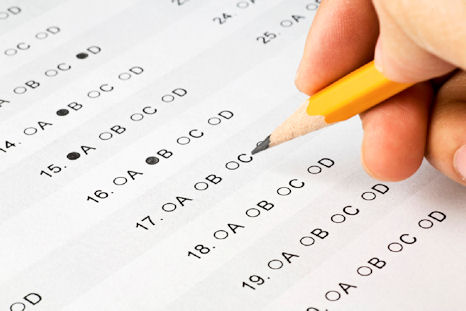
    In many college and university classes, instructors will use multiple-choice or Scantron exams because they are much quicker and easier to grade. Can you imagine marking short-answer and essay exams for a class of three hundred? As a student, you need to learn how to effectively study for multiple-choice exams.

    First, start studying early! This advice applies for all tests, but I cannot emphasize enough how important it is to start studying early. You are given your class schedule at the beginning of the semester, so there is simply no excuse for getting caught by surprise by the test date. Ideally, start studying at least two weeks before the exam.

    Second, get copies of old multiple-choice exams for the course you are studying for. It is better if these old exams were also written by the same professor that is currently teaching your course. Don’t just read through the exam questions, but actually work through them and answer them. This will give you experience with the kinds of multiple choice questions you might expect during your actual test.

    Third, there is another advantage of taking old exams. Because your time is limited, you need to be strategic about how you use your time. By answering old exams, you can now identify areas where your understanding and knowledge recall is weaker. Focus on the areas where you are less confident. Once you have brushed up on these topics, take the old exams again and see how much you’ve improved!

    Fourth, do not neglect specific details. You might think that since it’s a multiple choice exam, you can figure out the correct answer by the context. This is good advice for when you are taking the exam, but do not become reliant on this. Your professor may ask questions where options (a) to (e) differ by just one or two words. For these kinds of questions, it is difficult to figure out from the question and the options what is the correct answer, if you do not know it. So make sure you study the specific details as well as the broader concepts.

    The secret to acing multiple-choice exams is preparation. There is no magic. Just follow the tips above and you will find your multiple-choice exams a less stressful experience!


  • Are You A Solo Studier, or a Group Studier?

    Are You A Solo Studier, or a Group Studier?

    Effective study skills are essential to learning from your class readings, homework, and lectures. To get the greatest benefit from your study time, it is useful to know which type of studier you are, and how you learn best: solo studying, or group studying.

    You might prefer studying alone if you work best somewhere quiet with minimal distractions or interruptions, so that you can give your full and undivided attention to the topics you are reviewing. You may also learn the material best by thinking things through yourself, and independently researching when you are not sure of the answer.

    If you are a group studier, you likely prefer being able to discuss difficult material, ask questions when you get stumped, and explain things to others, in order feel that you have properly mastered the material at hand. You may also like quizzing each other on material, and being able to take a mental break with occasional moments of non-study socializing.

    Regardless of your methods, your top consideration should always be to study the way you feel you get the best understanding of the material. Whichever way you prefer to study, however, there are benefits to occasionally using the alternate method- mix it up.

    If you find your group study sessions become more about socializing than completing your work, or that everyone in your group wants to focus on material that you have already mastered, some solo study time might be a good idea. One solution is to have everyone in the group get through their own most-required material separately, then rejoin for a group review. This way you can focus independently on what you need to learn, and then later participate in a general review in the more social group setting.

    Conversely, if while studying solo you feel you’re not fully understanding the material, that you have trouble finding the correct answer or method on your own, or if the workload is extremely heavy and starts to feel overwhelming, it may be time for some group study. You can benefit from being able to talk through the difficult material with others, or you can take the opportunity to divide a heavy workload and note-taking tasks with a few trusted friends, then have regular review and note exchange sessions.

    Good study habits in school become good work habits, so learning early on what way you study and learn best will carry forward into any future career.


  • Workspace “Feng-Shui”

    Workspace “Feng-Shui”

    Ever wonder why you can’t get any work done? It’s possible that your environment is contributing to your lack of productivity. Everyone has different preferences for their ideal study space. If you’ve got a big test or paper coming up, it’s best if you adjust your surroundings to help your brain function at its optimal level.

    Here are some things to consider if you’re looking to “feng-shui” your workspace.

    Space yourself.

    A lot of projects require a large amount of space. Plus, sometimes it helps to have your work laid out all around you (like when you’re doing research). To prepare for this, make sure to keep your desk clear and clutter-free. If you constantly find yourself buried in piles of books and random papers—all of which have nothing to do with your work—you’re going to find it harder to focus. If you live in a small area or can’t spare the space, relocate to the library or a café with large tables when you need to spread out.

    Sound (or silence) it out.

    Some people need absolute silence to focus, while others thrive in the midst of noise. You can save appropriate soundscapes on your computer or phone to help you focus. Create a study playlist of “working songs” (depending on the person, that could feature hard rock, dubstep, classical piano sonatas, etc.). If music isn’t your thing, check out ambient or white noise generators, which create background noise to fit your preferences (like rainfall or “coffeeshop” sounds). And if you really like your silence… A pair of earplugs is your best friend!

    Eliminate distractions.

    Next time you’re finding it hard to concentrate, try and figure out what exactly is stopping you from getting your work done—and get rid of it. If Facebook updates or texts are constantly distracting you, disable those features on your devices (or put them away altogether). If you’re in a spot where people won’t stop talking, pack up your things and grab an individual study room. If you’re working near a window and can’t stop people-watching, close the curtains. It’s for your own good!

    Make it your own.

    The image of a cramped gray cubicle in a dimly lit office strikes panic in many of our hearts. Your workspace doesn’t have to be synonymous with a jail cell. You can actually form positive associations with your work if you personalize your environment a little. This can take on many forms: an inspiring desktop background, a mug of your favourite tea, a scented candle, a cat on your lap, etc. When work gets stressful, having familiar and comforting objects around can help you calm down.

  • How to Take Good Notes

    How to Take Good Notes

    Whether you’re in high school, college or university, note-taking is a valuable skill. As a student, it’s your responsibility to record and understand what the instructor is saying, especially in a lecture setting, where handouts or PowerPoint slides may not be provided at all. Good note-taking can make the difference between simply memorizing material and truly understanding what you’re learning, which is why it’s likely your grades will get a boost out of it, too.

    When you’re trying to keep up with a lecture, only jot down key points. You can typically tell which parts of the class are important for you to remember and which parts are just side notes or bonus material. Don’t get hung up on writing down every single point the instructor makes. Not only is doing so not that valuable, but you’ll never be able to get it all! Pay attention to key names, dates and concepts, and focus on summarizing the important information you learn in class.

    If you’re still having trouble getting the information down, use shortcuts. As long as you can understand what you’re writing, there’s no need to capitalize everything or use proper punctuation. Using short forms of words (e.g. instead of for example, bc instead of because, etc.) is a great strategy. If you miss something, keep going, but mark that section so you know to refer back to it and fill in the blanks later. (Some instructors also allow students to record their lectures as a bonus aid—but ask first.)

    When you’re in class, it’s useful to make references between the lesson and the relevant textbook passages or provided material. You’ll be able to form a more cohesive link between what the instructor is saying and your homework or readings, and therefore you’ll understand the material better. Jotting down things like “see page A” or “refer to diagram on slide B” will help you make sense of what you wrote down when you’re studying later.

    That being said, don’t copy. If a lecturer provides a handout, constantly references the textbook or publishes PowerPoint slides online, there’s no use in jotting down that information word for word: you already have the source to refer to later. If you focus only on registering what’s already in your books, you might miss points that are not provided for you, but that the instructor still expects you to know.

    Finally, review and summarize—at the end of the week (or, if you can bear it, after each class), go back over your notes. Highlight key ideas and look up things you didn’t understand the first time around. As well, consider making a summary of each note (3-5 sentences at most) to help you grasp the main points of that particular class. You can refer to those summaries when you’re studying for tests or exams.

  • High School Exam Prep

    High School Exam Prep

    Are you ready for your exams? High school exam periods can vary, but they typically occur either at the end of the year (for non-semestered schools), or at the end of both January and June (for semestered schools; winter and spring exams, respectively).

    Whether your evaluations have just passed, are coming up soon, or aren’t for a while, it’s always important to know how to prepare. An exam not only has a significant impact on your final grade, but it can also be a way to measure how much you’ve learned throughout the course. You should take every exam seriously, and make sure you allot enough time to get ready. It never hurts to do well!

    Here are three tips for high school exam preparation:

    Know the structure. Aside from obviously just studying the material, preparing for the format of the exam can be very valuable. Teachers usually release information related to the structure well in advance. As well, many exams are combined-format, so you might need different study strategies for each section. Let’s say an exam has 50 multiple-choice questions and an essay. You can create flashcards of key terms, concepts and definitions, as well as brainstorm potential questions and arguments.

    Play your strengths and weaknesses. If you know a certain part of the curriculum inside out, there’s no point in reviewing it in great detail. When you’re studying, focus on what you don’t know so well and make sure you understand it before moving on. This way, you’ll at least have general knowledge of all the material, instead of only studying what you’re good at. If you focus only on what you’re good at, there’s always the chance that those topics may not even appear on the exam anyway!

    Choose wisely. Sometimes exams offer students a choice (between short answer topics, for example), and this can be a great way to showcase your strengths. That being said, if you have to choose, pick the option that is easiest for you. Students sometimes try to write about what they think the teacher prefer, even if they don’t know what that specific topic is about. Take advantage of the opportunity and write about what you know. You’ll be able to provide more accurate information and concrete examples instead of “speculating” about something you don’t fully understand.

    Following the above guidelines will help you out, but ultimately you still have to put in the work. Make sure you make time to study properly before the exam (and preferably not the night before the exam). And remember, there’s no reason exam preparation can’t be fun—as long as you’re still being productive, studying with friends or classmates can actually be a great way to prepare. Good luck!

  • Why Do We Have to Study History?

    Why Do We Have to Study History?

    History is a very interesting subject. It is the study of ancient times up until the present since the discovery of writing. History is basically the written account of events since the very dawn of human civilization. So why is it so important to study the past? What’s so interesting about history?

    History is very important for a large number of different reasons. It isn’t only important to just remember the people and events of the past because we want to remember them; the events of the past have all, in some way, led to the way things are in the present. Studying history can help us understand this series of events, and how the changes that occurred led up to the present day.

    It is often repeated that, “if we don’t study history, we are doomed to repeat it.” This statement is very true.  Since the past affects us so much now it is important to know where ancient people went wrong, such as which decisions led to unpleasant things like wars, technological innovations, and laws.

    For example, World War One, which lasted from 1914 to 1918 was one of the most deadly and dangerous wars that ever occurred. This war changed the balance of power in the world, creating whole new countries and destroying old ones. Its easy to see why its so important to learn about this war, many of the reasons that things are as they are, is due to the changes that the war brought about.

    Another very big historical changing point was known as the Protestant Reformation. This event changed the entire world. Before the Reformation all of Christianity was controlled by the Pope and the Roman Catholic Church. Martin Luther was a German man who disagreed with the way the church was being run, so he nailed his 95 Theses to the front of a church door. This event led to the creation of many new sects of Christianity and more huge changes in the world. Wars happened between countries that supported the Catholic Church, and those who did not.

    The most important reason to study history is so that the mistakes of the past are never repeated again, for the good of all of humanity. Two major examples of this are the Holocaust and the atomic bombing of Hiroshima and Nagasaki, two Japanese cities. The Holocaust was a horrible atrocity that occurred in World War Two where millions of Jewish, Gypsy, Polish, and communists died under the orders of Adolf Hitler, the dictator of Nazi Germany. Knowing history is so important because awful events like this can never be repeated. As long as we remember the tragedies and mistakes of the past, we can take steps to avoid them in the present.

    Hiroshima and Nagasaki were destroyed entirely by American atomic bombs at the end of World War Two. The cities were completely destroyed with only one each. The power of the bombs shocked the world, and since then no country has ever again used a nuclear weapon in war. This is an example of people learning from the past by studying history, and putting the information to peaceful use  in the present.

    For these reasons, it is important for us to learn about the history of our world.

  • University Exam Prep

    University Exam Prep

    Before you can escape the stress of school and enjoy the winter break, you have to pass finals! You’re not alone. University students all over the country are cracking under the pressure of their exams. While this is an undeniably difficult and often exhausting time of year, it’s important to stay focused and motivated. You wouldn’t want all the hard work you’ve done over the course of the semester to go to waste over one bad test.

    When your exams are held depends on the university’s examination period. However, typically half-year courses taken in first semester have their exams in early- to mid- December. That being said, many full-year courses also have mid-term tests around this time of year, and while these may not be worth as much as final exams, it is nevertheless important to make sure you’re prepared for them.

    Here are some tips on how to get ready for a university exam.

    Summarize. Go through all your lectures and create a set of condensed exam notes. Write down all the important stuff, and paraphrase as much as possible in order to make the material more manageable. If you do this properly, eventually all you’ll need to do is glance at the key words and you’ll be able to explain the related material in detail.

    Draw connections. A subject can seem pointless if you don’t make the effort to connect it to your own life—instead of blindly memorizing, see if you can explain things through examples or anecdotes. Take a political theory and see if it’s manifested anywhere in world news, or do some more research on an experiment you found particularly interesting in biology. Get away from the word-for-word method of studying and think of ways to make what you’re studying relatable (and thus, memorable).

    Safety in numbers. Studying in groups is extremely valuable because you get to interact with the material instead of just reading alone in your room. Get together with a study group a few times before the exam. You should continue to study independently as well, but discussing concepts, quizzing, or even explaining things to someone else within a group will improve your knowledge and your memory.

    Get help. Don’t be intimidated by your professor or TA: they are really just there to help. If you have any questions about the course material, it is crucial that you clarify them before the end of the semester rolls around. Chances are, if you mention you’re stressing out about the exam, the prof or TA would be happy to give you some help on how to prepare.

    Take care of yourself. Get a good night’s sleep the day before the exam and make sure you’re keeping yourself healthy. Study hard, but make sure you keep well—otherwise, it could actually interfere with your focus. You wouldn’t want to compromise all of your hard work with one all-nighter or sick day, right when it matters the most.

  • Tips to Help Students With LD Pass High-Stakes Tests

    Tips to Help Students With LD Pass High-Stakes Tests

    A growing number of students now take tests that determine whether they will advance to the next grade level. If students do not pass these tests, they may be held back one year, which can damage self-esteem, lead to frustration, and increase their chances of eventually dropping out of school. A growing number of high school students now take exit exams that determine whether they will graduate with a standard diploma. Students who do not pass these exams often find themselves with limited options after high school.

    High-stakes tests can have serious consequences for all students, but they pose a particular challenge for students with learning disabilities (LD). Due to their one-size-fits-all format, many parents and educators believe that standardized tests tend to reflect a student’s disabilities rather than his or her abilities. With so much at stake, it is critical that students with LD be well prepared and receive the support they need when taking such tests. Parents should not confuse high stakes tests with the tests given by the school to meet the requirements under No Child Left Behind (NCLB). These tests hold states and districts accountable for poor student performance, but do not require states to impose personal accountability on students.

    Reasonable Accommodations
    Students with learning disabilities, who have an Individualized Education Program (IEP), are entitled to appropriate accommodations while taking high-stakes tests.

    Accommodations are changes to testing materials and procedures that can help to “level the playing field.” The purpose of accommodations is not to give students with LD an unfair advantage over other students, but rather to assist them in demonstrating what they actually know.

    A student with dyslexia, for example, might know the answers on a multiple choice test, but not have enough time to read all of the questions. A reasonable accommodation for this student would be to receive additional time. Depending upon a student’s disabilities, accommodations can be made with regard to the setting, timing, or scheduling of the test, how the information is presented, what additional materials can be used and how the student is allowed to respond. An accommodation could be:

    • receiving extended time;
    • using a computer with spell-check;
    • listening to an adult read the instructions and/or test questions; or
    • taking the test in a separate room or with a small group.

    How Parents Can Help
    Parents should play an important role in helping their children navigate high-stakes tests. It is often up to parents to work constructively with the school to make sure that their children have every opportunity to succeed. Here are some tips for parents:

    • Talk early on with your child, your child’s teacher and the IEP team to determine which accommodations your child needs while taking high-stakes tests. (Note: Ideally, accommodations should be the same or similar as classroom instruction. However, some accommodations are only for instruction and cannot be used on state/district tests.)
    • Find out if there are any accommodations that your child needs that are not allowed by your state, district and school during high-stakes testing.
    • Make sure that your child’s IEP clearly spells out appropriate accommodations for both testing situations and classroom use. (Note: You should clarify whether your child will be permitted to use accommodations for testing that he or she has already been using in the classroom as part of everyday learning.)
    • Check to see whether your child has been taught the content and skills on which he or she will be tested.
    • This is important because sometimes students with LD have not had sufficient instruction in the general education curriculum upon which the tests are based.
    • Should your child fail a high-stakes test, make sure that there are multiple opportunities to retake it.
    • For a small percentage of students with LD, accommodations may not be enough to level the playing field. If you and the IEP team decide that your child needs an alternate form of assessment, work closely with school personnel to determine which type of alternate or modified assessment is best suited for your child.

    The Bottom Line
    No one test can accurately measure all of the skills, knowledge and abilities of a student. When students with LD take high-stakes tests, they deserve the same opportunities as other students to demonstrate what they know. When parents and schools work together, students with learning disabilities can have the support they need when taking tests that may determine so much about their future.

  • Study Smart: Tips for Academic Success This Year

    Study Smart: Tips for Academic Success This Year

    I hope you had a great summer, because it’s September: back-to-school season. Whether you’re just entering high school or brushing up your last year in post-secondary, you’ve probably got a whole lot of work ahead of you. You’re probably already familiar with 1000-word papers, 3-hour exams, and PowerPoint summative presentations, and no doubt you’ve spent (or should have spent) ages preparing for them. But how do you know if your study tactics are truly hitting the spot?

    Everyone has a unique style of learning, and it’s important to establish this long before you hit the books. For instance, you’re writing that test and are stuck trying to remember a history date. Maybe you remember what the textbook page looked like, or what your instructor’s voice sounded like, or maybe you don’t remember any of that, but you definitely remember writing it down. Most people are primarily visual, auditory or hands-on learners (and many people are combinations of the three!). Whether you have to use colours and shapes, audio-record a lecture or write out all your notes by hand, your study habits should reflect your learning style.

    How much work, exactly, should you put in to achieve maximum results? Oftentimes, when it comes to studying, it’s quality over quantity. You could do eight straight hours of polynomial factoring, but if you’re still getting incorrect answers after the umpteenth attempt, chances are your studying habits are not working. Mix it up a little—approach concepts from different angles, in different ways, in order to find out what works best for you. Use media, too (instructional videos, scholarly articles, or even good old flash cards can work wonders). Each field of study offers different ways to learn its material, and you ought to test-drive at least a couple of them before you devote your time to studying in a single way.

    I am a student, and I’ve had my fair share of study experience. What I’ve discovered is that nothing helps me prepare for a test or exam more than explaining the material to someone else. Set up a study group for a class you’re having trouble with—or even a class you excel in, because others could use your help. If you’re stuck on a problem, chances are someone in your circle knows how to find the answer. Come test time, even if you don’t find the solution right away, you’ll remember how you helped (or were helped by) someone else, and the answers will come back to you in no time.

    Best wishes for a productive semester. Study hard, and study smart.

  • The Difference Between a Bachelor’s and a Master’s Degree

    The Difference Between a Bachelor’s and a Master’s Degree

    Many people say that an education is the key to a good job, a high income and a good life. That might not always be true, but earning a bachelor’s or a master’s degree is a good idea for anyone who wants to work in professions like education or law. Sometimes a bachelor’s degree is enough, but sometimes a master’s degree is necessary. How can you know how much education to get? Knowing the difference between a bachelor’s and master’s degree can get you started on making a decision.

    How much education you need for your chosen profession depends very much on what level of work you want to do. A Bachelor of Education, for example, is all that most teachers need to work in the classroom. If they want to work as supervisors or school principals, however, they might need to work towards a master’s degree. In fields like English literature, psychology or sociology, a bachelor’s degree is usually only the first step towards further training and rarely leads directly to a job. In programs such as nursing, however, a bachelor’s degree is considered a high level of education. Each field has somewhat different requirements and job possibilities.

    Despite all of these differences, most bachelor’s or master’s programs have some elements in common. Bachelor’s degrees are general introductions to the field and cover a wide variety of topics. Usually, students in these programs take some classes outside their chosen field, at least in the first year or two. A science student might be required to take an English literature or history class, for example, and an English literature student might be required to take a science class.

    Bachelor’s programs might be three years or four years long. Completing these programs normally involves relatively small assignments like research papers, tests, experiments and exams. Students get the information they need mainly through lectures the professor gives during class and through reading the textbooks and other materials, with an occasional student presentation to give others a chance to teach.

    At the master’s level, things begin to change. Most master’s classes use a seminar style, with students giving longer presentations and participating in discussions on each day’s topic. Class size is usually much smaller than at the bachelor’s level, but the assignments are more difficult. One of the biggest assignments is usually the thesis, which is a long paper of anywhere from about thirty to a hundred pages on a topic that the student chooses. Sometimes students can complete another major assignment instead of a thesis, but both choices involve a lot of work.

    If you find studying and research very difficult, a master’s degree might not be right for you. If your chosen career has few job prospects, you might need to consider your options carefully. However, if you are willing to do a lot of hard work, a bachelor’s or master’s degree might be good choices for you.