Tag: technician

  • Refrigeration and Air Conditioning Mechanic

    Refrigeration and Air Conditioning Mechanic

    Refrigeration and air conditioning mechanics install, maintain and service residential, commercial, industrial and institutional heating, ventilation, air conditioning and refrigeration units and systems. Their duties include laying out reference points for installation, assembling and installing components, installing wiring to connect components to an electric power supply and calibrating related controls. They also measure, cut, bend, thread and connect pipe to functional components and utilities.

    Refrigeration and air conditioning mechanics maintain and service systems by testing components, brazing or soldering parts to repair defective joints, adjusting and replacing worn or defective components and reassembling repaired components and systems. As part of commissioning, refrigeration and air conditioning mechanics start-up, test and charge systems.

    In addition to their regular duties, some mechanics may also prepare work estimates and plan systems for clients.

    Refrigeration and air conditioning mechanics work with a range of tools and equipment including hand, power, charging, diagnostic and measuring, and recovery and recycling tools and equipment.

    They may be employed by heating, ventilation, air conditioning and refrigeration contractors and manufacturers, property owners, retail establishments, and institutional and public sector employers. They also may be self-employed. Refrigeration and air conditioning mechanics may work on systems and units in office buildings, restaurants, food processing plants, ice arenas, supermarkets, hospitals and ships. They may also work on refrigerated trucks, automotive air conditioning systems, box cars and appliances.

    Refrigeration and air conditioning mechanics work in various locations such as rooftops, mechanical rooms and computer rooms. The work may be performed indoors or outdoors year round and may require extensive traveling. Much of the work is performed independently.

    Inherent risks in this trade include working at heights and in confined spaces, and working with compressed gases, utilities such as electrical, and hazardous chemicals.

    Key attributes for people entering this trade are strong customer service, writing, oral communication and problem solving skills, and an eye for detail. Coordination and manual dexterity are also important, as are mechanical and mathematical abilities. Good physical condition and the strength to lift heavy components are also valuable.

    This analysis recognizes similarities and overlaps with the work of steamfitters/pipefitters, plumbers, gasfitters, sheet metal workers, industrial mechanics (millwrights) and electricians.

    With experience, refrigeration and air conditioning mechanics may act as mentors and trainers of apprentices in the trade. They may also become specialized in one area of the trade, advance to supervisory positions or become instructors.


  • Rig Technician

    Rig Technician

    Drilling is an important phase of oil exploration and extraction in Canada. Drilling is one of the methods used to access hydrocarbon formations. Rig technicians work on drilling rigs and other specialized equipment to drill holes to retrieve these hydrocarbons.

    Drilling rigs are owned by companies specializing in drilling, called drilling contractors. Some contractors are larger than others and some specialize in certain types of operations. However, all contractors offer their drilling equipment and the services of their employees to exploration companies on a contract basis.

    A rig crew’s operational structure is organized by a clearly defined set of duties and responsibilities. After gaining entry level experience as a leasehand and floorhand, workers in this trade must progress through the ranks of motorhand (level 1) and derrickhand (level 2) in order to become fully qualified rig technicians/drillers (level 3). The division of duties in the levels of skilled workers on a rig crew is:

    Motorhands: maintain drilling rig engines, transmissions, heating systems, diesel electric generators and motors, hydraulic systems and other mechanical equipment; maintain equipment logs and records; monitor fluid and supply levels; participate in rig mobilization (rig up) and demobilization (rig out); supervise and are able to do all duties performed by floorhands and leasehands.

    Derrickhands: operate drilling fluid systems and pumps during drilling; mix chemicals and additives; handle sections of the drill string assembly from the monkeyboard during tripping operations; monitor and record volume and properties of drilling fluids; supervise motorhands, floorhands and leasehands; and are able to do all duties performed by motorhands.

    Rig technicians (drillers): operate the drawworks, rotary equipment and pumps; inspect rig; maintain records of drilling operations; are able to perform all duties performed by any crew member; and are responsible for the safety, training and supervision of the crew members.

    Rig technicians report directly to the drilling rig manager. The scope of the rig technician for this analysis covers the duties of motorhands, derrickhands and drillers.

    A rig crew works with a variety of hand and power tools, as well as motorized equipment, lifting and hoisting equipment, and personal protective equipment (PPE) and safety equipment. Computers are an important tool in this trade to maintain operational records and interpret data related to drilling activities.

    The rig is set up and transported to different sites resulting in the rig crew often travelling to remote locations. The work is performed in all weather conditions and workers should be prepared to work in all types of weather and environmental conditions (example: cold, hot, noisy, dirty, dusty, wet and muddy). Drilling activity peaks during the winter months when the ground is frozen. The work pressures and demands may fluctuate depending on world oil and gas supply and demand.

    Important attributes for rig technicians are good hand-eye coordination, mechanical inclination, the ability to work well in a team and with third-party service providers, and strong leadership, communication, and organizational skills. Good physical condition is important because the work often requires considerable lifting, long hours and repetitive movement.

    Drilling is a 24-hour operation, requiring rig technicians to work shifts and often long hours. The job requires mental alertness due to the inherent work hazards such as moving equipment, exposure to chemicals, risks of explosions and working at heights. Rig technicians work outdoors in all kinds of weather, often in remote and isolated areas away from home.

    Rig technicians are expected to perform supervisory duties and training of apprentices and other less experienced crew members. Experienced rig technicians may move into other positions such as rig managers, instructors, well site supervisors, sales representatives or other technical positions within the industry.

  • Career Profile: Telephone Repair Technician

    Career Profile: Telephone Repair Technician

    Learning to use something that is constantly changing can be a challenge. Have you ever learned to use a new phone, only to have the technology change as soon as you learned it? Telephone repair technicians often face that challenge. Their work is changing all the time and they constantly have to learn new methods to keep up with the new technology. For people who like technology and enjoy working with their hands, however, working as a telephone repair technician can be a good and fulfilling career.

    Telephones, especially these days, have a lot of technology in them. Cell phones can be especially difficult to fix, but even the older styles of phones can have a lot of small parts and tricky connections. Telephone repair technician have to be good with their hands and to be able to work with very small objects without dropping or breaking them. They also need to understand the technology to be able to fix the problems. They have to know how traditional landlines work and also have an idea of how signals connect with cell phones so that people can talk with each other.

    Some telephone repair technicians learn about their work from experience or from other people on the job. Sometimes, a high school diploma and a few years of experience can be enough for telephone repair technicians to get good jobs. However, many employers now want technicians to have professional certification, which involves learning about the different parts of the job and then passing a special test.

    Another way for telephone repair technicians to get to know their jobs is through apprenticeships. This way, they get to see first-hand how to work with telephone equipment and with the wires that connect home phones to the outside lines. Many telephone technicians also work with installing phones and also cable television or even satellite equipment. They might also need to know about how fax machines, pagers, and other pieces of equipment work.

    Working conditions for telephone repair technicians can sometimes be difficult. Often, they have to work outside, repairing phone lines that have been brought down by storms or icy weather. They might have to climb high on telephone poles to work with wires that could give them electric shocks if they move them the wrong way. The need for repairs can come at any time, and technicians often have to work days, evenings and weekends. However, the pay is generally higher than for similar jobs, and some workers can make $25 per hour.

    Being a telephone repair technician can be a good job for people who enjoy the challenge of dealing with equipment.  Does it sound like something you want to do?

  • Train to Be a Wind or Solar Technician

    Train to Be a Wind or Solar Technician

    One of the fastest-growing segments of today’s job market are “green careers,” such as wind and solar technicians. These careers are perfect transitions for those with previous construction experience who are seeking a career with potentially unlimited job growth. As more businesses and homeowners become more concerned about protecting natural resources and using alternative energy sources, these careers will be in high demand.
    People who are interested in becoming solar technicians can begin by researching online green energy courses. One of the best available resources is Solar Energy International, or SEI. This online training resource lets those who have previous construction experience or have completed an apprenticeship program gain access to training resources prior to beginning their studies.

    Solar Installation Careers
    There are many areas of interest that solar technicians can choose to specialize in such as:
    – Photovoltaic installation (PV)
    – Solar thermal installation
    – Sustainable building

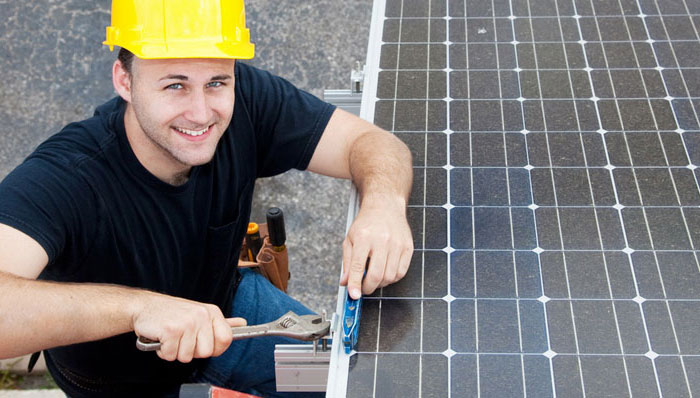
    Photovoltaic installation, also known as PV, involves the placement and repair of solar panels. Solar thermal installation involves installing solar water heating equipment, mostly for homeowners. Sustainable building involves designing and implementing long-term solar energy systems for residential and commercial properties.

    Selecting a Training Program
    The key to beginning a career in solar energy is selecting a training program that is properly certified and offers a combination of coursework and hands-on training. When searching for online green energy courses, it’s a good idea to select programs that work with the North American Board of Certified Energy Practitioners. Technicians who become certified usually have more work opportunities available to them, so it’s important to make sure the training program selected meets the desired certification standards. Most introductory training programs last six weeks, with one of those weeks designated for hands-on training at a solar energy facility.

    What Skills Do I Learn?
    Once a person is registered for a solar technician training program, it’s time to start learning the specific skills needed for the job. Since most technicians have previous construction experience, they are already skilled in blueprint reading, basic math and safety procedures associated with construction. Most solar technicians begin by taking classes in Solar Electric Fundamentals and Grid-Direct Design, introducing them to the basics of solar energy installation and repair. These courses provide information on renewable energy resources and how to measure solar electrical efficiency and load analysis. After learning the basics, students move on to learning basic PV system applications, system components and site and safety analysis.

    Hands-on Training
    Many community colleges are leaders in solar energy training, offering combinations of online and hands-on training. Students should sign up quickly for classes, because they can fill up fast. Solar energy programs are popular with military veterans who have been discharged and are seeking civilian jobs.