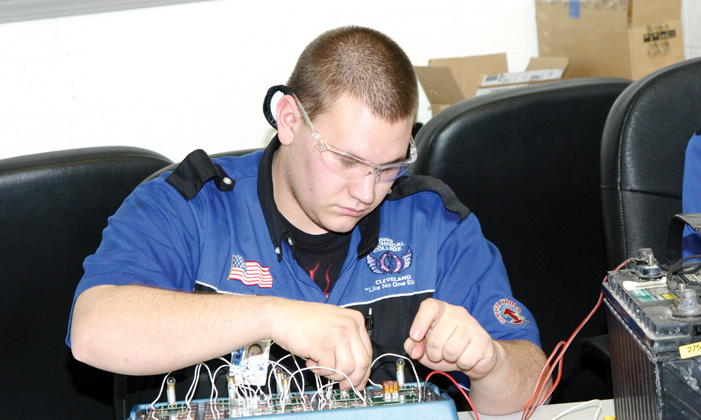
A career as an electrician provides a fair amount of job security whether you are self-employed or hired within a company. Electricians are required across the board, from domestic to commercial settings. Due to the dangerous nature of the work involved, electricians must be highly qualified and trained. If a career as an electrician appeals to you, read on to find out what steps you will need to take to become qualified as an electrician.
Education
In order to become an electrician you first need to get qualified, which requires you to enroll in an apprentice program. In order to apply for an apprenticeship program you will most likely be expected to possess a high school diploma or equivalent. Apprenticeship programs will provide classroom instruction as well as on-the-job training. Expect the apprenticeship to last a duration of 4 years, with approximately 144 hours of classroom based instruction and 2,000 hours of on-the-job training. Classroom instruction will consist of learning about electrical theory, mathematics, electrical code requirements, blueprint reading, and safety practices. Some specialized training may be received, such as working with elevators and fire alarm systems. As for on-the-job training, expect to work under the supervision of an experienced electrician who will set your tasks and guide you until you can master the tasks given on your own.
Graduating
Once you have graduated there are a variety of routes you can go down. Many electricians choose to work for construction firms, service companies or utility companies. Most graduates will be involved in some kind of maintenance work, where they will be expected to primarily maintain and upgrade existing electrical systems. If you enter into the construction field, you will be part of a team responsible for installing new wiring systems within new buildings. Alternatively you can go down the self-employed route, but that would require a lot of self-promoting and an understanding of registering your self-employed status for tax purposes. You would also need to pass a licensing exam in order to obtain a trading license. Check with your local authority about what is required to set yourself up, if you are interested in becoming a self-employed electrician.
Earning potential
Electricians are expected to command very good base wages. However, much of this depends on the company you work for and the perks they offer. If you are self-employed you will set your own hourly rate or job rate, but keep in mind that you will need to factor in promotional costs, transport costs and parts costs.
Advancement
Once experienced, electricians can advance to positions such as a supervisory roles. Within the construction field they can become employed as construction superintendents or project managers.
If this sounds like a career that would suit you, check online via your local job center or career center in order to inquire about local apprenticeship programs. Find out what apprenticeship opportunities there are with local electrical contractors and local electricians. In order to become qualified you will need to study in the apprentice role for 4 years, so make sure this is the right career choice for you before becoming committing.