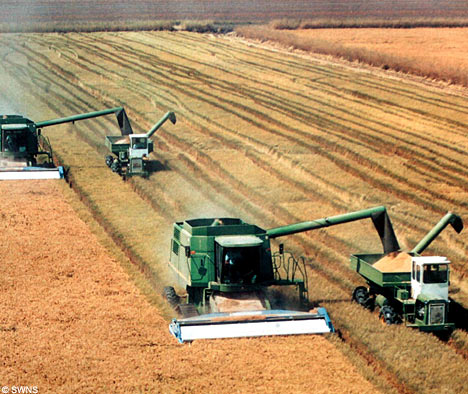
Tag: working on a farm

  • Working on a Farm

    Working on a Farm

    By Gavin Mercier

    Farm work is hard work- there’s no other way to say it. However, it is also some of the most valuable and rewarding work you can do. Farmers hold one of the most important jobs of our community, but they are also the most underappreciated. Working on a farm not only gives you a sense of what it’s like to be a farmer, but it also teaches you some real- life skills that will be valuable for your future.

    Hard Work, Fun Work, and Responsibility

    Yes, working on a farm is hard. But farming is the best example of the phrase “hard work pays off.” With farming, the harder you work the better the end result will be – in this case the end result is crop or cattle. Not only that, all the outdoor work is really great for great for your body. Working on a farm, you get to watch your work develop into something wonderful, whether it’s a crop of corn or a baby calf.

    While farming is hard work, it can also be a lot of fun. There is so much to do on farms you just can’t get bored. From feeding cows on a cattle farm to tending horses on a ranch, there are just so many fun things you can do on a farm – as long as you’re a little bit adventurous.

    Being on a farm isn’t all fun and games though. There is a lot of responsibility involved. Farmers are responsible for taking care of their animals and crops, and that can sometimes be a lot to handle. However, if you like being around animals and taking care of them, then this isn’t much of a chore at all.

    Appreciating Farmers

    Being a farmer is an underrated job – not many people choose to become a farmer anymore. There are also a lot of false facts about farming nowadays that put people off. Working on a farm, you get to see firsthand just how much they really do for us and what it’s really like. You will get a better appreciation for your food and how much work people really put into it. Seeing how your food is produced and being a part of that process gives a better understanding of the world we live in and how it all works for us.

    Appreciating Our Earth

    Not only will working on a farm help you appreciate all that farmers do for us, but it will also teach how to appreciate our planet more. Almost everything about farming is controlled by the weather and the landscape – crops are planted in the best soil around and watered by the rain. If there is no good soil, the crops can’t be planted, and if there is no rain then they cannot be watered. If we can’t take care of the earth, then it becomes harder for it to take care of us. Working on a farm is a great way to learn about the earth and how you can help take care of it.

    Working on a farm is great for so many reasons. I actually used to work on a cattle farm, and I still think it was one of the best experiences of my life. I had so much fun working there and learned so much, from the value of hard work to how I can help our earth. Working on a farm was one of the best things I ever did, and I hope it will be the best thing you ever do, as well.
  • The Farm as a Classroom

    The Farm as a Classroom

    In the small city of Hamburg, Iowa, students at Marnie Simons Elementary School are given a unique opportunity. Along with their usual classes, they can also watch over a duck and chicken house, care for a baby lamb, and tend to a garden. Their working farm was developed through several grants and carried out with the help of the school’s teachers. There are plans to include livestock and the production of cheese and eggs. Students are able to experience the ups and downs of life on a genuine farm, and are far better off for it.

    Working on a farm offers very valuable lessons that the urban world of a classroom is not capable of providing. Whether you are on a family farm, the family farm of a friend, or pursuing farming through a program, doing so is a great way to supplement your existing education. But prepare for a drastically different lifestyle from what you are used to. The homes tend to be older and simpler. The work involves many hours of physical labour and can be very exhausting. This is often quite a shock for city dwellers.

    Lessons abound from the many tasks at hand. Crops do not always turn out the way you want, and animals do not always survive as long as expected. Dealing with these losses and disappointment teaches perseverance. It is never clear what the harvest will be like from year to year. This helps you to plan for the future in a very practical way, unlike theoretical situations in a textbook. When there is a large yield of food, many farmers will share with those who are less fortunate. In those times, being charitable provides great lessons about the privilege of having more than you need and how using that good fortune to help others can enrich your community.

    In Nova Scotia, the importance of farming is integrated in the school curriculum for elementary school students. The Agriculture and Food Education office often visits classrooms to display chick hatching, types of soil, and other elements of the farming world. Farmers and agrologists (agrology examines the application of science to agriculture) come to schools to share stories about farm life. The Nova Scotia Cultural Agricultural Awareness Committee offers funding for class projects such as field trips, hosting local food events, and more. The Cole Harbour Farm Heritage Museum hosts the Farmer for a Day event every September, in which students get to engage in activities on a real farm, including grading Christmas trees.

    By having students performing farm work, they have the chance to handle animals and crops instead of just reading about them. They get to make mistakes and learn from those errors. Students get physical activity beyond the gym and can build endurance and strength. It becomes clear just how difficult it is to bring food from the earth to our kitchen tables. When we live in cities from birth, it is easy to forget the natural world from whence we all came. The ingredients for meat, vegetables, bread, and so on require great work to acquire and cultivate. You can read extensively about it, but you can only fully appreciate it by seeing it in person and tackling the process hands on.

    Farms are a very different world from the classrooms you are likely used to. This different realm comes with its own unique challenges and its own distinctive learning opportunities. By helping out at a family farm or the family farm of a friend, or taking advantage of programs offered by your school or your community, you can discover this world for yourself.

    Sources

    Iowa Farmer Today. “Elementary school engages students with working farm.” http://www.iowafarmertoday.com/news/regional/elementary-school-engages-students-with-working-farm/article_de3cb982-0bfb-11e6-84e4-a77f18911aab.html

    Lewis, Kara. “Do it well or not at all: 10 lessons learned from life on the farm.” FamilyShare. https://familyshare.com/2220/do-it-well-or-not-at-all-10-lessons-learned-from-life-on-the-farm

    Nova Scotia Canada. “School Programs: Elementary.” https://novascotia.ca/agri/programs-and-services/educational-resources/school-programs/elementary/

    Women on the Road. “Working on a Farm.” http://www.women-on-the-road.com/working-on-a-farm.html