
Tag: your financial future

  • Your Financial Future

    Your Financial Future

    “Money is the root of all evil” is not the full story. In fact, the old proverb is oft repeated incomplete; it is actually “The love of money is the root of all evil.” Those three words are paramount. When considered reasonably and given weighted importance with what matters most in your life, finances are something you want to start thinking about right away.

    Tax-Free Savings Accounts allow you to put money away and let it accumulate interest without having to worry about taxes. The government allows a limit each year for you to add to the account. If you are older than 18 and have not taken advantage of this yet, those amounts carry forward. You likely have a limit of tens of thousands of dollars. As you get older and advance in your career, you will likely switch over to Retired Registered Savings Plans, or RRSPS, for short.

    TFSAs are more ideal at this stage because the funds can be accessed much easier. RRSPs are, as their name suggests, ideal for your retirement as you pay tax on the money when you withdraw it. Your income bracket in retirement will be much lower, meaning the same can be said of your taxes. One thing to remember is your RRSPs are not required to be withdrawn only upon reaching retirement. If you decide to take a year off work to study, travel, or write a book, you can withdraw the savings just like you would when retiring. However, savings are also not the fully story.
    “It’s not what you earn; it’s what you spend.” My dad told me this over and over as I grew up, and still throws it into conversations the odd time to this day. The endless attention placed on saving is greatly valuable, but can also be misleading. When you neglect to nurture the other half of the finances equation, your savings prowess is at the mercy of your spending habits.

    For one week, make a list of every single cent that you spend. You might be surprised how the little expenses can add up over time. In a world of tapping cards and paying with our phones, it is easy to lose track. As life builds in complexity, so do your finances. By the time you are juggling a multitude of monthly expenses, you will be glad you built good habits back when you could count monthly costs in your head.

    Figure out the life you would like to live. This should be the ideal balance between having things that will bring you happiness worth the effort and discarding efforts not worth the result. How big of a place do you need? Will you take vacations? Eat out a lot? Is a car of great benefit in the area you live, or is the public transit system adequately robust to get you around? Be honest with yourself, and remember that your answers can and likely will change over time.

    Source:
    Fontinelle, Amy. 8 Financial Tips for Young Adults. http://www.investopedia.com/articles/younginvestors/08/eight-tips.asp
  • The Truth about Debt: How Debt Can Bring You Down in the Future

    The Truth about Debt: How Debt Can Bring You Down in the Future

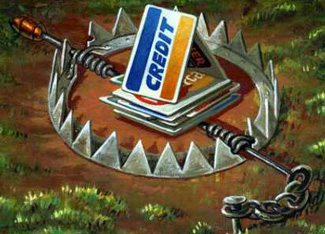
    If your family is like many in Canada, it is probably in debt. Your parents might owe money on the house or car, and you or your brothers and sisters might already have credit card debts or owe money to friends in school. Credit card use is a common way of buying products in Canada, but it can have negative effects on your future if you don’t pay it off.

    You might hear people talk about good and bad debt. Basically, “good debt” refers to something that the person has a good chance of repaying. For example, if someone has a high-paying, stable job, and they buy a house; unless something unexpected happens, like a major accident or job loss, the person can make regular payments on the mortgage, thus paying of the debt of the house.

    “Bad debt” is different. Bad debt refers to a debt that the person has little or no chance of paying off because of the size of the debt, a low-paying job, or other factors. This kind of debt could last a lifetime and affect the person’s ability to buy a house or a car, get insurance, or even to get a loan for a small project. If you have bad debt, you likely have a low credit score. A credit score is something banks, insurers and lenders look at to determine your financial position and how reliable you are in paying off things like your credit card or student loan.

    According to recent statistics, people who were born between 1980 and 1984 already have over five thousand dollars’ worth of credit card debt than their parents did at the same age. Unless they get very high-paying jobs in the future, that debt could follow them throughout their lives. If you do possesses that much debt at a young age (college and university students), the most important thing to do is always make your minimum payments. Also, you can notify your lender about your situation and arrange later payments.

    Being in debt can cause serious problems for people. They might not be able to go to university, and they risk losing their homes if they are unable to make the payments. Their wages might be taken to pay the debt, and they might have bill collectors calling to ask for the money. All of these things can cause a lot of stress.

    Buying everything with cash is probably the best way of avoiding any kind of debt. However, very few people actually have that kind of money, especially for large purchases like a house or car. However, other kinds of debt can be relatively easy to avoid or manage. For example, if you want to avoid credit card debt, you can start by paying off the entire balance every month. If you have cash with you when you go shopping, use that instead of credit or debit cards as much as possible. Staying out of debt can be difficult, but owing a lot of money is worse. Living within your means can be hard, however, very necessary when preparing for a healthy financial future.

    Sources:

    Kay, Michael F. The Truth About Debt. https://www.psychologytoday.com/blog/financial-life-focus/201602/the-truth-about-debt.

    Loans Canada. “How Your Debt Affects Your Credit Score.” https://loanscanada.ca/debt/how-your-debt-affects-your-credit-score/.

    White, Martha C. Today’s Young Adults Will Never Pay Off Their Credit Card Debts.”
    http://business.time.com/2013/01/17/todays-young-adults-will-never-pay-off-their-credit-card-debts/.

    Wolfe, Michael. “Problems That Personal Debt Could Cause.” http://www.ehow.com/list_7333636_problems-personal-debt-could-cause.html.