Category: Finance

  • Living On A Budget

    Living On A Budget

    As a young person, your parents are probably paying for most, if not all, of your expenses. Perhaps you have a job, in which case you may be making some of your own money. However, because of the time that school takes up, you probably are only able to work part-time. This means that your income is limited to what your parents give you and what small amount of money you can make at your job. Learning how to budget your money is an invaluable skill that will help you to learn the value of money and make important decisions about what you need and what you can live without.

    Budgeting starts by thinking about your expenses and what you can and cannot afford to buy. It also involves setting goals for what purchases you would like to make in the coming years, which can be very exciting and rewarding. Your parents may already be paying for your “big” expenses like rent, food and transportation costs (bus pass, car, etc.). They might also pay your phone and internet bill. In turn, you would then be responsible for paying for your clothing, hygiene products (like shampoo and conditioner) and your entertainment costs. All of these amenities add up and you will eventually have to pay for all of these things yourself.

    Setting goals about when you will be able to afford a certain purchase is a really good way to initially ease yourself into a budget. If, for example, you currently work part-time hours (20-30 per week) and you want to buy a car within the next 4 years, you can calculate how much money you will have to put away in your savings account. Knowing this will help to set you up for success and encourage you to spend your money responsibly. It will help you to make tough decisions about what you really need and what you don’t (do you NEED that new Xbox game?).

    Depending on your financial situation, you might also be responsible for paying your university or college tuition. These costs can reach into the tens of thousands of dollars and definitely require budget planning. You will need to factor in all of the above mentioned cost in addition to the cost of school. This is where applying for student loans and scholarships becomes vitally important. Remember – student loans you are required to pay back. Scholarships are essentially free money. Ensure you have applied for as many scholarships as possible!

    All of this responsibility can tend to weigh down on you and make you feel trapped. But don’t worry! Everyone has a budget. Some are more restricted than others, but with a little creativity and organizational skills, you will be able to manage perfectly well and become a better person for it. Money comes and goes, but as long as you are doing your part to earn an income and to actively plan and manage your money, you will be fine.


  • Scholarships and Bursaries for Aboriginal Students

    Scholarships and Bursaries for Aboriginal Students

    Bursaries and Scholarships
    The Aboriginal Financial Officers Association of Canada is dedicated to helping Aboriginals reach the highest standard of excellence in finance and management. AFOA’s initiatives in the development of Awards and Scholarships are examples of that commitment.

    See link below for scholarships and bursaries:
    http://www.metisnation.org/programs/education–training/education/bursaries–scholarships

    Want even more options? Check out the scholarships and bursaries for Aboriginal students that we found:

    The Aboriginal Canada Portal
    Offers an online Aboriginal funding tool that offers a way to search for scholarships, bursaries, loans & grants according to your needs.

    Canada Post Aboriginal Education Incentive Award
    The Aboriginal Education Incentive Award is part of Canada Post’s nation-wide scholarship program and commitment to furthering individual potential. Each of Canada Post’s eight regions across the country will grant three awards annually: Two $1,000 scholarships for the return to and successful completion of one full year of high school and One $1,000 scholarship for the return to and successful completion of one full year of post-secondary education, including vocational or trade skills training.

    FAAY (Foundation for the Advancement of Aboriginal Youth)
    FAAY is a scholarship program operated by the Canadian Council for Aboriginal Business. CCAB is dedicated to developing the future generations of Aboriginal leaders. They have scholarships for high school or post-secondary students.

    AMMSA (Aboriginal Multi- Media Society)
    Large listing of scholarships and bursaries available to Aboriginal people (including youth) in a variety of educational programs. You can look up educational institutions and find the awards available to their Aboriginal students only.

    Royal Bank of Canada Aboriginal Scholarships 
    Royal Bank offers scholarships to all Aboriginal people and also has a summer placement program as an award to qualified applicants. Royal Bank has employment opportunities for Aboriginal students in grade 9-12 for summer employment.

  • Scholarships and Bursaries for Students with Disabilities

    Scholarships and Bursaries for Students with Disabilities

    You’ve got big academic dreams – they’ve got the funds!

    Scholarships are “free money” given to a student for their college education—unlike loans, this money does not have to be paid back. Many private scholarships are available that grant money to students based on their particular strengths, interests, disabilities and other characteristics or qualities. Finding this money can be the hard part, but we’re here to help. The following is a select list of scholarships particularly for students with learning disabilities.

    Smart Kids with Learning Disabilities Youth Achievement Award

    A $1,000 award for a student with LD and/or ADHD who has demonstrated initiative, talent, and determination resulting in a notable accomplishment in any field–including art, music, science, math, athletics or community service.

    The Marion Huber Learning Through Listening Award

    Three $6,000 and three $2,000 awards available to high school seniors with LD who demonstrate leadership skills, scholarship and a high level of service to others; must be a member of Recording for the Blind and Dyslexic (RFB&D).

    The Hal Hazelett Scholarship

    Two $1,000 scholarships for students with LD, one of which is designated for a student pursuing an education and/or a math degree. One ADD/ADHD scholarship will also be awarded.

    Incight Go Getter Scholarship

    A renewable $750 award available to high school students with physical, learning, cognitive, hearing, or vision disabilities.

    LD Resources Foundation

    Awards of assistive technology tools (ex. Kurzweil products, Dragon Naturally Speaking and MacSpeech Dictate, Franklin Dictionary) are available to college students diagnosed with LD and/or ADHD. Students must be enrolled at a college/university with the intention of pursuing an undergraduate degree.

  • What Graduates Earn Over Their Lifetime

    What Graduates Earn Over Their Lifetime

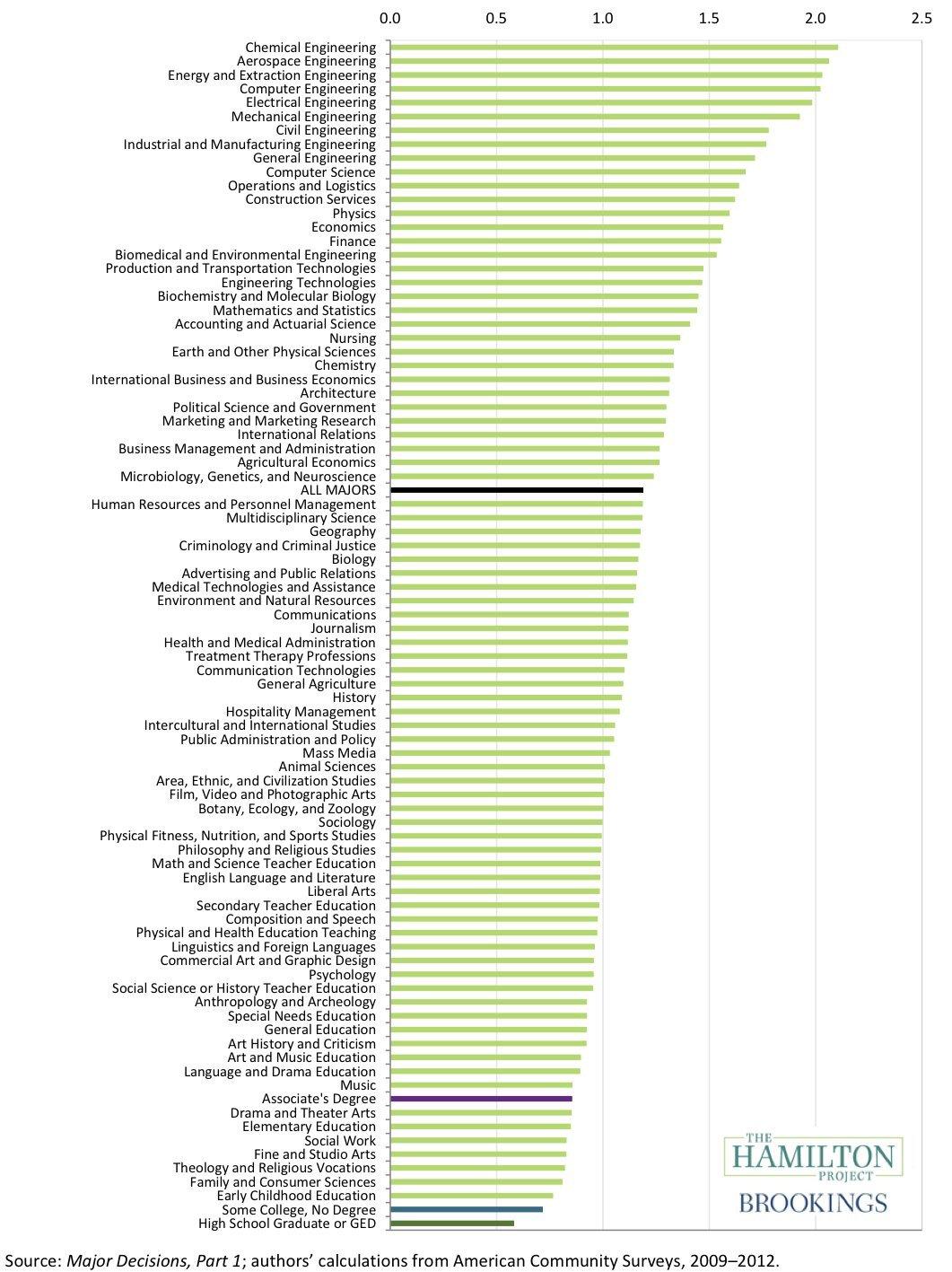
    A study released by the Hamilton Project in September of this year shows just how important a degree when it comes to earning money. A bachelor’s degree in ANY field has proven to unleash your earning potential exponentially. As the study’s authors noted, median earnings of bachelor’s degree graduates are higher than median earnings of high school graduates for all 80 majors studied. This is true at career entry, mid-career, and end of career.

    You can read the entire interesting study on the Hamilton Project website (link above). In the meantime, take a look at this chart that details which degrees earn you the most over your lifetime – and which earns you the least.

    Note: Unfortunately, this study is currently not available in French.

    HamiltonProject


  • December Scholarships of the Month – Apply Now!

    December Scholarships of the Month – Apply Now!

    When your exams are over for the month and you’re settling in for your winter break, why not take a few minutes to apply for scholarships? The little extra effort will go a long way to help you realize your post-secondary dreams. Here are a few scholarships we found this month:

    1. The RBC® Black History Month Student Essay Competition – Open to all students in Canada who submit an essay telling their story of how one or more black Canadians have helped define Canada’s diverse heritage and identity through their specific achievements and contributions. Deadline: December 5, 2014. Amount: $1500 – $5000.

    2. Gaspard’s Keep Canada Green Online Scholarship Contest – Open to students across Canada, excluding Quebec. Deadline: April 11, 2015. Amount: $1000 – $2500.

    3. CN Diversity Scholarship Program – Grants are available to support the post-secondary education of women, visible minorities, persons with disabilities, military veterans and people of Aboriginal heritage in Canada. Deadline: December 31, 2014. Amount: $3000.

    4. “Whipper” Billy Watson Education Bursary – Open to students with physical disabilities in full-time study at an Ontario College of Applied Arts & Technology. Deadline: April 25, 2015. Amount: $2000.

    5. AFOA-PotashCorp Aboriginal Youth Financial Management Awards – Open to students in Grades 11 and 12 of Aboriginal Ancestry. Deadline: January 12, 2015. Amount: $5000.

    6. Burger King Scholars – The BURGER KING℠ Scholars program assists employees, employees’ spouses or domestic partners, employees’ children and high school seniors in the United States, Puerto Rico and Canada in continuing their education. Deadline: December 15, 2014. Amount: Top prize of $50,000.

    7. Debut Atlantic Award for Musical Excellence – Awarded annually to an Atlantic Canadian high school music student as chosen by a member of their distinguished alumni. The award recognizes talented youth who are committed to the serious study of music. Deadline: January 31, 2015. Amount: $1000.

  • Myth: I Don’t Need Money – My Parents Pay For Everything!

    Myth: I Don’t Need Money – My Parents Pay For Everything!

    Many young students might think that having their parents pay for their school tuition, shelter, transportation, food, clothing, hygiene products, entertainment and anything else would provide them with enough money to survive university. But this is a myth! The reality is that money is more than something that is used to purchase the things you want and need. Making money is more than just having money in your pocket, it is building your path to independence and self-sufficiency. Making your own money on top of whatever amount your parents are giving you is a great way of creating independence for yourself. This is hugely important because when you are not dependent on others for every aspect of your material survival, you can feel empowered and able to make your own choices. Having the feeling that you control your own life and are not dependent on your parents will inevitably allow you to see your life more clearly and to see exactly how your own decisions affect your life.

    Working is valuable for gaining money and for experience that can be used in different areas of your life. When you work you are taking on responsibility and people are depending on you to do the job. Having people depend on you instead of constantly depending on others is empowering and reinforces your independence. Additionally, building your work experience looks great on a resume and will help you later in life when looking for a job and for getting through your day-to-day life tasks that inevitably require some taking on of responsibility.

    Having your own money also allows you to have a little fun and minimize the guilt you feel when you spend the money your parents give you. If you want to go on a trip to Wonderland with your friends, get your nails done or even buy some new shoes, having your own source of income will allow you to make these little trips and purchases that make life worthwhile. When you have your own money, you are more in charge of the direction that your life will take. Overall, money enables you to be independent and to make choices better suited to you than you would if you were dependent on your parents.

  • Covering the Cost of University

    Covering the Cost of University

    University tuition is a huge expense that leaves many students deep in debt by the time they graduate – especially if they choose to live on their own, either in residence or near campus. Income from summer jobs is difficult to stretch out through the school year. That’s why many students work part-time on or near campus to offset the costs of school.

    But even before you begin to peruse employment options, don’t forget to apply for as many scholarships and bursaries you can find for which you are eligible. Search your school’s website for scholarship and bursary information and ask someone at the finance offices for advice. There is often more money available to students through these awards than there are students who apply for them. So don’t let competition dissuade you from applying. You have nothing to lose and money to gain! (Remember that the most important thing to do with any application for scholarships and bursaries is to have someone edit your work before you submit it).

    On-campus jobs provide another fantastic source of income to help you pay for the school year. There are a lot more options for work than you might think! Some students with disabilities, for instance, require extra assistance reading journal articles or writing down their thoughts. Look for a resource centre on your campus and ask if you could be hired to help out. The work, which is government-funded, pays relatively well. Check out your university’s administration offices to see what else may be available and ask all of your professors what they recommend.

    Off-campus jobs are another alternative means to acquire income as you go to school, but there are things to consider before you apply:

    1. How long will it take me to get to and from the job?
    2. Will my boss allow flexibility so that I can prioritize my schoolwork?
    3. Does what I learn at the job compliment my degree?
    4. Can I get something from the job for free that I would otherwise have to pay for, like a gym membership, food or clothes?
    5. Will I be able to manage my time effectively enough to juggle a job and school?

    It may be a good idea to settle into your classes and develop a homework and study routine before you seek employment. Prioritize your goals and decide how much time you need to commit to your education compared how much time you need to spend earning money.

  • How To Get Scholarship Help

    How To Get Scholarship Help

    When it comes to college scholarships, the more that you can accumulate the better off you will be. You cannot always rely on college financial aid to be enough to get you through college. After all, financial aid is based on your parents’ salary and their assets, not your own. Therefore, if your parents are not willing or able to help as much as their financial aid sheet says they can, then you may have problems and be in need of college admissions assistance to find a way to afford your tuition. The good news is there are several ways that you can seek out college scholarship help.

    Utilize a college financial aid calculator
    The first thing you are going to want to do is head online and look for a college financial aid calculator. Although the tuition charged may change from school to school, you will have a rough idea of where you stand on what you will owe if you use a certified calculator. This gives you an estimate of how much you will be left owing after student loans so that you can figure out the amount of scholarships you will need to cover tuition. Keep in mind that scholarships can be applied before financial aid if they are sent directly to the school, so this is another factor to remember while shopping for useful scholarships.

    Check out your high school guidance office
    The second thing you need to do is make an appointment with your high school guidance office so that you can sit down with your counselor and go over your scholarship options. They are the best window into your local scholarship opportunities.They will know what you are eligible for and, since they have spent years helping other students, they know what you are likely to get. This will help save you a lot of wasted time.

    Seek out college admissions assistance
    Another great office to schedule an appointment with is the college admissions assistance office. Their assistance is also invaluable because they have experience helping freshmen every year. They can help guide you through the scholarships available in your college town so you can afford your education. They can also help you see if you qualify for anything directly from the school, because many times schools offer grants and these can be helpful to put towards your tuition.

    Online scholarship help
    Finally, the last thing you might want to think about doing is heading online to look for scholarships. There are actually many websites designed to offer college scholarship help to college freshmen. Online searches can reap a lot of rewards because you can apply for dozens of scholarships with just one click of a button, making it a very time efficient way to apply for help.

  • Earnings of College Graduates Over 20 Years

    Earnings of College Graduates Over 20 Years

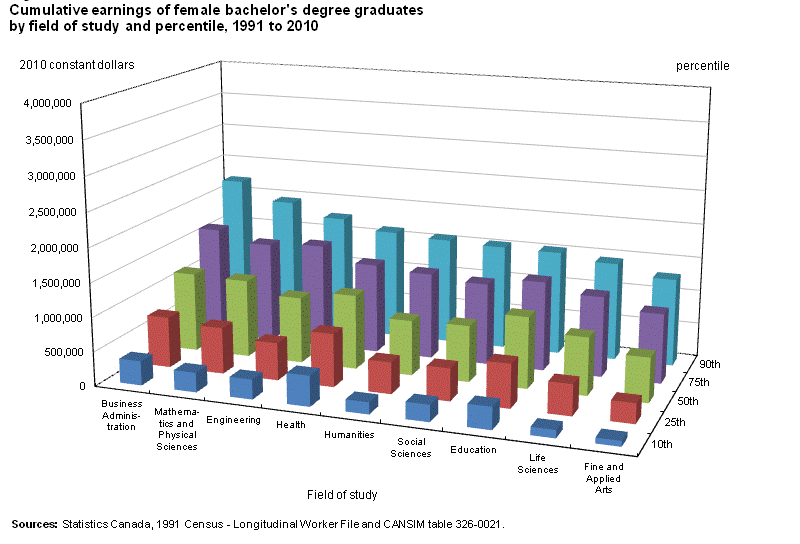
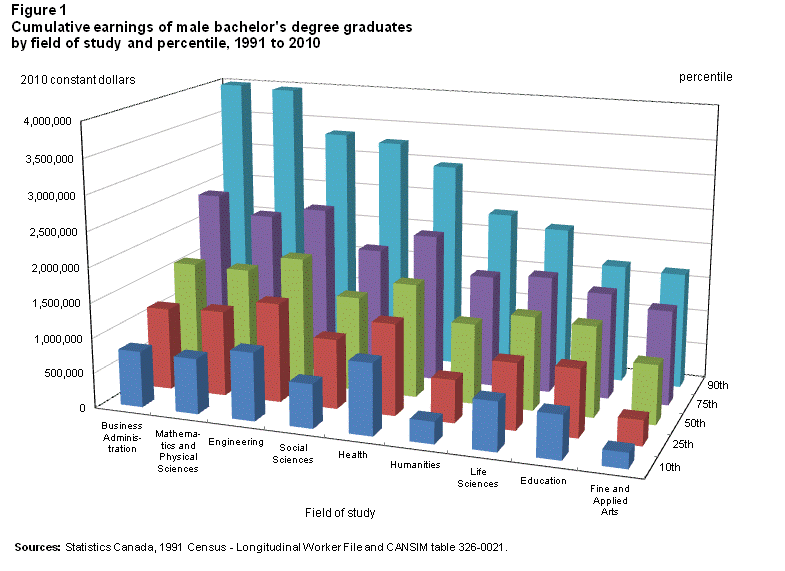
    Statistics Canada recently released a study that looked at earnings for college graduates  over a 20 year period. The study looked at the cumulative (total) earnings for both men and women, as well as earnings based on the degree they received from their college or university . Take a look at the charts below to see just how much money you can make in your career of choice over 20 years!

    earningsfemale


    earningsmale

  • Scholarships and Bursaries for Aboriginal Students

    Scholarships and Bursaries for Aboriginal Students

    Bursaries and Scholarships
    The Aboriginal Financial Officers Association of Canada is dedicated to helping Aboriginals reach the highest standard of excellence in finance and management. AFOA’s initiatives in the development of Awards and Scholarships are examples of that commitment.

    See link below for scholarships and bursaries:
    http://www.metisnation.org/programs/education–training/education/bursaries–scholarships

    Want even more options? Check out the scholarships and bursaries for Aboriginal students that we found:

    The Aboriginal Canada Portal
    Offers an online Aboriginal funding tool that offers a way to search for scholarships, bursaries, loans & grants according to your needs.

    Canada Post Aboriginal Education Incentive Award
    The Aboriginal Education Incentive Award is part of Canada Post’s nation-wide scholarship program and commitment to furthering individual potential. Each of Canada Post’s eight regions across the country will grant three awards annually: Two $1,000 scholarships for the return to and successful completion of one full year of high school and One $1,000 scholarship for the return to and successful completion of one full year of post-secondary education, including vocational or trade skills training.

    FAAY (Foundation for the Advancement of Aboriginal Youth)
    FAAY is a scholarship program operated by the Canadian Council for Aboriginal Business. CCAB is dedicated to developing the future generations of Aboriginal leaders. They have scholarships for high school or post-secondary students.

    AMMSA (Aboriginal Multi- Media Society)
    Large listing of scholarships and bursaries available to Aboriginal people (including youth) in a variety of educational programs. You can look up educational institutions and find the awards available to their Aboriginal students only.

    Royal Bank of Canada Aboriginal Scholarships 
    Royal Bank offers scholarships to all Aboriginal people and also has a summer placement program as an award to qualified applicants. Royal Bank has employment opportunities for Aboriginal students in grade 9-12 for summer employment.