Category: Fun

  • Co-Operative Education and Volunteering

    Co-Operative Education and Volunteering

    When we think of work we usually immediately think of compensation – which, in all fairness, is why we work. However, working for free or enrolling in what is called a co-operative education program can be quite beneficial for young individuals trying to get their foot in the door. It is usually offered to high school students and young adults working towards a high school diploma. Volunteering is also another way to get experience, so let’s take a deeper look into both of these options.

    Co-operative education is aimed at both high school students and young adults who have not yet completed the requirements for a high school diploma. The student normally chooses their place of employment and is scheduled to come to class a few times a week to log in what they did at their workplace and what they learned.

    Co-op placements, much like volunteering, gives hands on experience in the workplace. They do not differ much except that successful co-op students may be hired on by the employer upon successful completion of their assignment. In addition, students earn credits through the co-op program that go towards their high school diploma.

    Co-op is perfect for students who have not yet graduated; not only will they receive credits, but they may also be setting themselves up for future employment.

    Co-operative education is offered by all high schools and adult education centres in Ontario. Perquisites vary, but are not very strict. Check with your local high school or adult learning centre.

    Volunteering is ideal for high school students who are either looking to complete their 40 hours of community service (which is a mandatory requirement for high school graduates) or students who would like to see more of the workplace, gain first hand exposure at working life and determine which career would most suit them.

    In this day and age, networking is a must. By volunteering students can meet employers, build strong professional relationships with their colleagues and apply these skills to life after high school. Students can gain valuable workplace experience, use them as references and share their knowledge with classmates.

    With so many employment opportunities, students can limit their career choices and choose the appropriate courses that will guide them to their chosen field of study.

    Both volunteering and co-op serve as great chances to develop strong communication skills, familiarize yourself with the workplace and its people and get to know what career best suits you.

    By engaging in volunteering or co-op, students will carry life long references and lessons brought on by early workplace exposure. This will follow students to and from college or directly to the workplace.


  • The Human Cognition Project

    The Human Cognition Project

    Every day, you use your brain in many different ways. You use it to learn new material at school, to talk with your friends, and even to blink your eyes. Right now you’re using it to read and understand the words of this article. Scientists know that the brain controls the rest of the body, but there are still many mysteries about exactly how it works. How do people really think? Why do their brain functions change as they get older? Researchers working with the Human Cognition Project hope to find answers to questions of human thought.

    The word “cognition” usually refers to the process of thought, including how people get information and what they do with it. Cognition can be conscious, like when you talk with your friends and think about the words everyone is saying. It can also be unconscious, like when you quickly pull your hand away from a hot stove.

    People’s ability to think and process information changes throughout their lives. Young children have to learn the connection between touching hot stoves and burning their fingers, but most people can make connections like these without consciously thinking about them. They learn how to behave in different social situations and begin to develop their own ideas about the world and how it works.

    Cognition changes throughout people’s lives. Accidents, illnesses, stress, or getting older can often affect the brain. Everyone has occasional memory lapses and problems with understanding difficult ideas, but some people have more troubles than others. Some cognition problems are minor and cause few lasting troubles, such as when you forget to do your homework and have to hand it in late. Other problems can be much more serious, such as when people forget their own names and addresses. They could become lost or get into all kinds of other trouble.

    The purpose of the Human Cognition Project is to find out more about what happens when the brain is not working as well as it could. Seven projects are part of the research, covering topics like the connection between what people see and what they remember. Another topic is how this connection relates to witnesses of crimes. Helping people to remember events more accurately could be an important result of the work in this area.

    How people’s brains change as they age is another important part of the Human Cognition Project. When people get older, they often lose their memories or develop other problems with thinking clearly. These problems are often called dementia, and they are an important part of the Human Cognition Project. If scientists could understand exactly why the brain loses so many of its abilities as it ages, they might be able to find a cure for the mental troubles of old age.

    Will all of this study of cognition help people with problems like memory loss or other loss of brain function? It might not provide a cure, but it can at least provide a basis for future research into the human brain.

  • Projects Abroad: Offering Students Short-Term Volunteer Opportunities

    Projects Abroad: Offering Students Short-Term Volunteer Opportunities

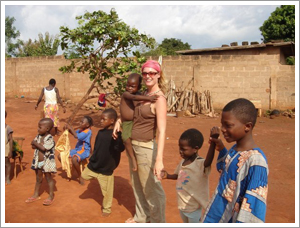
    Projects Abroad is a youth-oriented volunteer trip association that can help you plan a volunteer trip to help shape you career, your education and your life.

    The company offers the opportunity to do two weeks to several months of volunteer trips in many of the destinations where they operate. For volunteers who don’t have the time to commit to a month or more of volunteering abroad, but would still like to contribute to the community or their project of choice, then short-term two-week volunteer placements are a great option. These trips are not available in all situations; they have hand-picked only the countries and projects where it is suitable for both the host community and the volunteer to be there for such a short time. To see where these trips are available, check out their prices page – if there is a price listed, then it is possible to go for two weeks.

    Although you will not be able to make quite the impact that our longer-term volunteers make, in your two weeks you will be working intensely within the local community and building relationships. This will impart a level of cultural insight that is not possible for tourists to achieve.

    These trips operate in the same way that normal four-week or longer projects do, with some small adjustments to help you make the most of your two weeks abroad. For instance, they ask that you arrive on the weekend so that they can give you a formal induction to the area and culture before your first day of work on Monday.

    International Volunteer Work: What you get on 2 Week Trips

    Volunteers on 2 Week Trips are given the same benefits as those who join for longer periods of time. Start dates are flexible – just pick any weekend to arrive – and you’ll begin your project quickly after your arrival to maximize the amount of work you can do in country.

    In-country staff will be available to assist you throughout your two-weeks. You will be a part of an extensive volunteer network and meet people from all around the world. In some circumstances, you may be living with a local host family, which will provide you with the opportunity to get completely immersed in the local culture during your stay. On other projects, you may live with volunteers in a community-housing situation.

    Meaningful Volunteer Work in Two Weeks: 2 Week Trips and 2 Week High School Specials

    Short Term Volunteer Opportunities with Children: whether you’re taking time off from school, work, or just need a small career-break, there is always a way for you to squeeze a two week adventure into your schedule.

    For high school students (ages 16-19), we recommend the “2 Week Specials” program. These are group projects that have a high level of structure and central planning by local staff. You will be in a group of students your own age for the entire project. Local staff are always close at-hand. It’s a great way to travel and volunteer abroad for younger people who have never done this before. Staff members are with these groups.

    For ages 20+, we recommend joining projects for a month or longer. Most volunteers go for about two months. But if you can only squeeze in two weeks,  a “2 Week Trip” is worthwhile and productive as well.

    For more information about studying abroad, contact www.projects-abroad.ca

  • Volunteering Abroad – A “Travel Bug” Cure!

    Volunteering Abroad – A “Travel Bug” Cure!

    Imagine what it would be like to travel the world when you finish high school. Just think of walking along the Great Wall of China, seeing the ancient tombs and Pyramids of Egypt, or exploring the Coliseum in Rome. If you have the “travel bug” you might find the idea exciting. Unfortunately, travelling to see these places can also be very expensive and could cost much more than you can afford. However, you might still be able to see the places you want without using up all of your money. One of the best ways of doing this is through going abroad for short-term or long-term volunteer assignments.

    Depending on what you want from travel, a volunteer assignment could be an ideal way of seeing the world. Tourists tend to stay in hotels and to visit the standard tourist sites like historic buildings, museums and monuments. They frequently avoid eating much of the local food in case it makes them sick. Usually they have very little contact with the people of the country, other than tour guides or staff in hotels and restaurants. For some tourists, getting away is not much different from being at home.

    Volunteers, on the other hand, usually get to know about everyday life in the places they visit. They frequently work together with the local people on projects directly related to the people living in the region. They might help build schools, work with orphans, study the habits of animals, or even help dig up ancient monuments. They might teach English or help with the children at the local school. Special skills might be necessary for some assignments, but strength and the ability to work hard in the sun might be all that’s needed for others.

    Some volunteer assignments might last for a few weeks or be part of an ongoing service to the local people. Many volunteer organizations offer both short-term assignments that last a few weeks and long-term assignments that can last several months or even a few years. A short assignment might fit well during summer holidays, while others might need to wait until you can take a year off to go somewhere for a longer period of time. If you’re thinking of volunteering abroad, it’s a good idea to check with several different organizations to see which one is the best fit for you.

    Another question to consider is the cost. Most short-term overseas volunteer programs involve some payment to cover the costs of expenses such as housing and food. There are often additional costs such as airfare to and from the assignment. In exchange you’ll get far more help and support than you would ever get while travelling alone. The costs might even be lower than for other kinds of travel. If you like the idea of seeing the world but want the safety and comfort of having help from other people, volunteering abroad might be the right choice.

    Does volunteering abroad sound good to you? If so, it’s never too early to start finding out about the possibilities you can consider!

  • The Importance of Hobbies

    The Importance of Hobbies

    Between lectures, labs, essays and exams, the importance of constructive hobbies will quickly become evident within a post-secondary environment. Some turn to the arts, some to athletics, some look to develop skills that compliment their degrees and others choose hobbies that are as far from their individual programs as possible.

    Regardless of your hobby of choice, the need and importance of such activities will become clear. Soon you’ll be working hard at your degree, trying to balance your social life with work while trying to maintain some semblance of the evasive “you time”.

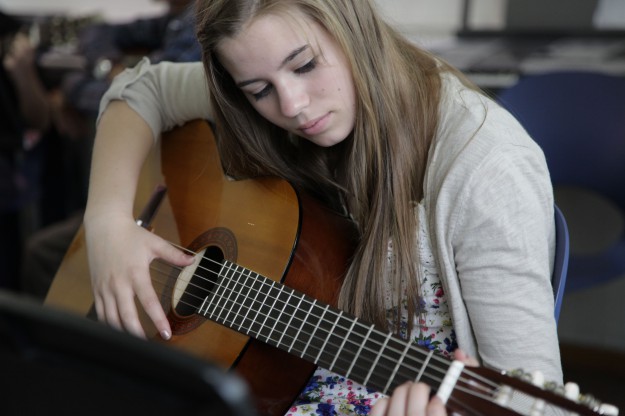
    Hobbies facilitate this. By dedicating yourself to a specific pastime you are making a promise to yourself to step back and breathe from the various pressures present in post-secondary education while, hopefully, allowing yourself to grow as an individual. Whether spending an hour on the treadmill, playing a video game, learning an instrument or sitting down to read a book, every hobby encourages the development of a new set of skills, allows you to meet a new network of individuals and, perhaps, allows a welcome escape from the stress of real life.

    A hobby is a good reflection of the ideals, characteristics and interests of an individual and, if you spend enough time on it, it will do so positively. Eventually you may be known as the guitarist of the group, the writer or maybe the athlete. Though such labels can be daunting, they can be positive as well. Soon people will be reaching out to you for music suggestions, writing tips or for advice on their new workout schedule.

    Such questions will only increase your standing within your community while allowing you to develop the skills and interests that will make you stand out as an individual. All the while giving you a welcome, constructive break from the strains of student life.

    The university atmosphere is also a perfect opportunity for the development of such hobbies. As with the academic quality unique to the post-secondary environment, you will find yourself surrounded by a new community of like-minded individuals, all of whom are eager and interested in developing their skills, meeting others with similar interests and sharing their expertise with one another.

    So go learn an instrument! Go join a sports team! Constructive pastimes are extremely beneficial to a healthy, well-rounded lifestyle and will allow you to grow as an individual, meet new people and develop new hidden talents.

  • Cardboard Bicycles: Would YOU Ride One?

    Cardboard Bicycles: Would YOU Ride One?

    Every morning, people around the world get up and take their usual transportation to work or school. But what is their usual transportation? In North America it might be the car, but it’s a different story in many other parts of the world. In most countries, the most common form of transportation is the bicycle. According to National Geographic, people around the planet own 800 million bicycles – which is twice as many as the number of cars. New technology in the bicycle world can affect the lives of millions of people worldwide, just as it did almost two hundred years ago.

    People have dreamed of riding on wheels for centuries. In the 1400’s, the inventor Leonardo da Vinci developed the idea of a machine like our modern bicycles but never made one. In 1840, an inventor from Scotland rode more than sixty kilometres on a two-wheeled machine operated by a foot-powered treadle. Twenty years later, a French inventor developed the idea to include cranks and rotating pedals, much like modern bicycles. In 1860, people first started to use the term “bicycle” for the new machine.

    Air-filled (pneumatic) tires were the next development in the bicycle’s story. Next, people developed different bicycles for all kinds of uses: sleek and lightweight racing bikes, heavy but sturdy all-terrain bikes and much more. The basic structure is the same, however: a metal frame with air-filled rubber tires which help to cushion the rider against bumps in the road. These bikes can be expensive to buy and they need frequent maintenance (especially for punctured tires), but who would think of making them any other way?

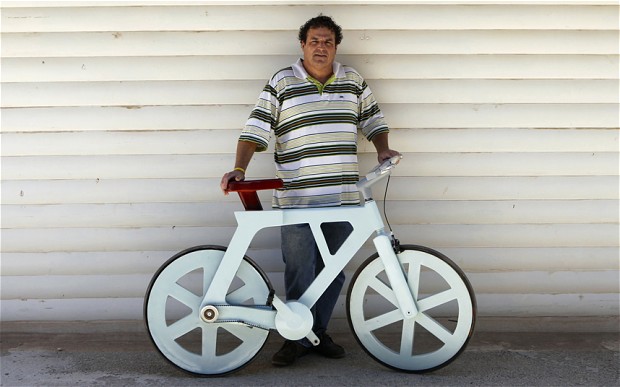
    An Israeli inventor named Izhar Gafni hopes to solve the some of the traditional bicycle’s problems with his new invention: cardboard bicycles with solid rubber tires. The tires, made from recycled rubber car tires, can’t get punctured because they have no air in them. Almost all of the rest of the bicycle is made from recycled cardboard, with a car’s timing belt instead of a chain. The outside of the bicycle is covered with a special coating to make it waterproof and fireproof and is then painted. Each bicycle weighs about nine kilograms instead of the usual fourteen kilograms for metal bicycles.

    The low-cost of the new bicycles could make a huge difference in places like Africa, where people might not be able to afford a traditional bike. Even if the bicycles last only a few years, they could give people the transportation they need to go to school, go to their jobs and maybe even get out of poverty. When these bicycles come into stores, they will likely cost about $20 instead of the hundreds or even thousands of dollars a metal bike can cost.

    If Izhar Gafni’s invention works, it could affect much more than just bicycles. Airplanes or cars made out of cardboard would be much lighter than metal ones and use less fuel, making travel cheaper. It could change the world’s transportation systems forever.

  • Online Learning: The Best Sites On The Web!

    Online Learning: The Best Sites On The Web!

    Finding information on any given subject is as easy as clicking a button on a search engine. Gone is the need for rows of encyclopedia’s, dictionaries and tangible books. Everything is available online at your discretion. Wading through the options, however, can take the shine off of the ease of accessibility. If you are looking for something specific, you still need to wade through your choices until you find a reliable source. This is not as easy as it sounds. Wikipedia, the wonderful, epic, online encyclopedia, is not considered a trustworthy website as it is user-generated. Literally any one can add and edit information at their discretion.

    Yet the World Wide Web is an amazing resource of quality material, knowledge from experts and an educational smorgasbord at your fingertips. It is argued that a quality education should not cost as much as some private universities are charging and that influential change makers are creating ways to offer learning opportunities through the internet that are solid and authentic. So how can you navigate your way through the dead ends, cobwebs and arm chair educators to find what you need? With a little research and a lot of time you can hunt out the best, but I have compiled a list of quality geography, history and science sites to get you on your way.

    Seterra is a geography program that offers a free download for a multiple level map game. Players choose their continent and go from there with either a wide focus, such as labeling the countries, or a more narrow one, such as finding the capital cities. The great thing about Seterra is the fun factor. It is easy to become addicted to improving your score and to forget that you are learning!
    www.seterra.net

    National Geographic is a trusted name and the organization has done a fabulous job of utilizing the internet to engage students of all ages with a variety of learning strategies that often come under the guise of games and videos.
    www.nationalgeographic.com
    http://kids.nationalgeographic.com/kids/

    The History Place is a gift to those who appreciate the past and love to dig deeper. It is a website filled with detailed information and pictures. The site has also won numerous awards.
    www.historyplace.com

    Ted Talks is an amazing website with hundreds of video presentations about ideas worth spreading by innovative change makers from around the world. You can find just about anything worth knowing about on this website.
    www.tedtalks.com

    Khan Academy is a free world class education that changed the way people learned online. It recently got a grant of money which has resulted in a lot more lessons and a lot more exposure.
    www.khanacademy.org

    BBC history section is an incredible source of material, both compelling and richly informative. Anyone who visits this website leaves with a better understanding of the world we live in.
    http://www.bbc.co.uk/history/0/

  • Travel by Backpack!

    Travel by Backpack!

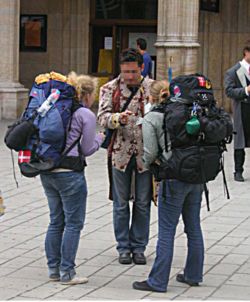
    A friend of mine was going on her first backpacking trip and needed some advice about what to bring. I looked in her backpack and the first thing I found were fake eyelashes. Those definitely wouldn’t be going! Then we looked through her ten-pound bathroom bag and I told her to make some decisions. Did she really need two types of shampoo or three half-bottles of sunscreen? Some things had to stay behind.

    Not everyone is as bad a packer as my friend, but it can be tough to know what to take on a backpacking trip. Taking too much will give you back problems, but leaving something out might get you stuck on the beach in hiking boots. Finding the right balance in your luggage is a matter of sticking to the necessities and knowing what you can find on your travels.

    Stick to the necessities.
    Good shoes are crucial. You’ll be traveling with lots of weight and you don’t want to get so sore you can’t walk by day three. A good pair of running shoes is usually your best bet. Hiking boots get really hot and they’re heavy to carry when you’re not wearing them. Also, most backpacking journeys have some resting time on the beach, so take some flip flops.

    Weather is unpredictable all over, so be sure to have warm and cool clothes. But don’t take much! Three or four t-shirts is enough. If you’re going somewhere hot, you won’t need more than one pair of pants along with your shorts. A sweatshirt or a light jacket is a necessity even in hot countries, and a bathing suit might prove useful even in cold places. Top it off with a few pairs of underwear and some socks, and you’re all set for clothes!

    Next, you need some bathroom supplies. Hostels might not have everything, so you should have the basics: toothpaste, a toothbrush, soap, shampoo and a towel. Sunscreen, bug spray and aloe for sunburns are good ideas, too.

    When in doubt, take less.
    Whether you’re in Brazil, Croatia or England, you can buy toothpaste or an extra pair of socks. Some people actually prefer to buy their clothes on the trip, since they can be much cheaper than they are at home. Also, never forget that where there are travelers, there are laundromats. If you only have four changes of clothes, that doesn’t mean you have to wear the same underwear for three weeks. There will be opportunities to wash them.

    Have money ready.
    You never want to carry around enough cash for your entire trip. You should have a debit card and ideally a credit card, too. These days, you can find ATM’s in pretty much any big city in the world. There are times when your debit card might not work or the bank listed in Lonely Planet isn’t there anymore. In those cases, American money never fails. Virtually anywhere you go in the world, people will take U.S. dollars.

    So keep things light, have some U.S. cash and a debit card and you’ll figure out the rest. If your clothes get a little muddy, that’s all part of the adventure.

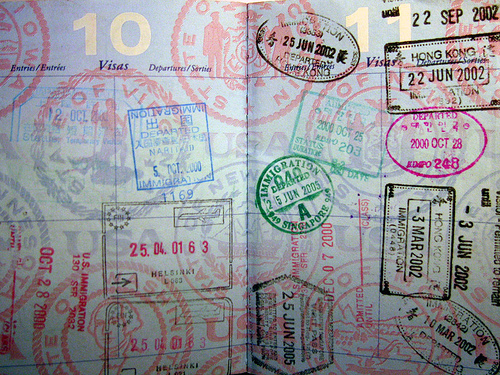
    And of course, don’t forget your passport!

  • Youth Mobility Visas

    Youth Mobility Visas

    Common belief is that your life follows a certain path – you graduate high school, go to university and then start your career. However, life isn’t always so black and white. Sometimes you don’t know what you want to do, you aren’t ready to decide or you just need a break from school or your hometown to see what life is like somewhere else. Living in a foreign country is a great way to give you an entirely new outlook on the world around you.

    The Canadian government has programs set up to allow young people to stay in a foreign country for a long period of time. These are called Youth Mobility Visas.

    What can I do with a Youth Mobility Visa?
    As a normal tourist without any special kind of visa, you cannot work or go to school in a foreign country and you can only stay for a short period of time. However, with a Youth Mobility Visa you can stay for a period of a year or two, depending on the country. While you’re there, you can work, study or simply travel around without worrying about your tourist visa expiring.

    Many people take the opportunity to immerse themselves in a new culture or to learn a foreign language. Travel can be a great experience, but actually living in a different country is something else altogether. It will forever change the way you view your own society, culture and place in the world.

    What kind of work can I get abroad?
    People living abroad often get jobs in the tourism industry as café employees or as language teachers. If you speak the local language of the place you’re visiting, then there’s nothing stopping you from getting the same jobs you could get at home.

    Will this help my career?
    Absolutely! Experience living in a foreign country is a great asset for a resume. It shows future employers that you are open-minded, willing to face a challenge and have exceptional communication skills. It also helps you stand out when someone is searching through a stack of resumes.

    How do I get a Youth Mobility Visa?
    It is easier than you might expect. You can get yourself set up in a foreign country before you even leave your home soil. You can obtain your Youth Mobility Visa at the embassy for the country you want to visit. The process is different for every country, but it involves a few basic steps such as signing up for international health insurance, getting a few pictures taken and filling out some forms. Some of the countries that have this program set up with Canada include Germany, Australia and the United Kingdom.

    It can be scary to move overseas and you will surely run into problems. You can get lost, you may miss certain foods from home and you may feel homesick at times. But it’s all worth it! It will teach you not only about a new culture, but will show you a different way to view your own.

  • Not prepared for the Interview ?

    Not prepared for the Interview ?

    We’ve all been there. Sitting in front of that ominous symbol of discontent and emotional reckoning in the form of a man(or woman) who staring at us from across that hardwood mahogany table assaults us with a barrage of nerve wrecking questions, determined to make us give in so that victory shall his alone

    Still haven’t guessed what I’m hinting at? Well, folks I’m talking about that very memorable first part time job interview and I’m about to give you a rundown of my very first job interview as an international student here in Canada.

    Okay so where I come from, people between the ages of 15-22 don’t normally work at all .So when I heard that there was an upcoming career fair in my neighbourhood I wasn’t the most excited of people. Nevertheless I still had to give it a shot since I needed a job.

    The day started out pretty well. I had spent the night before reading up internet articles on “how to appear confident during your first interview”” “ten interviewer-interview questions for first timers” and “JerseyShore-news, video and gossip”.Don‘t judge me.

    Anyways I had just about one more piece of information that I had to go through to fully prepare myself for the interview and that was the companies background information (anyone who’s applied for a job before know that the employer expects you to know the details about where you’re applying to).Unfortunately I was running out of time (I’m a slow eater), so I just printed a copy of that and tagged it into my jacket pocket. Next I opened the door to my house, only to be welcomed by the cold hard embrace of a snowstorm! Here’s the funny part…it was supposed to be a non white-early spring in Ottawa up until today that is. I sucked it up however and stepped into the great white terrain. On the bus I realized that somewhere along the way I had dropped that important piece of paper I was supposed to review. With that in mind I decided to go with what I already knew.

    I got to the building where I was supposed to have my interview. The guy at the front desk handed me an application form and asked me to fill it up. Halfway through that I put my hand in my pants pocket in order to retrieve my cell phone so I could get an ex-employers reference number from it. Only to realize that it wasn’t there. I had lost it somewhere along the way! At that point I was pretty much just about to give up and run off. I however once again managed to not do that (since the snowstorm outside wasn’t clearly going anywhere). After finishing the application made my way towards my interviewee who happened to be nice old lady, aged 40 or so by the looks of her. I was pretty sure I would do badly since my mind was still worrying about my lost phone was. But as I sat down and started talking I couldn’t help but not think about it. Suffice to say my interview went better than I expected apart from a couple of verbal bumps here and there. I also got a good “thumbs up” from the woman who judging from her constant bursts of laughter found me pretty entertaining.

    At the end of the day I managed to turn a potential bad day into a good one. And I think I have a solid of getting a call-back..now if only I had given them my home number instead