Category: Science

  • Messy Summer Science Experiments! (French version available)

    Messy Summer Science Experiments! (French version available)

    Ok, so school’s out, you’ve watched every episode of your favourite show on Netflix, and you’re trying to avoid doing chores. Or maybe you’re trying to entertain the kids you’re babysitting, a younger sibling or two, or just really, really feel like making a mess! Here are a few experiments that are fun, messy, and educational! No one can get angry about a mess when you’re learning. Right?

    *TIP: Do these outside.*

    • Giant bubbles: Everyone loves making bubbles, but giant ones are even better! This takes simple supplies you may already have around the house. You’ll need string, plastic straws, bubble solution, and a flat container like a cookie sheet. You’ll attach the string through the straws to form a big circle with “handles” (the straws). Then you can create large bubbles to delight kids of all ages. PBS.org has a great how-to with photos on their website.
    • Rainbow Bubble Snakes: Do you have a pile or a drawer full of socks missing a match? This activity will use those poor, lonely socks. You will need a water bottle, an orphaned sock, food colouring and dish soap. This website has detailed instructions with photos that show just how fun and messy things will get. See how long a bubble snake you can create. Can you create a rainbow? How many different colour combinations can you create?
    • Outrageous Ooze: One of my favourite messy experiments involves corn starch. You only need corn starch and water. You can add food colouring if you want more mess (who doesn’t?). The corn starch feels so silky smooth, and the properties it exhibits while you play in it are so soothing. When you manage to get the consistency right, it will look like a liquid in the container, but if you smack the surface of it hard with the palm of your hand, it feels solid! I did this one with 5-year-olds, and while they didn’t “get” the science behind it, they had a blast! You older kids will enjoy it as well, as you explore non-Newtonian fluids. This site shows you how to do it and explains the chemistry behind the ooze.
    • Ice cream in baggies: Now for an experiment, you can eat! Did you know you can make ice cream in a baggie with your own two hands? This website lists the recipe and the detailed instructions. But suffice it to say that this experiment is a delicious way to explore chemistry. I highly suggest this activity be done outside in case a baggie leaks, and bring your spoons. As an alternative, try doing more than a single serving in a coffee can, rolling it back and forth between you and a friend until the ice cream sets. Don’t forget your winter gloves, your hands will get very cold!  Have fun!
  • Water: Is the glass half empty or half full?

    We can’t live without water. We need it to stay hydrated and grow food. We use it to generate electricity. Water is in us and all around us. It makes up about 65 per cent of our bodies. Thanks to the hydrologic cycle, it circulates constantly, as liquid, gas, and solid, evaporating from oceans and fresh water, moving through air, raining onto Earth, flowing through plants and animals, into the ground, and back to the oceans through rivers, streams, and sewage outflows.

    Water covers 70 per cent of the Earth’s surface, but 97.5 per cent is saltwater. Of the 2.5 per cent that’s fresh, 68.7 per cent is locked in the ice and snow of the Arctic, Antarctic, and mountains, leaving about one per cent for our use. More than a billion people lack adequate access to clean water.

    Just as human activity is upsetting Earth’s carbon cycle, our actions are altering the water cycle. Water is our most precious resource, but we waste it, just as we waste other resources, including oil and gas. When we use so much that the system can’t renew itself, we create shortages and drought. When we pollute it, we make matters worse.

    More than a billion people in the world survive on just five litres a day, less than the amount of a typical North American toilet flush. The average Canadian uses 335 litres a day, more than double the average for similar industrialized countries. In fact, we use more in Canada than in any country except the U.S.

    As individuals, we can reduce consumption and find ways to use water more efficiently. We also have to look at industrial use. Energy generation, including what’s required to extract fuels, is straining water resources more every day. According to a report on the EcoWatch website, “fracking” is particularly worrisome. This process involves injecting massive amounts of water and chemicals into the ground at high pressure to fracture underground shale and release gas deposits.

    Each frack can use up to 30-million litres of water, and a well can be “fracked” as many as 18 times. According to EcoWatch, “The water, usually drawn from natural resources such as lakes and rivers, is unrecoverable once it’s blasted into the earth, and out of the water cycle for good.”

    With record high temperatures and widespread drought in the U.S., oil and gas drillers and the energy industry have to compete with farmers for scarce water. There, the fastest-growing use of fresh water is by coal, nuclear, and natural gas power plants, according to a report by the River Network. Our reliance on fossil fuels is also contributing to global warming, making water even more scarce, as glaciers melt, rivers dry up, and droughts become increasingly common.

    Beyond reducing individual use, one of our top priorities must be to move from fossil fuels to energy that has fewer detrimental effects on water supplies and fewer environmental impacts overall.

    We can also get creative. A study in the journal Science (referenced in the EcoWatch article), “Taking the ‘Waste’ Out of ‘Wastewater’ for Human Water Security and Ecosystem Sustainability”, concludes that we can employ substitution, regeneration, and reduction to conserve water.

    Substitution involves using low-quality water instead of high-quality for many activities, such as sprinkling a garden with collected rainwater rather than drinkable tap water. In Hong Kong, most residents use seawater for toilets. Regeneration means treating low-quality water to make it usable rather than flushing it away. Using a waste-stabilization pond, some households could transform sewage into water for irrigation. Wastewater can also be treated and recycled for large-scale uses. People can reduce usage in many ways, from installing low-flow plumbing to repairing leaks in infrastructure.

    We can also keep water clean and plentiful by protecting and preserving our valuable natural capital, often for less money! Instead of spending $8 billion for a water-treatment plant, New York City officials spent $1 billion to buy land and protect habitat that filters and stores water.

    In Canada, we often take water for granted. With increasing pressure on the availability and cleanliness of our water, we have to start paying closer attention to what we do with it.

  • Why We Should Protect the Environment (French version available)

    Why We Should Protect the Environment (French version available)

    Cleaning up a mess can be a dull job, but living with dirt and garbage is much worse than that. Have you ever smelled a piece of rotten fruit or a piece of meat that has gone bad? You can put rotten food in the garbage, but what if the whole world smelled like that? What if the water coming from the taps in your house made you sick with all kinds of diseases? Without clean water, good air, and healthy food, people easily get sick and die. That’s why caring for the environment is so important.

    For many years, people thought very little about the environment unless it affected them directly. Water shortages were important mainly for farmers and gardeners, and resources like trees or fuel were important for helping people make money. However, people’s ideas began to change when a writer named Rachel Carson published Silent Spring in 1962. The book showed how the pesticides designed to kill harmful insects were harming the environment and people. The author said that our food supply and the whole world were in danger because of these chemicals. Partly because of that book, the United Nations established Earth Day in 1970, and people have used that day and other campaigns to raise awareness of environmental issues ever since then.

    What do you know about the challenges that the environment is facing? One problem that you might have heard about is global warming, which refers to the rapid increase in the Earth’s temperature. Many scientists believe that most of this warming is the result of pollution from human activity, such as burning oil and gas for fuel. Other problems include polluted water and air, which can make people sick or even kill them, the overuse of resources that take many centuries to replace and the loss of the top layer of soil that makes farming possible. Another issue is the deaths or disappearance of the bees, which helps plants to grow through pollination.

    People have many different theories on issues such as climate change and pollution. Some people believe that human activity affects the environment, but others do not. However, taking care of your home planet is still a very good idea. How can you help? You can save fuel by walking or taking the bus to school or your friends’ houses instead of getting a ride in the car. You can use energy-efficient light bulbs and turn the lights off whenever you leave an empty room. You can turn your computer off at night and try to use as little water as possible in the shower. These changes will not save the environment alone, but if we all do them, they will make a huge difference.

    Caring for the environment is a huge task, far too big for one person or even one country to do. Some environmental issues are beyond anyone’s control, and others depend on people far away on other continents. However, if everyone on Earth took responsibility for only one small part of the problem, we could make a difference.

  • Green Christmas (French version available)

    Green Christmas (French version available)

    Most Canadians dream of a white Christmas. But perhaps we should be thinking of ways to add a little more green to this year’s holiday celebration.

    Every year, the cost of Christmas increases as the prices of products rise. The average Canadian household spends more and more on food, gifts and entertainment – often more than most families can realistically afford.

    But that’s just the financial cost. What about the environmental cost? We often forget about things like water usage, greenhouse gas pollution, solid waste and land disturbance. Think about how many tons of gift wrap are thrown away over the holidays, or how many hundreds of thousands of litres of water are used. What about the vast amount of electricity consumed to operate Christmas lights and TV, and DVD players so you can enjoy your favourite holiday classics?

    So what can we do to cut down on the environmental costs of Christmas? Here’s a list of nine ideas to try with your family this holiday season.

    1. Use environmentally friendly gift wrap. Foil and Metallic wrap are not recyclable, so remember to use paper that can be brought to your local blue bin after Christmas. To help cut down on financial costs, make your own wrapping paper using old newspaper, sale flyers, junk mail, calendars, maps or posters. You can also make your own cards, gift tags and bows using discarded ribbon.

    2. Turn off the lights when you are not home. When you are home and want to enjoy the tree lights, turn off all other lights, plug in the tree, light a few candles and enjoy a wonderful, cozy Christmas scene with reduced environmental impact. It’ll also help your family save a little on the power bill.

    3. Buy products that are environmentally-friendly alternatives to their counterparts. There are a number of cleaning products, candles, soaps, healthcare products and clothes that are considered green. When shopping, read the labels to see if what you are buying is environmentally safe.

    4. Buy second-hand gifts when possible and appropriate. Used video games and systems, books, CDs, DVD’s and board games offer a great way to reuse products. They also help make the holidays a little easier on the budget. Look for items that are in good condition and offer a guarantee.

    5. Use LED Christmas lights which will last longer than regular bulbs and use less energy.

    6. Recycle: It seems so obvious, but if each household recycled all of the boxes and packaging from gifts and food products, as well as plastic and glass bottles, milk jugs, etc., millions of extra tons of garbage could be eliminated from landfills.

    7. If you get a real Christmas tree, take it to a designated recycling area after the holidays so it can be turned into wood chips, which will be used in gardens and parks come spring.

    8. Use a reusable coffee mug when you go on Christmas shopping excursions, to local parades or friends’ holiday parties. This will cut down on the number of paper cups being thrown away. And if you make your favourite tea, coffee, hot chocolate or cider at home, it’ll also help you cut down on spending.

    9. Make your own gifts. Most people, parents and grandparents, especially enjoy receiving photo albums and calendars depicting fun family times. Perhaps you could make a Christmas scrapbook of Family Traditions that could be passed down to future generations. Make your own art if you enjoy drawing or painting, or if you enjoy sewing, make a gift using old fabric or clothing. Be creative. Making your own gifts is both environmentally friendly and financially feasible.

    Above all else, remember the true meaning of the holidays. Share in the joy of the season; rejoice in time spent with family and friends. Take a few minutes each day to be thankful for all you have and stop worrying about that which you don’t. ‘Tis the season to embrace the simple joys in life. And by making simple changes to the way you celebrate, you can help make this Christmas an especially green one.

  • STEM Career Profile: Astronomer

    STEM Career Profile: Astronomer

    The darkness of the night sky illuminates the countless stars, planets, and more that populate our universe. But have you wondered how we know all this? How can we measure their size, distance, movement, and history when we are so small and so far away? Part of the answer is the field of astronomy. Astronomers use the science and math that you study in class and point it skywards. They use equations, laws of physics, and more to figure out the universe.

    Becoming an astronomer is far from an overnight task. Earning a Ph.D. in astronomy can take five to seven years to complete. On top of that, graduates spend another two to three years researching under the guidance of more experienced astronomers. Those wanting to enter this field should work on their research skills and ability to analyze data. They should work hard at math and science in school, and also be able to work in a team.

    Astronomers do not typically work alone. They are usually working within a team composed of scientists in an office environment. They also use observatories to gaze up at the skies via telescopes. Most are hired to work at colleges and universities, where they conduct research in the field. Those are not the only places you will find astronomers, however. The federal government hires astronomers, too, and departments of private research and development may also rely on astronomers.

    In Canada, base salaries for astronomers range from $50,000 to $108,000, with the median salary at $90,000. With bonuses, profit sharing, and commission, total salaries can be up to $131,000.

    The field is filled with excitement and opportunity. The advent of new technologies and discoveries makes this a very exciting time to pursue the subject. Astronomers work hard to develop theories related to our universe and write proposals for research. It can be a thrilling challenge to find ways to test these ideas. This can be followed by extensive analysis and writing scientific papers that are read and reviewed by other experts. This ensures that ideas are accurate and can lead to groundbreaking discoveries. These newfound concepts and understandings of our universe have a profound impact on our lives.

    From planets to black holes, from in-depth mathematical formulas to childlike stargazing, astronomy is filled with wonder and awe. By putting greater effort into your math and science studies now, you can lay the foundation for your future career. The field pushes humanity’s knowledge beyond its supposed limits and helps us realize how vast existence really is. As an astronomer, you can be a part of that grand journey.

    Sources:

    Lindzon, Jared. I want to be an astronomy. What will my salary be? www.theglobeandmail.com/report-on-business/careers/career-advice/life-at-work/i-want-to-be-an-astronomer-what-will-my-salary-be/article24512769/

    National Careers Service. Astronomer. https://nationalcareersservice.direct.gov.uk/advice/planning/jobprofiles/Pages/astronomer.aspx

    PayScale.com Astronomer. https://www.payscale.com/research/CA/Job=Astronomer/Salary

    Study.com. Astronomer: Job Info & Career Requirements. http://study.com/articles/Astronomer_Job_Information_and_Requirements_for_Students_Considering_a_Career_in_Astronomy.html

  • Are you saying what you think you’re saying? The messages you may be giving off with body language.

    Are you saying what you think you’re saying? The messages you may be giving off with body language.

    You may think of yourself as a confident and friendly person, and anyone who really knows you might say the same. However, if you’re slouching, avoiding eye contact, and looking down, someone who is meeting you for the first time may perceive you in a completely different way. This is the power of body language. By now, you may be thinking, so what? Is body language really that important? The answer: absolutely! Most of what human communication is nonverbal. This means people who are meeting you for the first time, such as potential employers, may get an impression of you before you even have a chance to speak. The question is, is your body language giving off the impression you want? Let’s take a look at some of the key aspects of body language and talk about whether it may be time to adjust what your body is saying about you.

    Negative Body Language: Some signs you may not be putting your best foot forward.

    1. Avoiding eye contact.

    Making direct eye contact may feel a little scary, but it’s extremely important. A lack of eye contact gives off the impression of nervousness, a lack of confidence, and even dishonesty. Eye contact is especially important during an interview with potential employers, as confidence and honesty are some of the main points employers look for!

    1. Slouching.

    Poor posture results in poor body language! Slouching tells people you may be lacking in confidence, or are uninterested/bored in what’s going on. Although slouching is something many of us do without realizing it, it’s important to make a conscious effort to sit up straight, especially when trying to give off a good impression.

    1. Crossed arms.

    You may not be aware, but crossing your arms creates an invisible barrier between you and the person you’re speaking with. This sends the message that you are closed off or unwelcoming. Avoid this kind of negative body talk by keeping your hands to one side or on the other hand. This will indicate friendliness and openness.

    1.  Checking your phone or watch.

    While you may just be checking the time, you may be giving off the impression that you’re bored, anxious, or too busy thinking about what’s going on next to really focus on the person you’re speaking with. Break this habit by refraining from checking your watch during interviews, and make sure your cell phone is turned off and put away.

    For more signs of negative body language, check out this link.

    Positive Body Language: Ways you can give off the right impression for success.

    1. Give a firm (non-crushing) handshake.

    Handshakes are one of the most important forms of communication during a first impression. It sets the tone for the rest of the conversation and reveals confidence. Just be sure not to crush or pull someone’s hand, as this may reveal bullying or an attempt at intimidation.

    1. Slow down your speech.

    Interviews can be nerve-wracking, and your speech may speed up without you even knowing. Take a big, deep breath and slowly let it all out. Focus on slowing down your speech. It will calm you down and give off a stronger sense of confidence.

    1.  Give affirming movements.

    Nodding your head or smiling are affirming actions that show you’re engaged in the conversation, and you understand what is being said. Just be sure not to nod too frequently, as this may reveal a lack of confidence.

    1. Lean.

    This one may be unfamiliar to most people, but leaning in slightly when someone talks reveals active listening skills and shows engagement and interest in the conversation. On the flip side, leaning away gives off the opposite impression. Leaning away from the speaker reveals hostility or a lack of interest.

    For more positive body language tips, check out this link!

    The right body language may be hard at first, but just remember to be alert and aware of your actions. With practice, you’ll be revealing the incredible person you are the moment you walk in the room!

    Sources Used:

    https://blog.udemy.com

    http://study.com

  • What is Acid Rain?

    What is Acid Rain?

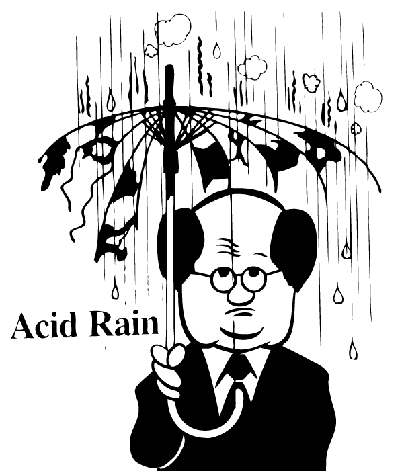
    The term acid rain refers to what scientists call acid deposition.  It is caused by airborne acidic pollutants and has highly destructive results.

    Scientists first discovered acid rain in 1852, when the English chemist Robert Agnus invented the term.  From then until now, acid rain has been an issue of intense debate among scientists and policy makers.

    Acid rain, one of the most important environmental problems of all, cannot be seen.  The invisible gases that cause acid rain usually come from automobiles or coal-burning power plants.

    Causes

    For many years, there was considerable debate and disagreement over what caused acid rain.  Recent scientific work, however, has helped to clarify this.

    The primary causes of acid rain are sulfur dioxide and nitrogen oxides.  These chemicals are released by certain industrial processes, and as a result, the more industrialized nations of Europe as well as the US suffer severely from acid rain.

    Most sulfur dioxide comes from power plants that use coal as their fuel.  These plants emit 100 million tons of sulfur dioxide, 70% of that in the world.

    Automobiles produce about half of the world’s nitrogen oxide.  As the number of automobiles in use increases, so does the amount of acid rain.  Power plants that burn fossil fuels also contribute significantly to nitrogen oxide eemissions

    Though human causes are primarily responsible for acid rain, natural causes exist as well.  Fires, volcanic eruptions, bacterial decomposition, and lightning also greatly increase the amount of nitrogen oxide on the planet.  However, even the gigantic explosion of Mt. Helens released only about what one coal power plant emits in a year.

    Once the tiny pollutant molecules have entered the atmosphere, they can travel for thousands of miles.  Eventually, the particles will combine with other compounds to produce new, often harmful, chemicals.

    Acid rain comes down to the earth in the form of rain, snow, hail, fog, frost, or dew.  Once it reaches the ground, the acidity in the substance can harm and even destroy both natural ecosystems and man-made products, such as car finishes.

    Acid rain moves easily, affecting locations far beyond those that let out the pollution.  As a result, this global pollution issue causes great debates between countries that fight over polluting each other’s environments.

    For years, science has studied the true causes of acid rain.  Some scientists concluded that human production was primarily responsible, while others cited natural causes as well.  Recently, more intensive research has been done so that countries have the information they need to prevent acid rain and its dangerous effects.

    The levels of acid rain vary from region to region.  In Third World nations without pollution restrictions, acid rain tends to be very high.  In Eastern Europe, China, and the Soviet Union, acid rain levels have also risen greatly.  However, because acid rain can move about so easily, the problem is definitely a global one.

    Effects

    Acid rain is having harmful effects both on people and on the natural ecosystems of the world.  Scientists today are convinced that acid rain is severe in many areas and that it is having an adverse effect on the environments of those locations.

    The problem of acid rain is rapidly spreading.  Because it is mainly caused by industrial processes, automobiles, and power plants, those countries that are developed have the most severe acid rain problems.   However, as the undeveloped nations begin to industrialize, acid rain will increase greatly.

    Determining just how much the planet is being hurt by acid rain is very difficult because the ecosystems that it affects are so diverse and complex.

    Many ecosystems are affected by acid rain.  Bodies of water, such as lakes and rivers, see many of their inhabitants die off due to rising acidity levels.

    Acidic water also ruins plant nutrients, hurting plants’ ability to survive and to give life to other organisms.

    Human-made products are also experiencing degradation from acid rain.  Cars can lose their finishes, and outdoor statues are beginning to rust.

    Acid rain’s effects are destructive and long-lasting.  Though scientists have studied lakes, streams, and many other natural ecosystems to prove its negative effects, acid rain continues to be produced and is increasing in many parts of the world.

  • Let’s Celebrate the Gifts of Winter (French version available)

    Let’s Celebrate the Gifts of Winter (French version available)

    We Canadians have a special relationship with snow and ice. We ski in it, skate on it, play in it, shovel it, drive through it, sometimes even bicycle through it and suffer through it for many months of the year — some of us more than others, depending on what part of the country we call home. But how much do we know about it?

    Do Inuit really have dozens of words for snow and ice? Are snowflakes always six-sided? Can two ever be alike? Why is snow white? Is it a mineral? What makes frozen water so important to us? Some of the answers are more complicated than you might imagine.

    Even though English-speaking skiers and snowboarders use multiple adjectives to more accurately describe different types of snow, such as powder, corn and champagne, some say the claim of numerous Inuit words for snow and ice is a myth. But is it?

    According to the Canadian Encyclopedia, “the few basic words used by the Inuit to refer to different types of snow or ice do not translate everything they can say about these two natural elements.” In Inuktitut, words consist of a foundational element that provides basic meaning, along with other elements “to clarify and/or modify the basic meaning. New words can therefore easily be created from another term.” For example, the word siku refers to ice in general, and sikuaq (“small ice”) refers to “the first layer of thin ice that forms on puddles in the fall.” Sikuliaq (“made ice”) refers to “the new ice appearing on the sea or on rock surfaces.” Some words also have broader meanings, depending on the context. The word maujaq, for example, means “soft ground”, but when referring to snow, it means “the snow in which one sinks.”

    So, “the total number of terms referring to the various aspects of snow and ice goes far beyond ten or a dozen,” allowing Inuit to “draw very subtle distinctions between a very high number of snow or ice types.”

    When it accumulates on the ground, snow appears white because, unlike many natural materials, it reflects most light rather than absorbing it, and visible light is white. And although snowflakes form in near-infinite patterns and shapes depending on temperature, wind, humidity and even pollution, each single crystal is always hexagonal, or six-sided, because of the complex way water molecules bond. When a frozen droplet or crystal falls from a cloud, it grows as it absorbs and freezes water from the air around it, forming a six-sided prism. The almost infinite variables mean it’s unlikely, although not impossible, for two snowflakes to be exactly alike.

    And yes, snow can be classified as a mineral. According to the U.S. National Snow and Ice Data Center, “A mineral is a naturally occurring homogeneous solid, inorganically formed, with a definite chemical composition and an ordered atomic arrangement.” Frozen water fits that description.

    Snow and ice are important to life on Earth for many reasons. Both are part of the cryosphere, which includes “portions of the earth where water is in solid form, including snow cover, floating ice, glaciers, ice caps, ice sheets, seasonally frozen ground and perennially frozen ground (permafrost),” according to the Snow and Ice Data Center. It covers 46 million square kilometres of the planet’s surface, mostly in the Northern Hemisphere, and helps regulate the planet’s surface temperature. Changes in the cryosphere can affect climate and water availability, with corresponding effects on everything from winter sports to agriculture.

    By reflecting 80 to 90 per cent of incoming sunlight back into the atmosphere, snow cover cools the Earth. Losing that reflective protection, as is happening in the Arctic, upsets the energy balance and accelerates global warming. Snow also insulates parts of the Earth’s surface, holding heat in and keeping moisture from evaporating. When soil freezes, it prevents greenhouse gases like carbon and methane from escaping into the atmosphere. When snow melts, it fills rivers and lakes.

    Instead of complaining about the dark and cold of winter, we should celebrate snow and ice. The cryosphere is an important piece of the intricate, interconnected puzzle that keeps us alive. So, build a snowperson, play some hockey, get out on the slopes and enjoy the gifts that winter brings.

  • Fall Foliage

    Fall Foliage

    There are many signs that fall has arrived; the start of school, colder-shorter days, and the first frost on car windshields. These signs are dreaded by students and adults alike, as they symbolize the coming of winter.

    But there’s one tell tale sign fall is here that never fails to amaze and delight. This phenomenon is called autumn leaf color, and takes place when the “normally green leaves of deciduous trees and shrubs” turn a variety of different colors from red to yellow during the autumn season.

    A lot of people think the changing of leaf colors is called fall foliage. However, this term refers to the viewing of the autumn leaf colors.
    There are a few regions of the world that are home to the most brightly colored autumn leaves: most of the Southern Mainland of Canada, most of the Eastern part of the United States, Scandinavia, Northern and Western Europe, the Caucasus region near the Black Sea, Russia and Eastern Asia (including Eastern China, Korea and Japan).

    The most famous area for viewing autumn leaves is Eastern Canada and New England. In these areas the best time to view the leaves is mid-October to early November.

    The Fundy Coastal Drive in New Brunswick is an especially brilliant spot. The drive follows the Bay of Fundy which is home to some of the highest tides in the world. The leaves change from “vivacious reds to deep pumpkin orange.” The tree varieties and colors found on the Fundy Coastal Drive are similar to New England, yet the New Brunswick area is far less crowded with tourists.

    Wherever they are viewed, one thing is for certain – taking time to enjoy fall foliage will definitely increase your enjoyment of the season.

    Quick Facts about Autumn Leaf Colors:
    – A green leaf is green because of the presence of a pigment known as chlorophyll.
    – In autumn, chlorophyll is replaced at a slower rate than it is being used. Therefore, the supply of chlorophyll is decreasing.
    – When the leaves change color, the other pigments (which have always been present) begin to show through. These are called carotenoids and give the leaves yellow, brown and orange colors.
    – Carotenoids are common in many things, such as carrots, corn, canaries, daffodils, egg yolks and bananas.
    – The hardwood species that change leaf colors are hickory, ash, maple, yellow poplar, aspen, birch, black cherry, sycamore, cotton wood, sassafras and alder.
    – The red and purple colors come from another pigment called anthocyanins. These are not present in the leaf all along, but instead become actually produced toward the end of summer.
    – These pigments are common in fruits such as cranberries, red apples, blue berries, cherries, strawberries and plums.
    – They are common in maple trees, oaks, sourwood, sweet gums, dogwoods and cherry trees.
    – When the two pigments, anthocyanins and carotenoids, are combined they create colors like deep orange, fiery red and bronze.

  • Fun science experiments to try at home

    Fun science experiments to try at home

    By Rabia Khan

    Life is full of surprises and science can be mind-boggling at times. We were also forced to try different things during the pandemic, watching YouTube videos and learning uncanny things. We know that science, physics, and chemistry are a part of society and our world, but don’t always know how.  If you’re ever bored at home, you don’t need to worry as there are a string of experiments that you can do in the confines of your humble space. Here is the list of fun stuff to try at home.

    Lemon juice can work wonders!

    Lemon juice can be used at home to make invisible ink. It can only be seen when it’s held up to a source of heat. For this experiment a piece of paper is needed, as well as a swab of cotton and a heat source like a lamp or electric stove, and lemon or milk.

    Squeeze lemon juice into a glass. It can be diluted with a little bit of water. A piece of cotton is dipped into the milk or lemon juice, then on a paper sheet start writing your message. Wait for it to dry before holding it over a heat source.  As the milk or lemon heats up, it will oxidize and turn brown. This experiment can also be done with vinegar, homer, or orange juice.

    Rainbow in a glass

    When sugar is added to a liquid, the solution tends to become dense. The more sugar, the denser the solution. Different solutions of different colours, densities, and colours will layer on top of each other. You just need to be careful about certain things like not spilling your rainbow on the carpet so it’s discoloured.

    Gooey slime all the way

    Slime is gooey and so calming to our souls. Borax added to a mixture of glue, water, and a dash of food colouring makes for a good slime. Polyvinyl acetate is present in glue. It is a liquid polymer. The molecules of polyvinyl acetate and Borax stick or attach creating a polymer slime.

    Pasta rocket

    A hybrid rocket engine can be made using yeast, hydrogen peroxide, a jar, fire, and uncooked pasta. Yeast and hydrogen peroxide when mixed together react to create pure oxygen gas. When the gas is funnelled through a piece of uncooked pasta and a bit of fire to push it through, we’ve got ourselves a pasta rocket!

    Homemade lava lamp

    The remedy for heartburn or upset stomach is Alka-Seltzer. It can also be used to create homemade lava lamps. When oil and water are mixed, the water sinks to the bottom because of the different densities and polarities of oil and water. An Alka-Seltzer tablet that has been put into water causes droplets of water to rise to the top where they go “Pop! Pop!” This releases air, and then they sink to the bottom.