Category: Trades

  • Killing the Stigma of the Trades

    Killing the Stigma of the Trades

    There is an unfortunate stigma surrounding the trades and it’s been present for several years now. Branded as a career path meant for those who failed to do well in school, many students diverge from trades jobs in order to find a career deemed more rewarding or “professional.”

    Despite the negativity surrounding the trades, there are plenty of available jobs that not only come with a hefty paycheque but also the reward of knowing that you’ve contributed to the construction of a building, ensured the quality and delivery of everyday products and building the furniture that shows up in everyone’s homes.

    The stigma associated with the trades lives around the rumour that people don’t need to be educated or experienced for these careers. But, the reality of the situation is that these jobs require degrees, hands-on experiences, and a dedication to the work in order to be successful. Being a hands-on worker doesn’t make a worker any less experienced than someone who entered into the workforce as a teacher or a business executive. A lot of trades positions require physical work, which may not speak to everyone but at the very least squashes the theory that trades workers don’t earn their money.

    Don’t believe me? In 2014, Trent Soholt, executive director of the NSCSC told Maclean that he was trying to encourage high school and elementary students to get more involved with the trades. He gave some background information into what you learn as an apprentice, “Students can test electrical circuits, lay a brick wall, cut and fit pipes, use a welding simulator, mix and finish concrete and draft plans in a trailer made to look like one that might be on a real job site.” He added that many students leave his institution with a feeling of surprise at the fact that so much education and dedication went into trades careers.

    For example, you need quite a bit of education. First, you’ll need to complete your GED. Once you earn your high school diploma, you need to complete an electrician apprenticeship, which takes about five years. 9,000 hours are required before you complete your apprenticeship and those involved are usually paid around $15-20/hr. You also need a good understanding of math and mechanical abilities. You also need to understand how to read technical drawings and building plans.

    Women are also becoming more involved in the trades thereby welcoming in more students and allowing for the stigma around trades to finally dispel given that it’s no longer a boy’s club. Due to a lack of skilled tradespeople (retirement and competition are usually to blame), the trades industry is going through a bit of a recession. But by opening the door for women to get involved, the industry is pitching trades as a first choice for young women.

    It doesn’t take much to look into the trades careers and understand just how much dedication and education is required in order to make a difference.


    Sources:

    Best Accredited Colleges. “Electrician: Education Requirements and Career Profile.” https://bestaccreditedcolleges.org/articles/electrician-educational-requirements-and-career-profile.html

    Bouw, Brenda. “I want to be an electrician. What will my salary be?” The Globe and Mail. http://www.theglobeandmail.com/report-on-business/careers/career-advice/life-at-work/i-want-to-be-an-electrician-what-will-my-salary-be/article20640423/

    Buck, Genna. “The tricks-and the stigma-of the trades.” Macleans. http://www.macleans.ca/education/college/jobs-report-the-tricks-of-the-trades/

    ECAO. “Become an Electrician.” https://ecao.org/electrician.asp

  • Not Your “Typical” Welder: Women In The Trades

    Not Your “Typical” Welder: Women In The Trades

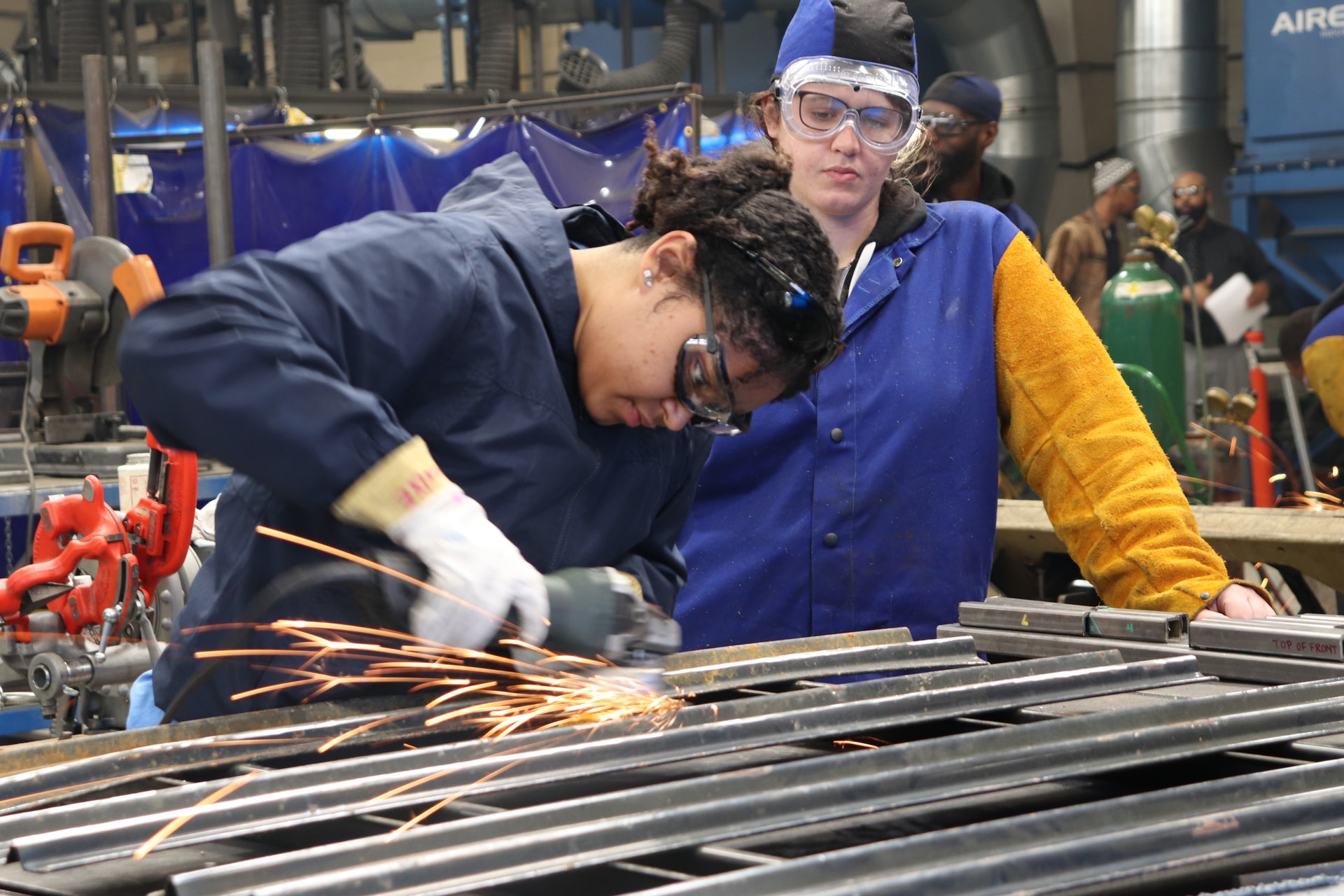
    Let’s be honest – how many of us girls grew up dreaming of being a mechanic or a welder? The answer is probably not many, and if you did you probably didn’t tell anybody because of the possibility of them thinking you were weird. When I was little I first wanted to be a marine biologist; I loved animals and wanted to work with them very badly. Then my life goal changed from a stunt car driver to a photographer to a mechanic and finally a welder.

    One of the things I was most excited about going to high school for was that I was now able to take the auto mechanics and construction classes. I took them all through high school and loved every minute of it. I learned, fixed and made things that a lot of people didn’t. How many of you can honestly say you are comfortable with changing a flat tire on your own? I can say with all honesty I am and that’s because of my awesome auto teacher. My technology teachers not only gave me the skills and knowledge about their trades but also the courage to love the trades; to not be scared of trying something totally out of my comfort zone and to not care about what people think.

    I got the smart remarks in class – “Girls can’t do that” and the classic, “Don’t break a nail!” Taking those courses gave me the courage to pick something not many girls pick for a college program – Welding Technician. I knew two things that I wanted for sure out of what I picked for a program. I wanted to be able to get a job and I wanted to make money. I know those are not the best reasons for someone to pick a program, but they were honest. I had originally wanted to be a mechanic because of how much I loved my auto class but I soon realized there were a lot of mechanics and not a lot of jobs. So I had cut up an exhaust pipe about two times in auto with an old oxy-acetylene torch and I knew welding was an in demand job, so I decided on being a welder. The only knowledge I had on welding was what I learned from those two experiences using the torch, so not a whole lot.

    I remember showing up for my first welding class and them telling me that I would need safety boots, safety glasses and a welding helmet for tomorrow. The first thing I thought to myself is, “What have I done?! I have gotten myself into something I can’t handle, I know nothing about welding! This is a horrible idea.” Then it got worse after I got all my equipment and they asked me to actually weld something. I don’t think I have ever sweated that much for a school assignment and it wasn’t from the heat of my torch. But with practice, some really great teachers and perseverance, I got the hang of it and now I am actually a very good welder. I am able to weld in shielded metal, arc welding in flat, horizontal and vertical positions. I can use gas metal arc and flux core arc welding machines and I am learning tungsten arc welding at the moment.

    For those of you out there wondering what kind of woman I am, I would say I am not your typical looking welder, but then again isn’t that what we are trying to change? The notion of what the “typical” welder looks like? So this is what the typical welder looks like – a petite 19-year-old woman, who stands at five feet and two inches, has a boyfriend and loves to go shopping just as much as anyone. The moral of the story is look at trades when you are deciding on college programs – any trade! Believe me, it’s a rewarding experience that is challenging.

    If I can do it, you can do it.

  • You Can Help Fight Climate Change with Green Jobs in the Trades

    You Can Help Fight Climate Change with Green Jobs in the Trades

    Climate change is one of the biggest challenges facing people in Canada and around the world.  Sustainability and renewable resources are key to overcoming this challenge.  The world is changing. As we move into the future, “green” jobs will be more essential and more plentiful than ever before, and many of these jobs will be in the trades.

    For young adults looking for a strong career with high potential for growth, which also aligns with their interests in the environment and helping to fight climate change, then these green trades jobs will be ideal.

    Solar Panel Technicians and Installers

    Solar power is one of the most promising solutions to the world’s growing energy needs. The use of solar panels is growing rapidly across the country, for both residential homes and larger power-generating solar farms.  These jobs include installing and maintaining solar panels for both residential and commercial use, repairing solar panels or related equipment, and working in power generating stations attached to solar farms.

    Wind Turbine Technicians and Installers

    Wind power is another sustainable energy source that holds a great deal of promise to support homes and cities with electricity.  With more wind turbine farms being built every year, the industry needs more tradespeople to install, maintain, and repair these giant wind turbines all across the country.

    Green HVAC Technicians

    As sustainable technologies advance, there are more options for green heating and cooling air circulation equipment for both homes and commercial buildings.  New technologies always need new tradespeople to install and maintain these systems. Green HVAC (Heating, Ventilation, and Air Conditioning) technicians are expected to be in high demand as residential, commercial, and industrial buildings need to install new green HVAC systems, or upgrade and retrofit their existing systems to be more energy efficient and climate friendly.

    Green Construction Workers and Managers

    New buildings are increasingly being designed for and built using sustainable construction materials, and this opens up opportunities for construction industry tradespeople who are knowledgeable about working with these materials.  Green construction workers and managers will be needed for renovations and new construction projects that focus on sustainability in materials and operation, and minimizing environmental impacts.

    Green Landscape Designer

    Residential yards as well as public parks and greenspaces all have a role to play in fighting climate change by being designed to be sustainable, particularly in regard to the management of water resources.  Green landscape design focuses on efficient water use, using regionally-appropriate plants, and managing or mitigating the use of chemical fertilizers and pest control solutions.

    Sustainable Forestry and Wetlands Restoration Technicians

    The natural forests and wetlands across the country serve important roles in managing climate change, with everything from carbon sequestration, cleaning the air, managing water resources and the impact of floodwater, as well as providing homes for natural fish and wildlife.  Expert tradespeople can help manage and maintain these natural areas to ensure they are preserved, cleaned, and operated in a sustainable manner.

    These are just a small handful of the new and future green trades careers that will help us fight climate change.


    Sources:

    Ladyzhets, Betsy. “30 green jobs that can help fight climate change.” Stacker. https://stacker.com/stories/3305/30-green-jobs-can-help-fight-climate-change.

    Olya, Gabrielle. “8 Jobs That Are Helping To Fight Climate Change.” Yahoo. https://ca.sports.yahoo.com/news/8-jobs-helping-fight-climate-110041050.html.

    On-Site. “Ontario is helping train skilled workers for green jobs in the building sector.” https://www.on-sitemag.com/1757/ontario-helping-skilled-workers-train-green-jobs/1003957146/.

    Trade Schools. “22 Environmental Sustainability Jobs That Truly Matter.” https://www.trade-schools.net/articles/environmental-sustaintainability-jobs.

  • Co-op Programs for the Trades in Ontario

    Co-op Programs for the Trades in Ontario

    Getting a job can be difficult, especially for people with little or no experience. When job seekers apply for work in the trades, it can help to show some skill in that field. One way of doing that is through a co-op program. With a co-op program in the trades, students can learn the basics of their field while practicing the technical skills they need for the future.

    A co-op program is one that includes both class sessions and practical work. Often, these programs alternate a semester of studies with a semester of work. That way, students have the chance to learn the skills they need for work while also gaining the theoretical background that can help them gain a better overall understanding of the field.

    Suppose that you want to become a plumber or an electrician. You could learn the techniques from a book or a video on the Internet. However, being able to do the work on the job is different. In many cases, people must work quickly to get the job done on time, and they need to know as much as possible. If you studied in a co-op program, you would be able to learn both the theory and practice of your profession.

    Like other parts of Canada, Ontario has various opportunities for co-op programs in the trades. The Co-op Diploma Apprenticeship Program, or CODA, is one example. This program is designed to match young people with employers who can provide apprenticeship opportunities. At the same time, participants can gain an associated college diploma. Earning this diploma can give students better career opportunities and the background necessary for learning the procedures for the job.

    A second co-op opportunity is the Ontario Youth Apprenticeship Program. This program is for students in Grades 11 or 12 who want to enter the trades. Through this program, students can begin their apprenticeships while they are still finishing high school. That way, they will already be well on their way to being able to work in a trade much sooner than might otherwise be possible.

    For many people, having an early start on a career can be beneficial. With extra time to get established, apprentices can take longer to finish their program if they wish, or they can start to build up experience in their field. Sometimes, students might even discover that they are not suited to the trade that they have chosen. In that case, beginning a co-op program early can help. Most trade training is in one of four categories: construction, industrial, motive power, and service.

    Many high schools and colleges have their own co-op programs. Before deciding on a program, it is important for you to ensure that all the necessary training is available in the course of study and work that you intend to pursue. For example, if you want to learn a particular type of electrical work, you should ensure that it is part of the course work and practical experience in the program.

    Before you begin a co-op program, you should consider how well it suits your needs. If you need more theoretical background than it offers, you might want to choose a different program or take some extra courses. The same is true if the program offers too little practical experience or the wrong type of work for what you need.

    Each person has different ideas of what to get out of a co-op program. However, in general these programs offer a good chance to get a solid background of both theoretical learning and practical experience. If this idea appeals to you, a co-op program in the trades might be your best choice for starting your career.


    Bibliography:

    Employment Ontario. “Co-op Diploma Apprenticeship Program (CODA).”  http://www.tcu.gov.on.ca/eng/eopg/programs/coda.html.

    Madawaska Valley High School. “Co-op and Ontario Youth Apprenticeship Program.” https://mvd.rcdsb.on.ca/en/programsservices/co-op-and-ontario-youth-apprenticeship-program.asp.

    Ontario.ca. “Skilled Trades in Ontario Schools.” https://www.ontario.ca/page/skilled-trades-ontario-schools.

    Ontario Colleges. “Skilled Trades Programs and Careers in Trades.” https://www.ontariocolleges.ca/en/apply/skilled-trades

    Study in Canada. “An Introduction to Co-op Education.” https://www.studyincanada.com/News/11/1510/Redirect.

  • Career Profile: General Machinist

    Career Profile: General Machinist

    In your home and school, and in almost every building you enter, you can find metal. It might be on doorknobs or window frames, and even on furniture, railings, and more. A general machinist is an important role of making these parts. If you enjoy working with your hands and helping with important aspects of construction, the job of general machinist might be a good choice.

    General machinists work with machines to cut and shape metal. Normally, getting into this field requires a minimum of a high school education or the equivalent. Most people also go through an apprenticeship program that includes both in-school and on-the-job training and work experience. Usually, this apprenticeship takes about four years to complete. With the right training and experience, people can be well prepared for work in this trade.

    In many parts of the country, general machinists are part of the Red Seal program. This certification is a program to ensure that standards are similar across Canada. A general machinist in British Columbia, for example, would have basically the same training and skills as one working in Ontario, Nova Scotia, or Manitoba. That way, it is easier for people in this trade to move from one part of the country to another.

    Salaries for general machinists generally begin at $16 per hour or $34,000 per year and can rise to $35 per hour or $76,000 per year with experience. Working with loud and potentially dangerous machines can be strenuous and risky. Accidents are common, even for the most careful workers. As people age, they may be less able to manage the dangers, and they might decide to leave the trade when it becomes too difficult.

    Certain characteristics help to make this trade easier. Attention to detail is important for doing the job well and avoiding mistakes. Standing at the machines for hours requires stamina. Also, carrying metal parts back and forth is easier with a degree of physical strength. Good vision with or without glasses is essential, and a good manual dexterity is also important. Clumsiness is a risk in this trade as it can potentially cause accidents.

    Usually, general machinists work in manufacturing plants, where they might need to be able to repair machines as well as work with the cutting and shaping. In many cases, the labour is in large factories where general machinists are part of a larger process. Sometimes, however, people in this trade can work in smaller companies where they may spend much of their time alone.

    Career prospects for general machinists vary, depending on the state of the economy and where the tradespeople live. Current job opportunities are only moderate, but retirement of older workers in the coming years could help open up jobs for new ones. Cities and large towns are most likely to have jobs available, but even a small town could have some opportunities.

    Working as a general machinist is not always an easy job, but it can be a good choice for people who enjoy using their hands and helping with building construction. It might be right for you.


    Bibliography:

    Glass Door. “Machinist Job Description.” https://www.glassdoor.ca/Job-Descriptions/Machinist.htm.

    Job Bank. “General Machinist in Canada.” https://www.jobbank.gc.ca/marketreport/outlook-occupation/16845/ca.

    Ontario.ca. “General Machinist.” https://www.ontario.ca/page/general-machinist.

    Payscale Canada. “Machinist Hourly Pay in Canada.” https://www.payscale.com/research/CA/Job=Machinist/Hourly_Rate.

  • Career Profile: Foresters

    Career Profile: Foresters

    Hiking in a forest can be fun, but not if a fire is burning or a disease has killed many of the trees. Forests are important for Canada, not just for recreation, but also for producing the wood that we need for furniture, houses, and many products that we use regularly. Forests are also important for the environment, helping to regulate the climate and produce the oxygen we need to breathe. The job of forester is important for many reasons. If you choose this career, you will have an important role in your community and all of Canada.

    Foresters are like professional caretakers of a forest. Especially in the first few years, much of the job is outdoors. It can involve taking samples of bark or of the leaves of plants, checking for insect activity and looking for evidence of animals, and then taking the information back for analysis. During the seasons when forest fires are common, it might involve setting up controlled burns in certain areas to keep the fire from spreading farther.

    Once foresters have collected the information, they often go back to a lab to analyze what they have found. The outdoor work can be physically difficult as people need to walk and hike in all kinds of weather, and some people might prefer the research aspect of the role. In large organizations, foresters can divide the work so that the younger and healthier people do much of the outdoor labour. However, all foresters should be prepared to be outside for at least some of the time.

    Some of a forester’s tasks are uncomplicated, and people in this field can occasionally start out with a high school education with some courses in subjects like biology and chemistry. Usually, however, people need to have at least a bachelor’s degree in science or a related field with courses in forestry. Alberta, British Columbia, New Brunswick, Ontario, and Quebec all have universities with this specialty, including six in BC: University of British Columbia, Royal Roads University, Simon Fraser University, Thompson River University, University of Northern British Columbia, and Vancouver Island University. Some colleges also have programs in the technical aspects of forestry, and some people take both types of courses.

    The ability to take and analyze information is important in this job. After a forest fire or disease has gone through an area, or loggers have cut down some trees, foresters need to decide what types of trees would work best in the area. They need to know about soil and how different plants grow. For the best results, they also need to study lakes, streams, rainfall patterns, animal activity, and more. Research and constant learning are important in this job.

    Often, foresters’ work is related to universities or governments, but they might sometimes work for private companies or even do contract work for local groups. Currently, job prospects are quite good, especially for people who are willing to move north or to other areas where the forests are. Annual salaries start at about $42,000 and can rise to $94,000 or more with experience. If you would like to help preserve an important Canadian resource, this could be the job for you.


    Bibliography:

    AG Careers. “Forester.” https://www.agcareers.com/career-profiles/forester.cfm.

    Bouw, Brenda. “I want to be a forester. What will my salary be?” https://www.theglobeandmail.com/report-on-business/careers/career-advice/i-want-to-be-a-forester-what-will-my-salary-be/article17117602.

    Canadian Forests. “Universities & Colleges.” https://www.canadian-forests.com/universities-colleges.html.

    Career Planner. “Forester.” https://job-descriptions.careerplanner.com/Foresters.cfm.

    PayScale Canada. “Average Forester Salary in Canada.” https://www.payscale.com/research/CA/Job=Forester/Salary.

  • Career Profile: Automotive Painter

    Career Profile: Automotive Painter

    If you look out on an average street, you can see cars and trucks in all different colours, from red or blue to black, white, or grey. Some even have several different colours. Automotive painters work with all kinds of vehicles to apply colours to the surfaces, both to make them look better and to protect them. If that sounds interesting, then the job of automotive painter might be right for you.

    When vehicles come out of factories, they already have paint on their surfaces. The paint helps them look nice, but it also protects the metal against the water from rain or snow and against the salt and other materials that help to melt the ice on streets in winter. Often, however, the paint can be scraped off in accidents or peel off as the vehicle ages. Automotive painters can work in factories to apply the initial coats of paint or in autobody shops, renewing or replacing the paint where it is needed.

    Training for automotive painters usually requires both education and experience. Training programs are available at many trade colleges, and apprenticeships are available through auto dealerships, factories, or many other places that deal with vehicle manufacturing and repair. The training courses might be offered as a block of full-time studies, a longer period of part-time classes, or as a weekly class. Normally, students can complete these classes in a year or less. In many jobs, having Red Seal certification is necessary.

    Practical experience is essential for automotive painters. Apprenticeships teach students how to apply the primer and paint, how to deal with small scratches and large scrapes, and much more. Being able to match paint to the colours that are already on the vehicle is important, although labels and codes on the containers can help in this regard.

    Automotive painters should also have a certain amount of physical strength and endurance to be able to handle heavy equipment for long periods of time. Being able to do very delicate work while covering small scratches or nicks in the paint is also important. Allergies can be problems for those in this field, and paint fumes can cause health problems for many people.

    Being in factories with large machines and heavy equipment all day can be dangerous, as well as quite dusty and dirty, and the painting job itself can involve hazards to the fingers and hands. Nevertheless, people can generally stay in this job fairly late in life, as long as they can still stand for long periods of time and manage the equipment.

    Wages in this job generally start at over $17 per hour and can rise to more than $30 per hour, depending on where people work. Many people work full time in automotive painting, but the hours can decrease, or jobs can disappear entirely in an economic downturn.

    Since automotive painting depends largely on people’s ability to buy new vehicles or to drive the ones they have, job availability depends heavily on the economy. Large cities and towns have the most opportunities but also the most competition. If this job sounds interesting, why not start looking into it?


    Bibliography:

    Careers.org. “Career Occupational Profile for: Automotive Painter.” www.careers.org/occupations/42424/automotive-painter

    College of Trades. “Automotive Painter.” https://www.collegeoftrades.ca/wp-content/uploads/Automotive-Painter.pdf.

    Neuvoo.ca. “Automotive Painter.” https://neuvoo.ca/view/?jpos=&jp=1&l=&id=da6310fe8226&lang=en&newjob=1&ss=1&context=serp&testid=talentChamp&nb=true&reqid=578c62efb803daa12694aeeccc6b4988&splitab=1&action=emailAlert.

    Payscale.com. “Automotive Painter: Hourly Rate.” https://www.payscale.com/research/CA/Job=Painter_Automotive/Hourly_Rate.

  • Career Profile: Gem Setter/Goldsmith

    Career Profile: Gem Setter/Goldsmith

    Every morning, people put on rings, bracelets, and more. Before they can do that, however, someone has to design and make the items. Gem setters and goldsmiths work with a variety of materials to make the jewellery that people wear each day. If you are creative and like to work with your hands, you should consider this career option. Working in this field can be a rewarding and interesting choice.

    Normally, goldsmiths and gem setters work at jewellery stores or repair shops, although it is possible to do some of the work from home with the right equipment. Many people learn the techniques on the job from other workers in the trade. Apprenticeships can be a good way of learning what to do in this field.

    For people who prefer to learn in a classroom, courses in this field are available at many career colleges and even some universities. Courses covering basic techniques are available in many schools, but students might need to go to a university to study advanced techniques like hydraulic die forming and granulation. Students can also learn the differences between the hardness of diamonds, for example, and the relative softness of emeralds or other gems. In some jobs, official qualifications might be necessary.

    Depending on their level of experience and skills, goldsmiths and gem setters can earn between about $15 and $29 per hour. Generally, people who work with diamonds earn more than others. Having good vision, with or without glasses, and steady hands is essential for this job. Often, people in this field work with tiny jewels and need good vision for such detailed work. As people age, their vision becomes worse and their hands might begin to shake. When the work becomes too difficult, people might need to retire or change jobs.

    Sometimes when customers buy jewellery, they might want it as a gift for a friend or relative. For that, they might want an engraving of the person’s name on it. When goldsmiths know how to do special tasks like engraving, they will have more possibilities for work. Although it is good to have a wide range of knowledge for different customer requests, it is often good to have a specialty, as well. For example, a gem setter could specialize in a certain design or a goldsmith could work mainly with wedding rings.

    Often, people in this field work fairly regular hours, but they might need to work on weekends or holidays in some cases. The work is not very physically strenuous. Still, working with tiny gemstones and small earrings or necklaces can be tiring on the eyes and the back.

    Like many other fields, goldsmith and gem setting work depends on the economy. When other people have good jobs and can afford to pay for jewellery, they will buy much more than when the economy is struggling.

    Some work will always be available, especially in large cities, but people in this trade should have other options in mind, just in case the work declines. For people who enjoy working with their hands and taking care of tiny details, becoming a goldsmith or gem setter is a good choice.


    Bibliography:

    Goldsmith Centre. “Setter.” https://goldsmiths-centre.org/industry-profiles/profiles-setter.

    The Goldsmiths. “Careers.” https://www.thegoldsmiths.ca/careers.

    Ontario Colleges. “Goldsmithing/Silversmithing.” https://www.ontariocolleges.ca/en/programs/arts-and-culture/goldsmithing-silversmithing.

    Payscale Canada. “Average Goldsmith Hourly Rate Canada.” https://www.payscale.com/research/CA/Job=Goldsmith/Hourly_Rate.

  • Taking the Trades Online: How to Learn Trades Skills without Leaving Your Homes

    Taking the Trades Online: How to Learn Trades Skills without Leaving Your Homes

    At the onset of the pandemic, among the sectors that were drastically affected was the educational sector, as the closure of colleges and universities across Canada was high in priority in the federal government’s to-do list to protect students from the onslaught of the virus. As a result, post-secondary students where thrust into a digital academic environment as their courses moved online. Some students were not as lucky and had their courses postponed altogether.

    Back in April until May, Statistics Canada reported the results of crowdsourcing data collection completed by over 100,000 post-secondary students during this period, indicating more than one-quarter (26%) of respondents had some of their courses postponed or cancelled as a result of the pandemic. The academic disruption had various effects over different fields of study, but trades was largely affected (53%) because of the requirements of job placements or course work such as labs, applied learning, and hands-on instruction that cannot be transferred onto a digital platform.

    Fast-forward to nine months later, and things seem to be heading in the right direction for the students who are interested in continuing their studies in trades. More and more institutions recognize the need and have embraced online learning platforms to ensure that education continues.

    Automotive Training Centre
    Available in Surrey, BC and Toronto, ON

    If you’re a car enthusiast, this option is definitely worth looking into. Automotive Training Centres or ATC have two campuses throughout Canada, one in Surrey, BC and the other in Toronto, ON. However, they now provide online learning, so whether it’s repair, dispatch, or running an auto shop that piques your interest, this one’s for you. Of course, ATC still provides the option of learning in-class if you’re looking more into mechanical or auto-body repair. They have repair facilities available for you to acquire hands-on experience.

    International Career School (Canada)

    International Career School or ICS provides over 55 online training programs, the majority of which are focused on the trades. They have affordable learning programs and ensure that the content is updated regularly to provide a seamless educational experience for students. Among the trades programs they offer are animal care (Pet Grooming), automotive (Automotive Mechanics, Diesel Mechanics, Motorcycle Repair, Small Engine Repair), culinary (Gourmet Cooking), Design (Drafting with AutoCAD, Dressmaking & Design, Floral Design, Interior Decorating, Jewelry Design & Repair), Aircraft Mechanics, Appliance Repair, Electronics, and others.

    Full Sail University

    Full Sail University is another school that offers a wide variety of programs, including ones that focus on trades. They offer both online and in-campus options for you to hone your trades skills, including 3D Arts and Audio Arts. Full Sail University is committed to student-centered education through its online programs by organizing online lectures with exclusive industry veterans and providing access to a technical support team.

    CDI College

    CDI College has campuses throughout Canada but offers online learning as well. In its more than 50 years of providing quality education, CDI College prides itself in changing people’s lives for the better. Among the trades programs offered are Veterinary Health Care Assistant and Computer-Aided Design and Drafting Specialist.

    As schools increasingly realize the need for online education, more and more trades courses will become available. If you are interested in a career in the trades, do not let the pandemic stop you. Take a closer look at the courses listed above as well as others.


    SOURCES

    https://www150.statcan.gc.ca/n1/pub/45-28-0001/2020001/article/00015-eng.htm

    https://www.trade-schools.net/ca/automotive-training-centres/

    https://www.autotrainingcentre.com/

    https://www.trade-schools.net/ca/ics-canada/

    https://www.icslearn.ca/

    https://www.trade-schools.net/full-sail-university/

    https://www.fullsail.edu/

  • Career Profile: Landscaper or Groundskeeper

    Career Profile: Landscaper or Groundskeeper

    Plants can make a place look beautiful, besides helping to improve air quality and many other benefits. Landscapers and groundskeepers help to grow plants around houses, office buildings, and more, contributing to a more pleasant and healthier environment. If you want to work in this career, you will have an important part in building up neighbourhoods and making them better.

    Landscaping and groundskeeping are two parts of the same basic job. In general, landscapers plan gardens and yards while groundskeepers take care of the plants after they are already growing, but the two aspects are often part of the same job. However, landscaping usually involves working at a variety of locations, while groundskeeping is generally confined to one or two workplaces.

    When people build a new house or other building, they generally want to have grass and other plants around it. Landscapers plan where to put the grass, trees, and flower beds. They might plan which flowers to put in, but they might decide to let others have that choice. The job of choosing where to put plants and grass might seem simple, but it can be quite difficult.

    For example, some plants do well in the sunlight, while others do better in the shade. The south side of a building might be too hot for some plants, while the north side could be too cool and dark for others. Grass does better in some soil than in others, and landscapers should know which type is best, or at least be able to find out. Research can be an important part of the job, as landscapers find information on the particular area where they work. Groundskeepers work less at the planning stage, but they also need to know about the needs of different plants.

    Some people in this career choose to learn what they need to know through a degree in an area like environmental sciences at a university. Usually, this takes at least three or four years to finish. Other people go through an apprenticeship process. The length of an apprenticeship can vary, but often it involves four twelve-month periods of classroom training and on-the-job learning with a certificate exam at the end. In most parts of Canada, certification is optional.

    Generally, landscapers and groundskeepers work forty hours a week, although they may sometimes work longer to finish a project. The work tends to be seasonal, although planning work can take place throughout the year. Hourly wages start at just over $13 per hour and can rise to just over $20 per hour. The work involves being outside, but much of the practical work might be impossible in bad weather.

    People in this field can get jobs almost anywhere, but working for construction companies is common, since new homes or office buildings need work on the land surrounding them. Work is more likely to be available in big cities than in the countryside, but people can find jobs almost anywhere. If you like working with plants in the outdoors, this might be the right career for you.

    Bibliography:

    Careers in Construction. “Career: Landscaper.” https://www.careersinconstruction.ca/en/career/landscaper.

    Canadian Nursery Landscape Association. “Clean Plants Certification.” https://cnla.ca/learn/clean-plants-certification.

    Environmental Science.org. “What Does a Landscaper Do?” https://www.environmentalscience.org/career/landscaper.

    Payscale Canada. “Average Landscaping or Groundskeeping Worker Hourly Pay in Canada.” https://www.payscale.com/research/CA/Job=Landscaping_or_Groundskeeping_Worker/Hourly_Rate.