Tag: tuition

  • Aboriginal Students: Scholarships and Bursaries

    Aboriginal Students: Scholarships and Bursaries

    Bursaries and Scholarships
    The Aboriginal Financial Officers Association of Canada is dedicated to helping Aboriginals reach the highest standard of excellence in finance and management. AFOA’s initiatives in the development of Awards and Scholarships are examples of that commitment.

    See link below for scholarships and bursaries.
    http://www.metisnation.org/programs/education–training/education/bursaries–scholarships

  • Grants and Financial Support for the Trades

    Grants and Financial Support for the Trades

    There are several grants and other supports available from the federal government, although additional ones provided by the province/territory vary from one jurisdiction to the next. Federal supports are available to apprentices, journeypersons and employers.

    The Apprenticeship Incentive Grant is a taxable grant of $1,000 per year or level, up to a maximum amount of $2,000 per apprentice. It is available to registered apprentices once they have successfully completed their first and second year/level (or equivalent) of an apprenticeship program in one of the Red Seal trades.

    The Apprenticeship Completion Grant is a taxable grant of $2,000 for registered apprentices who complete their apprenticeship training and obtain their journeyperson certification in a designated Red Seal trade.

    Apprentices are also eligible to apply for the Tradesperson’s Tool Deduction. The Tradesperson’s Tools Deduction provides employed tradespersons with an annual deduction of up to $500 to help cover the cost of new tools necessary to their trade.

    The Apprenticeship Job Creation Tax Credit is available for employers who hire apprentices. The Apprenticeship Job Creation Tax Credit is a non-refundable tax credit available to employers, equal to 10% of the eligible salaries and wages payable to eligible apprentices in respect of employment after May 1, 2006. The maximum credit is $2,000 per year for each eligible apprentice.

  • February Scholarships of the Month: Apply Now!

    February Scholarships of the Month: Apply Now!

    The shortest month of the year is upon us, but it’s still jam-packed with things to do. If you’re heading into college or university this fall, make applying for scholarships part of your February plan. Come September, you’ll be thankful to know that part (or maybe even all!) or your tuition will be covered by free money that you received simply by taking the time to apply for scholarships and bursaries. Here’s some of the latest ones we discovered this month!

    1. Gear-Up Scholarship – Open to students across Canada who are entering post-secondary education or are current college students. Amount: $1000. Deadline: February 15, 2014

    2. Canadian Meat Science Association Undergraduate Scholarships – Open to students across Canada who are enrolled in an undergraduate program in Agriculture and/or Food Science at a Canadian University. Amount:  Two (2) prizes of $2500. Deadline: February 14, 2014.

    3. Canadian Corporation for Studies in Religion Undergraduate Essay Contest –  Open to students across Canada enrolled in an undergraduate program who submit an essay about religious studies. Amount: $300 for first prize and $100 for second prize. Deadline: April 18, 2014.

    4. Ascent Social Enterprise Competition – Open to Ontario residents under the age of 35 who submit a business idea to solve a social or environmental issue. Amount: Top prize of $5000, secondary prizes of $2500 and $1000 plus a trip to Waterloo. Deadline: March 4, 2014.

    5. Industrial Undergraduate Student Research Awards –  Open to undergraduate students across Canada who are enrolled in a natural sciences or engineering program. Amount: $6500. Deadline: February 28, 2014.

    6. Keith Gilmore Scholarships – Open to Canadian students enrolled in an agriculture, agricultural journalism or veterinary medicine undergraduate program. Amount: Varying prizes ranging from $1500 – $2500. Deadline: May 15, 2014.

  • Making Peace with Debt

    Making Peace with Debt

    Debt is a four letter word that should not be feared.

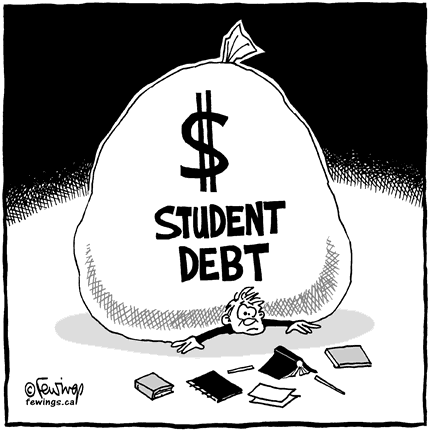
    Students who learn how to manage debt during university are paying themselves a great investment. You may be hearing horror stories of friends of friends who are paying off student loans years after graduation. Even the media pitches in and tells tales of students with debt so large that it seems unlikely they will ever pay off.

    No one wants to start out in life saddled with debt, but this could really be the best thing you do for yourself.

    Good Debt vs. Bad Debt

    A $1000 handbag or watch from your favourite designer is bad debt. $1000 towards books and supplies is good debt. Debt that goes towards something that will benefit you in the future is fine. Using borrowed money to earn your degree will only guarantee yourself a chance to earn much more than someone without a degree or diploma.

    Dr. Richard Settersten and Barbara E. Ray’s book Not Quite Adults highlights this fact, “taking on a little debt for a bigger payoff down the road is smart”. Settersten and Ray also shared Nobel laureate, Milton Friedman’s advice: people should borrow the most early on when their earnings are the smallest, save a lot when they are in their highest earning years in midlife, and then start spending all those savings after they retire.

    Be Realistic

    BMO Financial Group surveyed students across Canada and found that half believe that they will graduate with zero or less than $10,000 debt. This doesn’t quite match up with the findings from Statistics Canada, which states the average student graduates with $18,800. Be realistic when you’re borrowing money and always know how much you’ve taken out and how much you’re spending.

    Be Strategic

    Arthur Chan, who took out Canada Student Loans for fives years at Carleton University to complete his engineering degree, graduated with a debt of $21,000. He wasn’t able to find a job in his field until 8 months after graduation. Now, 2 years in a full time position with the government of Canada, that massive loan is all but a distant memory. How did he do it?

    Just because you’re able to borrow a large amount of money, doesn’t mean you have to spend all of it. Arthur lived at home during university and took public transportation everyday to keep costs low. He also worked part time retail jobs during summer vacations. When he wasn’t able to find a job right away, he applied for interest relief on his student loans. Once he was able to secure a job, he used his earnings to get rid of the debt as quickly as possible. The key is to learn how to save as much as you’re able to borrow.

    With tuition costs rising across Canada, sometimes adding everything up really discourages prospective students. Don’t let debt deter you from getting the education you want. Remember: education is a right, not a privilege.

  • Scholarships and Bursaries for Aboriginal Students

    Scholarships and Bursaries for Aboriginal Students

    Bursaries and Scholarships
    The Aboriginal Financial Officers Association of Canada is dedicated to helping Aboriginals reach the highest standard of excellence in finance and management. AFOA’s initiatives in the development of Awards and Scholarships are examples of that commitment.

    See link below for scholarships and bursaries.
    http://www.metisnation.org/programs/education–training/education/bursaries–scholarships

  • January Scholarships of the Month – Apply Now!

    January Scholarships of the Month – Apply Now!

    If you’re entering college or university in 2014, now is the time to get your applications in for scholarships and bursaries. The turning of the calendar to a new year heralds many new scholarship opportunities that you will not want to miss out on! Recently, the Canadian government announced plans for scholarships to honour Nelson Mandela – as soon as we have more information on these, we will pass them on to you. Until then, check out these great scholarships and bursaries that we have found for you this month:

    1. From Failure to Promise Essay Contest – Open to students across Canada who meet GPA criteria. Amount: $500 – $1500. Deadline: July 31, 2014.

    2. Fraser Institute Student Essay Contest – Open to students across Canada. Amount: $500 – $1500. Deadline: May 30, 2014.

    3. Tronia Systems Scholarship – Open to students across Canada enrolled in an Agribusiness program. Amount: $1000. Deadline: October 4, 2014.

    4. CBC Literary Prizes – Open to students across Canada who submit a 2500 word essay. Amount: Up to $6000. Deadline: February 1, 2014.

    5. AEF Edcuational Scholarship – Intended for students interested in pursuing an equine-related post-secondary education. Amount: Varies. Deadline: April 25, 2014.

    6. Joseph W. Atkinson Scholarship for Excellence in Teacher Education – Open to students in Ontario enrolled in a teacher’s college. Amount: $2000. Deadline: July 13, 2015.

    7. Farm Credit Canada Support Grant – Open to students who are members of 4-H in 2013/2014. Amount: 30 grants worth $500 each. Deadline: January 31, 2014.

    8. Industrial Undergraduate Student Research Awards – Open to students registered in a university bachelor’s degree program in natural sciences or engineering. Amount: $6500. Deadline: February 28, 2014.

  • How to Nail a Scholarship Interview

    How to Nail a Scholarship Interview

    Discovering that you have been chosen from a pool of applicants for a scholarship interview is an exhilarating moment. However, many students quickly find themselves getting anxious as they start to prepare for the big interview. It’s normal to feel this way, especially when you have great sums of money on the line. The following is a list of tips and tricks that can help you get ready for the big day:

    1. You’ve probably heard this from your parents and teachers already, but it’s important that you appear relaxed and confident. If you display confidence in yourself, the interviewers are far more likely to have confidence in you, too!
    2. Keep in mind that the interviewers have to sit through several students for hours, who often respond to the same questions with the same answers. If you want to stand out, provide memorable answers that will stick in their minds for the rest of the day. However, this doesn’t mean that you should give ridiculous responses either. You need to find a healthy balance between appropriate and creative. You can also make your responses stand out by sharing something personal about yourself. It might be a brief story or it might be a personal goal that you’ve held for years.  Just make sure it’s not too random and that it fits within the context of the question being asked.
    3. You need to present yourself as a worthy investment. Interviewers don’t just want to hear why you want or need the money; they want to know how you plan to use it to better your future. Try to prepare some ideas beforehand about how this scholarship money can change your life in the long-run.
    4. Your attitude can differentiate you from the pack as well. Try your best not to be monotone and boring. Speak conversationally with your interviewers because it will make the atmosphere far more relaxed. This will be like a breath of fresh air for the people interviewing you!  Remember that they have probably been sitting stationary for a while so they could use something to wake them up.
    5. There are several “little things” that you can also do to bring yourself to the top of that list. These little things are often forgotten by most so keep them in mind: Shake hands with your interviewer.  When they ask you how your day was, return the question. Thank your interviewers for even considering you for the scholarship. Believe it or not, these simple and polite gestures will increase your chances of being remembered!
    6. At the end of the interview, most interviewers ask if you have any questions.  Use this as an opportunity to extend the conversation beyond the standard questions that they ask everyone. A cool technique is to ask a question about the organization that is offering the scholarship. This gives the interviewers a bit more time to talk about themselves, which will be a welcome change from a long day of asking questions!

    You now have a bag full of tricks to get you through your big interview. Keep your head held high and remember to show off that sparkling personality!

  • How to Survive Without A Salary

    How to Survive Without A Salary

    Today my grandmother gave me a thick antiquated book entitled “How to Survive Without a Salary”, by Charles Long, circa 1981. The truth is that I’m employed, as a writer and a barista at a coffee shop. My grandmother is aware of both those facts. So I do in fact earn summer salaries, but with her infinite wisdom my loving old granny felt the need to bestow the book upon me nonetheless. With a career as a student and jobs that pivot around an education’s schedule, it’s pretty much impossible to predict long term income or complete financial stability anyway. My grandmother knows that despite the state of a person’s finances, tips on how to adopt what Long calls the “conserver lifestyle” are always good to consider.

    So let’s consider them. Long defines the term conserver lifestyle as “a means of coping better with what (one) already has.” Chapter one of his novel deals with internal factors preventing you from finding success in that regard. For interest’s sake, let’s pretend we don’t have any of those. But chapter two is ‘Assessing Yourself: Making a Budget,’ which is definitely worth a look. You never want to be spending more than your wallet can handle, especially when, as students, there are some costs that can’t be evaded.

    According to Statistics Canada, Canadian student tuition fees alone averaged at $5,777 in 2008-09, with Quebec’s $2,488 average the lowest and Ontario the highest, at $8,797. But there are also “ancillary fees,” those compulsory extra charges over and above tuition to cover things like athletic programs, health services and student associations. These fees added an average of $695 more to the demands on a full-time Canadian undergrad in 2008-09, ranging from a low of $423 in New Brunswick to a high of $827 in Nova Scotia. Ancillary fees are usually unregulated, but you can often look into them on school websites and find opportunities to opt out of what you don’t need.

    We can all survive without a salary while we are students if we keep watch on costs and budget ourselves accordingly. Long claims that “costs are always more important than earnings…there is nearly always more advantage in reducing costs than in increasing earnings.”

    In order to be able to sustain yourself while you get an education with an unstable salary and all of these subsidiary costs to student life, several banks like RBC and TD Canada Trust have places for you to create your own budget lists on their websites. At the time the book was written, without widespread use of the Internet it was a bit tougher to budget, but today many student budget list templates can be found online as well. The Office of the Superintendent of Bankruptcy Canada’s student budget section is a good resource, at http://www.ic.gc.ca/eic/site/bsf-osb.nsf/eng/br01399.html.

    After the section on budgeting, Long gives eleven more chapters of detailed analyses on financial strategies, many of them useful. He says, “A penny saved is not a penny earned. A penny saved is a hell of a lot more than a penny earned today.” We know that simply by keeping our savings in the bank, they grow with interest. That can apply to scholarship money or bursaries that may be extractable for personal holding (OSAP, for example).

    Chapter six on ‘The Second-Hand Market’ is my personal favourite, advocating the benefits of getting everything and anything used or pre-owned. Shopping in thrift stores doesn’t only help your wallet, but choosing to reuse can help our planet too.

    I’m glad to have been given this book, and prepared to become more money-conscious. With sky high tuition costs and the absence of established careers at this point in our lives, it’s smart to consider advice from anyone, outdated or otherwise, especially a published professional. And where did my grandmother find this yellowing treasure? At Value Village, naturally.


  • Scholarships for Aboriginal Canadians

    Scholarships for Aboriginal Canadians

    Bursaries and Scholarships
    The Aboriginal Financial Officers Association of Canada is dedicated to helping Aboriginals reach the highest standard of excellence in finance and management. AFOA’s initiatives in the development of Awards and Scholarships are examples of that commitment.

    See link below for scholarships and bursaries.
    http://www.metisnation.org/programs/education–training/education/bursaries–scholarships

  • December Scholarships of the Month – Apply Now!

    December Scholarships of the Month – Apply Now!

    With December upon us and exams in full-swing, the last thing on your mind might be how you’ll fund your post-secondary education next year. As you settle in for your holiday break in a few weeks, take some time to check out the scholarships we have sourced for you this month. Getting your applications in now can help grab that free money that you otherwise would not have. Take a look at the application criteria for each scholarship – you may be only a few clicks of your mouse away from getting help with your post-secondary tuition!

    1. Equals6 Top-Talent Scholarship – Open to all students across Canada attending high school full-time. Amount: $250. Deadline: December 31, 2013.

    2. Industrial Undergraduate Student Research Awards (I-USRA) – Open to students registered in a university bachelor’s degree program in natural sciences or engineering. Amount: $6500. Deadline: February 28, 2014.

    3. Simplycast Jutla Scholarship – Open to all students across Canada entering any field of study. Amount: $450. Deadline: February 28, 2014.

    4. Simplycast Scobey Scholarship – Open to all students across Canada entering any field of study. Amount: $450. Deadline: February 28, 2014.

    5. From Failure to Promise Essay Contest – Open to all students across Canada who write a 1000 word essay on a specific topic. Amount: $500 – $1500. Deadline: July 31, 2014.

    6. Canadian Society for the Study of Religion Undergraduate Student Essay Contest – Open to all students enrolled in undergraduate studies at a Canadian university or college who write a 2500 word essay on a specific topic. Amount: $100 – $300. Deadline: April 18, 2014.

    7. Fraser Institute Student Essay Contest – Open to all students enrolled in high school or an undergraduate studies program across Canada who write a 1000 word essay on a specific topic. Amount: $500 – $1500. Deadline: May 30, 2014.

    8. Terry Fox Humanitarian Award – Open to all students across Canada who demonstrate community service and volunteerism. Amount: 20 awards worth $7000. Deadline: February 1, 2014.