Tag: tuition

  • Comparing Tuition Fees in Canadian Schools

    Comparing Tuition Fees in Canadian Schools

    When children are young, their parents sometimes begin to set aside money for different purposes. Sometimes they start special bank accounts so that their sons or daughters will have some money to spend when they get a bit older. They might also start an education fund to start to save money for a university or college program in the future. Why would they do that? They know that post-high school education can be expensive, but saving money for their children can help make it possible to continue studying. When the time comes to choose a post-secondary school, students can also help by comparing costs and seeing where they can get the best value for their tuition money.

    Tuition refers to the fees students pay for being able to go to classes and to earn degrees, diplomas, or certificates. Normally, the cost of books and other supplies are not included in the tuition, which covers salaries, maintaining the buildings, and other basic costs. Tuition fees have been rising quickly almost everywhere in Canada, much faster than the cost of food, clothes, and other daily needs. In some places, the fees have almost doubled in the past five years, and in other places, they are almost four times as much as they were. One exception is the province of Newfoundland and Labrador, where tuition has been kept at the same level as it was in 2004. Ontario generally has the highest tuition fees, followed by Saskatchewan. Quebec and Newfoundland and Labrador generally have the lowest fees.

    Even within each province, tuition fees can vary a lot. In Saskatchewan, for example, there is only about a $200 difference in tuition between the most and least expensive university tuitions. In British Columbia, however, the most expensive university costs seven times as much as the lowest-priced. This difference can add up to a large amount of money for a four-year program, which could cost almost $55,000 by 2023. Unless students can live rent-free with their parents, they also have the expenses of rent, food, and other necessities of life. This can add up to a lot of money. Cost is an important factor in choosing your program after high school, but it is only one part of the decision.

    When the time comes for you to choose a post-secondary program, money should not be your only consideration. Sometimes, the best programs with the most support for job searching are also the most expensive. An expensive institution might also offer extra benefits, such as music or sports programs, volunteer opportunities, or a selection of courses not offered elsewhere. If these benefits are important to you, a high-priced school can be a good option. If not, a lower-cost program might be best. Beside these factors, being close to family or friends, being in a big city or small town, or other personal considerations should influence your decision. If you research your options well, you can find a program that combines good economic value with a useful education for your future.


  • Scholarships and Bursaries for Aboriginal Canadians

    Scholarships and Bursaries for Aboriginal Canadians

    Bursaries and Scholarships
    The Aboriginal Financial Officers Association of Canada is dedicated to helping Aboriginals reach the highest standard of excellence in finance and management. AFOA’s initiatives in the development of Awards and Scholarships are examples of that commitment.

    See link below for scholarships and bursaries.
    http://www.metisnation.org/programs/education–training/education/bursaries–scholarships

  • September Scholarships of the Month – Apply Now!

    September Scholarships of the Month – Apply Now!

    Preparing to enter college or university next year? Applying for scholarships now ensures you are ahead of the curve! Many scholarships and bursaries take applications well in advance, so students will be able to budget their scholarship prize money into their school finances. There is a scholarship for everyone, so don’t hesitate to apply. After all, every little bit helps when it comes to paying for your college education!

    1. Tronia Systems Scholarship – for students entering their first year of university who demonstrate an involvement in their community. Amount: $1000. Deadline: October 4, 2013.

    2. Larry Campbell Milton Memorial Scholarship – for current 4-H members planning to attend a Canadian University in a Food Science, Meat Science or Animal Science discipline. Amount: $2500. Deadline: October 23, 2013.

    3. AgriVenture 4-H Adventure Opportunity 2014 Scholarship – for 4-H members from every province that will be traveling with AgriVenture within one year of award. Amount: $3000. Deadline: November 1, 2013.

    4. Study and Go Abroad Fair Scholarships – open to students from across Canada in any field of study. Amount: $1000. Deadline: September 28, 2013.

    5. Canada’s Luckiest Student 2 – open to Canadian high school students and post-secondary students who are 16+. Amount: $30,000. Deadline: January 23, 2014.

    6. The National and Arbor Scholarship Program – by nomination from your secondary school, based on overall grades. Amount: $35,000 – $50,000, based on tuition needs. Deadline: November 8, 2013.

    7. Communications Nova Scotia Diversity Bursary – for Nova Scotian students from designated groups (Aboriginal Peoples, persons with disabilities, African Nova Scotians, racially visible people) enrolled in a post-secondary education program. Amount: $1000. Deadline: October 31, 2013.

    8. UBC Entrance Award – for students entering their first year of studies at UBC in 2014. Amount: up to $40,000. Deadline: January 31, 2014.

    9. Peter Corley Memorial Scholarship – candidates must be a member of SAC, have made at least one solo glider flight in the 12 month period preceding the application, and be attending a university or community college full-time or be accepted and scheduled to attend within six months of the date of the application. Amount: $2300. Deadline: October 1, 2013.

    10. Jump Canada Bursary – for students who are active members of the Equine Canada community. Amount: $2000. Deadline: September 30, 2013.

  • Grants for Students with Disabilities

    Grants for Students with Disabilities

    Am I eligible?
    You are eligible if you:
    – apply and qualify for a Canada Student Loan;
    – are enrolled in a full-time or part-time program (minimum 32 weeks) at a designated post-secondary institution;
    – meet the criteria for students with permanent disabilities; and
    – include one of the following with your loan application as proof of your disability: a medical certificate, a psycho-educational assessment, or documentation proving receipt of federal or provincial disability assistance.

    What’s available?
    $2,000 per academic year (August 1 to July 31).
    This grant is available for each year of post-secondary studies, provided you continue to meet the eligibility criteria. This includes post-secondary studies beyond the undergraduate level. Grant money is issued by your province or territory of permanent residence at the beginning and in the middle of the school year.

    Since grant amounts are fixed, the amount you receive may exceed your assessed need.
    Example: If you qualify for the grant and you have an assessed need of $1,400, you will receive a $2,000 grant. In this case, the grant would cover your assessed need, so you would not need a student loan.

    How do I apply?
    The application process for this grant differs in each jurisdiction. To make sure you meet all the application requirements, contact your province or territory’s student financial assistance office.

  • Student Loans: The OSAP Process

    Student Loans: The OSAP Process

    It is a question that student advisors are intimately familiar with and search engines encounter all the time. What is OSAP? If you are financially unable to attend post-secondary schooling, OSAP can help you with that. OSAP is run by the Ontario Ministry of Training and is funded by the province. Their services entail an individualized program specific to your needs. Potential applicants must prove their financial need to attain registered status.

    The criteria is particularly focused on demographics, income and loan history, according to campusaccess.com.

    “You must have either resided in Ontario all of your life or Ontario is the last province where you resided for 12 consecutive months without attending a post-secondary institution,” the site advises.

    There are two ways to apply for OSAP: The online application and the written application. Living in a digital age, online applications seem to be the more popular medium. The majority of applicants choose this because it is quicker, requires no fees, and the system provides online estimates of the funding you may receive. With this option, there is no waiting around and you are able to track the status of your application online.

    University graduate Sabrina Sagl is attending college and still using OSAP to fund her education.

    “I first got OSAP five years ago and was incredibly grateful , because of OSAP, I was able to afford to go to university,” said Sagl. Despite her ability to attend her school of choice, she was met with harrowing realizations about the negative sides of the service. “You get a certain amount of money per year, in two large lump sums, and it is incredibly easy to spend the money negligently.”

    The harsh realities are instilled after a few years of accumulated debt. Once students have completed their educational studies, they are given a six-month grace period to repay their student loans interest free. Some students are forced into trying to maintain a balancing act.

    “It was very difficult having to work, especially shift-work during the school year,” said Sagl. “I had to decrease my course load and take summer courses in order to obtain my degree.”
    If you are applying for OSAP, you need submit your application as early as you can. While OSAP provides a helping hand to students struggling with educational fees, it is far from a one-stop solution. The service often leaves students in a difficult spot financially. Students are advised to focus on their own fiscal prudence in addition to relying on the program for support.

  • The Cost of Education

    The Cost of Education

    Don’t let college and university be a costly mistake.

    Avoid the lure of a big paycheck for a diploma or degree that you really don’t love.

    It’s hard to make a decision at the tender ages of 16 and 17 regarding the career you’ll have for the next 30 years. Yet this is what parents, teachers and guidance counselors are hoping you would do when it’s time to apply for post-secondary. A Gallup and Sallie Mae survey titled How America Pays for College, found that more than half of high school seniors spent more time planning for the prom than thinking about university.

    CBC reports that the average cost for tuition in Ontario rose 207% from 1990 to 2007. It would now cost Ontario students $5,160 a year. It’s cheapest in Newfoundland and Labrador at only $2,606 and the most expensive tuition fee goes to Nova Scotia, where students fork over $6,571.

    With tuition fees on a meteoric rise, pressure is placed on the students often for the wrong reasons. Parents who are weathering the recession and stock market crisis will warn their son or daughter of choosing professions that offers stability and a large paycheck. Accountant? Programmer? Nurse? Sure, they all sound interesting…why not give it a try?

    Valentina (not her real name) started off going to university to pursue a Bachelor in Public Administration. It became evident that this really wasn’t for her. She then tried switching into Pharmaceutical Studies, only to finally graduate in Sociology. A year after receiving that degree she enrolled in college for Event Management. Still unhappy, she is now halfway through an Optician program. She feels confident that she has found her true career and even landed a student optician position during her studies.

    College and university can be very expensive, if you’re still unsure of what you would like to do. Not everyone can afford to switch around majors like Valentina did. Worse still if you stay in a program that you know you’re not suited for. Erica Cervini’s recent article for The Age found that, “If students don’t feel they belong to their university, the odds are high that they will drop out”. The greatest price to pay for education is an incomplete one.

    It’s okay to take your time and not rush into university or college when you’re not sure of what you would like to do. Volunteer during high school, talk to other adults, explore sites like Jobspeopledo.com or even consider taking a gap year to think about what would you be happy to do. Treat your future career like finding your soul mate. If you meet a big shot executive who makes loads of cash, would you be with him/her if your heart just isn’t into it?

  • Two Jobs Are Better Than None!

    Two Jobs Are Better Than None!

    My first year of university officially ended on the 21st of April and the time arrived for me to finally think about getting a summer job. As I am an international student with a ears almost as big as my fiscal expenses, I would need to work at least 65 hours per week in order to cover my tuition for the coming school year. That is the equivalent of working one full-time and one part-time job. Now, who would have thought that going to school was the fun part of the year?!

    Luckily, I had already landed one job at a certain casual Canadian restaurant; the second job came soon after at a local convenience store thanks to the efforts of a well-built network of friends. The first thing I was grateful for is that both the jobs I landed required the same base skill set. I worked as a cashier at both the restaurant and the convenience store and my job required me to do the following tasks on a day-to-day basis:
    1) Take customer orders
    2) Manage any and all numerical transactions
    3) Talk to customers and solve their problems
    4) Clean the restaurant/store from time to time
    5) Do not spill anything on the boss’s pants( one of my co-workers had the unfortunate pleasure of doing so)

    Much to my surprise, I had mastered the base skill set in under a week without much difficulty. My first job had me working mostly overnight shifts and, as bad as it may sound, it was actually the ideal situation for me to work. This is because I would work from 11 pm to 7 am every night (or day; honestly working overnight really messes up your perspective of time), go home, have breakfast by 8, take a 2 hour nap and go to my second job (which would start at 11 in the morning and would go on until 3 pm).

    So the days passed and I continued with my daily exploits. I will not lie to you – it was hard. But the work itself was not bad and I enjoyed most of it. I made some great friends and went through some very hilarious experiences.

    So here is my final pieces of advice for anyone who wants to make the most out of working two jobs:
    1) Find two jobs that essentially are similar in nature and require the same basic skill set. Doing so will allow you to improve on those required skills and perfect them.
    2) Find jobs that are close to your house. Doing so will save you a long commute to work and will also save you time that you can utilize to do other things – like sleep!
    3) Make the most out of every situation. As clichéd as this may sound, it does work. Try and make new friends at work. Broadening your horizons will also widen your network of contacts that may help you later in life.
    3) You do not want to physically and mentally over-exert yourself. If you cannot handle two jobs then it is better to just have one. You will avoid making mistakes and potentially being let go from both your jobs this way. Instead, focus your energy on looking for scholarships/bursaries/loans to help pay for school. Also, ask your employer for help as many companies have educational benefit plans for student workers.

    Working two jobs is a strenuous task but it is possible. So if you find yourself in a situation like this sometime in the future then hopefully you shall remember my advice for you!

  • Doing Scholarships the Right Way

    Doing Scholarships the Right Way

    Like getting a ton of free money? Of course you do!

    Those lines might sound like the beginning of an un-reputable online advertisement, but the truth is there are plenty of scholarships aiming to do just that – hand you free money to support your education.

    So how do you score some of this free cash? Start by applying to any and all scholarships that you can. The more you apply to, the higher your odds of receiving an award.

    If you’re not sure of your eligibility for a scholarship, apply anyway. Many scholarships are not given out due to lack of applicants. Even if your eligibility is hazy you may be the lucky winner by default. This was the case when Sandro Rocco, Niagara College Photonics alumni, applied to the Walker Technology Grant.

    “I wasn’t entirely sure if I qualified but I thought – why not give it a shot? A lot of people don’t bother,” he commented.

    “It turned out I was the only person to apply for the scholarship so I won. The award was really helpful and got applied directly to my tuition,” Sandro continued.

    Some students shy away from scholarship applications because they feel their grades aren’t high enough. However, plenty of scholarships are handed out as a result of achievement in other areas, including extracurricular involvement, athletics or charity work. Financial aid and area of interest are also taken into consideration when handing out scholarships.

    Take time out of your schedule to make great applications. Prioritize and spend time on scholarships that are most applicable to your skills and experiences.

    Remember that scholarship application is not limited to your first year of studies. Many students stop applying after their first year thinking that the majority of scholarship funding is reserved for new students. This is not the case, as many awards are reserved for students in their second, third and fourth year of studies.

    Students are sometimes intimidated by the amount of work involved in applying to scholarships, but by using an incremental approach and developing decent time management (yes, it is possible) you will be able to handle the stress and hopefully reap the benefits of scholarship application.

    Many online scholarships allow you to save your work in their own word processors, making it easy to finish one or two parts of the application at a time.

    Having a stock application template done in advance is another easy way to save time and minimize stress while scholarship hunting.

    Have a thorough list of your skills, past experiences, awards and academic achievements on hand as part of your application template. This go-to list will make a world of difference in the quickness of your application process.

    Also, prepare a general and flexible essay that highlights your personal qualifications and that can be tweaked to fit specific scholarship criteria.

    Keep your audience in mind when filling out applications.

    If you are applying to an academic scholarship, be sure to use academic language and keep the tone of your writing as professional as possible.

    In contrast, some scholarship review panels are looking to see a more personal response. For these, don’t be afraid to use a less formal language and be sure to highlight your own opinion, giving judges a better understanding of your personality.

    Just like that summer job, it is never too early to start the search for scholarships! So good luck and happy applying!

  • University = Show Me The Money?

    University = Show Me The Money?

    During your first year of post-secondary education, you might feel like you have a chorus of administrators telling you to SHOW ME THE MONEY! This is probably the least awesome part of your university/college experience, but don’t lose hope! You can pay for your education and still have some dough left over if you manage your money.

    There are some great resources for student loans and scholarships that you can check out, but for now I’m going to share the best money-managing tip that’s saved me some moolah over four years of university.

    Some students may want to work during their first year, while some might prefer having more time to focus on their studies and soak up the university/college atmosphere. Either way, you’re going to want to have some extra cash handy to buy food, clothes, video games, hovercrafts, etc. The best way to make sure you’re not broke by October 1st is to…

    MAKE A BUDGET
    …and follow it! You could aim for a monthly budget, a weekly budget, or something in between. The disadvantage of the monthly budget is that you might get to the end of the second week and realize you don’t have enough coffee coins to last until the 31st. However, the monthly budget is advantageous if you KNOW you are responsible with your money and your self-discipline is strong enough to withstand the barrage of media which daily tells us that we need more stuff.

    Since I am personally quite fond of stuff, I went the way of the weekly budget and it worked fairly well. The disadvantage of the weekly budget is that it could be Monday and you’ve spotted a pair of jeans that you simply MUST have, or the new Halo game just came out and you’re not sure you can live without it. In cases like these, you might be tempted to dip into next week’s budget or blow a month of your carefully pinched pennies. Borrowing from one week’s budget to pay the expenses of another week is acceptable as long as it doesn’t happen too often and you’ve got legitimate reasons. Sometimes you might have to talk yourself out of that cute new top (everyone else is going to buy it anyways) or the pair of nunchucks you thought you just HAD to have (what are you ACTUALLY going to use them for?)

    If the personal pep talk doesn’t work and you decide you absolutely have to have something, just remember: you must eat (canned spaghetti for dinner every night does not count) and you must pay bills (interest rates are killer and cell phone companies are not as forgiving as their cute little mascots make them appear.)

    Here are some things to consider when making your budget:

    • The contents of your bank account!
    • Do you have a meal plan or will you be buying groceries?
    • Will you be working throughout the school year and how much will you make?
    • Do you have job plans for the summer?
    • How will you be paying for your next 2/3/4 years of university or college?
    • Are you eligible for or currently receiving financial aid? (Remember, loans must be paid back. Try saving a percentage of your money to put against your loan so that you don’t finish school and fall into a pit a debt.)

    Don’t be too generous with your budget or you’ll run out of money, but don’t be too strict either because you have to live on more than bread and water rations! Keeping the above six things in mind will help you to structure a budget that should work for you AND your bank account.

    Happy saving! (more…)

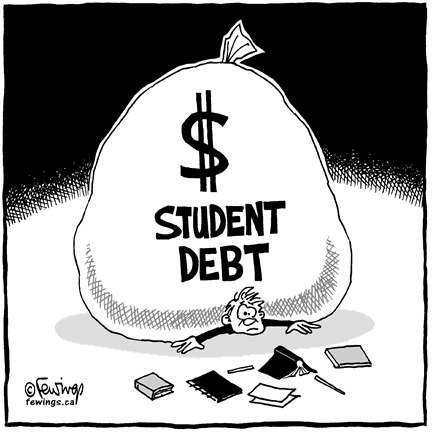
  • Student Debt: Your New BFF

    Student Debt: Your New BFF

    Debt is a four letter word that should not be feared.

    Students who learn how to manage debt during university are paying themselves a great investment. You may be hearing horror stories of friends of friends who are paying off student loans years after graduation. Even the media pitches in and tells tales of students with debt so large that it seems unlikely they will ever pay off.

    No one wants to start out in life saddled with debt, but this could really be the best thing you do for yourself.

    Good Debt vs. Bad Debt
    A $1000 handbag or watch from your favourite designer is bad debt. $1000 towards books and supplies is good debt. Debt that goes towards something that will benefit you in the future is fine. Using borrowed money to earn your degree will only guarantee yourself a chance to earn much more than someone without a degree or diploma.

    Dr. Richard Settersten and Barbara E. Ray’s book Not Quite Adults highlights this fact – Taking on a little debt for a bigger payoff down the road is smart. Settersten and Ray also shared Nobel Laureate Milton Friedman’s advice: people should borrow the most early on when their earnings are the smallest, save a lot when they are in their highest earning years in mid-life and then start spending all those savings after they retire.

    Be Realistic
    BMO Financial Group surveyed students across Canada and found that half believe that they will graduate with zero or less than $10,000 debt. This doesn’t quite match up with the findings from Statistics Canada, which states the average student graduates with $18,800 in debt. Be realistic when you’re borrowing money and always know how much you’ve taken out and how much you’re spending.

    Be Strategic
    Arthur Chan, who took out Canada Student Loans for fives years at Carleton University to complete his engineering degree, graduated with a debt of $21,000. He wasn’t able to find a job in his field until 8 months after graduation. Now, 2 years into in a full-time position with the Government of Canada, that massive loan is all but a distant memory. How did he do it?

    Just because you’re able to borrow a large amount of money doesn’t mean you have to spend all of it. Arthur lived at home during university and took public transportation everyday to keep costs low. He also worked part-time retail jobs during summer vacations. When he wasn’t able to find a job right away, he applied for interest relief on his student loans. Once he was able to secure a job, he used his earnings to get rid of the debt as quickly as possible. The key is to learn how to save as much as you’re able to borrow.

    With tuition costs rising across Canada, sometimes adding everything up really discourages prospective students. Don’t let debt deter you from getting the education you want.

    Remember: education is a right, not a privilege.