Author: Teodora Pasca

  • Catching Z’s: Keeping your sleep routines in check

    Catching Z’s: Keeping your sleep routines in check

    Whether you have a set bedtime or just go to bed “whenever”, sleep is certainly an important part of your life. Getting rest is crucial for both your physical and mental well-being and helps you recharge for the morning ahead. Staying up late might be fun, but sometimes it’s not worth it to wake up groggy and miserable after watching too many movies into the wee hours of the morning.

    Have you ever considered how important it is to keep a regular sleep schedule? Your body runs on an internal 24-hour clock, called a circadian rhythm, which means it naturally gets used to doing things like sleeping according to the time of day (or the amount of light or darkness outside). If you’ve ever experienced jet lag, you’ll know how off-kilter you feel when your rhythm is thrown off: it’s totally unpleasant to be exhausted at noon and wide awake at midnight, just because you’re suddenly in another time zone.

    That means it’s important to keep your sleep rhythm regulated according to your own day, which includes going to bed around the same time every night, and waking up around the same time every morning. Chances are you already do something similar when you’re following your regular school schedule (and you just stay up later on Fridays and sleep in on weekend mornings). If you keep your sleep schedule on track, you won’t have any trouble feeling awake when you need it the most.

    Sleep is important at all stages of your life, especially during your time in elementary school. However, the stakes will be much greater when you’re cramming for high school exams, or writing big university papers, or trying to get up bright and early for your first job. To achieve all that you want to do in the coming years, you’re not only going to need a lot of energy, but you’re going to need it in regular and dependable bursts. In that way, cultivating your sleep patterns today can definitely help you out in the future—you’ll already be used to keeping yourself well rested and ready to go.

    To make sure you’re getting the most out of your rest, be proactive about your sleep habits. Set a 30-minute window for yourself in the morning and evening, and try to wake up and go to sleep within that time frame each night. You can even keep track of how many days you do this, and see if you feel better after some time on a regular sleep schedule. (In order to stick to your plan, it helps if you plan all your morning and evening activities around that window; e.g. you could brush your teeth around 10 minutes before lights out.)

    Finally, of course you can have a couple of late nights—sleepovers aren’t very fun when everyone has to be in bed by 9. Just make sure that waking up at noon doesn’t become a bad habit, and you’ll be good to go.


  • Career Profile: Private Investigator

    Career Profile: Private Investigator

    Many people enjoy mysteries on television or in books. They like the challenge of trying to solve the mystery before the detective does and enjoy learning how the different parts of the story fit together. Some people also like solving mysteries in real life. How would you like to do that for a living and become a private investigator?

    If nothing very exciting happens to you or your friends, it might seem as if there is no mystery in life. A closer look, though, might show that you really have many different puzzles to solve. Suppose that your friend’s bicycle disappears. You could follow the clues and try to find out what happened to it. If one of your family members suddenly started being secretive, you could ask questions to find out why. The information that you get could help you and your family.

    Finding information is the most important part of a private investigator’s job. Some people in this field use their skills to find missing people or to solve crimes. Often, private investigators work together with the police. They might work individually or in a company. Some of the most famous private investigators worked for a company called Pinkerton’s in the United States.

    Many of the people who joined Pinkerton’s were former police detectives, and they used the skills that they had used in their jobs for the new investigations. However, people without that background can also learn the skills of private investigation from books, through courses at a career college, or on the job with other investigators.

    A lot has changed since the first Pinkerton’s detectives, but many of the basic skills are the same. Private investigators still look for information, but some of the tools for doing that have changed. Being able to talk to people and get answers is a very important skill. Sometimes, a person in the investigation might know all of the answers but might not realize it or might not want to admit it. Besides talking with people, private investigators should be able to use various tools such as the Internet or different databases to find information. The tools for each investigation might vary, but many of the basics are still the same.

    Having a good education is useful for private investigation. Many people in this field have degrees in areas such as criminal justice or even science or literature. Almost any area of study can be helpful, and it is important to keep on learning.

    In Canada, all private investigators have to be licensed. This means that they need to pass an exam to show that they know the country’s laws and the techniques of investigation. They should not have a criminal record or be under investigation for a crime. Besides that, they usually need to be healthy and active so that they can walk long distances when they are following people or doing other parts of their work. They should have good memories and be able to keep information organized. For some jobs, they might need to work alone, but being able to work well with others is helpful.

    Some private investigators work in areas like security and background checking. Large companies might hire them to check potential employees to see if they have told the truth in their job applications. Other people might hire them to provide security guards for events like concerts or sports games or possibly to help protect politicians or other famous people. Sometimes, private investigators might also work for individuals, such as people who are looking for family members or who need help with another problem.

    Salaries for private investigators can vary widely, depending on where and how much they work. Some very experienced investigators can earn about $90,000 per year, but the average salary is closer to $35,000. Experience can help, and gaining skill in solving problems is the best way to advance in this career.

    If you love to solve mysteries and are good with people, why not consider becoming a private investigator?

    Bibliography:

    Alberta Learning Information Service. “Occupational Profile: Private Investigator.” https://occinfo.alis.alberta.ca/occinfopreview/info/browse-occupations/occupation-profile.html?id=71003126.

    Career Profiles. “Private Investigator and Detective.” http://www.careerprofiles.info/private-investigator-detective-career.html.

    Discover Criminal Justice.com. “Career Profile: Private Investigator.” http://discovercriminaljustice.com/career-profiles/private-investigator/.

    Neuvoo.ca. “Private Investigator Salary in Canada.” https://neuvoo.ca/salary/private-investigator/.

  • Handling the Heat: Learning to Bake

    Handling the Heat: Learning to Bake

    For many, the kitchen is a foreign environment. The utensils, ingredients, and appliances loom over you in all their complexity. Yet food is a necessity. School teaches formulas and formats, but often does not delve nearly enough into fundamental life skills. Baking is a great way to venture into the kitchen and gain comfort in that strange new world. Whereas cooking is an intricate art, baking is a science.

    Experienced cooks are comfortable improvising, swapping ingredients, and trying new things. Baking can incorporate these ideas as well, but it is very important to follow recipes closely in order to get the right reactions from the right ingredients mixed together in just the right amounts. Do a search for a simple recipe, such as for cookies. Websites typically tell you the length of time it will take and the level of difficulty. Before you even enter the kitchen, take plenty of time to read and reread the list of ingredients and instructions.

    When you locate the ideal simple recipe, look for YouTube videos that take you through the process of making that particular dish. As you watch, take notes and physically gather all the ingredients you are going to need. This might require a trip to the grocery store, but it is also useful to learn the many substitutions you can make for common ingredients. No butter? Try applesauce. Out of sugar? Use some honey.

    Ingredients from the fridge typically need to sit on the counter for a while for a while to warm up. This gives you plenty of time to reread the recipe once again. When you are starting out, you will want to follow the instructions to the letter. It may feel tedious, but adopting this strategy will aid you in learning the ins and outs of working with different ingredients and utensils. For example, after figuring out the perfect touch for cracking an egg, move on to techniques for separating the egg yolk. Some people do this by hand, with a spoon, or by moving the yolk back and forth in a cracked shell.

    Try your hand at a variety of simple variations of different baked goods. There are seemingly limitless varieties of cookies, cakes, muffins, and breads at a many difficulty levels. But make sure to also repeat the ones you have already done. Some will turn out better than others – in fact, some of your attempts will not turn out very good at all. This happens to everyone in the kitchen, and it is especially important to take notes in these instances on what exactly went wrong. Just like essay drafts, it takes multiple attempts to get it right.

    As you gain comfort in the kitchen, consider investing in additional equipment. A sifter is great for removing clumps from the dry ingredients. Having multiple and different-sized bowls makes it much easier to prepare things separately and carefully add items into one large bowl. Separate measuring cups for wet and dry foodstuff allow the recipe to come together better. Tupperware containers and freezer bags are great for storing your creations for sharing, and mean you are always ready to make more.

    The scientific nature of baking, in which specific amounts of wet and dry ingredients come together in the oven for the desired result, make it an ideal way to study and analyze the art of making food. From there, you can try your hand at other meals and cooking styles. School offers many valuable lessons, but as you grow up and head out on your own into the world, you will be extremely grateful for the ability to feed yourself.

    Sources:

    Clift, Cortney. “25 Essential Baking Tips and Tricks for Beginner Bakers.” Brit+Co. http://www.brit.co/new-bakers/

    Roberts, Anna Monette. “Baking Basics: 10 Tips For Beginner Bakers.” Popsugar. http://www.popsugar.com/food/Tips-Beginner-Bakers-24477467#photo-24477467

  • Calm amidst the Madness

    Calm amidst the Madness

    Machines, computers, and artificial intelligence have increasingly handled more and more tasks once done by humans. Yet, paradoxically, we find ourselves with busier and bustling lives. The ability to conduct business faster has, for better or worse, led to faster business. Meditation is a highly effective way of coping with homework, part-time work, the loud noises and bright lights of the city, and more. It may seem like the act of doing nothing, but the act of meditating is the calming and silencing your mind, regardless of the activity and hustle of the world around you.

    There are different types of meditation, and people often personalize and customize the practice individually. Some meditators focus on one specific bodily sensation, such has breathing. Others will use an object as their focal point. Some will instead use open-monitoring, which involves noticing everything that is occurring in the area you are in while remaining calm and non-reactionary.

    This can all be done in your room after or before bedtime, during lunch, on the bus, or whenever you have at least 10 minutes to spare. Studies have shown that doing this daily can start making a difference for your mental and emotional well-being in as little as eight weeks. It can reduce stress and anxiety, as well as help you cope with injuries or other physical pain you may be enduring.

    In addition, you are likely to see boosts in your memory and creativity. Researchers at Leiden University found that open-monitoring meditation helped people generate new ideas. Further research has been done indicating that meditating helps you ignore distractions and recall facts quicker. This is especially beneficial for exams.

    From a scientific standpoint, meditation weakens the connections in the brain between scary or anxiety-causing sensations and your conscious awareness. Instead, more activity takes place in the parts of the brain devoted to logical reasoning, helping you to better assess that test you have to study for or the problems going on amongst friends.

    The solitary act of meditating also helps in your interactions with others. Studies indicate that habitual meditators have greater development in the regions of the brain associated with empathy and compassion. This makes you less prone to outbursts of anger or tension, and more likely to work out situations with friends in a calm manner.

    Beyond the mental effects, practicing meditation can also help you feel better physically. A study demonstrated that those who practiced regularly had a better immune response to the flu vaccine compared to others. This boost to your immune system can help you stay healthy for a better school attendance and engagement in extra-curricular activities.

    Another study showed that meditating can help protect the genes inside of you. Certain protein complexes called telomeres are strengthened via the act to help ward off diseases. This may not be of much value at the moment, but is especially important for your long-term health.

    Meditation has many positive benefits, but these can only be achieved for dedication and effort. I know from experience how easy it is to say you want to meditate and then never get around to it. You have to very consciously decide to put aside your phone and the hectic world around you for a little bit each day. In a world full of distractions, doing nothing is a challenging task.

    Sources:

    Cooper, Belle Beth. “What Happens to the Brain When You Meditate (And How it Benefits You).” Lifehacker. http://lifehacker.com/what-happens-to-the-brain-when-you-meditate-and-how-it-1202533314

    Loria, Kevin. “7 ways meditation changes your brain and body.” Business Insider. http://www.businessinsider.com/how-meditation-changes-your-brain-2015-

  • Raindrops keep falling on my head—why do I feel like the world is out to get me?

    Raindrops keep falling on my head—why do I feel like the world is out to get me?

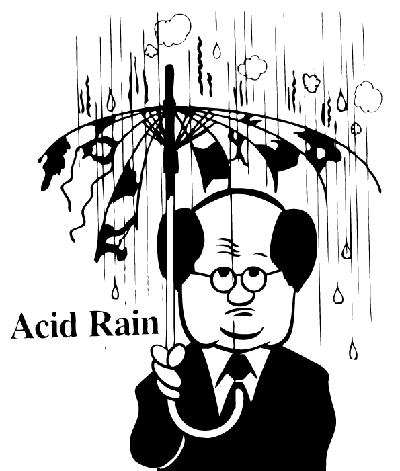
    It goes without saying that university can be a very stressful time. And true to the old saying…when it rains it pours. Problems never seem to come one at a time, but rather all at once. Being under academic pressure comes with side effects that can reach out to your personal and professional life. But other times, nothing seems to be connected and yet numerous things are wrong. So why is the world out to get you? The truth is, it’s not. But your attitude and the campus setting can seriously affect the results of day-to-day life. So what can you do?

    Ask for help

    You never have to be alone. Even if one of the problems is that you feel lonely and like it is just you against the world. Every school provides free counselling services and there are support groups. If it is a problem with studies and getting assignments completed your professors are there for you. In fact, it’s their job to give you advice and help. Use them. When the problems pile up, you have to put aside your pride and reach out to friends and family and anyone else that can help you. In the end, you will realize who is there for you.

    Focus on one problem at a time

    Yes the problems are piling up—but the truth is that there is no possible way they can all be handled at once. Make a list of everything that is going wrong from smallest to largest (or easiest to hardest), and try to tackle the more important of these first. If that is too daunting and you just cannot bring yourself to do it, pick the one you can solve the soonest and that will get the ball rolling. The success of solving a problem will feel amazing.

    Wait

    If what is wrong right now requires no action but rather time…wait. This too shall pass, and sometimes waiting is not being passive but rather being patient. Sometimes all you need to do is wait out the storm. In the meantime, find ways to envision a good outcome and calm yourself down through exercise, meditation and friendship.

    Tackle your anxiety

    Does the world feel like it’s out to get you because you’re anxious and constantly expecting the worst? Identify what makes you anxious and research ways to fight it. Envision your worst fears and then understand that your worst fears truly never often happen. Oftentimes it is our own insecurities and fears that contribute to the chaotic state of our lives, not outside events.

    When you look back

    The truth of the matter is that when you look back on these hard times, you may actually forget what caused them or what was happening. Oftentimes all these disasters that make university a hell at the time actually seem mundane down the road. Again, this too shall pass.

  • What to Do When You Feel You Have No Career Path

    What to Do When You Feel You Have No Career Path

    By Gavin Mercier

    Committing to a career path is a big deal, and one of the bigger choices that you will make in your life. “The rest of your life” is a long time, and finding a career that you will enjoy for it is a big decision. For some people, this decision might be an easy one – maybe you’ve known what you want to do since you were young. For others, however, it might be a little harder. Maybe you don’t know what you want to do, or maybe you feel like you can’t. In either case, it’s important to take a step back and take a look at what you like to do.

    Take a step back

    Sometimes you just need a break. Take a little bit of time to yourself and think about what you really want to do. Relax a little bit and let your mind settle before making decisions like this. When you feel ready, then you can begin to look. Start by looking at the jobs that really appeal to you, no matter how unrealistic they may be. If for some reason, you can’t do what you would like to, look at things that are similar to it. For example, if you want to be a chef but can’t get in, try starting small. Look for opportunities in the same field, because chances are you can cross over and become what you really want to be.

    Take a look at your hobbies

    Your hobbies best reflect what you like. Anything that you willingly do in your free must be appealing to you at least a little. So, look at the things that you enjoy doing, then look at jobs related to that activity. You’d be surprised what kind of jobs are out there, all you have to do is look. Say, for example, that you like to paint miniatures. Someone has to design those miniatures, so why can’t that someone be you? The same applies for all sorts of things, all you need to do is look.

    Look at what you like to do

    This might sound a lot like your hobbies, but it isn’t. Just look at the things that you enjoy doing. Things like driving, writing, painting, taking pictures, and etcetera. There are so many things that you can do with an interest. Just think a little bit outside the box. If you love to paint, you don’t have to be an artist. You can be anything from a house painter to an air brusher doing custom paint jobs on cars. The possibilities are endless, you just have to be a little creative.

    Picking a career path is a tough choice, and it’s even tougher when you don’t know what you want that path to be. However, by taking a step back and looking at what you like doing, what interests you, and what you can really see yourself doing, hopefully that path will become a little clearer.

  • Why We Need Laughter During Stressful Times

    Why We Need Laughter During Stressful Times

    At some point in your life, your stress level will be extremely high. There are some easy, quick, and readily available ways to bring yourself back a more calm state of mind. If you’re still having issues after trying the options I’ve mentioned previously on this site (hobbies, games with friends), please consider talking to a therapist or a mental health hotline. Bell Let’s Talk campaign (January 25th) is very timely: http://letstalk.bell.ca/en/get-help/ . You are not alone. There are people and organizations willing and able to help you.

    For now, I’m speaking in general terms: laugh during stressful times. It’s not only the best way to change the mood when you feel several things coming at you at once, whether they’re related to dating, school, family, or work.  Switch to something that you consider upbeat. It could be a funny movie, laughing at something that just came to you, a humorous fiction novel, cat videos on YouTube, or even TV or online shows specifically centered on a comedy of errors.

    Laughter is good for you for several health-related reasons. It’s the reason why advisors keep recommending leaving a job (if possible) if it’s causing you stress that has physical implications, such as feeling run down and staying in bed for long periods. By taking the time to look after your mental health, you can also look at your physical well-being, by easing the impact of stress on your heart and immune system.  This can also help you become healthier as compared to those people dealing with major stress. This is another reason why health professionals encourage more fun activities for you to enjoy.

    There’s also another source of laughter: your friends. If you surround yourself with positive energy and upbeat personalities, it can lift your mood considerably as compared to others who are generally more negative. It’s not a bad thing: everybody sees the world differently, but since you’re looking to help yourself in stressful times, keeping this interaction towards ‘negative’ friends can be helpful to keep to a minimum, until another time.

    Above all remember that stress and depression are serious issues that can impact your mental health. If none of these simple strategies help you; there is no shame in looking elsewhere for support. The Bell “Let’s Talk” page (see the link above) provides contact info for several organizations (websites and phone numbers) where you can seek further assistance. You are not the only person to feel this way, and you are helping yourself by seeking the help you need.

  • Don’t Be Late- Why Being on Time Matters Now and Why It Will in Post-Secondary

    Don’t Be Late- Why Being on Time Matters Now and Why It Will in Post-Secondary

    Some people feel as if they spend most of their time waiting. Others are always late for supper, for parties, or even for work or school. Everyone is late at some point in their lives, but being on time is important, especially as people finish high school and move on to post-secondary classes and jobs. No matter how many years you still have left before you graduate, it will help you in the future if you already develop a habit of being on time.

    What happens if students arrive late at your school?  Do they have to go to the office to get a late slip or do they just go to class? Some schools are very strict about punctuality but others are not. Many university professors also allow their students to miss classes or to arrive late, but others require regular attendance and punctuality. Even if you are allowed to be late, you should try to be on time. That way, you can be sure not to miss anything important.

    Being on time can help you deal well with your classmates, as well.  Many courses include group projects, and you will need to meet with your classmates to work on an assignment. Being a few minutes late might not matter, but if you keep your classmates waiting too often, they might not want to work with you again.

    Learning to be on time is good for many reasons. It shows respect for other people’s schedules and commitments. If you keep your friends waiting, you might make them late for their appointments. If you are punctual, people will see you as reliable and will trust you with more responsibility than if you’re always late. That will be especially important when you start to look for work.

    Punctuality is also important for many employers. Being late too often might get you fired or cause other problems for you at work. Suppose that you worked at a restaurant during the afternoons. If your replacement for the evening always arrived late, you might miss your supper or be unable to go to a party or other event. At a hospital, being late for work might affect a patient’s health. Factory work, truck driving, and many other jobs depend heavily on punctuality. Employees can even lose their jobs if they are late too often.

    If you are normally on time for school and appointments, you can keep on developing your good habits. If you tend to be late, you can already start to develop the habit of being on time. Many different techniques can help you to become more punctual. Writing out a schedule or putting it onto your phone or other device will help. If possible, allow yourself an extra ten or fifteen minutes to get to each appointment. If that isn’t possible, you should at least try to leave as early as you can.

    Suppose that you could take two different buses to school. One gets you there ten minutes before class and the other arrives two minutes early. You might think that the second bus is good enough, since it still gets you to school on time. However, thinking that way might end up making you late far too often. What happens if traffic is slow because of bad weather or an accident or construction on the road? Even a short delay might make you late.

    While you’re in school, you might not have a lot of choices about your schedule during the day. Before or after school hours, you have much more choice. Then you can decide to become involved in activities that best suit your personality and habits. Choosing an activity for the part of the day when you can control your schedule and be alert and energetic will help you not to be late. If you learn to say “no” to activities that will make your schedule too full, that will also help you to be on time.

    Being late can cause problems for you and for the people around you, but you can develop the habit of being on time. People will appreciate your efforts, and many parts of your life will be easier.

    Bibliography:

    Benefits Canada. “Top 12 excuses workers have used for being late.” http://www.benefitscanada.com/news/top-12-excuses-workers-have-used-for-being-late-49879.

    Ketchum, Dan. “Why is Punctuality Important in the Workplace?” http://smallbusiness.chron.com/punctuality-important-workplace-10253.html.

    Prolific Living. “The Importance of Being Punctual.”  http://www.prolificliving.com/the-importance-of-being-punctual/.

    Wakefield Council. “School Attendance Matters – a Parent’s Guide to Good Attendance.”

    http://www.wakefield.gov.uk/residents/schools-and-children/supporting-families/education-welfare-service/school-attendance-matters.

  • Dress to Impress: How to Dress for Your Job or Scholarship Interview

    Dress to Impress: How to Dress for Your Job or Scholarship Interview

    By Gavin Mercier

    Your outfit says a lot about yourself – oftentimes before you even get a chance to say anything. In high pressure situations such as job interviews, you want to be doing the talking, not your clothing. Think of your clothes as a picture frame and yourself as the picture: the frame is meant to show off the picture, not to take away from it.

    Now, there isn’t a single “go-to” outfit that you can wear to every job interview. Every interview is different, as is every person. It is important to know what kind of attire your interviewer is expecting. This can vary based on what kind of job you are interviewing for, but typically you can expect business casual for non-professional jobs. This is different for men and women, but that doesn’t mean it’s hard.

    Men

    Let’s start from the bottom. While shoes aren’t exactly a focal point, they’re an important part of your outfit. Dark, plain coloured shoes with same-coloured laces are ideal (I prefer black). Don’t worry about leather shoes for business casual. You shouldn’t have to worry about your socks, either – unless they’re clearly visible. Next, your pants. Simple, solid-coloured pants are fine, nothing to fancy. Dark or light isn’t crucial (although khaki is a safe bet), just as long as it matches the rest of your outfit. Finally, wear a long-sleeved collared shirt. Colour isn’t important, but don’t pick something too bright – and make sure it matches.

    Women

    Again starting from the bottom, flats or low heels are fine in the shoe department. Dark or plain shoes are always a safe choice. Moving on to pants, there are plenty of options available. First, dark pants are good – especially when worn with a blazer. Skirts are also a respectable look – although it goes without saying to make sure the length is appropriate. A dress is another good option provided it isn’t too flashy or extravagant. For your top, a simple sweater works just fine. However, you could choose to throw a blazer or cardigan overtop of a nice shirt as an alternative. Patterned or plain doesn’t matter, as long as it looks nice and has a professional cut.

    Everyone

    There are a couple things everyone should remember about dress code. For one, hats are a big no-no in almost every situation, unless they are relevant to the job you are applying for. Secondly, winter coats. While this isn’t as important or specific as any of the other items, if you have a bright or flashy snowboard jacket, consider wearing something of a plainer style. Again, this is only relevant if your jacket is REALLY out there. For most instances, you shouldn’t have worry.

    Job interviews are stressful enough without having to worry about your outfit. All of your attention should be focused on your interview and making a positive first impression on your potential employer. Hopefully, with this article, you’ll be able to think less about your outfit and more about getting that job.

  • Is it Time to See a Counsellor? How to Realize It’s Time to Seek Professional Help, and Where to Find It.

    Is it Time to See a Counsellor? How to Realize It’s Time to Seek Professional Help, and Where to Find It.

    Sometimes when we hear the word “counsellor,” it can be easy to fall into the misconception that counselling is a helpful resource designated only to those struggling with a mental health illness. While proper counselling is an excellent tool in coping with mental health struggles, that is not it’s only beneficiary use. Someone may want to seek counselling for a variety of different reasons, not all of which involve having a diagnosed mental illness. A sudden tragedy, feeling increasingly overwhelmed or stressed, or struggling to live a sustainable life are a few potential signs it may be time to consider counselling. Acknowledging the need to see a counsellor is an excellent first step in resolving whatever conflicts may be standing in your path, and achieving your desired goals.

    When is it a good idea to consider counselling?

    With today’s students facing incredible amounts of challenges (not to mention all the curve balls life throws your way), it’s easy to see why proper counselling can be so crucial. Whatever the struggle in your life may be, here are a few key signs it may be time to consider seeking professional guidance to help you through it.

    • Your hardship is causing distress in your life
    • You have faced a tragedy
    • You feel lost, hopeless or stuck
    • Nothing you seem to do appears to fix or help the situation
    • You find yourself thinking/stressing about it constantly
    • You feel completely overwhelmed
    • Your daily life is affected
    • You are feeling depressed or anxious
    • It is hard to handle or cope with the situation
    • Someone has mentioned their concerns about you
    • You have concerns about your own well-being
    • You are losing sleep
    • Your work/academic performance is suffering
    • One or more of your relationships is strained

    Would seeing a counsellor actually be beneficial for me?

    You wouldn’t continue playing soccer with a broken ankle, because you know you’d be doing much more harm than good if you did. Instead, you would go see a doctor and receive the right treatment you need in order to heal. The same should be true with your mental health. Let’s compare it the broken ankle scenario.

    • Noticing the signs that something isn’t quite right would be the same as feeling/seeing that you have broken your ankle.
    • Recognizing you can no longer put yourself through this turmoil could be viewed as removing yourself from the soccer game.
    • Seeking proper treatment from a counsellor is just like going to the hospital to receive proper treatment for your injury.

    While recognizing you have broken your ankle and removing yourself from the game are important first steps, you know those that alone will not heal your ankle. The same is true when it comes to your mental health. Noticing the signs and recognizing something must change are excellent first steps to overcoming your adversity, but they aren’t enough to get you completely back on track. Counsellors provide a safe, judgement free environment along with the support, professional guidance and life-long skill development designed specifically to help you conquer your challenges.

    I think it’s time to see a counsellor, but I heard they can be expensive. Is this even an option for me?

    Many post-secondary institutions in Canada offer counselling services to their students, free of charge. To find the counselling services offered by your institution, visit your institution’s official website under services, or visit your on-campus administration services for more information.