Category: Featured Articles

  • My Co-Op Experience: OPS Learn and Work by Melanie Munoz

    My Co-Op Experience: OPS Learn and Work by Melanie Munoz

    By Melanie Munoz

    My name is Melanie and I am here today to share my success story as a result of my participation in the coop program – OPS Learn and Work.

    My journey began in September 2012.   I was in my late teens and a high school dropout and my life revolved around friends and parties. My parents nagged me to finish school but I was too stubborn to care.  My mother and my father worked very hard both day and night to make sure my brother and I had everything because they didn’t have much growing up.  Looking back now, I regret not appreciating them more at that time in my life.

    In the fall of 2012, I enrolled in the Co-Op Program, but I was still not in a good mindset, despite making the commitments to my teacher, that I would attend regularly and apply myself.  I was placed as an administrative assistant at a government office.  My biggest challenge that I faced continued to be my attendance.

    At first my attendance was as expected but after a few weeks I was absent as often as I was there, sometimes only attending two out of four placement days.  Of course, this behaviour didn’t last too long.  My Co-Op Manager sat me down one day and told me that if I continued on this path I could lose my placement and my high school credits, too.  Up until that moment, I never really understood the meaning of personal responsibility.  I will never forget the tone in his voice on that day.   He was talking to me as a manager but also as someone who cared for my future.  I recall calling my teacher in tears for her words of encouragement and she left me with this challenge: “Melanie, you can do this.”  That day changed the direction of my life and forced me to think seriously about my future, the value of the people around me, and the courage I needed to overcome the obstacles ahead of me.

    Just as I was making critical decisions about my future, I found out that I was pregnant.  All of a sudden, I was not thinking about “my future” but “our future.”    While challenges to get to placement on time included crowed busses while experiencing morning sickness, fatigue and fear of failure, I wanted nothing more than to work harder for my family and to better myself.   My child and the support of the OPS Learn and Work Program at that time in my life motivated and inspired me to better myself.  I began for the first time to believe in myself and that failure was no longer an option.  Believing and Motivation are everything.

    The co-op program did wonders for me on many levels. I not only received the mentorship from my manager, workplace buddies and teacher at a time when I really needed it, I also acquired and developed skills that I never thought I could. Today, I am able to provide advice and guidance to clients. I can perform general clerical duties such as such as filing, record maintenance, use computers and software and answer telephone calls. I have teamwork skills.   I learned how to work with others as a group and take action when necessary.

    Shortly after I completed my term as a Co-op Student, I continued my education and graduated from high school.  I had a little girl who is now two and a half years old.

    I kept in touch with my Co-Op manager and he continued to encourage me to seek employment with the Ontario Government.   I just completed 3 years of contract work and just recently, I was offered a permanent position.

    Today, I am in a place I thought I would never be.  I am truly grateful to have been involved in this program then and am honored to be able to be here today to share my story about the role the OPS Learn and Work Program has played in my life.

    Thank you to everyone who supported me: my parents, managers, colleagues. You are all awesome. A special thanks to my husband for pushing me every single day to strive to do better and of course for waking me up in the mornings because without him it would be very hard!  I learned that “There is no failure except in no longer trying.”
  • My Co-Op Experience: General Internal Medicine Unit by Kristina Duricic

    My Co-Op Experience: General Internal Medicine Unit by Kristina Duricic

    Written by Kristina Duricic

    How it Started

    My name is Kristina Duricic and I am currently a grade 12 student attending high school in Hamilton, Ontario. Last semester, I was enrolled in the co-op pro-gram within a hospital placement. Nursing is the career path I plan on pursuing and being able to encounter first hand experiences with professionals in a hospital helped me determine my goals for a career.

    Pros/Cons

    The positive experiences I had within the hospital includes that I was able to ‘shadow’ professionals (nurses, doctors, Physio/occupational therapists, etc), observe procedures, see how blood work/glucose levels are taken, vital signs, and much more. Some negatives about being in a hospital co-op was that you are exposed to a busy environment, so you are not always given a task. Initiative is a huge skill you must obtain, as well as not taking things too personally (example: nurse may be too busy to explain/teach, patients can be rude, you may create a bond with a certain patient that passes, etc).

    My Favourite Moment

    My most memorable moment at my placement was that I was able to learn about IV nurses and their responsibilities. I was able to watch multiple PICC procedures which in the end, had me wanting to become an IV nurse myself. Some surprises that came up during my placement are that I did not know that I would be learning, observing and doing so much. I was also exposed to situations that I now know make me un-comfortable (ex. Bedside chest tube insertion) or excited (procedures, blood work). My goals before starting my co-op was to learn as much as I can about different professions within healthcare. When I was finished my placement, I decided to apply to programs which offer a BScN (bachelor in science of nursing), so I will be able to graduate and become a Registered Nurse.

    My Favourite Observations:

    • Blood work
    • PICC procedure
    • Bed baths
    • Wound care
    • Filing/preparing charts
    • Stocked blood carts
    • Helped get items for nurses (blood work/vital signs)
    • Wiped equipment
    • Saw MRI, CT, Ultra-sound
  • Perfecting the Art of the Job Interview

    Perfecting the Art of the Job Interview

    Ah, the job search. Endless applications, emailing resumes…it seems like a never-ending process! However, scoring an interview is just a matter of time and being patient. When you finally do get the call to come in for an interview, you need to be prepared – often you will be called in on short notice.

    And who am I to give advice you ask? Well, I am currently a recruiter for a marketing company and have done full-cycle recruitment for various companies. You’d be surprised at the strange things I hear when I am interviewing potential candidates! Based on this experience, I want to offer you some of my interview “do’s and don’ts”.

    Don’t # 1:
    The most common mistake I find in job interviews is candidates mentioning that they applied to so many jobs that they don’t remember applying to this one. As a recruiter, the first question I usually ask is, “Have you heard of our company before?” Saying that you haven’t because you have applied to so many jobs shows me that you don’t really care about this position, so why should I even continue the interview? By then I’m already turned off.
    Do:
    Do your research! I can’t emphasize this enough. It’s so important and requires little time. There’s really no excuse not to. It’s a matter of Googling a company name and just remembering at least three points about the company that you can talk about. Doing your research will ensure that you appear knowledgeable and it shows that you are actually interested in the position and being a part of the company. In addition, keep track of all the jobs that you apply to. That way, you can easily refer to it when an employer calls you.

    Don’t # 2:
    Don’t be too honest. I’m not saying you should lie in your job interview, but when I ask a candidate, “Why are you interested in this position?” don’t reply back saying that you just need a job, you need to support your family, you need to pay your way through school. This is too much information and shows me as an employer that you are just interested in making money and not interested in the job itself.
    Do:
    So how should you answer that question? Start by explaining why you want that position. Maybe it fits your skill set, you feel you can excel in the job environment, you can hone your sales skills, etc. Name anything that tells me why I should hire you and why you would be good fit for the company. Remember you are trying to sell yourself and trying to show the employer that you are actually interested in the position.

    Don’t #3:
    Don’t dress casually. Jeans, t-shirts and running shoes are definite no-no’s. You are not going for a walk in the park, it’s a job interview! So take it seriously. First impressions are everything and dressing casually shows that you don’t care about this position and, as an employer, I wouldn’t want you to represent my company.
    Do:
    Dress professionally. Suit and tie for men, blazers and business pants for women. Image is everything and an appropriate business look shows that you would be a great representative of the company. Most importantly, you will be taken seriously.

    My final tip: Be patient. You applied to a job and are now waiting for a call from the employer. Do not call the employer that same day to follow-up. In fact, some employers do not like phone calls at all. Be mindful of the fact that employers are very busy – think about how many resumes they receive in one day. There are many people out there in the same boat as you who are looking for work, so patience is key. Consider sending a follow-up email within a week to see if the position has been filled.

    These are only a few do’s and don’ts for job interviewing. Remember, sometimes it’s just a matter of practice. The more you go to interviews, the more comfortable you get. In a matter of time, you will perfect the art of the job interview. I wish you the best of luck! Happy interviewing!

  • Uncover the Tricks for an Outstanding Cover Letter

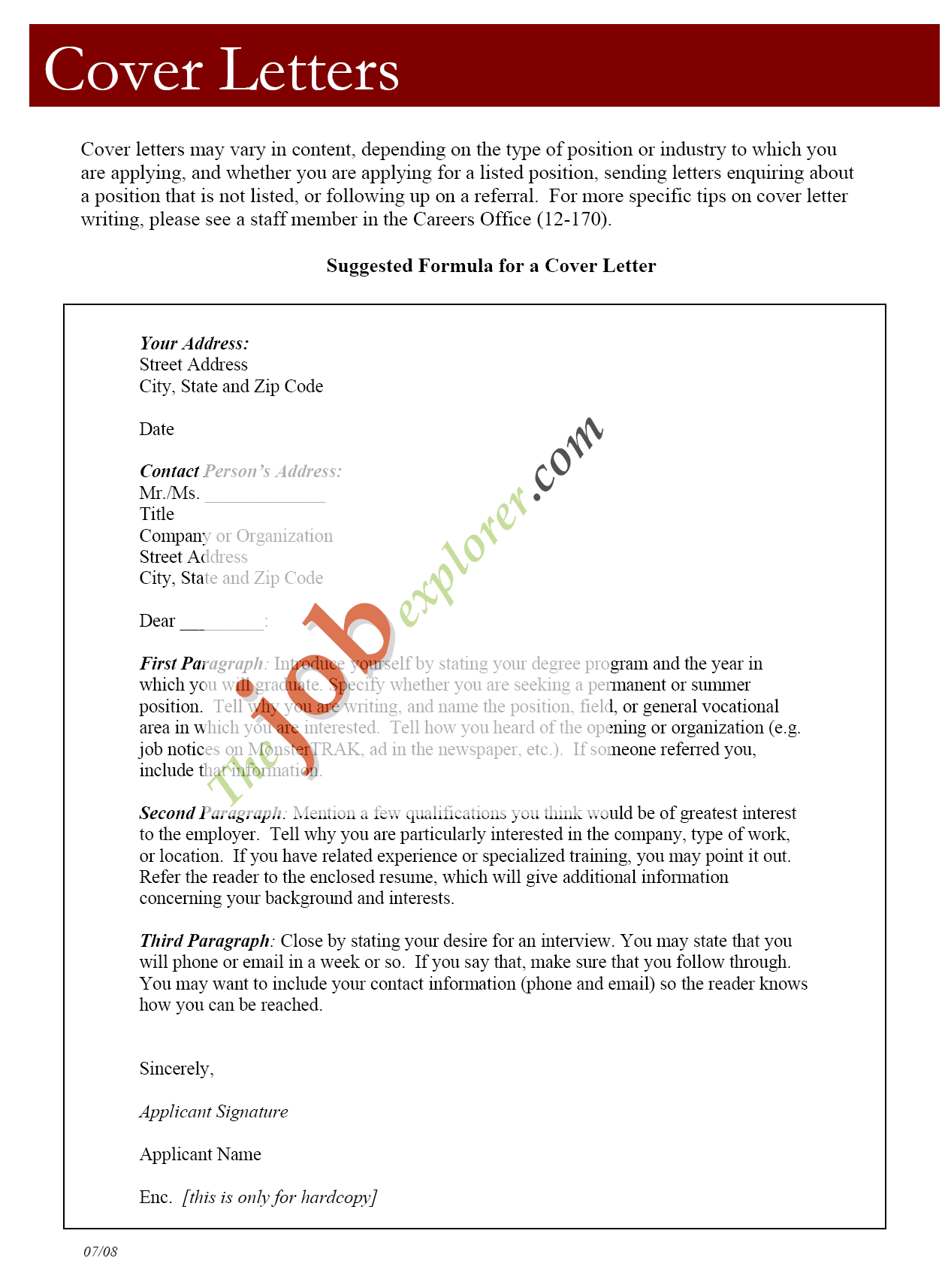
    Uncover the Tricks for an Outstanding Cover Letter

    We all know that a resume is a necessary tool when you set off to go job hunting. However, not a lot of people are aware that they should submit a cover letter along with their resume.

    Writing a cover letter though requires patience and attention to detail. However, once you have prepared a good resume for yourself, a cover letter will be manageable to craft within a few hours. The thing to remember about a cover letter is that a generic one is a no-no; you should always tailor it according to your target job. To do this, here are the tricks to keep in mind:

    Understand what your target position needs

    However, sometimes it will take you two or three passes to process what the essentials are. As such, when you see a job posting you are interested in , don’t be keyboard-happy and send your resume right away. Take the time to read the qualifications and skills required for the position and be sure to note a commonality. The most common thing you find out about them will be the one to highlight in your cover letter.

    Summarize your qualifications

    This is similar to the qualifications summary in your resume where you detail your job positions, core competencies, industry, length of experience, strengths, accomplishments, and educational experience. In this part, ensure that you are providing information that is relevant to the position you are applying for. For example, say you take pride in your email communication skills, but you are applying to a direct sales representative role. In this instance, you can play up your interpersonal skills and outgoing personality and mention your persuasive skills, but your writing skills may have to take a backseat.

    Align your strengths with the prioritized requirement

    If you are looking to apply as a shift supervisor at a busy café, what do you think is the most important quality that the hiring manager or recruiter will look for? The first thing an employer might look for in this role is a candidate who can provide efficient service and a positive environment. Once you know that, you can do a self-evaluation and look for your skill that best fits this necessity. For example, you worked as a supervisor at a clothing store at a busy mall during Christmas time; this will catch the attention of a prospective employer of a busy commercial establishment.

    Research the company

    A cover letter is essentially about you, but hiring managers and recruiters will also want to know how you fit into their team. This is the part when you have to take the time and do research on the company you are applying to. Find out about their mission and vision. Research their company values. Discover what foundations or organizations they support. Once you have researched these aspects, you can find something that speaks to you.

    A cover letter complements your resume, and it should not be taken for granted. It gives the hiring manager or recruiter a glimpse of what you can offer them. A cover letter can also distinguish whether they should have a look at your resume or throw it away. Follow the tips above and you will be on your way to having a cover letter that grabs attention.

    SOURCES:

    https://blog.livecareer.com/how-to-tailor-your-cover-letter-the-easy-way/

    http://careers.workopolis.com/advice/how-to-tailor-your-resume-to-any-job-posting/

    http://www.bubble-jobs.co.uk/blog/b2c/tailor-write-cover-letter/

  • Dressing Up Your Resume: Knowing the Essentials

    Dressing Up Your Resume: Knowing the Essentials

    Job hunting is a grueling process so you would like to have the right tools to make it a less grueling task, and the best way to do that is to have a well-written resume. A resume reflects what you have to offer, and if it does not succeed in doing that, it will end up in the bin (harsh, I know).

    As such, Think of preparing a resume to dressing up for the job interview itself:  Wear your best suit or dress, your best hairstyle, your best pair of shoes, and your best accessories. Below is a short guide on how your resume should be dressed for success:

    Objective

    If you are meeting a friend you have not seen for a long time at an unfamiliar restaurant or café, the first thing you do is research for directions to get there. If you don’t, you might end up at the wrong place; this applies when you are preparing your resume. . The objective should clearly state to the Hiring Manager or Recruiter what position or job title you are applying to. Otherwise, you will end up going through the application process for a job you are not interested in or might not like at all. Or because your objective is unclear, the recruiter may pass on your resume altogether.

    As such, when writing your objective, keep in mind the position you are aiming for, the key skills that make you qualified for the position, and the benefits or values that you bring to the table. If you are an aspiring digital marketing freelance writer, for example, a good objective is “Well-versed digital marketing specialist who aims to be part of an online marketing team to craft strategic copies and campaigns which focus on brand establishment and loyalty.”

    Qualifications Summary

    We all want to put our best foot forward in a resume, but you do not want to give away too much information that will give your readers a difficult time. Thus, instead of listing down all your qualifications, be sure to condense them coherently so it is readily apparent what you can offerthe company.

    To summarize your qualifications, the key points to include are: Title, core competencies, industry, length of experience, strengths, combination of accomplishment highlights, and academic experience. You can also mention language skills, technical skills, and personal profile. Some examples are:

    • Self-motivated and customer service-focused supervisor with two years of experience in retail and customer service industries providing exceptional frontline assistance.
    • Demonstrates outstanding time management skills and prioritization skills.
    • A Journalism graduate at Ryerson University who is a well-articulate communicator fluent in English and French and proficient in Microsoft Office Suite, Customer Relationship Management systems, and Sales Force.

    Professional Experience

    When noting your professional experience, conciseness is key since you would not want too many details which might make your resume longer than necessary. To start on a good note, remember this simple format: company name, city and state, month and year of employment, and position title.

    A rather easy part of putting your professional experience on paper is that you do not necessarily have to be creative as the primary focus is to list your job descriptions. You can refer to your contract. If that is not available, you can refer to internet postings or detailed classified ads in newspapers.  Do not merely copy or paste, though. You have to relay how you performed on those respective responsibilities. Highlight your accomplishments and provide statistics when you can. For example, we all know what a customer service representative does, but what made you different from the rest? Write “Achieved 95% quality score in the first year” or “Increased sales performance for the campaign by 5% in the first quarter.”

    Educational Attainment

    As high school or college or university graduates, you are not expected to have a lot of information under educational attainment like an MBA or Ph.D. as compared to those who have been working for several years. However, realize that job search is truly competitive and you would like to stand out from the rest by highlighting your skills as a student.

    So apart from noting down your degree or coursework, you can also mention your extra-curricular activities like sports or participation in the school newspaper. You can also mention your leadership skills and say you were elected as Treasurer in Senior Year or you represented your class in school board meetings.

    Readying a resume is overwhelming for newcomers and old-timers to the job search process. However, once you take note of those essentials above, you can get the hang of it and you will have your resume all dressed up to get the job.

    SOURCES:

    Resume Magic – Trade Secrets of a Professional Resume Writer by Susan Britton Whitcomb (Book)

    https://www.thebalance.com/what-do-employers-look-for-in-a-resume-4050949

    https://www.glassdoor.com/blog/4-employers-resumes/

  • Career Profile: Medical Laboratory Assistant

    Career Profile: Medical Laboratory Assistant

    Medical laboratory assistants are also known as medical laboratory technicians, and as the name implies, these health care professionals work in medical laboratories. There is some overlap in the roles of medical laboratory assistants and medical laboratory technologists, so read on for more information!

    What is the role of a medical laboratory assistant?

    Medical laboratory assistants work under the supervision of physicians, medical laboratory technologists, or other health care professionals. A common task is processing specimens for analysis by a technologist in the same lab. Educational programs often emphasize phlebotomy skills, as medical laboratory assistants are primarily responsible for collecting blood samples. In addition, the ability to perform ECGs (electrocardiograms) Holter monitoring means medical laboratory assistants have a certain degree of patient interaction.

    What is the difference between a medical laboratory assistant and a medical laboratory technologist?

    Though the names of these careers are similar, they are not the same. Medical laboratory technologists are trained to perform more tasks than medical laboratory assistants (hence their programs of study are longer). In addition, the work of medical laboratory assistant centers on pre-analytical and data-entry tasks. Technologists perform the actual analysis of specimens, using various analyzers and special tests.

    Where do medical laboratory assistants work?

    Most medical laboratory assistants find employment in hospitals, working in their laboratories and phlebotomy teams. Because they are trained to take blood, they may also work in doctor’s offices and blood donor testing centres.

    How do you become a medical laboratory assistant?

    There are many medical laboratory assistant programs across Canada. These programs are typically found in community colleges, and last around a year. When comparing programs, don’t look at just the tuition costs, but ensure that the program you want to enroll in offers a clinical placement. Clinical placements give you invaluable work experience and a start on career networking.

    Becoming a medical laboratory technician is for those interested in a combination of lab work and patient interaction. The added advantage is the educational programs are typically short, allowing you to hit the workplace as soon as possible!

    References:

    1. http://www.medixcollege.ca/Programs/MedicalLabAssistantTechnician
    2. http://www.centennialcollege.ca/programs-courses/full-time/medical-laboratory-technician/
    3. http://www.cmlto.com/index.php?option=com_content&view=article&id=1356&Itemid=281
    4. http://www.osmt.org/content/index.php?pid=2&cid=24
    5. http://michener.ca/program/medical-laboratory-science/

    https://www.trade-schools.ca/programs/medical-lab-technician.asp

  • “Sorry, What Did You Say?” How to Become a Better Listener, and Why It Is Essential for Success.

    “Sorry, What Did You Say?” How to Become a Better Listener, and Why It Is Essential for Success.

    Imagine one of your classmates went up to the front of the room right now and gave a ten-minute presentation. Immediately after the presentation, would you be able to confidently recite all the information that was just given? Most of us would probably like to say yes, but what if I told you immediately after a ten-minute presentation you will likely only retain about half of what the presenter just said. After 48 hours that number splits in half, leaving you with only about a quarter of the original information. It’s easy to see how problematic and ineffective this is for a student when trying to learn, especially when beginning post-secondary. There must be a better way to effectively learn and understand information, which leads to more personal, academic, and professional success. Thankfully, there is! The answer is becoming a better, more effective listener. If your listening skills aren’t your greatest asset, don’t worry. We’ll look at some different strategies on how to get you there.  Here are some (but not all) of the ways you can improve your listening skills.

    DO:

    • Keep eye contact with the speaker.
    • Remain focused and attentive.
    • Ask questions at appropriate times.
    • Anticipate what the speaker is going to say next. This will help ensure you are remaining focused while properly understanding what is being said.
    • Make short, mental summaries of what has just been said.
    • Identify the key aspects of the speakers point, and how it’s relevant.
    • Take an interest in what the speaker is saying.
    • Put away all distractions (like your phone or laptop) and give the speaker your full attention.
    • Connect what is being said to experiences in your own life.
    • Observe non-verbal communication, such as body language.
    • Be aware of your own body language. Nodding off, a loss of eye contact or inappropriate posture indicate a loss of interest to the speaker.

    DO NOT:

    • Fall into the, “this is boring” trap. Telling yourself the topic at hand is uninteresting will leave you struggling to remain focused and will drift your attention elsewhere.
    • Pretend to be listening. Better listening skills will help you retain information more effectively. Simply pretending to be listening won’t help you improve.
    • Switch your attention to what you are going to say next, rather than what is being said right now.
    • Allow bias to cloud your perception. Open your mind to all possible areas of the topic, even if you don’t agree.
    • Try to pay attention to more than one thing at a time. Give your speaker the respect you would want if you were in their positon.
    • Give into selected hearing. Only hearing bits and pieces of what the speaker is saying does not allow you to fully comprehend the subject.

    How will becoming a better learner help you?

    The first answer that may pop into your head is that being a better listener means a lesser need to cram before exams. Once you understand and retain information more effectively, you won’t need to re-teach yourself the information you didn’t retain during the lesson. When listening effectively, reviewing your material afterwards should be all you need. This is especially crucial in post-secondary. Many professors only speak during lectures without providing written notes, leaving you responsible to effectively listen, interpret and retain the given information.

    You may have also considered the personal benefits of becoming a better listener. Effective listening and communicational skills are key aspects to stronger personal relationships. Remaining attentive, focused, and interested in what another person is saying allows you to better understand someone’s perspective, leading to stronger connections and more meaningful conversations.

    Did the professional benefits of becoming a better listener cross your mind as well? One of the main skills employers are searching for in younger generations of employees is strong listening and communication skills. Set yourself apart from other candidates by strengthening your listening skills before entering the workforce.

    Remember like all skills, being an effective listener won’t happen overnight. With time, practice and a conscious desire for change, your listening skills will improve before you know it.

  • Career Profile: What is a Bioinformatics Scientist?

    Career Profile: What is a Bioinformatics Scientist?

    Bioinformatics is an exciting, emerging field of science that combines two seemingly unrelated fields: biology and computer programming. A bioinformatics scientist is someone who is trained to analyze biological data using computer software. Computers have become so ubiquitous and their capabilities so advanced that we can apply their power to helping answer questions regarding gene function, protein structure, molecular evolution, drug targets, and disease mechanisms. If this sounds like something you would be interested in pursuing, read on for more information on this career.

    How do I become a bioinformatics scientist?

    Bioinformatics scientists require extensive education. After earning a four-year undergraduate degree in biology or computer programming, the aspiring scientist would pursue graduate studies. It is usually during this time that you would specialize in bioinformatics. To work as a bioinformatics scientist, you need at least a Master’s degree or preferably a PhD in this field—note that these programs are a minimum of five years. Alternatively, you may attend medical school and then after graduation, enroll in further training specifically in bioinformatics. All in all, bioinformatics is a complex field and you need to be prepared to study for several years.

    Where do bioinformatics scientists work?

    Bioinformatics scientists are in high demand! They may work for a variety of employers, including universities, hospitals, private corporations, and government agencies. Bioinformatics scientists, given their specialized knowledge, are commonly asked to consult with other scientists and researchers. If hired by a university, they may have their own lab, supervising laboratory technicians and mentoring students. The working hours are typical nine-to-five, but longer hours or weekend work may be required.

    What is the career outlook for bioinformatics scientists?

    Very positive, in fact! The average US salary is a very comfortable $75,000. A quick search on Glassdoor indicated that in Canada, average salaries are around the same figure. Salaries are likely to increase as demand goes up—and demand is expected to rise. In the US, this career has grown by 16% since 2004 and 7,170 vacancies are expected to be filled by 2018.

    Becoming a bioinformatics scientist is a difficult but rewarding career choice. If you love biology and you love computers, this may just be the perfect fit for you!

    References:

    1. http://www.senecacollege.ca/fulltime/BIF.html
    2. http://study.com/articles/Bioinformatician_Job_Description_Duties_and_Requirements.html
    3. http://www.sciencebuddies.org/science-engineering-careers/health/bioinformatics-scientist#keyfactsinformation
    4. http://www.sciencebuddies.org/science-engineering-careers/health/bioinformatics-scientist#onthejob
    5. https://www.sokanu.com/careers/bioinformatics-scientist/
    6. https://www.glassdoor.ca/Salaries/bioinformatician-salary-SRCH_KO0,16.htm
    7. https://www.recruiter.com/careers/bioinformatics-scientists/outlook/
  • Don’t Be Late- Why Being on Time Matters Now and Why It Will in Post-Secondary

    Don’t Be Late- Why Being on Time Matters Now and Why It Will in Post-Secondary

    Some people feel as if they spend most of their time waiting. Others are always late for supper, for parties, or even for work or school. Everyone is late at some point in their lives, but being on time is important, especially as people finish high school and move on to post-secondary classes and jobs. No matter how many years you still have left before you graduate, it will help you in the future if you already develop a habit of being on time.

    What happens if students arrive late at your school?  Do they have to go to the office to get a late slip or do they just go to class? Some schools are very strict about punctuality but others are not. Many university professors also allow their students to miss classes or to arrive late, but others require regular attendance and punctuality. Even if you are allowed to be late, you should try to be on time. That way, you can be sure not to miss anything important.

    Being on time can help you deal well with your classmates, as well.  Many courses include group projects, and you will need to meet with your classmates to work on an assignment. Being a few minutes late might not matter, but if you keep your classmates waiting too often, they might not want to work with you again.

    Learning to be on time is good for many reasons. It shows respect for other people’s schedules and commitments. If you keep your friends waiting, you might make them late for their appointments. If you are punctual, people will see you as reliable and will trust you with more responsibility than if you’re always late. That will be especially important when you start to look for work.

    Punctuality is also important for many employers. Being late too often might get you fired or cause other problems for you at work. Suppose that you worked at a restaurant during the afternoons. If your replacement for the evening always arrived late, you might miss your supper or be unable to go to a party or other event. At a hospital, being late for work might affect a patient’s health. Factory work, truck driving, and many other jobs depend heavily on punctuality. Employees can even lose their jobs if they are late too often.

    If you are normally on time for school and appointments, you can keep on developing your good habits. If you tend to be late, you can already start to develop the habit of being on time. Many different techniques can help you to become more punctual. Writing out a schedule or putting it onto your phone or other device will help. If possible, allow yourself an extra ten or fifteen minutes to get to each appointment. If that isn’t possible, you should at least try to leave as early as you can.

    Suppose that you could take two different buses to school. One gets you there ten minutes before class and the other arrives two minutes early. You might think that the second bus is good enough, since it still gets you to school on time. However, thinking that way might end up making you late far too often. What happens if traffic is slow because of bad weather or an accident or construction on the road? Even a short delay might make you late.

    While you’re in school, you might not have a lot of choices about your schedule during the day. Before or after school hours, you have much more choice. Then you can decide to become involved in activities that best suit your personality and habits. Choosing an activity for the part of the day when you can control your schedule and be alert and energetic will help you not to be late. If you learn to say “no” to activities that will make your schedule too full, that will also help you to be on time.

    Being late can cause problems for you and for the people around you, but you can develop the habit of being on time. People will appreciate your efforts, and many parts of your life will be easier.

    Bibliography:

    Benefits Canada. “Top 12 excuses workers have used for being late.” http://www.benefitscanada.com/news/top-12-excuses-workers-have-used-for-being-late-49879.

    Ketchum, Dan. “Why is Punctuality Important in the Workplace?” http://smallbusiness.chron.com/punctuality-important-workplace-10253.html.

    Prolific Living. “The Importance of Being Punctual.”  http://www.prolificliving.com/the-importance-of-being-punctual/.

    Wakefield Council. “School Attendance Matters – a Parent’s Guide to Good Attendance.”

    http://www.wakefield.gov.uk/residents/schools-and-children/supporting-families/education-welfare-service/school-attendance-matters.

  • Dress to Impress: How to Dress for Your Job or Scholarship Interview

    Dress to Impress: How to Dress for Your Job or Scholarship Interview

    By Gavin Mercier

    Your outfit says a lot about yourself – oftentimes before you even get a chance to say anything. In high pressure situations such as job interviews, you want to be doing the talking, not your clothing. Think of your clothes as a picture frame and yourself as the picture: the frame is meant to show off the picture, not to take away from it.

    Now, there isn’t a single “go-to” outfit that you can wear to every job interview. Every interview is different, as is every person. It is important to know what kind of attire your interviewer is expecting. This can vary based on what kind of job you are interviewing for, but typically you can expect business casual for non-professional jobs. This is different for men and women, but that doesn’t mean it’s hard.

    Men

    Let’s start from the bottom. While shoes aren’t exactly a focal point, they’re an important part of your outfit. Dark, plain coloured shoes with same-coloured laces are ideal (I prefer black). Don’t worry about leather shoes for business casual. You shouldn’t have to worry about your socks, either – unless they’re clearly visible. Next, your pants. Simple, solid-coloured pants are fine, nothing to fancy. Dark or light isn’t crucial (although khaki is a safe bet), just as long as it matches the rest of your outfit. Finally, wear a long-sleeved collared shirt. Colour isn’t important, but don’t pick something too bright – and make sure it matches.

    Women

    Again starting from the bottom, flats or low heels are fine in the shoe department. Dark or plain shoes are always a safe choice. Moving on to pants, there are plenty of options available. First, dark pants are good – especially when worn with a blazer. Skirts are also a respectable look – although it goes without saying to make sure the length is appropriate. A dress is another good option provided it isn’t too flashy or extravagant. For your top, a simple sweater works just fine. However, you could choose to throw a blazer or cardigan overtop of a nice shirt as an alternative. Patterned or plain doesn’t matter, as long as it looks nice and has a professional cut.

    Everyone

    There are a couple things everyone should remember about dress code. For one, hats are a big no-no in almost every situation, unless they are relevant to the job you are applying for. Secondly, winter coats. While this isn’t as important or specific as any of the other items, if you have a bright or flashy snowboard jacket, consider wearing something of a plainer style. Again, this is only relevant if your jacket is REALLY out there. For most instances, you shouldn’t have worry.

    Job interviews are stressful enough without having to worry about your outfit. All of your attention should be focused on your interview and making a positive first impression on your potential employer. Hopefully, with this article, you’ll be able to think less about your outfit and more about getting that job.