Tag: apprenticeship

  • Machinist

    Machinist

    Fully qualified machinists possess the knowledge and abilities to set up and machine using conventional, portable and Computer Numerical Control (CNC) machines that cut or grind metal and other materials into products with precise dimensions. These machines include lathes, milling machines, saws, grinding machines, drilling machines, boring machines, line borers and portable milling machines.

    Machinists work from drawings, specifications and their own measurements to calculate dimensions, tolerances and types of fit. Precise measurements are critical to machinists’ work. They must be knowledgeable about the properties of metals and non-metallic materials.

    Machinists may work in industries where machines are manufactured, repaired or used. These may include industries that manufacture machinery equipment, motor vehicle or aerospace parts. Machinists produce precision parts that are used in all aspects of manufacturing. They may also work in shipyards, rail yards, refineries, pulp and paper mills, mines, smelters, metal fabricating and repair shops. Shiftwork is common in some companies. Machinists tend to work indoors.

    Safety is important at all times. There are risks of injury working with moving machine parts, sharp edges, flying debris and extreme temperatures from heated or chilled materials. Precautions are required while working with manufacturing chemicals and airborne irritants.

    Key attributes for people entering this trade are: communication skills, mechanical aptitude, hand-eye coordination, manual dexterity, an ability to work independently and knowledge of mathematics and physics. The work often requires considerable standing and the handling of heavy objects. This analysis recognizes similarities or overlaps with the work of other tradespeople such as tool and die makers, mould makers, welders and industrial mechanics (millwrights).

    Experienced machinists may move into supervisory positions. With additional training, they may transfer their skills to related occupations such as tool and die maker, mould maker, industrial mechanic (millwright) or CNC programmer.

  • Hot Jobs: Careers in Trades

    Hot Jobs: Careers in Trades

    The trades sector in Canada is constantly growing and changing. So how do you know which career path is right for you? Here at Jobs People Do, we’ve assembled a list of some of the hottest jobs in the trades industry that will be in high demand for years to come. Take a look at just some of your options and then click on the link to be taken directly to career information. Find out what kind of education you will need and how much you can expect to be paid.

    Aboriginal Child Development Practitioner
    Agricultural – Dairy Herdsperson
    Agricultural – Fruit Grower
    Agricultural – Swine Herdsperson
    Agricultural Equipment Technician
    Alignment and Brakes Technician
    Appliance Service Technician
    Arborist
    Architectural Glass and Metal Technician
    Assistant Cook
    Auto Body and Collision Damage Repairer
    Auto Body Repairer
    Automotive Electronic Accessory Technician
    Automotive Glass Technician
    Automotive Painter
    Automotive Service Technician
    Baker
    Baker-Patissier
    Bearings Mechanic
    Blacksmith
    Brick and Stone Mason
    Cabinetmaker
    Cement (Concrete) Finisher
    Chef
    Child and Youth Worker
    Child Development Practitioner
    Composite Structures Technician
    Computer Numerical Control (CNC) Programmer
    Concrete Pump Operator
    Construction Boilermaker
    Construction Craft Worker
    Construction Millwright
    Cook
    Developmental Services Worker
    Die Designer
    Draftsperson – Mechanical
    Draftsperson – Plastic Mould Design
    Draftsperson – Tool and Die Design
    Drywall Acoustic and Lathing Applicator
    Drywall Finisher and Plasterer
    Educational Assistant
    Electric Motor System Technician
    Electrical Control (Machine) Builder
    Electrician – Construction and Maintenance
    Electrician – Domestic and Rural
    Electrician (Signal Maintenance)
    Electronic Service Technician
    Elevating Devices Mechanic
    Entertainment Industry Power Technician
    Exterior Insulated Finish Systems Mechanic
    Facilities Mechanic
    Facilities Technician
    Fitter – Assembler (Motor Assembly)
    Floor Covering Installer
    Fuel and Electrical Systems Technician
    Gemsetter / Goldsmith
    General Carpenter
    General Machinist
    Hairstylist
    Hardware, Lumber and Building Materials Retailer
    Hazardous Materials Worker
    Heat and Frost Insulator
    Heavy Duty Equipment Technician
    Heavy Equipment Operator – Dozer
    Heavy Equipment Operator – Excavator
    Heavy Equipment Operator – Tractor Loader Backhoe
    Hoisting Engineer – Mobile Crane Operator 1
    Hoisting Engineer – Mobile Crane Operator 2
    Hoisting Engineer – Tower Crane Operator
    Horse Groomer
    Horse Harness Maker
    Horticultural Technician
    Hydraulic / Pneumatic Mechanic
    Industrial Electrician
    Industrial Mechanic Millwright
    Information Technology – Contact Centre Customer Service Agent
    Information Technology – Contact Centre Sales Agent
    Information Technology – Contact Centre Technical Support Agent
    Information Technology – Hardware Technician
    Information Technology – Network Technician
    Institutional Cook
    Instrumentation and Control Technician
    Ironworker – Generalist
    Ironworker – Structural and Ornamental
    Light Rail Overhead Contact Systems Lineperson
    Locksmith
    Machine Tool Builder and Integrator
    Marine Engine Technician
    Metal Fabricator (Fitter)
    Micro Electronics Manufacturer
    Motive Power Machinist
    Motorcycle Technician
    Mould Designer
    Mould Maker
    Mould or Die Finisher
    Native Clothing and Crafts Artisan
    Native Residential Construction Worker
    Network Cabling Specialist
    Optics Technician (Lens and Prism Maker)
    Packaging Machine Mechanic
    Painter and Decorator – Commercial and Residential
    Painter and Decorator – Industrial
    Parts Technician
    Pattern Maker
    Plumber
    Pool, Hot Tub and Spa – Installer
    Pool, Hot Tub and Spa – Service Technician
    Powered Lift Truck Technician
    Powerline Technician
    Precast Concrete Erector
    Precast Concrete Finisher
    Precision Metal Fabricator
    Pressure Systems Welder
    Process Operator – Food Manufacturing
    Process Operator – Power
    Process Operator – Refinery, Chemical, and Liquid Processes
    Process Operator – Wood Products
    Pump Systems Installer
    Railway Car Technician
    Recreation Vehicle Technician
    Refractory Mason
    Refrigeration and Air Conditioning Systems Mechanic
    Reinforcing Rodworker
    Relay and Instrumentation Technician
    Residential (Low Rise) Sheet Metal Installer
    Residential Air Conditioning Systems Mechanic
    Restoration Mason
    Retail Meat Cutter
    Roll Grinder / Turner
    Roofer
    Saddlery
    Saw Filer / Fitter
    Sheet Metal Worker
    Ski Lift Mechanic
    Small Engine Technician
    Special Events Coordinator
    Sprinkler and Fire Protection Installer
    Steamfitter
    Surface Blaster
    Surface Mount Assembler
    Terrazzo, Tile, and Marble Setter
    Thin Film Technician
    Tire, Wheel and Rim Mechanic
    Tool / Tooling Maker
    Tool and Cutter Grinder
    Tool and Die Maker
    Tool and Gauge Inspector
    Tractor-Trailer Commercial Driver
    Transmission Technician
    Truck and Coach Technician
    Truck-Trailer Service Technician
    Turf Equipment Technician
    Utility Arborist
    Water Well Driller
    Welder
    Wooden Boat Rebuilder
  • Career Profile: Blacksmith

    Career Profile: Blacksmith

    Some jobs never go out of style. Doctors, for example, are always necessary because people continue to get sick. Teaching methods might change a lot over the years, but students will always need people to help them gain the knowledge and skills they need for life. Other jobs seem to disappear over time, but they might still be important, even if they change a lot. For example, blacksmiths used to be essential in the days before factories produced all kinds of metal and plastic goods, but their work is almost unknown now. However, blacksmiths still have an important role in society.

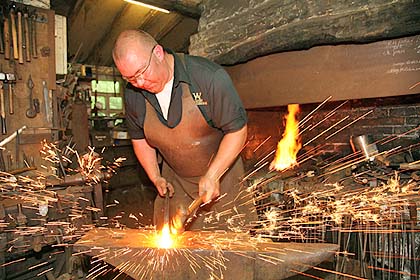
    In the past, blacksmiths worked mainly in small shops, using hot fires in forges to soften metal enough so that they could pound it into horseshoes, fence posts and much more. These days, very few people ride horses, and the discovery of steel has made metals like iron much less popular than they once were. However, blacksmiths still work in making all kinds of things, such as ornamental metal railings and plastic parts for larger objects. Many blacksmiths work in factories rather than in their own shops, but many of the basic techniques are similar to what they used to do.

    Basically, blacksmith work involves shaping metal and other materials into different shapes. Often, the material has to be heated up before the blacksmith can work with it. When metal is hot enough, the blacksmith can pound it with hammers or bend it using strong tools until it becomes something new. In factories where machines do much of the work of shaping and molding objects, blacksmiths might spend much of their time setting up and maintaining the machines to make sure that they are working properly. In small businesses, like those that produce souvenirs for tourists or ornamental metalwork, the job might resemble the traditional blacksmith’s role.

    No special education is necessary for becoming a blacksmith, but a high school diploma is helpful. Good mathematical skills are important for being able to calculate amounts, weights and prices. For ornamental blacksmiths, an education or training in the fine arts is helpful, but not always necessary. The most important training for blacksmiths is learning from others in their field. Official apprenticeships are good options, but informal training can also help. If you are interested in blacksmith work, you can already try to find mentors who can guide you through the process of learning what you need to know.

    If you want to become a blacksmith, you can already talk with people who are working at the kind of job that you want to do. You might even be able to work at a small blacksmith shop on Saturdays or help out in the summer. Depending on where you end up working, you might make the standard blacksmith’s salary of about $29,000 per year or you might have an irregular wage, depending on tourism and other factors.  Does a career as a blacksmith sound good to you? Why not start to prepare for your career now?

  • Career Profile: Florist

    Career Profile: Florist

    One of the very nice parts of spring is the time when the flowers begin to bloom again. When the snow melts, the return of crocuses and daffodils is a sign that spring has finally arrived and that the cold weather is almost over. During the short summer season, many people grow gardens with daisies, roses, and many other kinds of flowers to enjoy before the winter comes again. Do you like the spring and summer flowers? What if you could work with flowers all year? As a florist, you could work at arranging and selling flowers to people for all kinds of occasions.

    If you ever buy flowers, you probably know a bit about what florists do. Many florists work in shops where they sell flowers to customers and advise them about what kinds of plants look nice together. However, being a florist can involve much more than that.

    Many people who want to work with flowers attend classes at a place like the International Florist Academy and School in Montreal. Students learn how to put together flower arrangements and learn about topics like European floral design and balloon art. They learn the basic techniques of wrapping flowers but also work with colour and design to produce the best possible arrangement, and also learn about basic care of flowers. Having a natural ability with flowers is good, but a program like this helps students to gain a broader knowledge of their work.

    Even for people with formal training, working as a florist often means beginning with sales and learning on the job. Contacting various flower shops and grocery stores is a good way to find work. Pay for jobs in florist shops often starts at minimum wage and can go up to about $17.00 per hour.

    At first, the job might involve tasks like talking to customers in person or on the phone, wrapping up flowers and sweeping up fallen leaves and branches from the floor. As employees learn more about the work, they might progress to flower arranging and later to ordering flower shipments from other countries. Many of the flowers that people in Canada buy come from warm countries in the Middle East or Africa. Learning to arrange shipments of flowers is an important part of working as a florist.

    Special occasions are important times for florists. Weddings, graduations, funerals and Mother’s Day traditionally involve flowers, and florists have to be ready to fill their customers’ orders. Different occasions require different types of flower arrangements, and florists need to be prepared for whatever customers want. Knowing what people normally like for these occasions is helpful, since then florists can have the right flowers ready to arrange.

    Creativity is often very helpful. Florists who can produce unusual and beautiful arrangements, using flowers that people rarely buy, might find it easier to attract customers than florists who stay with the traditional arrangements and colour combinations. If you love flowers and can combine tradition and innovation, a career as a florist might be right for you.

  • Transmission Technician

    Transmission Technician

    Transmission technicians specialize in the maintenance and repair of automatic transmissions. They must be skilled at examining a vehicle and estimating the repair costs, using computerized diagnostic equipment, taking apart the transmission and replacing damaged parts, and testing the vehicle’s performance. Transmission technicians also perform routine inspections and preventative maintenance.

    Certification Requirements
    • The Transmission Technician apprenticeship consists of 6,000 hours of on-the-job training.
    • Apprentices must also complete two 8-week in-class technical training sessions.
    • Once you have successfully completed the apprenticeship requirements, you receive a Certificate of Apprenticeship and are considered a journeyperson candidate. You must challenge the Certificate of Qualification exam and pass to become certified as a journeyperson and be legally allowed to work in the trade in Ontario.
    • A person with at least 6,480 hours of related work experience is eligible to apply for a Trade Equivalency Assessment (TEA) and challenge the Certificate of Qualification exam to become certified as a journeyperson in this trade.
    Educational Prerequisites

    Grade 12 or equivalent.

  • Roofer

    Roofer

    Roofers install, repair and replace flat and sloped roofs. They work with membrane roofing systems that consist of a variety of materials with different application methods. They also install, replace and repair shingles, slate, shakes, roofing tiles, sheet metal and other preformed sheeting on sloped roofs.

    Before the work begins, roofers may inspect existing roof systems and determine the extent and procedure for repair of the substrate or removal and replacement of roofing materials. Some roofers may be involved in the estimating of material and installation costs.

    As part of the job preparation, roofers may set up scaffolding to provide safe access to the work area and may install fall protection systems. They also weatherproof, waterproof and damp-proof roofing surfaces, foundation walls, floor slabs and bridge decks. They install roofing accessories such as sheet metal flashings, roof vent flashings, anchor bolt flashings, drain inserts and clamps.

    Roofers may be employed by roofing companies, general contractors or they may be self-employed. They may work on all types of roofs or may specialize in the flat or low sloped roofs of commercial and industrial buildings or on the steep sloped roofs found in most residential buildings.

    Key attributes for people in this trade are mechanical aptitude, manual dexterity and the ability to work as a team. Roofers work primarily outdoors and work may be seasonal. The work environment is exposed and may vary from extreme cold to extreme heat. Roofing is physically demanding work and requires considerable effort in lifting, climbing, bending, kneeling and balancing on high, sloped and sometimes slippery surfaces.

    Roofers work in conjunction with other tradespeople in the construction trades. With additional training, roofers may transfer their skills to related occupations such as carpenter or sheet metal worker. With experience, they may advance to positions such as supervisors, contractors or inspectors.

  • Choosing To Work In A Trade

    Choosing To Work In A Trade

    Times have changed in the world of jobs. You might have heard from your parents or teachers that the best way to get a high-paid, reliable job is through a university education. Sometimes that still holds true. These days, however, a better choice for both men and women might be a skilled trade, where there are many opportunities for a rewarding career.

    What comes to your mind when you hear the term “trade”? Do you think of low-paid labourers, barely making enough money to pay their bills and never sure how much longer their jobs will last? Many unskilled labourers work under these conditions, but the situation is different for skilled tradespeople. They are often well-educated, with diplomas or certificates in their fields.

    Tradespeople might have as much education as university graduates. Unlike many university programs, however, training in the trades is geared specifically to learning the practical skills needed on the job. Tradespeople might be trained as carpenters, auto mechanics, electricians or any of the other trades. Through practical work and classroom studies, they learn everything they need to know to work in their trades. Another important part of the training process in the trades is an apprenticeship, in which students work together with an experienced person to learn practical skills for the job. For some trades they might also need to get an official license or certificate.

    Becoming qualified in a trade can take from one to three years of classroom education, between two and four years of apprenticeship, and two or three years of on-the-job training. Many university programs are just as long or even longer and more expensive. Graduates can also have trouble finding work in their field. In contrast, tradespeople can usually find work soon after they finish their studies and can easily pay off any loans they received for their school tuition.

    Almost anyone can become qualified to work in a trade. Most tradespeople, about 97 % in 2007, are men. However, more women are joining the trades and becoming qualified to work in carpentry, welding and other skilled trades. Possibly up to 320,000 people in Canada currently working in construction alone will be retiring in the next few years and that could open up good opportunities for both men and women. Becoming a journeyperson (someone with official qualifications in a skilled trade) could be a wise career move.

    How do you know if you could be successful in skilled trade? Natural ability and interest are important places to start. If you love to take things apart to see how they work, you might want to choose to be a mechanic or electrician. If you have a fear of heights, on the other hand, you might not want to choose the construction industry. The best way to decide whether or not a trade would suit you is to research it and to talk with people about it. Then, if you decide to pursue a trade, you’ll have a good basis for a stable and rewarding lifelong career.

  • Career Profile: Glazier

    Career Profile: Glazier

    Every building has windows, and almost every room in a building has windows with glass in them. Some windows have fancy stained glass and others have plain glass, but they all have one thing in common. All of these windows required the work of a glazier – a specialist in glass. Glaziers are tradespeople who cut glass and fit it into various shapes and sizes of window. They work in new buildings, but they also help to repair breaks and to restore windows to their best condition. Being a glazier involves a combination of knowledge and skills in a trade that many people can enjoy.

    Windows come in many different forms. They can be the small ones in car doors, the glass in kitchen windows, large storefront windows, or even skylights on the roofs of buildings. Some glass even comes in several different colours for making stained glass windows. Glaziers install and repair all of these different types of glass. They have to be able to measure spaces where the glass will go and know how to use power tools with breakable material.

    Working as a glazier can be somewhat difficult. Sometimes glaziers get cuts from either the metal edges or from broken glass, and they have to be careful how they work. They might work with poisonous chemicals or be injured from lifting heavy pieces of glass. Glaziers work together with others to lift the glass into place, but they still need a certain amount of physical strength and an ability to climb ladders and manage heights. Although the job does not normally require great strength, it requires some physical ability and stamina.

    People become glaziers through a combination of education and experience. Besides being able to cut glass and fit it into metal, they often need to be able to read blueprints and to estimate costs for projects. Vocational training or an apprenticeship can be useful to teach people the skills they need to know for the work, such as the mathematical calculations for estimating costs. Learning from other people on the job is also an important part of training.

    Wages for glaziers in Canada are highest in areas of southern Alberta around Calgary and Banff and lowest in the Montreal area, but the average is about $20 per hour. Some glaziers work mainly in people’s homes, but others work in factories, stores or offices. They might work with all types of glass or specialize in one type, such as stained glass. Wherever there are windows that need glass, glaziers are at work.

    Does a job as a glazier sound like the kind of job you would enjoy? Maybe you should consider it as a career option.

  • What Does It Mean To Be an Intern?

    What Does It Mean To Be an Intern?

    When you think of the word intern, unpaid work, fetching coffee and running errands may come to mind. All these thoughts may be correct, but think of the true purpose of being an intern and the positive aspects of being one.

    Being an intern is doing some sort of job at a workplace, usually unpaid, in exchange for experience or school credit. It’s a win-win situation for both the employer and the intern, as the employer benefits by receiving free labour and the intern benefits by gaining first-hand experience in an industry they may be interested in pursuing while gaining valuable work experience and skills. In addition, it’s experience you can put on a resume and is a stepping stone for future career opportunities. It’s also a great way to make contacts and networks within that industry. Who knows? That internship could even turn into a job – a reason why students (or even those who have already graduated from school) take on internships.

    The reality is that if you graduate from a university or college and are about to enter the workforce, having that certificate, degree or diploma just doesn’t cut it these days. Employers are more interested in seeing the practical experience in the industry and internships allow you to gain that practical experience and skills.

    At times as an intern, you may think the tasks you are being given is menial. Just remember that it’s important to take it with a grain of salt, as it is really your foot in to your chosen industry. It’s a great way to learn about the various positions in the organization, the company culture and even if that chosen career path is really for you.

    It’s also important to make the most out of your internship, meaning that you do more than just the tasks and duties that are given to you. This is your opportunity to shine, so take advantage of it. It’s important to be proactive. Maybe you have some ideas you want to contribute or maybe you are interested in assisting in other roles. Make sure you express this to the manager you report to or work for. They may be impressed with what you have to offer and can see that you are indeed valuable to the company. This great for future job prospects in that organization.

    It’s also important to know your worth. There are many times that interns are taken advantage of and are used only for menial work that may not have much value to you. Be clear about your goals to the organization offering you the internship and what skills you want to gain from the experience. The internship has to be beneficial for both parties.

    What is the best way to find internships? Sometimes your college or university may help find them for you. You can also search online for internships. Do a Google search for companies in your industry, find out the main contacts and reach out to them saying that you are interested in interning for them.

    Internships truly do open up many doors for you so take advantage of them. Good luck!

  • Career Profile: Telephone Repair Technician

    Career Profile: Telephone Repair Technician

    Learning to use something that is constantly changing can be a challenge. Have you ever learned to use a new phone, only to have the technology change as soon as you learned it? Telephone repair technicians often face that challenge. Their work is changing all the time and they constantly have to learn new methods to keep up with the new technology. For people who like technology and enjoy working with their hands, however, working as a telephone repair technician can be a good and fulfilling career.

    Telephones, especially these days, have a lot of technology in them. Cell phones can be especially difficult to fix, but even the older styles of phones can have a lot of small parts and tricky connections. Telephone repair technician have to be good with their hands and to be able to work with very small objects without dropping or breaking them. They also need to understand the technology to be able to fix the problems. They have to know how traditional landlines work and also have an idea of how signals connect with cell phones so that people can talk with each other.

    Some telephone repair technicians learn about their work from experience or from other people on the job. Sometimes, a high school diploma and a few years of experience can be enough for telephone repair technicians to get good jobs. However, many employers now want technicians to have professional certification, which involves learning about the different parts of the job and then passing a special test.

    Another way for telephone repair technicians to get to know their jobs is through apprenticeships. This way, they get to see first-hand how to work with telephone equipment and with the wires that connect home phones to the outside lines. Many telephone technicians also work with installing phones and also cable television or even satellite equipment. They might also need to know about how fax machines, pagers, and other pieces of equipment work.

    Working conditions for telephone repair technicians can sometimes be difficult. Often, they have to work outside, repairing phone lines that have been brought down by storms or icy weather. They might have to climb high on telephone poles to work with wires that could give them electric shocks if they move them the wrong way. The need for repairs can come at any time, and technicians often have to work days, evenings and weekends. However, the pay is generally higher than for similar jobs, and some workers can make $25 per hour.

    Being a telephone repair technician can be a good job for people who enjoy the challenge of dealing with equipment.  Does it sound like something you want to do?