Tag: elementary

  • Bullying Is Everyone’s Problem

    Bullying Is Everyone’s Problem

    There is no doubt that bullying is a problem which has been around for a long time – within all forms of human interaction, there have always been those that not only feel superior to others but feel the need to demonstrate this at any cost. Where bullying was once mostly confined to the schoolyard, now more and more children are plugged in to the internet. This has made the problem significantly worse, becoming more insidious, dangerous and sometimes even fatal.

    By now, most people will have heard about the B.C. girl who, having been relentlessly bullied for a number of years online, combined with her allegedly fragile state of mental health, felt it was necessary to end her own life. Sadly, she is certainly not the first to do this and will not be the last. While it is impossible to find any shred of positivity in the current situation, the fact is that social media allows more people to become aware of the severity of the problem. Although bullying will likely never be completely eliminated, this may lead to concrete measures being taken to severely diminish it over time.

    While it is obvious that the bully and the bullied are the central players, the problem of bullying is far-reaching, affecting family, friends, entire schools and workplaces. It is no surprise that the majority of people who are aware that some form of bullying is taking place are more likely to ignore it rather than take action. However, it is a fact that by becoming involved, whether simply standing up to the bully on behalf of the victim or making friends with the victim (who are often in great need of friends), the bully will think twice about his or her actions. Of course, this is not always the case and sometimes a greater degree of intervention is needed.

    The first step for anyone being bullied, or for those that suspect it is happening to someone, is to speak up. It is widely believed, particularly among kids, that ‘telling’ is akin to ‘tattling’ which is just not the case. The fear also may be that by telling someone they may inadvertently make the problem worse by angering the bully. While this is a genuine concern, it certainly should not be a reason to remain silent. Making bullying known through Facebook or some other form of social media may not always be the best idea as this can leave the victim open to even more abuse and torment from anonymous comments made by online bullies and ‘trolls’. Even if the victim is reluctant to speak up, they can still get support through one of the many anti-bullying organizations that exist online such as www.kidshelpphone.ca, www.pinkshirtday.ca and www.antibullying.net.

    While it is obviously the victim of bullying that requires the most immediate help, one shouldn’t forget that by letting them continue their behaviour, the bully’s future can also be put in jeopardy. It is rare that a bully simply bullies for the sake of it and by getting help early on they can avoid problems later in life. According to Free From Bullies, 60% of adults aged 18-24 who once bullied end up with criminal convictions, a fact that can have an effect on society and the economy as a whole.

    There is no simple solution to the problem of bullying and it is very sad that even adults who should know better can be just as guilty as children. The problem will not be stamped out overnight, but through talking, understanding and, most importantly, taking action, we can make small steps to fight back.

  • Gossiping Is Bad For You!

    Gossiping Is Bad For You!

    Gossip is something that is very prevalent in high school, generally due to all of the changes that people are going through. With any luck, gossiping will diminish as you grow up and move on with your life. It is a type of conversation that is not very productive in terms of creating positive change in communities, and in fact is often the source of a lot of unnecessary harm and pain.

    An interesting quote I read recently said: “Great minds discuss ideas, average minds discuss events, and small minds gossip about people. Life is much too short to be lived talking about people, gossiping, and stirring up trouble that has no substance. If you don’t understand someone, ask questions. If you don’t agree with them, tell them. But don’t judge them behind their back to everyone else” –Entrepreneur Secrets 2012.

    This quote draws attention to the fact that there are often conversations that you would rather avoid, because they are nothing but mean-spirited and a waste of time. I disagree with the quote because I think that there is a time and a place for gossip. Often talking about other people is a way of understanding the social world that we live in, which is just as important as understanding anything else. Sometimes not talking about other people is a mistake because you don’t have an opportunity to digest what another person is about. People are interesting, and talking about them is not always a waste of time. The linchpin is the intention that you have when talking about other people. If you are attacking someone out of mean-spiritedness and to gain power over that individual, you must be bored or looking to “stir trouble” like the quote above says.

    I agree with the above mentioned quote in how they draw attention to the fact that not understanding someone should bring you to asking more questions. This is really true, because most of the time other people are misunderstood simply for lack of information. This is not something to capitalize on with gossip, but rather an opportunity to learn more about something that you don’t understand. A popular old adage states “don’t hate what you don’t understand”.

    In school and work situations, there will always be times when people will say or do things that you don’t agree with. It is during these situations that it is healthy to vent about the outcome of a certain conversation or event. The distinction to be made, however, is between attacking someone’s character and attacking their words or behaviours. There are relevant points and there are irrelevant points when talking about other people. If you are trying to capture them as an individual with pros and cons, this is usually a better approach than trying to twist them into a character with only cons. Most people are not evil, so spreading rumors and creating a monster out of someone else is simply mean and counter-productive.

  • Dream Jobs: Ballet Dancer

    Dream Jobs: Ballet Dancer

    Imagine being a delicate butterfly one day and an elegant swan the next day, all in front of an audience. How is that possible?  For ballet dancers, playing a lot of different parts is part of everyday life. For dancers and audience members, the ballet can be a wonderful experience of movement, music, and interesting stories. If you like to watch the ballet on television or in live performances, you might want to become a ballet dancer as well. You might even become famous, like the dancer Anna Pavlova of Russia.

    Becoming a ballet dancer is not something that people start late in life. It involves skills that people need to learn when they are teenagers or even younger. Anna Pavlova was only ten years old when she began to study at the Imperial Ballet School in St. Petersburg, Russia. She joined the Mariinsky Theatre Company in 1899 and was already the main ballerina in 1906. Later, she started her own dance company, which toured around the world. For some people, seeing Anna Pavlova and her company was their first experience of ballet. Even now, people still think of Anna Pavlova as one of the best ballet dancers ever.

    If you have gone to the ballet, you know that the dancers often stand on the tips of their toes and twirl around.  Ballet requires an ability to balance on one foot or on toes, to twirl around without getting dizzy, and sometimes to leap into the air and land lightly on one foot. All of this movement also needs to be graceful and to appear easy and natural. Through practice, dancers can learn to be graceful and elegant. Ballet dancers are usually slim and strong, with a good sense of balance and flexible arms and legs. Maintaining good health is essential for all ballet dancers.

    Understanding of the art of ballet is also important for success. Anna Pavlova’s ability to understand and interpret music in dance helped to make her famous, just as much as her physical abilities. If you want to become a dancer, you will need to understand music as well. Ballet companies in large cities often offer short courses or seminars that can help students understand what dancing is all about and what it requires. If you decide to continue as a ballet dancer, the next step is to take formal lessons. Through these lessons, you can learn the techniques of ballet and continue to practice your skills throughout your career. Many professional dancers train at the National Ballet School of Canada.


  • Too Cool for School?

    Too Cool for School?

    “A human being is not attaining his full heights until he is educated.” – Horrace Mann

    It is important to remember messages such as these when you start to feel the pressure of entering high school. Will I make friends? Will I fit in? Will my teachers be too strict? It takes a few years and a couple life lessons to really understand the insignificance of these questions. High school isn’t a popularity contest or a soap opera, it’s a learning institution that will help to mold you into the person that you one day hope to be. It’s a stepping stone on the path to a life that you can be proud of.

    Too many high school students are not taking their education seriously and are putting their futures on the back burner. It may seem cool to work in a fast food restaurant or a trendy clothing store while you are living at home with your parents or guardians and your income is solely for material things. But eventually that roof will no longer be over your head and your free ride will be over. You’re faced with the reality of bill payments and rent cheques and that bank account is getting smaller and smaller every month. This is when it hits you – “I should have just toughed it out and stayed in school.”

    It takes a lot of hard work and motivation to succeed in this world. A  high paying job won’t just be handed to you on a silver platter  and every dollar in that bank account will have been earned with pride.

    Whether you’re feeling bullied or burdened, remember that a high school diploma is an accomplishment that is recognized all over the world and there is nothing that should keep you from it. Keep your eye on the prize and before you know it, you’ll be throwing your hat in the air and anxiously awaiting what comes next!

  • I Like History Because…

    I Like History Because…

    Not only can we learn from history, but history makes us who we are!

    There are people who think history is boring – and sometimes it is.  For some people, history is just about remembering a lot of dates.  What happened on the 10th of July in 2003?  Who knows?  But history is more than just a bunch of dates.  History is also the story of the world. How do we know who we are without it?

    Think about it: what would your answer be if someone asked you,“who are you?”  Would you tell them you are a human who lives in North America on the planet Earth?  Or would it be a little more personal?  Maybe you would say, “I’m Anna.  I’m Brad and Janet Duffy’s daughter.  I am in the 6th grade at Sir John A. MacDonald Elementary School.”  I think most people would say something like that if they were asked who they were – and that is history!  History is simply a story and it can be as short as what you did last night or as long as all the books in the library combined.

    Now that we know what history is, the next thing we need to figure out is: why is history important?  Well, just like how knowing your own history tells you who you are, the history of a country tells us who the people of that country are and world history tells us who the people of Earth are. History gives people a shared story, one they can gather around and celebrate.  For example, your family may have its own traditions and heritage, but on Canada Day we are all celebrating the same thing.

    You may still be wondering, however, why history is an important subject to study in school.  Along with teaching us who we (and others) are, history also teaches us many important lessons.  You have probably heard the old saying that we learn from our mistakes and it is true – everyone learns from their mistakes!  Well, you can consider history a record of some of the greatest mistakes and successes ever made.  Imagine if your parents never taught you to look both ways before you crossed the road?  I bet you’re glad they did!

    Humanity has come as far as it has thanks to our unique ability to learn from the past.  And that is not just from our mistakes, but from the mistakes of others, too. This is something we should never stop doing!  So whether it is the story of your summer or ancient history, remember that history is our story and we can learn from it.

  • I Want to Be a Music Teacher

    I Want to Be a Music Teacher

    Listening to music can be fun, but learning to play an instrument can be even better. Have you been taking music lessons? Some people can learn to play an instrument on their own, just by practicing their skills. Most people, however, need to learn from an expert. Music teachers help students learn the theory and techniques of playing music.

    Becoming a music teacher begins with knowing music. If you choose to become a piano teacher, you should know how to play the piano, and if you decide to become a clarinet teacher, you should be able to play your instrument. However, playing well is not enough. You also need to know about music theory, music history, and possibly even about composing (writing) music. How much you need to know depends on the age of your students and the level of music they want to learn. Students who want to reach a professional level of musical ability will need a teacher with a high level of skill in the instrument.

    Besides professional skills, music teachers need to know how to work with students, some of whom might not be interested in what they are learning. Some music teachers work in schools, where they teach regular classes to groups of students, but others teach students one or two at a time, either in their own homes or in the students’ houses. Flexibility in choosing a location depends on the size of the instrument and the needs of the teacher and students. A flute, for example, is much easier to carry than a piano.

    Another important skill is the ability to make arrangements for events like music recitals. In school, students do assignments and take tests to show what they have learned. How can anyone test a student’s musical ability? One way is through recitals, when students play music in front of an audience. As a music teacher, you might have to help students choose and practice the pieces they want to play. You might also need to make other arrangements for events like these, such as renting a room and finding chairs where people can sit. Even if you get help for tasks like these, you will have to learn the organizational skills to make sure that everything gets done.

    If you love music and enjoy sharing your skills with others, the job of music teacher might be a good choice for you.

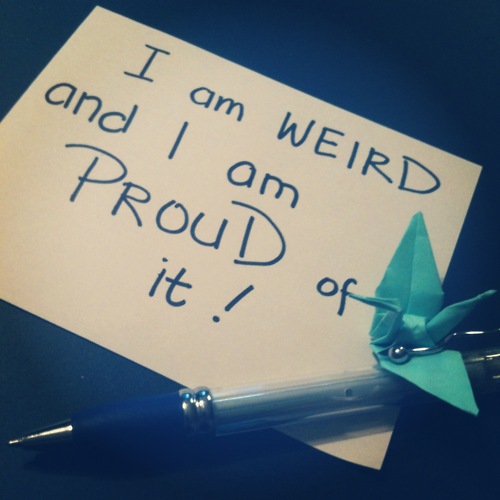
  • Embrace Your Weirdness

    Embrace Your Weirdness

    A lot of people spend time trying to fit in. They don’t want to stand out or be considered different, weird, awkward or strange. Having the same clothes, interests and ideas seems like the most important thing in the world. Everyone just wants to fit in.

    But who established what is normal ?  And what exactly is considered weird? For most people, normal is what they are used to and weird is what they are not used to.

    The word weird is defined by www.dictionary.com in three ways, one of which is fantastic and bizarre. Interesting, isn’t it, how we took a word meaning fantastic and bizarre and created a label for people with an unflattering connotation? When you look at it like that, being “weird” really doesn’t seem that bad. In fact, some of the most successful people in the world were considered strange, different or weird growing up.

    Take Justin Timberlake, for example. He was once quoted as saying, “I grew up in Tennessee, and if you didn’t play football, you were a sissy. I got slurs all the time because I was in music and art.” He also suffers from Attention Deficit Disorder (ADD) and Obsessive Compulsive Disorder (OCD), both of which haven’t stopped him from succeeding.

    Prince Harry was ridiculed and bullied for being a redhead. He was quoted as saying he was teased “for being ginger.” However, not everyone made fun of him. His fellow soldiers in the British Army all wore red wigs to make him stand out less in combat.

    Michael Phelps is one of the most successful Olympians of all time, but as a kid his long limbs, large ears, and lisp caused him to be bullied and teased by his classmates. He also has ADD, and was told he’d “never be able to focus on anything.” Yet he didn’t let that stop him. He used all of his feelings, both good and bad, as motivation to win and as a result became the most decorated Olympian of all-time (winning 22 medals, 18 gold, 2 silver and 2 bronze).

    Chris Colfer, who plays Kurt on Glee, was called a “freak” growing up. He said, “I was teased daily, mainly because of my voice. They said I sounded like a chipmunk! Now everyone likes to remind me how they used to be my best friend, but I have a very good memory- that wasn’t always the case.”

    Lady Gaga has said she didn’t have the best high school experience. She said she didn’t fit in as a teen. “I wanted to be like Boy George and I felt like a freak. So I like to create this atmosphere for my fans where they feel like they have a freak in me to hang out with, and they don’t feel alone.”

    The list of differences goes on and on…

    Albert Einstein, whose name is pretty much synonymous with genius, was a theoretical physicist, and one of the most renowned scientists of all time. However, he didn’t talk until he was four and he didn’t learn to read until he was seven. It is now believed he had Asperger’s Syndrome, which is a form of Autism. Sir Isaac Newton is also believed to have had Asperger’s, and he too was a mathematical and scientific genius.

    Jay Leno, Orlando Bloom, Vince Vaughan, Alexander Graham Bell, John Lennon and Muhammad Ali all had dyslexia.

    Christopher Columbus, Karina Smirnoff, Eleanor Roosevelt, JFK, Walt Disney, Will Smith, Jim Carey and Ernest Hemingway and Bill Gates had ADD.

    Mozart, Daryl Hannah, Tim Burton, Andy Warhol and Susan Boyle all had or have forms of Autism.

    All of these people were considered weird for how they behaved, what they felt and what made them different. They all experienced obstacles they needed to overcome, and they did so by embracing their weirdness. They didn’t let others define who they were and what their limits would be.  They used their uniqueness to their advantage and succeeded. So don’t be afraid to embrace your weirdness too. As Lady Gaga has said, “let your teenage freak flag fly.”

  • You Are Your Best Cheerleader

    You Are Your Best Cheerleader

    Being your own cheerleader is probably the most important thing you can do as you face new and repeated challenges. If you are entering secondary school for the first time, you are undoubtedly going to be faced with challenges and meet many new people. Due to diversity of opinions, and the fact that all people are different and see things differently, there is always risk of being hurt by others, or of questioning your own intentions or your own self-worth. If you are on your side, and you are your own cheerleader, you put yourself ahead of the game in terms of ensuring that you will not lose self-esteem because of other people’s misunderstandings. When you are well aware that what you are doing is the best that you can do, and you are happy within yourself about this, you are being your own cheerleader. When you know that you are taking actions and trying to do what is right for you, and you acknowledge this by demonstrating positive qualities like good self-esteem and confidence, you are being your own cheerleader.

    Although other people can tell you that you are doing a great job, no one can ever really replace you in terms of being the keystone to your confidence. If you rely on other people telling you that you are doing a good job, you may be fooling yourself as to your genuine happiness. Being your own cheerleader really means knowing yourself,  doing what is best for you and rewarding yourself for your positive thoughts, actions and behaviors. When you are on your own side, you are less reliant on other people to tell you of your worth.

    Everyone needs a social network and to feel loved and appreciated by their peers; this is necessary for good self-esteem. However, loving yourself is the most important thing. If you are always dependent on other people to tell you of your worth, you are not being your own cheerleader. By being dependent on yourself to know your worth and to know your own strengths and weaknesses, you are freeing yourself from the imprisoning perspective of others who do not know you as well as you know yourself.

    When you can pick yourself back up after you fall, you are demonstrating that you love and respect yourself and want what is best for you. When you are being your own cheerleader, you are being your best friend – and this is your key to success.

  • School vs. Life

    School vs. Life

    When you  make the move to junior high and high school, everyone seems to think that there is no way to balance both having a social life and excelling in you academics. However, there is always a way – as long as there is a will!

    The way I see it, you need to earn your breaks, vacations and time off; That is what used to drive me to finish up my last essays and my final projects. I would look at the calendar and mutter to myself, “It’s almost March Break – I got to work hard now so that I can fully enjoy my time off school”. Then I would put all of my effort into my work until the very last class and forget about (almost) everything! Essentially, you want to be able to relax during your breaks and long weekends, so you just have to think of this as a “crunch time”.  Even now, in university, I do this to myself – I work and study hard and once I finish the exam, I shop! Sounds odd to some people, but I call it a “Celebratory Spree Day”, the day when I get to relax after pushing myself to study so hard for my exam period.

    One can also practice time management by planning when you will study and setting aside a few hours for fun with friends, too. For example, give yourself some hours to hang out with your friends before heading home to finish assignments and study.  It’s possible to have great academic standing and a social life, you just need to have the determination and the planning.

    Always remember to enjoy life!

  • Are You Supposed to Pick Just One Career When You Grow Up?

    Are You Supposed to Pick Just One Career When You Grow Up?

    As you enter the world of responsibility, you will be facing many challenges and questions that will have you wondering what exactly it is that you are supposed to do when you grow up. This can leave some wondering whether they need to have a perfect career path already planned out or if they can experiment a little bit and see what feels like a fit. There are many different paths to success and sometimes it takes people a little longer to find what is right for them. This is natural and normal and is a result of the questions and challenges that individuals face along their life’s path.

    When looking at what type of career path you want to pursue, having an idea of what subjects you are good at and can get good marks in is important. This will help you to determine what your natural skills are and will lead you on the path to having a job that you love. Maybe you do really well in your science classes and will follow the path towards a career that involves science in some way. If you excel in sports, you might dream of becoming a professional athlete or even teaching sports and fitness to others. The important thing to remember is that you don’t have to choose a career right now – just follow your heart and it will take you where you need to be.

    Know that you are not alone, and seek to get the answers you want about different jobs you see people doing. But above all, have fun and you will find that your career path will open up before you!