
Tag: Nature

  • Getting Dirty May Be Healthy (French version available)

    Getting Dirty May Be Healthy (French version available)

    Jobs People Do | JobsPeopleDo.com

    For much of human history, we lived close to the natural world. As civilization evolved, we became increasingly urbanized, and most of us now live in cities. As we’ve moved away from nature, we’ve seen a decline in other forms of life. Biodiversity is disappearing. The current rate of loss is perhaps as high as 10,000 times the natural rate. The International Union for Conservation of Nature’s 2008 Red List of Threatened Species shows that 16,928 plant and animal species are threatened with extinction. This includes a quarter of all mammal species, a third of amphibian species and an eighth of bird species. And that’s only among those we know about; scientists say we may have identified just 10 to 15 per cent of existing species.

    It can be a challenge to communicate why this loss is important. We know species diversity is critical to the healthy functioning of ecosystems that provide services on which humans depend. But could we live with fewer? Some would argue we could do without mosquitoes and other annoying critters. We could keep the ones we want and those that are useful to us. Do we need biodiversity to keep humans healthy?

    According to an article in Conservation magazine, there is a link between biodiversity and human health. Ilkka Hanski and his colleagues at the University of Helsinki compared allergies of adolescents living in houses surrounded by biodiverse natural areas to those living in landscapes of lawns and concrete. They found people surrounded by a greater diversity of life were themselves covered with a wider range of different kinds of microbes than those in less diverse surroundings. They were also less likely to exhibit allergies.

    What’s going on? Discussion of the relationship between biodiversity and human health is not new. Many have theorized that our disconnection from nature is leading to a myriad of ailments. Richard Louv, author of Last Child in the Woods, says people who spend too little time outdoors experience a range of behavioural problems, which he calls “nature deficit disorder”. It fits with theories of modern ecology, which show systems lacking in biodiversity are less resilient, whether they’re forests or microbial communities in our stomachs or on our skin. Less resilient systems are more subject to invasion by pathogens or invasive species.

    Hanski studied a region in Finland where few people move far. He randomly selected 118 adolescents in an equal number of homes. Some were in the city, and others were in the woods or on farms. The team collected skin swabs from subjects and then measured the biodiversity of plants around each house. Their data revealed a clear pattern: higher native-plant diversity appeared to be associated with altered microbial composition on the participants’ skin, which led in turn to lower risk of allergies.

    Hanski and his colleagues found that one group of microbes, gammaproteobacteria, appears to be associated both with plant diversity and allergies. And it didn’t matter whether they considered allergies to cats, dogs, horses, birch pollen or timothy grass. People with more diverse kinds of gammaproteobacteria on their bodies were less likely to have allergies.

    The immune system’s primary role is to distinguish deadly species from beneficial and beneficial from simply innocent. To work effectively, our immune system needs to be “primed” by exposure to a diverse range of organisms at an early age. In this way, it learns to distinguish between good, bad and harmless. If not exposed to a wide array of species, it may mistakenly see a harmless pollen grain as something dangerous and trigger an allergic reaction. We also know that bacteria and fungi compete. Fungi are often associated with allergies, and it could be that the high diversity of bacteria keeps the fungi in check.

    A conclusive explanation for Hanski’s observations is not yet available. More research is needed. But we know we evolved in a world full of diverse species and now inhabit one where human activity is altering and destroying an increasing number of plants, animals and habitats. We need to support conservation of natural areas and the diverse forms of life they contain, plant a variety of species in our yards, avoid antibacterial cleaning products and go outside in nature and get dirty — especially kids. Our lives and immune systems will be richer for it.
  • Why We Should Protect the Environment (French version available)

    Why We Should Protect the Environment (French version available)

    Cleaning up a mess can be a dull job, but living with dirt and garbage is much worse than that. Have you ever smelled a piece of rotten fruit or a piece of meat that has gone bad? You can put rotten food in the garbage, but what if the whole world smelled like that? What if the water coming from the taps in your house made you sick with all kinds of diseases? Without clean water, good air, and healthy food, people easily get sick and die. That’s why caring for the environment is so important.

    For many years, people thought very little about the environment unless it affected them directly. Water shortages were important mainly for farmers and gardeners, and resources like trees or fuel were important for helping people make money. However, people’s ideas began to change when a writer named Rachel Carson published Silent Spring in 1962. The book showed how the pesticides designed to kill harmful insects were harming the environment and people. The author said that our food supply and the whole world were in danger because of these chemicals. Partly because of that book, the United Nations established Earth Day in 1970, and people have used that day and other campaigns to raise awareness of environmental issues ever since then.

    What do you know about the challenges that the environment is facing? One problem that you might have heard about is global warming, which refers to the rapid increase in the Earth’s temperature. Many scientists believe that most of this warming is the result of pollution from human activity, such as burning oil and gas for fuel. Other problems include polluted water and air, which can make people sick or even kill them, the overuse of resources that take many centuries to replace and the loss of the top layer of soil that makes farming possible. Another issue is the deaths or disappearance of the bees, which helps plants to grow through pollination.

    People have many different theories on issues such as climate change and pollution. Some people believe that human activity affects the environment, but others do not. However, taking care of your home planet is still a very good idea. How can you help? You can save fuel by walking or taking the bus to school or your friends’ houses instead of getting a ride in the car. You can use energy-efficient light bulbs and turn the lights off whenever you leave an empty room. You can turn your computer off at night and try to use as little water as possible in the shower. These changes will not save the environment alone, but if we all do them, they will make a huge difference.

    Caring for the environment is a huge task, far too big for one person or even one country to do. Some environmental issues are beyond anyone’s control, and others depend on people far away on other continents. However, if everyone on Earth took responsibility for only one small part of the problem, we could make a difference.

  • Getting Dirty May Be Healthy (French version available)

    Getting Dirty May Be Healthy (French version available)

    For much of human history, we lived close to the natural world. As civilization evolved, we became increasingly urbanized, and most of us now live in cities. As we’ve moved away from nature, we’ve seen a decline in other forms of life. Biodiversity is disappearing. The current rate of loss is perhaps as high as 10,000 times the natural rate. The International Union for Conservation of Nature’s 2008 Red List of Threatened Species shows that 16,928 plant and animal species are threatened with extinction. This includes a quarter of all mammal species, a third of amphibian species and an eighth of bird species. And that’s only among those we know about; scientists say we may have identified just 10 to 15 per cent of existing species.

    It can be a challenge to communicate why this loss is important. We know species diversity is critical to the healthy functioning of ecosystems that provide services on which humans depend. But could we live with fewer? Some would argue we could do without mosquitoes and other annoying critters. We could keep the ones we want and those that are useful to us. Do we need biodiversity to keep humans healthy?

    According to an article in Conservation magazine, there is a link between biodiversity and human health. Ilkka Hanski and his colleagues at the University of Helsinki compared allergies of adolescents living in houses surrounded by biodiverse natural areas to those living in landscapes of lawns and concrete. They found people surrounded by a greater diversity of life were themselves covered with a wider range of different kinds of microbes than those in less diverse surroundings. They were also less likely to exhibit allergies.

    What’s going on? Discussion of the relationship between biodiversity and human health is not new. Many have theorized that our disconnection from nature is leading to a myriad of ailments. Richard Louv, author of Last Child in the Woods, says people who spend too little time outdoors experience a range of behavioural problems, which he calls “nature deficit disorder”. It fits with theories of modern ecology, which show systems lacking in biodiversity are less resilient, whether they’re forests or microbial communities in our stomachs or on our skin. Less resilient systems are more subject to invasion by pathogens or invasive species.

    Hanski studied a region in Finland where few people move far. He randomly selected 118 adolescents in an equal number of homes. Some were in the city, and others were in the woods or on farms. The team collected skin swabs from subjects and then measured the biodiversity of plants around each house. Their data revealed a clear pattern: higher native-plant diversity appeared to be associated with altered microbial composition on the participants’ skin, which led in turn to lower risk of allergies.

    Hanski and his colleagues found that one group of microbes, gammaproteobacteria, appears to be associated both with plant diversity and allergies. And it didn’t matter whether they considered allergies to cats, dogs, horses, birch pollen or timothy grass. People with more diverse kinds of gammaproteobacteria on their bodies were less likely to have allergies.

    The immune system’s primary role is to distinguish deadly species from beneficial and beneficial from simply innocent. To work effectively, our immune system needs to be “primed” by exposure to a diverse range of organisms at an early age. In this way, it learns to distinguish between good, bad and harmless. If not exposed to a wide array of species, it may mistakenly see a harmless pollen grain as something dangerous and trigger an allergic reaction. We also know that bacteria and fungi compete. Fungi are often associated with allergies, and it could be that the high diversity of bacteria keeps the fungi in check.

    A conclusive explanation for Hanski’s observations is not yet available. More research is needed. But we know we evolved in a world full of diverse species and now inhabit one where human activity is altering and destroying an increasing number of plants, animals and habitats. We need to support conservation of natural areas and the diverse forms of life they contain, plant a variety of species in our yards, avoid antibacterial cleaning products and go outside in nature and get dirty — especially kids. Our lives and immune systems will be richer for it.
  • What is Acid Rain?

    What is Acid Rain?

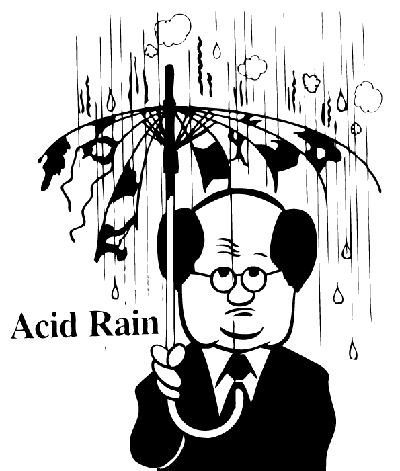
    The term acid rain refers to what scientists call acid deposition.  It is caused by airborne acidic pollutants and has highly destructive results.

    Scientists first discovered acid rain in 1852, when the English chemist Robert Agnus invented the term.  From then until now, acid rain has been an issue of intense debate among scientists and policy makers.

    Acid rain, one of the most important environmental problems of all, cannot be seen.  The invisible gases that cause acid rain usually come from automobiles or coal-burning power plants.

    Causes

    For many years, there was considerable debate and disagreement over what caused acid rain.  Recent scientific work, however, has helped to clarify this.

    The primary causes of acid rain are sulfur dioxide and nitrogen oxides.  These chemicals are released by certain industrial processes, and as a result, the more industrialized nations of Europe as well as the US suffer severely from acid rain.

    Most sulfur dioxide comes from power plants that use coal as their fuel.  These plants emit 100 million tons of sulfur dioxide, 70% of that in the world.

    Automobiles produce about half of the world’s nitrogen oxide.  As the number of automobiles in use increases, so does the amount of acid rain.  Power plants that burn fossil fuels also contribute significantly to nitrogen oxide eemissions

    Though human causes are primarily responsible for acid rain, natural causes exist as well.  Fires, volcanic eruptions, bacterial decomposition, and lightning also greatly increase the amount of nitrogen oxide on the planet.  However, even the gigantic explosion of Mt. Helens released only about what one coal power plant emits in a year.

    Once the tiny pollutant molecules have entered the atmosphere, they can travel for thousands of miles.  Eventually, the particles will combine with other compounds to produce new, often harmful, chemicals.

    Acid rain comes down to the earth in the form of rain, snow, hail, fog, frost, or dew.  Once it reaches the ground, the acidity in the substance can harm and even destroy both natural ecosystems and man-made products, such as car finishes.

    Acid rain moves easily, affecting locations far beyond those that let out the pollution.  As a result, this global pollution issue causes great debates between countries that fight over polluting each other’s environments.

    For years, science has studied the true causes of acid rain.  Some scientists concluded that human production was primarily responsible, while others cited natural causes as well.  Recently, more intensive research has been done so that countries have the information they need to prevent acid rain and its dangerous effects.

    The levels of acid rain vary from region to region.  In Third World nations without pollution restrictions, acid rain tends to be very high.  In Eastern Europe, China, and the Soviet Union, acid rain levels have also risen greatly.  However, because acid rain can move about so easily, the problem is definitely a global one.

    Effects

    Acid rain is having harmful effects both on people and on the natural ecosystems of the world.  Scientists today are convinced that acid rain is severe in many areas and that it is having an adverse effect on the environments of those locations.

    The problem of acid rain is rapidly spreading.  Because it is mainly caused by industrial processes, automobiles, and power plants, those countries that are developed have the most severe acid rain problems.   However, as the undeveloped nations begin to industrialize, acid rain will increase greatly.

    Determining just how much the planet is being hurt by acid rain is very difficult because the ecosystems that it affects are so diverse and complex.

    Many ecosystems are affected by acid rain.  Bodies of water, such as lakes and rivers, see many of their inhabitants die off due to rising acidity levels.

    Acidic water also ruins plant nutrients, hurting plants’ ability to survive and to give life to other organisms.

    Human-made products are also experiencing degradation from acid rain.  Cars can lose their finishes, and outdoor statues are beginning to rust.

    Acid rain’s effects are destructive and long-lasting.  Though scientists have studied lakes, streams, and many other natural ecosystems to prove its negative effects, acid rain continues to be produced and is increasing in many parts of the world.

  • Let’s Celebrate the Gifts of Winter (French version available)

    Let’s Celebrate the Gifts of Winter (French version available)

    We Canadians have a special relationship with snow and ice. We ski in it, skate on it, play in it, shovel it, drive through it, sometimes even bicycle through it and suffer through it for many months of the year — some of us more than others, depending on what part of the country we call home. But how much do we know about it?

    Do Inuit really have dozens of words for snow and ice? Are snowflakes always six-sided? Can two ever be alike? Why is snow white? Is it a mineral? What makes frozen water so important to us? Some of the answers are more complicated than you might imagine.

    Even though English-speaking skiers and snowboarders use multiple adjectives to more accurately describe different types of snow, such as powder, corn and champagne, some say the claim of numerous Inuit words for snow and ice is a myth. But is it?

    According to the Canadian Encyclopedia, “the few basic words used by the Inuit to refer to different types of snow or ice do not translate everything they can say about these two natural elements.” In Inuktitut, words consist of a foundational element that provides basic meaning, along with other elements “to clarify and/or modify the basic meaning. New words can therefore easily be created from another term.” For example, the word siku refers to ice in general, and sikuaq (“small ice”) refers to “the first layer of thin ice that forms on puddles in the fall.” Sikuliaq (“made ice”) refers to “the new ice appearing on the sea or on rock surfaces.” Some words also have broader meanings, depending on the context. The word maujaq, for example, means “soft ground”, but when referring to snow, it means “the snow in which one sinks.”

    So, “the total number of terms referring to the various aspects of snow and ice goes far beyond ten or a dozen,” allowing Inuit to “draw very subtle distinctions between a very high number of snow or ice types.”

    When it accumulates on the ground, snow appears white because, unlike many natural materials, it reflects most light rather than absorbing it, and visible light is white. And although snowflakes form in near-infinite patterns and shapes depending on temperature, wind, humidity and even pollution, each single crystal is always hexagonal, or six-sided, because of the complex way water molecules bond. When a frozen droplet or crystal falls from a cloud, it grows as it absorbs and freezes water from the air around it, forming a six-sided prism. The almost infinite variables mean it’s unlikely, although not impossible, for two snowflakes to be exactly alike.

    And yes, snow can be classified as a mineral. According to the U.S. National Snow and Ice Data Center, “A mineral is a naturally occurring homogeneous solid, inorganically formed, with a definite chemical composition and an ordered atomic arrangement.” Frozen water fits that description.

    Snow and ice are important to life on Earth for many reasons. Both are part of the cryosphere, which includes “portions of the earth where water is in solid form, including snow cover, floating ice, glaciers, ice caps, ice sheets, seasonally frozen ground and perennially frozen ground (permafrost),” according to the Snow and Ice Data Center. It covers 46 million square kilometres of the planet’s surface, mostly in the Northern Hemisphere, and helps regulate the planet’s surface temperature. Changes in the cryosphere can affect climate and water availability, with corresponding effects on everything from winter sports to agriculture.

    By reflecting 80 to 90 per cent of incoming sunlight back into the atmosphere, snow cover cools the Earth. Losing that reflective protection, as is happening in the Arctic, upsets the energy balance and accelerates global warming. Snow also insulates parts of the Earth’s surface, holding heat in and keeping moisture from evaporating. When soil freezes, it prevents greenhouse gases like carbon and methane from escaping into the atmosphere. When snow melts, it fills rivers and lakes.

    Instead of complaining about the dark and cold of winter, we should celebrate snow and ice. The cryosphere is an important piece of the intricate, interconnected puzzle that keeps us alive. So, build a snowperson, play some hockey, get out on the slopes and enjoy the gifts that winter brings.

  • Completing the Puzzle: Why Nature Matters

    Completing the Puzzle: Why Nature Matters

    With so many devices to keep a person entertained in the confines of their home, it is hard to blame anyone for spending much of their time inside. You may be reading this in your room. I wrote these words sitting at home. So it can come across as a trite platitude when you are told to spend more time in nature. You have heard that time and time again. You know it is important. But knowing is only one piece of the puzzle.

    By stepping outside, a response is triggered in your mind and body that no words can match. The sights and sounds of nature have a physiological effect that reduces stress and puts your body in a more relaxed state. Touch trees, run your fingers through blades of grass, smell flowers, and breathe in the air. Let your senses take in nature directly and you will build a relationship with nature.

    By spending more time in nature, you understand more and more that the separation between nature and society is an imaginary line. Every single bit of technology on your desk, every bit of material used to make the building or bus you are in- all of it is derived from the Earth. We have simply taken all those elements and mixed and rearranged them in a very unique way. By seeing a human home not as something different from a bird’s nest or beaver dam, but rather a more complex version of the same thing, you can feel the connection to nature and the need to care for it.

    From there, you will be more aware of opportunities around you to care for the world around you. You can use science class to practice gardening. You can find countless volunteer programs helping the environment in your local area or beyond.

    These might feel like small steps in a world this big. It’s so easy to be cynical and feel like you have no impact. On one hand, towering trees and endless fields can make you feel small. But they also show how literally every single thing that exists is interconnected. From the plants rooted in the soil, to the soil stretching across the land. From the animals eating those plants, to the air those animals breathe stretching across the Earth’s atmosphere. Nature reveals everything as integral pieces to a larger puzzle. Those tall trees have stood for centuries, and those animals will give birth to offspring. Nature connects you not only to everything in the present, but to the past and future as well.

    Remember that your small actions lead to other actions. Recycling, planting one small tree, and picking up of trash off the ground can inspire your friend to follow suit and think more positively. That can affect another person, and another. No one piece completes any puzzle, but no one puzzle is complete without every piece.


  • Embracing Nature Around Your Campus

    Embracing Nature Around Your Campus

    Being in school can be hard when the sun is shining and the weather is warm. It can also be hard to enjoy nature, but that can be a very important part of the learning process. Wherever you go to school, you can try to embrace the natural world around you and to appreciate the many benefits that people receive from it.

    Many people enjoy being outside, hearing the birds and looking at the trees and flowers around them. Natural settings can be very calming. It can help people relax and relieve stress that they might otherwise be feeling. Outside in the fresh air, people can interact with each other in ways that are harder inside with artificial lighting and stale air. Out in nature, people can see themselves and each other in new ways.

    Nature is not just about feeling good emotionally, however. It is also essential to people’s health. You probably hear a lot about the pollution in the air, which causes diseases and can seriously harm people. Trees help produce oxygen that people need to breathe, but they can also help reduce pollution by filtering out the chemicals in the air. On hot days, they help to keep the temperature down, and they provide shade from the sun. Other plants, including grass, are important, not only to make places look nice, but also to help keep the soil from washing away and otherwise keeping the environment clean and healthy.

    Embracing nature on campus is also about what people can do to help keep the environment healthy. One way to do that is through cleaning up the garbage that collects on the ground. Some schools and universities have clean-up days once or twice a year when people pick up garbage, recycle what they can, and put the rest in bags to take away. That helps to make the area look nice but also removes sharp objects that can injure people and other garbage that can clog drains or cause other problems.

    Your school campus might be small or very large, but you can help it to become an important natural area, whatever its size. Even after school is over for the year, you can start to make plans for how you will embrace nature wherever you go to school next. Many schools and universities have environmental policies, and it’s a good idea to learn as much as you can about that. If you see a problem, you can talk to others and see what you can do to help.

    Suppose your school’s administration plans to cut down some trees to build an addition to the school. You could learn as much as you can about the plans and try to think of alternatives to avoid getting rid of any trees. Or suppose your science class wants to go on a nature walk; you could suggest looking at nature right where you are.

    You might find more than you expect once you start to look.


    Bibliography:

    Durham College. “DC Embraces Nature During the 2015 Campus Clean-up.” http://www.durhamcollege.ca/new-notable/college-news/dc-embraces-nature-during-the-2015-campus-clean-up

    Project Evergreen.org. “Environmental Benefits of Green Space.” http://projectevergreen.org/resources/environmental-benefits-of-green-space/.

    Roden, Isabella. “Everyday Environmentalist: Go Green on Campus.” http://www.nature.org/greenliving/gogreen/everydayenvironmentalist/go-green-on-campus.xml.

    University of Western Ontario. “Sustainability: Campus Master Plan.” http://sustainability.uwo.ca/initiatives/buildings_green_space/campus_master_plan.html.


  • Nature Watch: Exploring Our Solar System – Events To Watch In 2015

    Nature Watch: Exploring Our Solar System – Events To Watch In 2015

    Our solar system is our neighbourhood, with many questions remaining about our planets, moons, comets, and asteroids. If you are interested in space and planetary exploration, the search for water on other planets, and uncovering the secrets of our solar system, these are three events to keep an eye on this summer.

    Rosetta Mission – Comet 67P/Churyumov-Gerasimenko

    (European Space Agency)

    The Milestone: Rosetta is performing the first long-term close observation of a comet, and the Philae lander is the first scientific lander on a surface other than a planet or moon.

    The Mission: Launched in March 2004, Rosetta’s main objective was to catch up to and orbit comet 67P/Churyumov-Gerasimenko, and deploy the Philae lander to the surface. Both events succeeded in November 2014. In 2015, Rosetta continues to observe 67P as it nears its closest approach to the Sun, examining gas and dust interactions that create a comet’s characteristic “tail”. Both Rosetta and Philae have sent back stunning photographs of the comet from orbit.

     Events This Summer: 67P’s perihelion (closest approach to the Sun) will occur around August 13, 2015. The data gathered will show what happens to comets as they pass close to the Sun.

    More Information: http://sci.esa.int/rosetta

    http://blogs.esa.int/rosetta


    Dawn Mission – Protoplanet Vesta and Dwarf Planet Ceres

    (NASA and JPL)

    The Milestone: Using a specially designed ion propulsion system, Dawn achieved a remarkable feat: visiting two separate planetary bodies in the asteroid belt, and performing orbital observations around both. This also marks the first visit to a dwarf planet by any spacecraft.

    The Mission: Launched in September 2006, Dawn travelled through the solar system to encounter and orbit the proto-planet Vesta from July 2011-September 2012. After mapping and science observations, Dawn broke orbit from Vesta and travelled another two years to rendezvous with dwarf planet Ceres in March 2015. By studying these planetary bodies, we hope to learn about the early formation of the solar system.

    Events This Summer: August 2015 and December 2015 will see Dawn perform the two lowest mapping orbits, providing detailed surface photographs and scientific measurements, and hopefully solving the mystery of the “bright spots” on Ceres’ surface.

    More Information: http://dawn.jpl.nasa.gov


    New Horizons Mission – Pluto System Flyby

    (NASA)

    The Milestone: The first ever flyby of the dwarf planet Pluto and its moon system, the most distant and still unexamined member of our solar system.

    The Mission: New Horizons launched in 2006, and will perform a flyby observation of the Pluto system, then continue on an extended mission into the distant Kuiper Belt to visit the small, icy bodies orbiting the outer edges of our solar system. This mission will provide detailed photographs, surface maps, and valuable scientific data about Pluto, and help us learn about the outskirts and formation of our solar system.

    Events This Summer: New Horizons closest approach to Pluto is scheduled for July 14, 2015. Currently in approach phase, new pictures with increasing detail are regularly transmitted back to Earth and made available to the public.

    More Information: http://nasa.gov/mission_pages/newhorizons


  • Why Do We Want to Protect the Environment?

    Why Do We Want to Protect the Environment?

    Protecting the environment, natural resources and wildlife is something that is not only supported by people who are environmentalists. Everyone can take part in helping to improve the health of the planet.

    When you walk outside, you may not realize it, but you are depending on fresh air to survive. In Canada, we are fairly lucky as our levels of air pollution are not nearly as high as those in more heavily populated countries like China or India. The health effects of bad air quality have been researched and it is proven to cause a number of diseases and illnesses. Improving the quality of the air is something that can be accomplished via grassroots efforts; That is, through individual efforts to emit less carbon into the atmosphere. Reducing carbon emissions can also be accomplished through the efforts of large companies and corporations, who emit the most carbon of all.

    The quality of the water is also something that is important to consider since we all depend on clean water to survive. Maintaining clean water is something that can be accomplished through individual efforts like not flushing hazardous chemicals down the drain or toilet and trying to conserve water to reduce the demand on the water treatment facilities – an operation that requires a lot of water to conduct. Big businesses could also pitch in to conserve water by investing in water saving initiatives and partaking in water conservation efforts.

    Wildlife also needs our protection. With more and more urbanization, spaces where wildlife are safe is decreasing at alarming rates. Deer, moose, cougars and bears are all often reported in the news as having caused car accidents due to the decline in their natural habitat and their subsequent wandering out onto developed land transformed into highways or suburban neighborhoods. In order to protect wildlife, we must invest in protecting Canada’s natural spaces.

    If you support clean air, water and having a wide range of wildlife in Canada, see if there is a way you can get involved in your community. Help to clean up your local park or visit a wildlife sanctuary to see how they take care of animals.

  • Working with Nature: Park Rangers

    Working with Nature: Park Rangers

    Every year, people across Canada go to visit national or provincial parks. They go hiking or camping, and they spend time walking in the forests or swimming in the lakes. Have you ever thought of the people who help keep those parks going? Someday, you might be able to look after the animals and people in these places if you decide to become a park ranger – also called a warden.

    Park rangers or wardens are people who help to keep parks running smoothly, helping both the animals that live there and the people who come to visit. If you love the outdoors and want to help preserve it for the future, working as a park ranger might be the job for you.

    Many different activities can be part of a park ranger’s job. Rangers have to know how to deal with both large and small animals and to be able to work with them safely. They have to know about the different types of animals in the area and to be able to help them when they are sick or injured. This work can often be dangerous. Moving animals from one place to another spot inside or outside the park is also a dangerous but important part of the job.

    Knowing about the plants in the area is also important for park rangers. If they know the locations of poison ivy, for example, they can tell people what areas to avoid and where they need to be careful. They can take people on nature tours to teach them all about the animals and plants they might see.

    Learning all about the plants and animals in the park takes a mixture of education and experience. Normally, park rangers have four-year degrees in areas such as wildlife biology or botany (the study of plants). Having a general knowledge is important, but park rangers can also become specialists in one or two areas, like bears or insects.

    In some cases, the work of park rangers is close to law enforcement, especially when they work with people who come to visit the park. Park rangers help to enforce the rules, such as the regulations about when people can build fires or what they can do in campgrounds. They might also have to search for people who are lost or help anyone who has been injured or is feeling sick. Park rangers have to know basic first aid and to be able to deal with whatever happens.

    If you decide to become a park ranger, you should be prepared to live in a small community instead of a city so that you can be close to your work. You should be comfortable with working alone but also be able to work with people and to talk with the public. If this kind of job sounds good to you, maybe you should consider becoming a park ranger.