Author: Linda Mendes

  • The Health Benefits of Swimming and Tips for Practicing Swimming (French version available)

    The Health Benefits of Swimming and Tips for Practicing Swimming (French version available)

    Swimming is an activity that people of all ages can do. It has many health benefits, and it is great for your body as well as your mind.  If you don’t swim regularly, maybe this article will convince you to hop in the pool more often!

    So, what are some of the benefits of making swimming a habit?

    It Can Reduce Stress

    Like other exercises, swimming can reduce your stress. It can help you keep your mind off of things that could be stressing you. When you exercise, your body reduces the stress hormones and releases endorphins. Endorphins are natural “feel-good” chemicals that help boost your mood. If you’re feeling stressed, go for a swim and you will feel better by the time you get out.

    It Works Out Your Entire Body

    Swimming works out your entire body. It may seem like your arms and legs do most of the work, but that is not the case. Swimming can strengthen your core, tone muscles, build strength and endurance, and also increase your heart rate. When swimming, you will feel a burn in your body in as little as 20 minutes. There are many different strokes you could do. Each of these strokes focuses on different muscle groups. These strokes include breaststroke, backstroke, sidestroke, butterfly, and more.

    It Has a Lower Impact on Your Joints

    Most workouts are either high intensity and hard on your joints or low intensity and easy on your joints. Swimming has a lower impact than other cardio exercises. This is because water holds you up and will reduce the stress and the impact on your joints. Since you are being held up by the water, your chances of injury are reduced.

    Tips for Practicing Swimming

    • Don’t Waste Your Breath

    You may end up inhaling water if you gasp for air every time your head reaches the surface. Instead, you should exhale all the air from your lungs before taking another breath. Beginners usually need to take a breath more often, but as you build endurance, you’ll be able to control your breath much better. When taking a breath, make sure to alternate sides. This will reduce the strain on your neck and shoulders.

    • Keep Practicing

    When you watch professional swimmers swim, you may think that they make it look easy and relaxed. This is because they have been practicing for a very long time and still continue practicing. In order to improve your swimming skills, it is important to keep practicing.

    • Get Feedback

    Receiving and listening to feedback is a good way to know what you are great at doing and what you need to work on. If you can, try to get a coach or a friend to watch you swim and later give you feedback. Another option is to record yourself swimming. The next time you swim, make sure to keep the feedback in mind.

    If you’re looking for a low-impact, stress-reducing workout for your entire body, then go hit the pool!


    Resources

    Bean, Matt. “Seven Steps To Better Swimming Technique.” Runner’s World. https://www.runnersworld.com/uk/training/triathlon/a764520/seven-steps-to-better-swimming-technique/.

    Berry, Jennifer. “Endorphins: Effects and how to increase levels.” Medical News Today. https://www.medicalnewstoday.com/articles/320839.

    House, Lydia and Morgan Fargo. “12 major benefits of swimming that’ll convince you to take it up, from better sleep to weight loss.” Women’sHealth. https://www.womenshealthmag.com/uk/fitness/g27268961/benefits-of-swimming/.

    Marcin, Ashley. “What Are the Top 12 Benefits of Swimming?” Healthline. https://www.healthline.com/health/benefits-of-swimming#get-started.

    Petty, Amber. “13 Reasons to Just Keep Swimming.” Greatist. https://greatist.com/health/benefits-of-swimming.

    Poirier-Leroy, Olivier. “Swimming Tips: The 7 Fundamentals of Faster Swimming.” YourSwimBook. https://www.yourswimlog.com/swimming-tips/.


  • April 2025 Scholarships – Apply now!

    April 2025 Scholarships – Apply now!

    Optimist International Essay Contest
    Scholarship Value: $2,500
    Awards Available: 45
    Award Deadline: April 15, 2025

    Devine Family Scholarships
    Scholarship Value: $50,000
    Awards Available: 2
    Award Deadline: April 15, 2025

    Fred Hindle Bursary
    Scholarship Value: $5,000
    Awards Available: 2
    Award Deadline: April 15, 2025

    Gary Knechtel Memorial Scholarship
    Scholarship Value: $10,000
    Awards Available: 1
    Award Deadline: April 15, 2025

    Lift Parts Express Scholarship
    Scholarship Value: $500
    Awards Available: 1
    Award Deadline: April 30, 2025

    Emmett and Loretta Regan Memorial Award
    Scholarship Value: $4,500
    Awards Available: 2
    Award Deadline: April 30, 2025

    Bobby Orr Entrance Scholarship
    Scholarship Value: $2,100
    Awards Available: 1
    Award Deadline:  May 1, 2025

    TC Energy Scholarships
    Scholarship Value: $5,000
    Awards Available: 850
    Award Deadline:  May 3, 2025

    Charles B. Staats Memorial Foundation Scholarship
    Scholarship Value: $12,000
    Awards Available: 1
    Award Deadline:  May 27, 2025

    Voice for Animals High School Scholarship
    Scholarship Value: $500
    Awards Available: 21
    Award Deadline:  May 31, 2025

    Luke Santi Memorial Award
    Scholarship Value: $1,000
    Awards Available: 1
    Award Deadline:  May 31, 2025

    MADD Canada Youth Bursary Fund
    Scholarship Value: $10,000
    Awards Available: 3
    Award Deadline:  May 31, 2025

    Pet Food Association of Canada Martha ‘Marty’ Wilder Honorary Scholarship
    Scholarship Value: $5,000
    Awards Available: 1
    Award Deadline: June 1, 2025

    Algonquin College Tuition Contest
    Scholarship Value: $5,000
    Awards Available: 1
    Award Deadline: June 30, 2025

    Durham College Tuition Contest
    Scholarship Value: $5,000
    Awards Available: 1
    Award Deadline: August 29, 2025

    Western Continuing Admission Scholarship of Excellence for Black Students
    Scholarship Value: $6,000
    Awards Available: 30
    Award Deadline: Ongoing

    Western Continuing Admission Scholarship of Excellence for Indigenous Students
    Scholarship Value: $6,000
    Awards Available: 30
    Award Deadline: Ongoing

  • Indigenous Student Scholarships for April 2025

    Indigenous Student Scholarships for April 2025

    First Nations, Métis, Inuit, Women’s Scholarship – Women’s Program (Elementary Teachers’ Federation of Ontario)
    Scholarship Value: $1,250
    Awards Available: 4
    Award Deadline: April 30, 2025

    First Nations, Métis, Inuit, Women’s Scholarship – Women’s Program
    Scholarship Value: $12,500
    Awards Available: 2
    Award Deadline: April 30, 2025

    Kenneth R. Good Family First Nations Student Award
    Scholarship Value: $7,000
    Awards Available: 1
    Award Deadline: May 1, 2025

    Kathleen Blinkhorn Aboriginal Student Scholarship
    Scholarship Value: $2,000
    Awards Available: 5
    Award Deadline: May 2, 2025

    Calgary Foundation First Nations, Métis (Metis) and Inuit Graduate Bursary
    Scholarship Value: $3,000
    Awards Available: 2
    Award Deadline: May 15, 2025

    First Nations, Métis and Inuit Undergraduate Bursary
    Scholarship Value: $3,000
    Awards Available: 6
    Award Deadline: May 15, 2025

    Yukon First Nations Heritage
    Scholarship Value: N/A
    Awards Available: 1
    Award Deadline: May 31, 2025

    James Bartleman Indigenous Youth Creative Writing Awards
    Scholarship Value: $2,500
    Awards Available: 6
    Award Deadline: May 31, 2025

    Innovation Place Scholarships for Indigenous Students in the Sciences
    Scholarship Value: $5,000
    Awards Available: 1
    Award Deadline: June 1, 2025

    Petro-Canada Award for Indigenous High School Students
    Scholarship Value: $750
    Awards Available: 8
    Award Deadline: July 1, 2025

    Dr. & Mrs. G.B. Gowd Bursary for First Nations Women
    Scholarship Value: $1,000
    Awards Available: 1
    Award Deadline: October 15, 2025

    Western Continuing Admission Scholarship of Excellence for Indigenous Students
    Scholarship Value: $6,000
    Awards Available: 30
    Award Deadline: Ongoing

  • Time to Get Out in (And Think About) Nature!

    Time to Get Out in (And Think About) Nature!

    April 1st is here, which means you might want to double-check your chair before sitting down or look twice at any “breaking news” headlines. April Fool’s Day is all in good fun, but it’s also a great reminder not to take things too seriously and to let yourself laugh a little – especially as school ramps up again for the final stretch of the year.

    Thankfully, April isn’t all pranks. It’s also home to Earth Day on April 22nd, a time to reflect on how we treat the planet and what we can do better. In this month’s issue, we’re featuring several articles that highlight the importance of environmental awareness. Learn how environmental engineers are helping shape a greener future, why Greta Thunberg’s activism matters, and what you can do to help the environment right now. We’ve also got pieces on acid rain, environmental education, and going vegetarian for health and the planet.

    There’s more to explore beyond the environment, too. We’re profiling careers like traffic technician, psychiatrist, public relations specialist, and even library technician – proving that no matter what your interests are, there’s a path out there for you. And if you’re scratching your head over taxes this month (because yes, it’s that time of year), we have articles to help you understand what they are and how to handle them whether you’re employed or self-employed.

    April is also a great time to tap into your creative side, with World Creativity and Innovation Day on April 21st. Whether that means picking up a musical instrument for the first time or finding small ways to solve problems differently, creativity plays a bigger role in our lives than we sometimes realize.

    And as always, for even more unique insights into the world of work, be sure to check out our interviews with industry pros. They’ve been where you are, and their stories can help you figure out where you’re going.

    Wishing you a great start to spring (no pranks, we promise!),
    Anthony Teles
    Vice-President, Content

  • Saving the World One Project at a Time: A Profile of Environmental Engineers

    Saving the World One Project at a Time: A Profile of Environmental Engineers

    The world is changing at a rate like never before. City populations are getting bigger and technology is more advanced. That has a major impact on the environment. We are faced with problems such as pollution, the creation of new laws, and how land should be used. This is done with the help of environmental engineers. These professionals use their education, skills, and technology to help find solutions to growing problems related to air, water, soil, and more.

    Environmental engineers work either in an office environment or in the field. They have the responsibility of measuring the impact of projects run by the government or companies and offer advice on how laws and other issues may affect projects. In addition, they test the quality of the air and water, make sure waste and garbage from projects do not harm the planet, and help design systems to help the environment. These engineers may get to travel to different locations and work on many different projects that have a huge impact on the world. On the other hand, there is also a lot of stress in dealing with major developments run by the government or large companies. Environmental engineers have a huge responsibility to make sure the environment is not harmed.

    The salary in this career field can range from about $51,000 to $90,00. The average salary is about $67,000. The career outlook for this job can be seen by looking at the field of civil engineering, which this career is a part of. From 2014 to 2024, it is estimated there were about as many people looking for civil engineering jobs in Canada as there are positions with about 17,000 openings and 16,600 job seekers. This means that, while there will be competition, finding a job is very much possible.

    Environmental engineers may work for government agencies or consulting firms, as well as large companies in industries for forestry, mining, and more. This means there is a lot of potential to work in many different locations for different types of organizations. Your role can grow from writing proposals and assisting in small projects to designing technology and playing a part in major developments that affect millions of people.

    If this career is of interest to you, then you will want to work towards a bachelor’s degree in civil engineering or a related engineering field. For more advanced positions, you will require a master’s degree in a related engineering field or even a doctorate. Depending on where you live, you may need to obtain licensing from the association of professional engineers for that province. It is not an easy path, but it is most definitely a rewarding one.

    Environmental engineers may not have a flashy role that will make them famous, but they have the opportunity to make sure major projects do not harm the environment. This very important role helps to make the planet livable for humans for many years to come. Environmental engineers are not just working to help people today but striving to help all the people who will come after us.

    Sources:

    PayScale. “Environmental Engineer Salary.” https://www.payscale.com/research/CA/Job=Environmental_Engineer/Salary

  • How You Can Help the Environment Right Away

    How You Can Help the Environment Right Away

    Climate change is the biggest problem we face in the 21st century. There is a lot of news about the effect it will have on the planet in the near future, and much of it is terrifying. This is the time for everyone, you included, to take action. Some of us can take bigger steps than others, but the worst thing we can do is nothing. The sooner we take that first step, the better the next century will be. There is a lot you can do right now that will inspire yourself and others to keep working toward a better future.

    Our individual journeys start with ourselves. What comes to mind when you hear the words “environment” or “climate?” Write down everything that comes to you. This will give you an idea of what is important to you and where you can start. There are steps you can take in your day-to-day life. Try eating less meat, especially beef, as the industry adds a lot of carbon to the atmosphere. Instead of just recycling, try “precycling,” which is when you make sure there will be less garbage before you get something. Bring your own bag to the store instead of using plastic bags. Buy the smaller item or one that has less packaging.

    The next step in your journey is to look at the people and places around you. Encourage your family to think more about how their actions impact the environment. Remember that you are not judging each other but trying to help one another make the world better. Your school is a big opportunity to spread great ideas and make things happen. Talk to your friends and teachers and ask for their ideas as well. Your next classroom project or presentation could be on the environment. Parents can be encouraged to leave the car at home and walk their children to school each morning. Many schools have started tree-planting projects and gardens that help students learn more about nature and why it is important.

    If there are no nature or environmental clubs at your school, start one yourself! You can get teachers and staff to help you with school-wide activities and presentations at assemblies or community events. As a group of students, you can start campaigns that will help the environment and community through organizations such as DoSomething.org or IMatterYouth.org. As your journey continues and grows, you can set your sights on larger goals. This might include contacting government officials or starting up a larger group in your city using a community centre. What started as some ideas written down on paper can turn into something much bigger and make a grand impact.

    Threats to the environment are great and growing, and sometimes, it can be very difficult to hear the latest news on environmental destruction or climate change. This is why it is more important than ever for all of us, no matter your age, to take action. The smallest of steps can grow into the biggest of changes. One person alone is not enough to make the difference needed. But as more and more individuals take those steps, the brighter the future will be for everyone.

    Sources:

    Gienapp, Rebekah. “9 Ways Kids Can Protect the Planet, on Earth Day and Every Day.” The Barefoot Mommy. http://www.thebarefootmommy.com/2017/04/earth-day-for-kids/

    The Guardian. “How to make your school more eco-friendly.” https://www.theguardian.com/environment/2010/feb/12/carbonfootprints-carbon-emissions

    We Have Kids. “26 Ways Kids Can Protect the Environment!” https://wehavekids.com/parenting/26-ways-your-kids-can-help-protect-the-environment

  • What’s an Apprenticeship?

    What’s an Apprenticeship?

    Apprenticeship is a form of post-secondary training that teaches the skills and competencies necessary to perform tasks to an industry standard. Apprenticeship training provides the opportunity for hands-on learning under the direction of a certified journeyperson, with the ability to earn while you learn. The training combines alternating periods of on-the-job (80 to 85%) and technical training (15 to 20%). Technical training can occur at a college, a union training centre, a private trainer or online. Once the apprentice has completed the required hours and/or modules for the trade, the apprentice can write a certification exam. Apprenticeship is regulated by the provinces and territories, creating 13 unique systems geared to the labour market needs and conditions in each region of Canada.

    Canada also has a standard of excellence known as the Interprovincial Standards Red Seal Program. It is offered in 55 trades. Through the Program, tradespersons obtain an endorsement on their provincial/territorial certificates by successfully completing an interprovincial exam, making it easier for them to move between provinces or territories and employers.

    How long does it take to complete an apprenticeship program and become a certified tradesperson?
    The length of the training varies depending on the trade, but generally takes between 2 and 5 years. Most of the training is provided in the workplace. Normally, an apprentice works for 40 to 44 weeks a year and goes to school for a six-to-eight week “block” of training.

    How much does it cost to complete an apprenticeship?
    Apprenticeships cost very little compared to most post-secondary training options. Tuition costs vary depending on the trade and the province/territory. There may be additional costs for books, equipment, tools and living expenses. However, apprentices are paid during their on-the-job training. There are also a number of grants and tax credits available to reduce the cost of apprenticeship training. Consult your local apprenticeship office to learn more about both federal and provincial/territorial supports.

    Another big benefit of apprenticeship training is that it allows apprentices to “earn while they learn,” significantly reducing student debt loads. University undergraduates left school with an average debt load of $25,000 in 2005, with much higher rates of debt in the eastern provinces. As paid employees, apprentices are generally able to cover their costs without substantial student debt.

    Does an apprentice receive an income while attending a technical school?
    If apprentices have been employed for long enough to qualify, most are eligible for Employment Insurance (EI) while they are in school. Some employers pay their apprentices while they’re in school or “top up” EI benefits so apprentices continue to receive the equivalent of their wages while they’re in school. It is recommended that apprentices have this discussion with their employers upfront. Apprentices serve only one two-week waiting period per apprenticeship and are not generally required to wait in subsequent training periods. It is important to understand the regulations surrounding Employment Insurance eligibility, so be sure to contact Service Canada for more information.

    Are apprenticeships regulated by the government?
    Apprenticeship programs are regulated by provincial and territorial governments. Each province and territory is responsible for deciding whether a trade is designated “compulsory” or “voluntary.” If a trade is compulsory, legislation generally requires someone working in that trade to be a qualified journeyperson or an apprentice working under the supervision of a journeyperson. This typically comes into play in areas involving public safety (i.e. an electrician). Check with your provincial/territorial apprenticeship authority to learn more about designated trades in your jurisdiction.

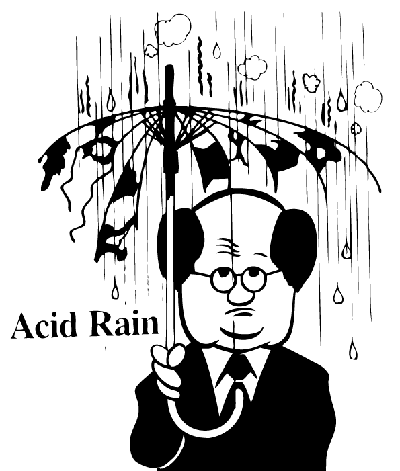
  • What is Acid Rain?

    What is Acid Rain?

    The term acid rain refers to what scientists call acid deposition.  It is caused by airborne acidic pollutants and has highly destructive results.

    Scientists first discovered acid rain in 1852, when the English chemist Robert Agnus invented the term.  From then until now, acid rain has been an issue of intense debate among scientists and policy makers.

    Acid rain, one of the most important environmental problems of all, cannot be seen.  The invisible gases that cause acid rain usually come from automobiles or coal-burning power plants.

    Causes

    For many years, there was considerable debate and disagreement over what caused acid rain.  Recent scientific work, however, has helped to clarify this.

    The primary causes of acid rain are sulfur dioxide and nitrogen oxides.  These chemicals are released by certain industrial processes, and as a result, the more industrialized nations of Europe as well as the US suffer severely from acid rain.

    Most sulfur dioxide comes from power plants that use coal as their fuel.  These plants emit 100 million tons of sulfur dioxide, 70% of that in the world.

    Automobiles produce about half of the world’s nitrogen oxide.  As the number of automobiles in use increases, so does the amount of acid rain.  Power plants that burn fossil fuels also contribute significantly to nitrogen oxide eemissions

    Though human causes are primarily responsible for acid rain, natural causes exist as well.  Fires, volcanic eruptions, bacterial decomposition, and lightning also greatly increase the amount of nitrogen oxide on the planet.  However, even the gigantic explosion of Mt. Helens released only about what one coal power plant emits in a year.

    Once the tiny pollutant molecules have entered the atmosphere, they can travel for thousands of miles.  Eventually, the particles will combine with other compounds to produce new, often harmful, chemicals.

    Acid rain comes down to the earth in the form of rain, snow, hail, fog, frost, or dew.  Once it reaches the ground, the acidity in the substance can harm and even destroy both natural ecosystems and man-made products, such as car finishes.

    Acid rain moves easily, affecting locations far beyond those that let out the pollution.  As a result, this global pollution issue causes great debates between countries that fight over polluting each other’s environments.

    For years, science has studied the true causes of acid rain.  Some scientists concluded that human production was primarily responsible, while others cited natural causes as well.  Recently, more intensive research has been done so that countries have the information they need to prevent acid rain and its dangerous effects.

    The levels of acid rain vary from region to region.  In Third World nations without pollution restrictions, acid rain tends to be very high.  In Eastern Europe, China, and the Soviet Union, acid rain levels have also risen greatly.  However, because acid rain can move about so easily, the problem is definitely a global one.

    Effects

    Acid rain is having harmful effects both on people and on the natural ecosystems of the world.  Scientists today are convinced that acid rain is severe in many areas and that it is having an adverse effect on the environments of those locations.

    The problem of acid rain is rapidly spreading.  Because it is mainly caused by industrial processes, automobiles, and power plants, those countries that are developed have the most severe acid rain problems.   However, as the undeveloped nations begin to industrialize, acid rain will increase greatly.

    Determining just how much the planet is being hurt by acid rain is very difficult because the ecosystems that it affects are so diverse and complex.

    Many ecosystems are affected by acid rain.  Bodies of water, such as lakes and rivers, see many of their inhabitants die off due to rising acidity levels.

    Acidic water also ruins plant nutrients, hurting plants’ ability to survive and to give life to other organisms.

    Human-made products are also experiencing degradation from acid rain.  Cars can lose their finishes, and outdoor statues are beginning to rust.

    Acid rain’s effects are destructive and long-lasting.  Though scientists have studied lakes, streams, and many other natural ecosystems to prove its negative effects, acid rain continues to be produced and is increasing in many parts of the world.

  • Les organismes qui aident la recherche d’emploi pour les personnes ayant une déficience de développement

    Les organismes qui aident la recherche d’emploi pour les personnes ayant une déficience de développement

    Trouver un emploi est un défi considérable pour tout étudiant. Votre CV est court, votre expérience est limitée et vos compétences n’ont pas atteint leurs pleines capacités. Ce défi est encore plus colossal pour ceux qui souffrent de déficience développementale. Il y a des paramètres supplémentaires qui peuvent mener à des niveaux de stress, d’angoisse et de déprime qui sont néfastes pour la santé. Heureusement, dans tout le Canada, plus en plus d’organismes ont été créés pour les aider. Il en existe beaucoup vers lesquels ces personnes peuvent se tourner pour trouver un travail.

    Les différentes provinces proposent de tels organismes ; l’Ontario, notamment, avec sa taille et sa large population offrent beaucoup de possibilités. A Toronto, depuis 1953, Community Living Ontario se bat pour s’assurer que les personnes avec des déficiences intellectuelles soient totalement intégrées dans la communauté. Leur action « Ready, Willing & Able » se fait en partenariat avec des associations semblables qui mettent l’emphase sur l’accès au marché du travail des personnes avec des déficiences développementales. « Student Links » est une autre initiative qui fournit des mentors aux étudiants de l’école secondaire pour les aider à déterminer leur futur au-delà du secondaire. Community Living Ontario propose aussi de nombreuses conférences et ateliers tout au long de l’année sur divers sujets, qui aident les étudiants à rencontrer plus de gens et ouvrir plus de possibilités dans leur recherche d’emploi.

    LinkUp Employment Services se situe à Vaughan, tout près de Toronto. Ils agissent comme une agence d’emploi pour les personnes avec des déficiences. Si vous cherchez un travail, ils vous rencontreront pour évaluer vos besoins, vos compétences, votre éducation et votre expérience. À partir de là, ils vous aident à établir un Employment Action Plan pour développer un but clair qui vous guidera dans votre recherche. LinkUp peut faire des changements sur le lieu de travail, comme des appareils fonctionnels et des encadrements professionnels. L’organisme peut se rendre disponible pour l’employeur pendant l’apprentissage du nouvel employé. Leurs employeurs partenaires offrent aussi du travail non rémunéré pour aider à acquérir de l’expérience.

    Pour ceux hors de l’Ontario ou pour ceux qui veulent élargir leurs recherches, il y a beaucoup d’organismes dans tout le pays, qui travaillent pour aider les étudiants avec des déficiences développementales. Workink est un site uniquement consacré aux emplois inclusifs. Ceux qui cherchent un travail peuvent installer une alerte d’affichages, et trouver des informations telles que préparer un CV et les règles générales de divulgation. Easter Seals Canada est situé à Toronto mais s’efforce d’aider les jeunes avec des déficiences dans tout le Canada. Ils offrent aussi des bourses et des bourses d’études pour aider à rendre les études post-secondaires plus accessibles, ce qui peut réduire le stress et permettre aux étudiants de se concentrer sur leur recherche d’emploi.

    Trouver un emploi n’est jamais facile, notamment pour les étudiants qui doivent déjà gérer le stress de leurs études. Il y a plus de possibilités que jamais pour les personnes avec des déficiences de développement de trouver de l’aide pour leur recherche d’emploi et atteindre leurs objectifs. Les barrières sont en train de tomber et de plus en plus d’employeurs découvrent les forces et les compétences que tous les étudiants apportent sur le marché du travail. Il existe encore bien plus d’organismes en Ontario et dans tout le pays qui travaillent fort pour rendre cela possible.

    Sources

    Community Living Ontario. https://communitylivingontario.ca/en/about-us/

    Easter Seals Canada. https://easterseals.ca/english/

    LinkUp Employment Services. http://www.linkup.ca/

    Workink. https://www.workink.com/

  • Career Profile: Traffic Technician

    Career Profile: Traffic Technician

    When you look at a street full of traffic, you might think that no one is in charge and that people just drive wherever they want. However, the way that traffic works is the result of careful study and analysis. Traffic technicians work with information from traffic studies to monitor patterns and find better ways of helping people get to their destinations quickly and easily. If you are good at seeing patterns and using data to find better ways of organizing people, the job of traffic technician might be right for you.

    For drivers, cyclists, and pedestrians, it can be difficult to see how much work goes into making sure that everything goes as smoothly as possible. Sometimes, dangerous curves need to be straightened out, crowded intersections need better coordination of traffic lights, or crosswalks need to be moved to make them safer.

    Traffic technicians work with engineering companies, government agencies, city planners, and even the army to make sure that traffic moves as safely and smoothly as possible. This might involve changing the timing of traffic lights at intersections to make sure that the largest amount of traffic can get through as smoothly as possible. Traffic technicians might suggest narrowing the lanes on the road to encourage people to drive more slowly or look for sections of road that drivers find especially difficult.

    Working with data is a large part of a traffic technician’s job. First, technicians need to conduct surveys to find the information they need. This might involve counting vehicles that pass by certain spots or looking at accident statistics to see what happens in an area without a clear view of the road ahead. Traffic technicians need to know what the problems are and be able to think of potential solutions.

    Being able to see and analyze overall trends is important for traffic control technicians, but seeing the details is also very important. People in this job need to know how small changes can make a difference in the way that traffic works. For example, understanding how people respond to yield signs versus stop signs could help traffic technicians recommend the most useful changes to how the system works. These technicians might work with engineers and road builders to alter the design of roads if necessary.

    Traffic control technicians can work in almost any area that has a large amount of traffic, but jobs are more likely to be available in large towns or cities. Government departments and universities are the most likely places to find work. Salaries start at $53,000 per year and can rise to $72,000 per year.  Much of the work is indoors, but some people in this job might work outside on occasion to see the traffic flow firsthand.

    Being able to learn and work with others is important in this job. People with more experience in a certain area of the city, for example, might know more about the area than the traffic technician does. Receiving advice from those people could be important. Traffic patterns can also be different in the morning than they are in the evening and can change at different times of the year. Doing research into factors that affect traffic is important.

    Traffic technicians are important for keeping people safe and vehicles moving on the road. If you are detail-oriented and organized, this job could be right for you.


    Bibliography:

    Career Explorer. “What Is a Traffic Technician?” https://www.careerexplorer.com/careers/traffic-technician/.

    Glassdoor. “Traffic Technician Salaries in Canada.” https://www.glassdoor.ca/Salaries/traffic-technician-salary-SRCH_KO0,18.htm.

    Government of Canada. “Traffic Technician.” https://forces.ca/en/career/traffic-technician/.

    Owl Guru. “How To Become a Traffic Technician.” https://www.owlguru.com/career/traffic-technicians/requirements/.