
Author: Carly Wignes

  • Five Steps to a Strong Essay

    Five Steps to a Strong Essay

    Writing essays shouldn’t seem like a massive burden. Just try to follow these five simple steps.

    Step 1: Think
    Ask yourself, “What is the purpose of this assignment?” The assignment is meant to assess how much you have learned in class. Keep this in mind constantly from when you begin to write to when you revise your final draft.

    Step 2: Brainstorm
    Depending on the assignment’s requirements, decide what you want to say in the essay. Make a list of what you want to write about and don’t hesitate to write down any and all ideas that enter your mind. The more, the better.

    Step 3: Plan
    Planning your essay might be the most important step. Once you have determined what it is you want to say, you will now need to map out how you’re going to say it. A typical essay format might look something like this:

    Introduction with a thesis statement that says your essay will be about topics A, B and C
    Body paragraph that describes topic A
    Body paragraph that describes topic B
    Body paragraph that describes topic C
    Conclusion that restates the introduction (but does not repeat it verbatim)

    Step 4: Write
    Choose the items on your brainstorm list that you want to use in the essay and write a full sentence for each. These sentences might become the topic sentences for your body paragraphs. It doesn’t matter (yet) exactly how you will say it, but rather that you have included everything your teacher has asked for. Don’t worry about writing formally or even completely logically. Just write. You can improve your work later. Sometimes it is helpful to say what you want to write out loud. Tell a sibling, parent or friend about what you are trying to say and then work what you have said to them into sentences in your essay.

    Step 5: Edit
    Edit your work at least three times. Every essay you write should go through several drafts. If you have done a good job of editing, your final draft will likely be significantly different from the first. (Hopefully you will have completed the first draft early enough to edit and not the night before the assignment is due!) Read your work through once from the beginning to end without stopping to make sure the sentences flow and the paragraphs are logically connected by transition sentences. Read your work through twice to make sure the thesis statement (which explains what your essay is about and which is usually the last sentence of your introduction) describes what you have written in the body paragraphs and vice versa. Read your work through a third time very slowly to check for spelling and grammar mistakes. Then ask someone else to read your work through in case they spot anything you might have missed.

  • Why Trades? Labour Shortages in Canada

    Why Trades? Labour Shortages in Canada

    The trades are one of the fastest growing sectors in Canada and, as such, there are projected labour shortages in the coming years. This means there are more jobs than there are people to fill them. For this reason, a career in trades is a great way to ensure you will have employment when you leave school.

    Red Seal Trades:
    Based on the Canadian Occupations Projections for Red Seal trades, there are 24 Red Seal trades with projected labour shortages.

    Construction:
    The national construction labour force is estimated to rise by 100,000 workers between 2012 and 2020. The industry will need to replace 219,000 workers that are expected to retire over the next decade.

    To address expansion and replacement demand requirements, industry will need to recruit an estimated 319,000 new workers to construction.

    Growth in construction will be concentrated in the non-residential sector related mostly to resource projects. Trades required for this type of construction work include: boilermakers, carpenters, construction estimators, construction millwrights and industrial mechanics, crane operators, electricians, gasfitters, ironworkers, plumbers, sheet metal workers, steamfitters and pipefitters, and welders.

    Oil and Gas:
    By 2015, employment in the oil sands sector is projected to increase by 29 per cent over 2011 levels, or approximately 5,850 jobs.

    The pipeline sector will add about 530 jobs over the same period.

    The industry will need to do significant hiring to replace retiring workers and for turnover.

    Mining:
    The mining industry will need 112,000 new workers by 2020.

    Forty per cent of the industry are 50 years old or older. One third of the workforce will be eligible to retire by 2015.

    In Ontario, for example, employers will have significant hiring requirements– almost 16,000 workers over the coming decade will be needed just to replace retiring workers and people who leave the mining workforce in Ontario for other reasons.

    Automotive:
    In the automotive industry, cumulative shortages over the next ten years are projected to range between 43,700 to 77,150 positions.

    Overall, almost one-half (48.1%) of employers reported that the insufficient supply of qualified staff to hire was a significant or very significant issue for their organization.

    Labour shortages were seen as a major problem among employers in the motorcycle repair sector (57.1%) and auto body/collision repair sector (54.3%).

    Tourism:
    By 2030, demand for labour in the tourism sector will grow to 2.1 million jobs, an increase of 33 per cent.

    The growing gap between labour demand and the number of available workers will cause a significant number of jobs to go unfilled over the next 20 years.

    By 2030, shortages in the tourism sector could grow to 228,000 jobs, leaving 10.7 per cent of potential labour demand unfilled.

    If the expected shortages are not mitigated, the sector could forgo $31.4 billion in potential revenues by 2030.

  • A Career in Trades: Automotive Service Technician

    A Career in Trades: Automotive Service Technician

    Do you…
    • Enjoy working with your hands?
    • Enjoy fixing cars, trucks, motorcycles or small engines?
    • Want to learn more about electrical, hydraulics (fluid power), pneumatics (air power) and mechanical components in machines?

    If you answered “yes” to any of the questions above, then a career as an Automotive Service Technician may be right for you!

    What Is An Automotive Service Technician?
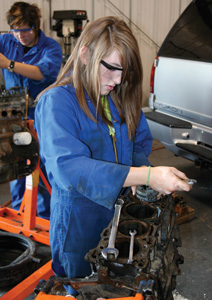
    An Automotive Service Technician is a certified and skilled tradesperson who diagnoses and repairs motor vehicles (e.g. cars, minivans, SUV’s, light duty trucks and medium duty trucks).

    An Automotive Service Technician performs various duties that help maintain a vehicle as well as repair it. Some of these job activities include:
    • Engine maintenance and repair
    • Transmission maintenance and repair
    • Exhaust system repair
    • Body repair and adjustments
    • Brake maintenance and repair
    • Steering, suspension and alignment repairs

    Where Does An Automotive Service Technician Work?
    An Automotive Service Technician may work in:
    • Dealerships
    • Independent automotive shops, repair shops and garages (owned by other people or themselves)

    Some Automotive Service Technicians may prefer to work as:
    • Teachers in high school teaching automotive class
    • Teachers in colleges that offer an accredited Automotive Service Training program

    What Does A Typical Day For An Automotive Service Technician Look Like?
    A typical day for an Automotive Service Technician in a dealership or automotive shop usually begins when a customer brings their vehicle to the shop. The customer tells the service advisor what the problems are with their vehicle. The service advisor documents the problems on a work order. The vehicle and corresponding work order is then given to an Automotive Service Technician who begins to work on this particular job.

    An Automotive Service Technician follows a certain procedure when working on a new job. He/she:
    1. Reads the work order written up by the service advisor.
    2. Examines the vehicle to further assess the problems mentioned on the work order.
    3. Provides the service advisor with an estimate on how much it will cost to fix the problems.
    4. Waits for the service advisor to confirm that the customer is OK with the repair costs before fixing the problems.
    5. Fixes the problems once the service advisor gives the go ahead.
    6. Takes the vehicle for a test drive and/or performs operational checks to ensure that the customer’s concerns are resolved.
    7. Informs the service advisor that the customer can pick up their vehicle.

    How Do You Become An Automotive Service Technician?
    1. Attend a college that offers a certified Automotive Service Technician training program.
    2. Complete the Automotive Service Technician program successfully.
    3. Find a suitable employer who will hire and train you as an Automotive Service Technician apprentice. (Complete your apprenticeship booklet/hours/activities at work and get it signed off by your employer).
    4. Write the Automotive Service Technician certification exam put out by the Ministry of Training, Colleges and Universities.
    5. Pass the exam, obtain your 310S license and become a licensed Automotive Service Technician!

  • A Look at the Trades from Insiders

    A Look at the Trades from Insiders

    With a plethora of career paths available to students once they leave high school, it can sometimes be difficult to determine where you should turn. You can go to university and spend four years gaining a Bachelors degree, you can obtain a diploma through college, or you can decide to study a trade. Increasingly, the latter option is becoming more and more popular with young people. But why?

    According to Line Breton, counsellor with the Ministry of Training, Colleges and Universities, a job in a trade is a stable career path. “Trades will always be needed in any economy,” she told us, “and your certification will always be recognized.”

    While going to school to obtain your certification, you will have the opportunity to work as an apprentice in your chosen field. JobsPeopleDo.com spoke with Bob Benner, owner of Hamill Machine Shop in Niagara Falls, Ontario. Benner has been regularly hiring apprentices for over 14 years and gave us the scoop on why the experience is so valuable.

    “An apprentice has the benefit of watching how the job is done and being able to go back to class with that experience,” said Benner. “They go to school to learn the right way to do things, but then get the practical experience and learn new methods while on the job.”

    Another often-overlooked benefit of a career in the trades is your ability to move up quickly and earn more money.

    “Once you start working, it gives you a chance to prove your worth,” says Benner. “In our shop, you may start at $14 per hour but can move up to as much as $27 per hour. If you work hard and keep your certification up-to-date, there is really nothing holding you back from earning more money. That is a big incentive for many students interested in trades.”

    The trades cover a wide array of different career paths, from mechanics to hairdressers, electricians to carpenters. No matter what path you decide on, both Benner and Breton agree that you need to follow your natural instincts.

    “Spend a semester working in a trade that interests you. It will expose you to both the positive and negative aspects of the job,” says Breton. This will help you to decide if this is the right trade for you.

    “Love what you do,” says Benner. “If you like working in trades, there will always be a place for you if you have your papers.”

    So why not discover the different options available to you in the trades sector? Check out all of the editorials and career profiles that we have for you right here on the JobsPeopleDo.com trades page!

  • Tips on Student Finances

    Tips on Student Finances

    1. Start planning your finances early. Figure out how much money you’ll need as soon as possible (tuition, ancillary fees, books and supplies, living expenses) so you’ll know how much financial support you’ll need. Include a realistic monthly budget for transportation, laundry, groceries, toiletries, entertainment, rent, etc.

    2. Use free money first if you have access to it (money from parents, money saved for your education including RESPs, scholarships and bursaries, etc.). If you need to borrow money, use low interest or no-interest options first, with OSAP being the best example. If you need to borrow money on top of that, try and get a cheap student loan. Stay away from credit cards if you can.

    3. Check out the OSAP Access Window at http://osap.gov.on.ca. The OSAP Access Window was developed by the Ontario government to help students make informed decisions when planning for their post-secondary education. It provides approximate costs by post-secondary institution, OSAP funding estimators, repayment tools and lots of other useful information.

    4. Explore early the scholarships, awards and bursaries offered by the university. There may be some program-specific or special interest awards that you may be eligible for. Many scholarships, awards and bursaries have deadlines and require applications.

    5. Don’t miss an application deadline. Include deadlines for financial support applications in your calendar and make sure you apply in time to be considered.

    6. Investigate getting a job as a source of income. If you need to work, work as much as possible in the summer period, rather than during the school year. If you need to work during the school year, try to avoid working a great deal in your first semester or in any semester that you expect to be particularly challenging. If you expect to be pressed for cash, consider postponing your studies for a year and saving some money, or consider reducing your course load from five or six courses to three or four courses per semester.

    7. Look into various means of saving money:
    • Brown bag it. Packing your own lunch is cheaper and healthier.
    • Buy new to you. Whether it’s used books, secondhand clothing or garage sale furniture, you can find what you need at a fraction of the cost.
    • Shop online to browse, create budgets, compare prices and take advantage of online savings.
    • Take advantage of student discounts. Be sure to flash your student ID at entertainment venues, on public transportation and anywhere else that will take it. Check out special deals through your student union.
    • Pick up the free weeklies to see what entertainment is going on in the city for free. Also check out free events hosted by the university.
    •Maximize public and active transportation (walking, cycling) to keep commuting costs down.
    • Avoid the latte effect and buy a coffeemaker or a kettle to make your own.

    8. Resist the temptation to sign up for a student credit card. If you end up falling into the “this-is-my-only-credit-card” crowd, make sure you get one with a low interest rate and ask them to fix the credit level at $500. Then be sure to use it only for emergencies. When credit cards are the only accepted methods of payment, as in online transactions, save the money you will need before you make the purchase. Then pay off your credit card immediately after charging it.

    9. A line of credit typically has a much lower interest rate than credit cards. A line of credit can be a cost-effective, convenient way to borrow money for a short period of time. Most financial institutions have a student line of credit that offers a lower interest rate, no annual fee and fairly lenient terms and conditions.

    10. Monitor your expenses. Keep all your receipts and track your expenses. This will force you to write down how much you’re spending, prompting you to think about whether you really need to spend that money or not. This will also definitely let you know if you need to change your spending habits and/or increase your income before it’s too late.

    11. If you find you’re running into financial difficulties, immediately speak to a student financial assistance advisor on campus or at your bank. They will look at your budget and give you some good advice before you get in over your head.

  • Carbon Scrubbers to Clean Up Emissions

    Carbon Scrubbers to Clean Up Emissions

    Research into methods of reducing carbon emissions is a continually advancing field, and a team of researchers developed an improved way to remove emissions directly from sources like smokestacks.

    The team recently had an article published in the Journal of the American Chemical Society detailing their findings, which focused on using substances based on a material called polyethylenimine to remove carbon dioxide (CO2) from sources. According to the article, these substances whoed some of the greatest results in removing CO2 from the air when compared to alternatives. The substances also proved capable of effectively capturing the CO2, and could either be re-used or isolated, so it wouldn’t contribute to global climate change.

    The team, which consisted of researchers from the Loker Hydrocarbon Research Institute and Department of Chemistry from the University of Southern California, explained in their article that the materials used are uniquely effective largely due to their low cost and reusability. The material is relatively inexpensive when compared to other options, and can be reused numerous times without losing its ability to capture CO2.

    The article also explains that materials manage to remain effective in real-world conditions. This means that the materials were observed as being able to accommodate for exceptionally humid, moist or dry environments, something that is important when considering practical application of scientific research such as this.

    Other options for CO2 reduction are more expensive, less effective or durable and use large amounts of energy than the processes being researched by this team. If the researchers are able to effectively implement these polyethylene materials, they will have created a valuable resource that is much easier to use. Considering the cost-effectiveness and stability of the polyethylenimine materials, the application of them will make sustainability much more accessible, and therefore potentially more widespread.

    The material’s main target for carbon reduction is smokestacks; however the research could also potentially be used to reduce CO2 emissions from car exhaust, submarines, and even the open atmosphere itself. Cleaning of the upper atmosphere would hopefully reduce the greenhouse effects of the CO2.

    CO2 is one of the greatest threats to the environment in recent years. The amount of CO2 emissions produced by humans is of great concern to the population due to its effects on climate change,rising sea levels and air pollution. Research on ways to reduce emissions of CO2 is an area of international concern.

    According to the World Health Organization, high levels of greenhouse gases — of which CO2 is a prominent part of — affect necessities to health like clean air and water and increase the incidence rates of climate-sensitive diseases.

    Up until now, finding ways to reduce these emissions has proven challenging and unpromising. However, if this research team is successful in implementing polyethylenimine as a way to reduce emissions, the levels of CO2 in the atmosphere may be significantly reduced. This would help reduce concerns of climate change, and result in cleaner air in an effective and affordable way.

  • Green Cleaning

    Green Cleaning

    Whether you live at home, or at campus, cleaning is an unavoidable part of the daily routine. Have you ever read the list of ingredients in store bought cleaning products? Not only are its contents difficult to pronounce, they are harmful and toxic. Green cleaning is not hard, and will save you money. Listed below are 3 simple ingredients that can be used to simply and efficiently clean your entire house.

    Vinegar or Baking Soda:  By adding warm water to either vinegar or baking soda, a natural all-purpose cleaner can be made. Vinegar and baking soda can be mixed together with water to clean as well. Do not worry about the vinegar smell; yes it is strong at first, but it will go away. The vinegar/water mixture can be used to clean both inside and outside of various machines and appliances like tea kettles, steam irons, coffee makers, and more. Vinegar or baking soda can be used to deodorize the home too (i.e. placing a slightly opened container of baking soda in the fridge). These green all-purpose cleaners can be used to clean almost anything! Everything from windows, clothing, furniture, microwaves, and even the kitchen sink can be cleaned with these simple ingredients.

    Lemon Juice:  The acid in lemon juice works great as a natural stain-remover . However, work quickly while using lemons as a stain remover since they do have “a bleaching effect, particularly when exposed to sunlight”. A lemon half can be used to scrub away at copper and steel surfaces; but be careful on marble. Or a cloth wetted with lemon juice (bottled or squeezed from a lemon) can also be used to rub away stains. Lemon juice can be combined with either salt or baking soda to form a paste, to make cleaning easier since lemon juice by itself it quite runny. Clothing, and other cloth-like material can also be freed from stains by using this lemon juice paste. After gently rubbing the mixture into the stain, be sure to wash the item of clothing after.

    Now that you know about green cleaning, your commercial cleaning products can be replaced; however, since they are toxic they must be disposed of responsibly. Toxic recycling programs are held in most communities to properly dispose of these chemicals. So even while cleaning may still be a chore, at least we can feel better that we are not harming the planet in the process.

    Check out these websites that offer more tips on green cleaning, and other ways on how to go green:

    http://planetgreen.discovery.com/

    http://www.treehugger.com/

    http://odyb.net/food-cooking/62-little-known-uses-of-vinegar/

  • Is it Smart to Work for No Money?

    Is it Smart to Work for No Money?

    Working for no money is a very common thing. It might seem strange that people would work without being paid. However, people do it every day when they cook meals for their families, clean their houses, or help their friends with construction projects or other jobs. When people talk about working for free, however, they usually mean something a bit different from the small, ordinary jobs like these. Usually, working for no money falls into one of two categories: volunteering or unpaid internships. They can both be good if treated with care.

    The most common form of unpaid work is volunteering. In 2010, over thirteen million people in Canada volunteered at least a small amount of time in many different places, such as hospitals, libraries, schools, and special events like festivals. Some people volunteered for only an hour or two, while other people spent hundreds or even thousands of hours helping others. They fed the hungry, planted trees, counted migrating birds, helped build houses for the poor, and did many other things in their own communities, in another part of Canada, or even in different countries.

    People volunteer for many different reasons. Sometimes they volunteer to meet people with similar interests and to work with organizations where they are already receiving some benefit, such as when mothers volunteer as helpers in their own children’s classrooms. Others volunteer as a way of learning skills like teamwork and communication or to meet people who work in their chosen careers.

    In some fields, unpaid internships are another form of working for no money. While volunteers usually work no more than a few hours per week, interns work full-time at a job with the expectation that they are learning something about a career. The idea of internships started in medicine, where people who had graduated from their basic studies would spend time working in hospitals and learning to apply what they had learned. These days, almost anyone can work as an intern.

    Internships like these can be good, but they can frequently lead to problems. One of the keys of an internship is that the interns are supposed to learn from the experience. If employers make the interns do the work of a paid employee or fail to teach them any new skills, they have broken the rules. Some of the internships currently being done in Canada are illegal because of these kinds of problems.

    So should you work for no money if the benefits are so uncertain? It really depends on the situation. Volunteering is usually a good idea since it shows that you are trying to be a responsible citizen who cares about the community. Unpaid internships are more problematic, but they can still be good. With the proper guidelines and supervision, they can help launch you into your chosen career. When everything comes together, the benefits of working for no money can last a lifetime.

  • Too Cool for School?

    Too Cool for School?

    “A human being is not attaining his full heights until he is educated.” – Horrace Mann

    It is important to remember messages such as these when the pressure of high school really sets in. Will I make friends? Will I fit in? Will my teachers be too strict? It takes a few years and a couple life lessons to really understand the insignificance of these questions. High school isn’t a popularity contest or a soap opera, it’s a learning institution that will help to mold you into the person that you one day hope to be. It’s a stepping stone on the path to a life that you can be proud of.

    Statistics Canada reports that 191,000 young people aged 20 to 24 had not completed a high school diploma and were not attending school in 2009-2010, though this is a significant drop from the 340,000 in 1990-1991, it is still a cause for concern. Too many high school students are not taking their education seriously and are putting their futures on the back burner.

    It may seem cool to work in a fast food restaurant or a trendy clothing store for now, while you are living at home with your parents or guardians, and your income is solely for partying or material things. But eventually that roof with no longer be over your head, and your free ride will be over. Suddenly, those 32 hours a week and that minimum wage job won’t seem so glamorous anymore. You’re faced with the reality of bill payments and rent cheques and that bank account is getting smaller and smaller every month. This is when it hits you – “I should have just toughed it out and stayed in school.”

    It takes a lot of hard work and motivation to succeed in this world. A cushy, high paying job won’t just be handed to you on a silver platter (unless you are one of the lucky few, but let’s face it… if you were, you wouldn’t need us) and every dollar in that bank account will have been earned with pride.

    Whether you’re bullied, burdened or just plain lazy, a high school diploma is an accomplishment that is recognized all over the world, and there is nothing that should keep you from it. Keep your eye on the prize and before you know it, you’ll be throwing your hat in the air, anxiously awaiting what comes next…

  • Don’t Be THAT Girl

    Don’t Be THAT Girl

    “Your hair is so ugly!”

    “Did you gain weight?”

    Have you heard some of these or other worse things uttered in the hallways? Were you the one who said some of those nasty things? A recent article from the New Zealand Herald found that 85 per cent of teenage girls have experience some sort of bullying. The most shocking thing is that, when it comes to girls, some of this bullying is coming directly from their friends.

    If you’re the victim of a friend’s torment you may be blaming yourself first and bringing unnecessary doubt and confusion to yourself. Rachel Simmon, author of Odd Girl Out, found that “one of the chief symptoms of a girl’s loss of self-esteem is the sense of being crazy, of not being able to trust one’s own interpretation of people’s actions or events.” If you don’t understand why your BFF is turning on you, it may be her problem – not yours.

    Now, if you’re on the other side of the equation and are part of bullying, please think about your actions. It’s a false position of power to be the bully. Girls may form cliques and have their own way of dressing, talking or sharing of a secret. Leora Tanenbaum states it simply in her book Catfight – “the ironic thing about being included is that it necessarily entails exclusion.”  Bullies need to ask themselves why they are excluding others. There isn’t a guarantee that you’ll stay in the exclusive clique forever; you may just end up being the outcast.

    Some would tend to think that bullying would involve violence, but this isn’t always the case. Getting a group of friends to ostracize, say hurtful things and spread rumours about you are all forms of bullying, too.

    The one thing someone being bullied should do is also the thing they will most likely avoid: to talk to your parents about what you’re experiencing. If you’re too scared to do that, you should talk to an adult you trust. Sometimes it’s beyond your own control when it comes to bullying. It’s important to let someone in a position of authority know what’s going on. High school should be a place that will give you four years of great memories, not something you should dread.