Author: Alex Yew

  • The Scholarship Application Process

    The Scholarship Application Process

    If you have decided that you would like to apply for a scholarship then you will need to start by finding one. You will also need to apply early because you do not want to be rushed and pressured to get your application in on time. If you have really good grades and you have been able to maintain them for most of your academic career, look for academic scholarships. If you are really good in sports, then this is where you may want to focus your attention and you will want to conduct a search for these types of scholarships. Just take your time. You will find a large list of different scholarships online, at your local library or even from your school counselor.

    Take some time and really think about your positive qualities. What are you good at? What do people like about you? Do you have any experience or hobbies that make you special or help you stand out from others? What makes you the best person for the scholarship that you are looking at? If you are able to write these things down, you will be more prepared for the entire process when you are ready to start applying and completing applications. It is always best to brainstorm because you will not feel stuck the further along you get.

    Once you have your list of available scholarships you will need to get ready to apply. You should never start this process without taking your time and reading through all of the qualifications and directions very carefully. You may also find a large amount of small print on the pages and you must be sure that you are reading that as well.

    Something that you should look for when it comes to reading the application is to search for anything that says if you will be given special consideration for any work that you have completed in the past. For example, if you volunteered you may be able to write an essay about that and it can greatly improve your chances of getting the scholarship over those individuals that did not volunteer.

    Many of the scholarships that you find are going to require you to apply in the form of an essay. Always have someone read through what you have prepared to ensure that the questions were answered completely and that your spelling and grammar is correct. You will make a very poor impression if you do not do this and your essays are incomplete.

    As you can see, it can be very easy to apply for scholarships as long as you are taking your time. You may be a little bit concerned about this in the beginning but the more scholarships that you apply for the more you will be learning. It becomes easier the more that you do it and you will find that you will be more relaxed as time goes by.

    You never want to let your nerves get the better of you and you shouldn’t give up just because you are unsure about something. What you need to remember is that in many cases you may never meet the individuals that are giving you the scholarship. So, you should just try to relax and put in your best effort. If you do not succeed then no one needs to know. You can just apply for the next one and try even harder. Always try to find out why you did not get the scholarship because this can really help you determine what you may be able to do differently on the next one that you apply for. You can learn from your mistakes and that can really help you in the future if you are willing to turn a negative into a positive when it comes to your college career and your life goals.


  • How To Get Scholarship Help

    How To Get Scholarship Help

    Contributed by Sachin Kumar Airan from amazines.com

    When it comes to college scholarships, the more that you can accumulate the better off you will be. You cannot always rely on college financial aid to be enough to get you through college. After all, financial aid is based on your parents’ salary and their assets, not your own. Therefore, if your parents are not willing or able to help as much as their financial aid sheet says they can, then you may have problems and be in need of college admissions assistance to find a way to afford your tuition. The good news is there are several ways that you can seek out college scholarship help.

    Utilize a college financial aid calculator
    The first thing you are going to want to do is head online and look for a college financial aid calculator. Although the tuition charged may change from school to school, you will have a rough idea of where you stand on what you will owe if you use a certified calculator. This gives you an estimate of how much you will be left owing after student loans so that you can figure out the amount of scholarships you will need to cover tuition. Keep in mind that scholarships can be applied before financial aid if they are sent directly to the school, so this is another factor to remember while shopping for useful scholarships.

    Check out your high school guidance office
    The second thing you need to do is make an appointment with your high school guidance office so that you can sit down with your counselor and go over your scholarship options. They are the best window into your local scholarship opportunities.They will know what you are eligible for and, since they have spent years helping other students, they know what you are likely to get. This will help save you a lot of wasted time.

    Seek out college admissions assistance
    Another great office to schedule an appointment with is the college admissions assistance office. Their assistance is also invaluable because they have experience helping freshmen every year. They can help guide you through the scholarships available in your college town so you can afford your education. They can also help you see if you qualify for anything directly from the school, because many times schools offer grants and these can be helpful to put towards your tuition.

    Online scholarship help
    Finally, the last thing you might want to think about doing is heading online to look for scholarships. There are actually many websites designed to offer college scholarship help to college freshmen. Online searches can reap a lot of rewards because you can apply for dozens of scholarships with just one click of a button, making it a very time efficient way to apply for help.

  • It’s Natural To Be Healthy

    It’s Natural To Be Healthy

    It’s amazing how our bodies regenerate. We get hit and bruises form as blood leaks into tissues. Over time, the dark blue colour is diluted, and may move before disappearing. Even broken bones will heal and return to full strength. And skin, our largest organ, is a miracle layer. It keeps the rest of us inside and everything else outside. It wards off infections, sheds water, cools us in hot weather, and repairs itself.
    Subscribe to Science Matters

    Still, viruses, bacteria, and parasites are ever-alert for opportunities to penetrate our protective layer. As well as frequent nicks and cuts, we have natural openings like mouths, ears, noses, anuses, and genitals, each with its own protective mechanisms. If an invading organism gets inside, we have an incredible barrier, our immune system, constantly generating new proteins to fight off infections we’ve never even encountered. We have a defence system that recognizes and fights against any cell with a genetic makeup different from our own (which is why it’s so difficult to transplant organs, tissues, or cells). Yet, pregnant women support a foetus that is genetically different for nine months.

    Thanks to evolution, our bodies have powerful ways to ward off illness and infection and enable us to live long and healthy lives. Why, then, do health costs continue to climb at unsustainable and frightening rates? Part of it is that medical care has become so sophisticated that doctors are able to treat more problems. Another part is the ever-increasing cost of drugs. And with a medical system, people are more likely to seek help. Still, health-care costs can’t continue to rise forever. Governments are always looking for ways to reduce costs, often by offloading a greater share of the burden onto patients.

    We must pay greater attention to keeping our bodies and minds healthy and able to heal. Yet we are making it difficult for our defences to work. We allow things to be sold that should not be called food. Many have no nutritive value and lead to obesity, salt imbalance, and allergies. We spew chemicals into the environment by the millions of tonnes. Molecules pour into us through air, water, and food, overwhelming or weakening our protective immune systems. According to Harvard University doctors Eric Chivian and Aaron Bernstein, “Our behaviour is the result of a basic failure to recognize that human beings are an inseparable part of nature and that we cannot damage it severely without severely damaging ourselves.”

    The medical literature tells us that the most effective ways to reduce the risk of heart disease, cancer, stroke, diabetes, Alzheimer’s, and many more problems are though healthy diet and exercise. Our bodies have evolved to move, yet we now use the energy in oil instead of muscles to do our work.

    In 2007, the World Health Organization concluded that environmental factors contribute to 36,000 deaths and 13 per cent of the disease burden in Canada annually. The Canadian Medical Association claims air pollution causes more than 20,000 premature deaths a year. And according to author and environmental lawyer David R. Boyd, scientists estimate that environmental factors affecting heart and respiratory disease, cancer, and birth problems contribute to anywhere from 10,000 to 25,000 deaths, 78,000 to 194,000 hospitalizations, 600,000 to 1.5 million days in hospitals, and other problems totalling $3.6 billion to $9.1 billion in direct and indirect costs each year.

    It’s easier, more effective, and cheaper to let healthy bodies fight off disease and infections than to weaken those defence mechanisms and then compensate for them medically. If we want a stable health system, we must put more resources into reducing pollution and environmental degradation and creating a way of life that keeps bodies and minds happy and in good health

  • A College Students’ Guide to Smart Foods

    A College Students’ Guide to Smart Foods

    With Halloween fast approaching, it is more tempting than ever to indulge in candy and sweets – especially when they all go on sale November 1 so stores can make room for Christmas stock! So how can you avoid these temptations and ensure you keep up your energy with healthy foods?

    I once had a math teacher who would tell us about his college days – the mistakes he made, his strange professors, and, what stood out the most, his diet. He consumed Pop Tarts and Coke every day for a whole year! Though it is a fast and delicious choice, you would not be doing yourself any favours. College is a whole new world for everyone. If you are dedicated, you will have little time and energy to make healthy meals like the ones we’d get at home. Here are a few quick and easy tips to boost your energy levels and stay healthy as a busy college student.

    1. Morning Banana: Holy benefits, Batman! Bananas are packed with nutrients and vitamins everyone can use. They are a natural mood booster, protect your eyesight (due to the combination of vitamin C and carotenoids), aid your digestion and keep your bones healthy. Smoker? Bananas can help! Bananas contain vitamins B6 and B12 as well as potassium and magnesium which help the body recover from the effects of nicotine withdrawal. In the stressful life of a college student, our body’s potassium levels will drop as the stress goes up. Bananas are a great, natural way to re-balance your potassium levels. It’s Bananas!

    2. Nut case: With monounsaturated fat, vitamin E, folic acid, magnesium, copper, protein and fiber, nuts are rich in antioxidant phytochemicals. Nuts are generally high in protein and therefore a great snack for hungry, on-the-go college students. Try almonds, walnuts and pecans (avoid the ones drenched in sugars and salt!). Choosing a cereal containing nuts is also a great way to bust hunger.

    3. Hello Blueberry! Blueberries improve memory, motor skills and reverse age-related declines in balance and coordination. Add a few brainberries, I mean blueberries, to your daily diet to keep your mind sharp and clear all year!

    4. Hot Cocoa! A study from Cornell University showed that two tablespoons of pure cocoa powder has almost two times the antioxidant power of red wine, 2-3 times the power of green tea and 4-5 times the power of black tea. The antioxidants in hot cocoa protect brain cells from “oxidative stress” that can lead to Alzheimer’s disease and other disorders. So warm up a cup of cocoa, snuggle up and STUDY!

    Stay away from greasy junk foods that drain your energy and ultimately do you no good. Try making your own meals or packing healthy snacks. If you find yourself eating in a cafeteria, try to choose something like a salad or wrap with veggies. Pizza, burritos and hot dogs are not your friends. Good luck and stay smart!

  • Incredible Eyes

    Incredible Eyes

    Did you know that tuna have a third eye? Or that shrimp can see colours we can’t even imagine? We humans rely so much on our eyesight that it’s hard to imagine there are things it can’t do. At least your eyes can help you read a few strange facts about vision in the animal kingdom.

    Three-Eyed Beasts!
    Though it’s hard to see, many fish, reptiles and amphibians have a third eye called the parietal eye. It’s smaller than the other two and often covered by a layer of skin. It usually appears as a small, grey oval between their other eyes. The parietal eye can’t see the same way other eyes do, but it has a small lens and retina that allows it to detect light and dark. It helps animals keep track of the time of day and regulate their body temperature.

    That Creepy Glow
    Everyone’s seen that creepy Halloween image of a black cat in the middle of the night, invisible except for it’s shining green eyes. Why do cats have that unsettling trait and we don’t? Actually, it’s not just cats. Lots of animals can do this, particularly ones that are active at night (nocturnal). This includes horses, cows, dogs and hyenas. These animals have a layer at the back of their eye called the tapetum lucidum. When light shines at them from a bright source, they reflect it back like a mirror. This helps them see in the darkness.

    Seeing Heat
    Infrared vision – the ability to see heat – is something we think of superheroes having. Well, snakes have it, too! Pitvipers, as well as some boas and pythons, can all see heat. This actually has nothing to do with their eyes, but it’s still a sort of vision. It takes place in a “pit organ” between the eyes and the mouth, which functions differently in different kinds of snakes. Since many snakes have poor vision, this helps them to find warm-blooded prey. It’s so powerful that it even allows a blind rattlesnake to strike at the vital organs of its prey. Scientists have recently discovered that this pit organ is not just for hunting, it’s also a survival tool. The snakes that have it are better at finding a place to warm themselves up than other snakes who don’t.

    Expanding the Rainbow
    We have something in our eyes called cones that allow us to see colours. Our eyes have three cones: red, green and blue. By combining them, we see all the colours that we think of in a rainbow. But we’re missing out. Some other animals have far more cones than we do. The mantis shrimp takes the prize, with sixteen cones in their eyes! This means they see colours that we can’t even dream of. Scientists have also speculated that some women have a fourth yellow cone that allows them to see more variations in colour than the rest of us. So maybe you or your sister is privileged with seeing a wider rainbow than the rest of us.

    It’s easy to think of us humans as being the most evolved species on the planet. Sometimes we forget that even a cow sees things in a way that we can’t!

  • Bike-sharing: An Idea for City Cycling

    Bike-sharing: An Idea for City Cycling

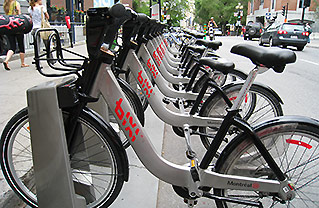
    How good are you at sharing with others? Do you ever let your friends use your bicycle? How would you like to share it with hundreds of other people? You might not want to do that with your own bicycle, but what if you and your friends could use public bicycles like taxis or buses? If you had to go somewhere, you could pick one up near your house, drop it off at your destination and then get another one for the return trip. Then someone else could use it for their own ride. That way, you could experience the benefits of cycling even if you didn’t own a bicycle.

    The idea of a public bicycle system began in the 1965 in Amsterdam, Netherlands. The White Bikes (Witte Fietsen in Dutch) were intended to be used for a short trip and then left for the next rider to pick up, but it didn’t work out that way. There was no way to know who had taken the bikes, and many of them were damaged or stolen. The program ended after only a few days, and bicycle-sharing seemed to be finished. Then in 1991 and 1993, four small bicycle-sharing programs began in Denmark. The largest of these was in Copenhagen, where bicycles were available at certain stations throughout the city for a coin deposit. The bicycles were much better built than the White Bikes of Amsterdam, but they were still often abandoned or stolen. The organizers needed a new way of keeping track of the customers who borrowed the bikes. Eventually, technology helped to provide a solution to the problem.

    The main trouble with previous systems was that there was no way of knowing who had the bicycles or where they went. In 1996, the Bikeabout program at Portsmouth University in England helped provide an answer with electronically-controlled bike racks and magnetic stripe cards for borrowing a bicycle. By 2005, the idea of bike-sharing was spreading around Europe. The city of Lyon, France bought 1500 bicycles for shared use, and the government of Paris started its own program called Vélib (from the French words for “bicycle” and “free”) in 2007. The program began with 7000 bikes but has now expanded to 23,600 around the city. In 2008, similar programs began outside Europe in places like Brazil and New Zealand. In 2009, the Bixi (“bicycle taxi”) program began in Montreal with 5000 bikes at 400 stations.

    The idea behind bicycle sharing is quite simple. People can buy daily, weekly or yearly passes. When they want to ride, they use their credit cards to release the bicycles from the racks. The first half hour of the ride is free, and after that they start to pay a rental fee for extra time. Bicycle repair people pick up damaged bikes, fix them, and return them to the racks.

    This system is especially good for people who use bicycles for short trips, such as riding to work or school. It saves the trouble of finding parking spaces for their cars, not to mention giving people a chance to exercise and to avoid adding to pollution in the air. If bicycle-sharing continues to grow, it could change the way people travel in the world’s cities.

  • Languages Open Doors!

    Languages Open Doors!

    You might wonder what’s the point of learning a language that you don’t need to speak in order to get by. It’s a question worth asking and there’s more than one answer. Languages will help you in some obvious ways and some ways you might not expect, whether it’s opening doors to travel, providing job opportunities or giving you a unique perspective on the world.

    One of the obvious advantages of learning other languages is that they allow you to see places you wouldn’t otherwise see. Nearly every city that people travel to has something called the “tourist circuit.” What that means is there’s an area of the city filled with hotels, restaurants and activities like boat tours that are mostly reserved for tourists. These places are easy to visit, because everyone who works there speaks English. Sure, anyone can appreciate riding an elephant in Laos even if they don’t speak Laotian, but there’s much more to see in a country.

    If you go to Germany and speak German, you can talk to a local on the bus and find a club to see some good live music. If you go to China and speak Mandarin, you can leave the tour group and find out what “Chinese food” really is. More than that, just being able to have conversations with the locals is worth it. There’s a feeling of satisfaction from having worked at learning a language and reaching the point where it can get you more than the ability to read a menu.

    Languages also help with your career. Businesses from video game testing to restaurants to customer service often search for employees who speak a second language. If you’re in sales and you happen to speak Korean, you have a leg up in the industry when dealing with Korean customers. Businesses know that. It might seem strange to be learning Portuguese in an English-speaking country, but that means when an employer needs someone to edit documents written in Portuguese or deal with Portuguese customers, you have a rare skill that gives you a huge advantage in the job market.

    Knowing an additional language will also give you access to another culture. You get a master key to a whole set of books, music and movies that most other people can never see. Even within Canada, English news and French news will give you different points of view on the same issue. If you can read both, or if you can listen to your local Spanish radio station, you’ll know about things that other people will never have heard of and you’ll have more well-rounded knowledge about your city and environment.

    There are plenty of ways to learn a new language. Many people start learning in high school, but you can also attend private classes. Probably the most exciting way to learn is through a foreign exchange to an area that speaks the language. After all, studying a language will give you all the basics you need, but you have to actually use it if you want to understand it and to speak it smoothly.

    So if you happen to find Italian interesting, take your school’s Italian class even if you can’t see how it will help you right now. Follow your gut and you’ll end up in fascinating places.

  • The Importance of Academic References

    The Importance of Academic References

    If you are like any other teenager, I am sure you have been told to try to find and maintain strong professional references. These references usually consist of past employers or supervisors from volunteer opportunities. While professional references are very important, you also need to consider academic references.

    What is an academic reference?
    An academic reference is someone that can speak to your knowledge and research abilities in your field of study, usually a professor that has a doctorate degree and is an expert in the field. Some students may be tempted to ask a graduate student that is teaching the course or a teaching assignment for a reference, but because they do not have a PhD in the field they are not considered an appropriate academic reference.

    Who is a good candidate to be your academic reference?
    One of the most important things to consider when you are choosing an academic reference is how well the professor knows you. You want to get a professor that you have worked with closely throughout your time in university. Avoid picking professors you had in a class of 500; They should know you personally. It is best to pick your fourth year project supervisor or a professor from a seminar course that allowed for a lot of discussion and one-on-one contact. You also want to choose a professor from a course you did particularly well on – it is difficult to get a good reference if you received a poor grade.

    Start to cultivate relationships with professors as soon as you start in school. Discover who works in the field you’re most interested in and arrange to meet them prior to your last year of school. Inquire about working for this professor as a teaching or research assistant. You want a professor that knows you and that worked closely with you so that he or she can write a very personal letter. Generic reference letters look bad and do not stand out. You are much better off to get someone that knows you well and can speak to your academic achievements.

    Why is an academic reference valuable?
    Academic references can speak to your mastery of your major and your researching abilities. While most of your professional references can speak to your abilities working in a particular field and within the context of that job, an academic reference can speak to your knowledge of a subject, research abilities, potential, work ethic, oral and written communication skills and overall abilities. Not only are academic references a great asset to have when applying to jobs, they are a requirement when applying to graduate school or any type of professional degree (e.g. Law school or Teacher’s College). Most graduate programs require two to three academic references. These references are an integral part of the application process and can make a big difference in whether or not you are accepted. A glowing reference from an expert in your field can significantly improve your chances of being accepted into competitive programs.

  • The Plight of the Honey Bee

    The Plight of the Honey Bee

    They are a marvel of architectural design and one of nature’s most heroic creatures. The honey bee is an incredible insect with a work ethic beyond anything humans could ever endeavor to mimic. The honey bee works day and night without tiring, each assigned to a specific task.

    There are three groups bees can be categorized into: workers, queens and drones. The worker bees are the only bees people ever see. They gather food from the outside world, build and clean the hive and work to protect it. The drone’s only job is to fertilize the queen and in the fall, when the hive is at its bursting point, they are ejected from their home, sent to live in the wild elements where they eventually die. Honey bees are social creatures that co-operate well within the confines of their narrow existence. They have a job to do and they do it well.

    The worker bees must gather food for the queen and the drones. They do so by collecting pollen and nectar from flowering plants, thus beginning the production of new seeds. This process is called pollination and the honey bee is the biggest contributor. Without pollination, many crops of fruits, vegetables and nuts would die. It is estimated that one third of the world’s food source depends on honey bees to pollinate them.

    In 2006, there was a sudden collapse in honeybee colonies. This decline in bees was so drastic that scientists coined the event “Colony Collapse Disorder” or CCD. Throughout history bee colonies have experienced sudden and unexplainable collapses, but none so wide spread and epic as in recent years. Why is this happening? Many scientists have speculated that there is no one particular cause for the decline in the bee population, rather it is several factors put together. Some believe the pesticides farmers use on crops is to blame. Others feel it the radiation from cell phones causing poor navigation for the bees. Global warming has been cited as a possible reason as well. The real answer is that no one knows why the bees are disappearing, but everyone agrees on one sobering fact – if the problem continues to persist, the world has a very big problem.

    Humans have been exploiting the actions of the honey bee for centuries, capturing and manipulating their surroundings to acquire the much sought after honey and wax the bees so guilelessly create. It was not until the 1600’s that North America was introduced to this ambitious worker. European settlers brought their precious bee hives to ensure a certain quality of life laced with the natural sweetness of honey, and today it is unfathomable to imagine a life without the bees and their effects.

    Fabricated bee colonies are cropping up everywhere in a global effort to repopulate the bees. So far this has met with success, but perhaps this phenomenon should be a warning to all of us. Rather than try to only fix the problem, we might just want to ask what the bees are trying to tell us. If there is a lesson to be learned from their disappearance it would be wise to understand it.

  • Why Choose a School Far Away from Home?

    Why Choose a School Far Away from Home?

    When considering post-secondary options, there are many decisions that dictate which school you settle on. This can range from the programs offered, the cost or the familiarity of the school itself. Yet there is often one question central to every student’s choice: whether to stay at home or go away for school.

    Each options has its pros and cons and are often influenced by the specific school, what they offer and their corresponding communities. But for many students, going to school away from home proves to be a fantastic and self-defining experience.

    Moving away from home is scary. You are thrown into a new room in an unfamiliar city surrounded by strangers. The independence you have always fought for is now imposed upon you and you are expected to not only adapt to your new circumstances but also excel academically and socially. It can be absolutely terrifying at first and you may want to forget the whole thing and go home.

    Soon the room will become your own, you will be able to successfully navigate between your classes and you will have met more new, young, enthusiastic individuals then you will know what to do with. It is completely natural to get homesick sometimes, but new friends, clubs and classes will keep you busy while waiting for the latest update from home.

    By going away for school you finally receive, and accept, your first taste of independence. You are now responsible for forcing yourself up for those 8:30 classes, eating right and simply taking care of yourself while effectively balancing your studies with your social life – both of which are crucial to a healthy student lifestyle.

    Your experience throughout university or college will only further advance these sentiments and allow you to grow as an individual. As you continue through second, third and fourth year you will come upon different challenges and tests, whether mundane or monumental, that will continue to define both yourself and your post-secondary experience. Such experiences may not be unique to those who go away for school but by choosing an independent lifestyle you are now more responsible for your own decisions.

    It can be difficult but it can also be a sensational, unforgettable experience. By going away for school you will become part of a new community of like-minded students, experience a new city and grow as an individual!