Author: Joy Kita

  • The Importance of Wetlands

    The Importance of Wetlands

    What Are They?
    A wetland is a habitat where land meets water such as ponds, marshes, swamps, bogs and fens. To classify as a wetland, the area must be completely covered or partially covered with water for a significant amount of time over the course of a year. This could be from flooding due to rain or melting snow, or because it exists as an established waterway. Wetlands are home to aquatic and land creatures, a combination that creates an incredible habitat able to function at great efficiency. This produces a rich environment for its inhabitants – wetlands sustain more life than any other ecosystem!

    Swamps: streaming water, often confused with marshes, set apart by the presence of trees and shrubs.
    Ponds: shallow waters, surface free of vegetation.
    Marshes: continually flooded with lots of surface vegetation.
    Bogs/fens: high water levels, large accumulation of peat, looks like solid ground but easy to fall through.

    Why Should I Care?
    Wetlands are home to more than 200 species of wildlife. Canada has a diverse population of amazing creatures, many that are endangered or at risk. Scientists have estimated that a third of these rely upon the wetland ecosystem. Migrating birds return to the same spot each year, and if that wetland is now a Superstore they have lost nesting grounds and their food source.

    Wetlands act like sponges, preventing floods from rainfall and melting snow. They also filter the water from pollution and chemicals, cleansing it before it recycles to the larger water basins. Amazingly, wetlands also remove and store greenhouse gases from the environment, making them important to the future of climate change as well.

    Cause to Worry
    Canada is home to many varieties of wetlands. It is estimated that 14% of the country is covered by a wetland, though the number shrinks every year. Wetlands are in danger of disappearing across the globe due to agriculture and residential development. According to the Alberta Wilderness Association, 70% of wetlands have been destroyed in that province alone. It is only in more recent years people come to understand the great importance of wetlands and their impact on our country. Without these powerful ecosystems, fowls, amphibians, mammals, reptiles and plants will eventually become extinct.

    What Can I Do?
    There are numerous organizations that recognize the value of wetlands and work hard to see them untouched and preserved. There are many things still yet to be done and much awareness that still needs to be raised. One factor in the decline of wetlands is the rapid consumption of water. We all need to conserve our water intake. Limiting the chemicals and pesticides we use will also have a positive effect on this ecosystem. Perhaps the most important thing one can do to help protect the wetlands is to educate themselves and others on the subject and become willing advocates. Finally, we can all take the time to enjoy the remaining wetlands and allow ourselves to be reminded why they are important.


  • Bullying Is Everyone’s Problem

    Bullying Is Everyone’s Problem

    There is no doubt that bullying is a problem which has been around for a long time – within all forms of human interaction, there have always been those that not only feel superior to others but feel the need to demonstrate this at any cost. Where bullying was once mostly confined to the schoolyard, now more and more children are plugged in to the internet. This has made the problem significantly worse, becoming more insidious, dangerous and sometimes even fatal.

    By now, most people will have heard about the B.C. girl who, having been relentlessly bullied for a number of years online, combined with her allegedly fragile state of mental health, felt it was necessary to end her own life. Sadly, she is certainly not the first to do this and will not be the last. While it is impossible to find any shred of positivity in the current situation, the fact is that social media allows more people to become aware of the severity of the problem. Although bullying will likely never be completely eliminated, this may lead to concrete measures being taken to severely diminish it over time.

    While it is obvious that the bully and the bullied are the central players, the problem of bullying is far-reaching, affecting family, friends, entire schools and workplaces. It is no surprise that the majority of people who are aware that some form of bullying is taking place are more likely to ignore it rather than take action. However, it is a fact that by becoming involved, whether simply standing up to the bully on behalf of the victim or making friends with the victim (who are often in great need of friends), the bully will think twice about his or her actions. Of course, this is not always the case and sometimes a greater degree of intervention is needed.

    The first step for anyone being bullied, or for those that suspect it is happening to someone, is to speak up. It is widely believed, particularly among kids, that ‘telling’ is akin to ‘tattling’ which is just not the case. The fear also may be that by telling someone they may inadvertently make the problem worse by angering the bully. While this is a genuine concern, it certainly should not be a reason to remain silent. Making bullying known through Facebook or some other form of social media may not always be the best idea as this can leave the victim open to even more abuse and torment from anonymous comments made by online bullies and ‘trolls’. Even if the victim is reluctant to speak up, they can still get support through one of the many anti-bullying organizations that exist online such as www.kidshelpphone.ca, www.pinkshirtday.ca and www.antibullying.net.

    While it is obviously the victim of bullying that requires the most immediate help, one shouldn’t forget that by letting them continue their behaviour, the bully’s future can also be put in jeopardy. It is rare that a bully simply bullies for the sake of it and by getting help early on they can avoid problems later in life. According to Free From Bullies, 60% of adults aged 18-24 who once bullied end up with criminal convictions, a fact that can have an effect on society and the economy as a whole.

    There is no simple solution to the problem of bullying and it is very sad that even adults who should know better can be just as guilty as children. The problem will not be stamped out overnight, but through talking, understanding and, most importantly, taking action, we can make small steps to fight back.

  • Finding a Career in Words: Editing as a Profession

    Finding a Career in Words: Editing as a Profession

    What would you do if you found a mistake in something you’d read, like a menu in a restaurant, an online blog or a newspaper? Would you just try to ignore it or would you try to tell someone about it? If you chose the second option, you might want to consider working as an editor someday. Editors are people who love words and writing, and who want writers’ thoughts to be communicated as clearly and effectively as possible, whether on paper or online. Editors are the link between writers and readers.

    Many different jobs can be part of an editor’s work. Some editors work as managers of newspapers, magazines or publishing companies. They decide what materials to publish and what to reject or to send back to the author for rewriting. Others work directly with authors to help them improve their work by making suggestions about the style or content. If a novel has far too many characters for readers to remember or is written in a very difficult style, stylistic or substantive editors can help.

    Near the end of the process, some editors work with the layout of the book or article, deciding how to fit it onto the page and make it look presentable. Others check names, dates and facts to ensure they’re correct. Just before the book or article goes to be printed or put on a website, a proofreader or copy-editor might look at it to check for mistakes in word usage, grammar, punctuation and spelling. If all of these parts work together, the result is a well-written and accurate document.

    To some extent, almost everyone is an editor. Have you ever checked your friend’s school assignment for mistakes? You were acting as an editor then. Have you ever stopped in the middle of a sentence to think of a better way of saying something? You were editing your own words. Professional editors do that kind of thing for a living.

    Generally, editors are not required to have any particular education in order to work. However, a Bachelor’s degree in English literature, creative writing or communications is very helpful. Some editors might also be required to obtain professional certification in areas such as technical communication. They might need to take courses on a variety of topics to keep their knowledge current. For many editors, a good knowledge of grammar is essential. Nouns, verbs, and prepositions are daily concerns for many editors. Reading all kinds of fiction, non-fiction and poetry is another form of training for editors. The more they read, the better prepared they’ll be to work with other people’s writing.

    In some cases, becoming an editor means a steady job with a regular paycheque. In most cases, however, the work is far more uncertain. Freelance editors who work with many different people have to be comfortable with an uncertain income. They have to be willing to work long hours and often to find another job to support themselves. For many editors, however, the enjoyment they get from the work is worth the trouble.

    So if you love words, why not consider becoming an editor?

  • Using a Tutor – Benefits Beyond Raising Your Grade

    Using a Tutor – Benefits Beyond Raising Your Grade

    Have you ever considered using a tutor? If your answer is no, there are a few things you should know about the benefits of a tutor that may help sway your decision. This article will explore how hiring a tutor can help students gain confidence in their own academic ability in addition to giving them a new outlook on course material. A good tutor will be willing to help their pupil become a stronger student, which will reflect in their assessments. I will also advise those hiring a tutor on what to look for when choosing a tutor to insure they are suited for your needs.

    Even those students that are satisfied with their academic achievements can obtain value from the guidance of a tutor. If you have ever studied for a test and skipped over a lesson or two because you did not fully understand it, all the while convincing yourself that one lesson would not affect your grade, you are not alone. Many students feel this way when studying for tests. What you need to consider is that one lesson in a grade 10 class may grow into an entire unit in grade 11 and you may regret not taking the time to get extra help to understand the material more fully. Tutors act as private teachers – to answer tough questions that you might not feel comfortable to ask in class and to help you understand difficult course material. By using a tutor to answer those questions, you will soon learn that no question is a “dumb” question and you will feel more comfortable speaking up in class (and trust me – there is always at least one other student wondering the same thing). Before you know it, your peers will be asking you for help!

    Understanding tough concepts is another place tutors can help. Sometimes it takes someone to explain a concept differently in order for you to understand it. Tutors can be great for this. They are there to help you understand and they can spend as long as you need – using examples until you feel comfortable with the material. For example, when being taught about optics in science class, understanding the specifics about near and farsightedness is lost on many students but few will ask for clarification. A tutor could take this concept of sight and compare it to the clarity of the words on an overhead screen as you adjust the focus to give the student a concrete example they can draw on when discussing or during tests.

    The examples above are determined by quality of tutor you hire. When hiring a tutor you should consider their education (a teacher, university student or senior high school student), their experience with the subject matter/course (they have already taken or taught the course and been extremely successful, or they have tutored this course in the past) and their philosophy on learning. I suggest meeting your potential tutor in person before hiring them and explain your needs and goals. When possible, consider tutors that have been recommended to you by family or friends. If that is not an option, try asking a teacher, professor, teaching assistant or guidance counselor for suggestions. Good luck!

  • Travel by Backpack!

    Travel by Backpack!

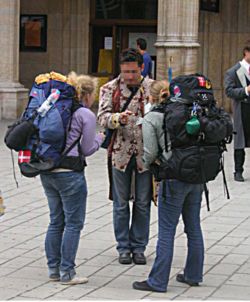
    A friend of mine was going on her first backpacking trip and needed some advice about what to bring. I looked in her backpack and the first thing I found were fake eyelashes. Those definitely wouldn’t be going! Then we looked through her ten-pound bathroom bag and I told her to make some decisions. Did she really need two types of shampoo or three half-bottles of sunscreen? Some things had to stay behind.

    Not everyone is as bad a packer as my friend, but it can be tough to know what to take on a backpacking trip. Taking too much will give you back problems, but leaving something out might get you stuck on the beach in hiking boots. Finding the right balance in your luggage is a matter of sticking to the necessities and knowing what you can find on your travels.

    Stick to the necessities.
    Good shoes are crucial. You’ll be traveling with lots of weight and you don’t want to get so sore you can’t walk by day three. A good pair of running shoes is usually your best bet. Hiking boots get really hot and they’re heavy to carry when you’re not wearing them. Also, most backpacking journeys have some resting time on the beach, so take some flip flops.

    Weather is unpredictable all over, so be sure to have warm and cool clothes. But don’t take much! Three or four t-shirts is enough. If you’re going somewhere hot, you won’t need more than one pair of pants along with your shorts. A sweatshirt or a light jacket is a necessity even in hot countries, and a bathing suit might prove useful even in cold places. Top it off with a few pairs of underwear and some socks, and you’re all set for clothes!

    Next, you need some bathroom supplies. Hostels might not have everything, so you should have the basics: toothpaste, a toothbrush, soap, shampoo and a towel. Sunscreen, bug spray and aloe for sunburns are good ideas, too.

    When in doubt, take less.
    Whether you’re in Brazil, Croatia or England, you can buy toothpaste or an extra pair of socks. Some people actually prefer to buy their clothes on the trip, since they can be much cheaper than they are at home. Also, never forget that where there are travelers, there are laundromats. If you only have four changes of clothes, that doesn’t mean you have to wear the same underwear for three weeks. There will be opportunities to wash them.

    Have money ready.
    You never want to carry around enough cash for your entire trip. You should have a debit card and ideally a credit card, too. These days, you can find ATM’s in pretty much any big city in the world. There are times when your debit card might not work or the bank listed in Lonely Planet isn’t there anymore. In those cases, American money never fails. Virtually anywhere you go in the world, people will take U.S. dollars.

    So keep things light, have some U.S. cash and a debit card and you’ll figure out the rest. If your clothes get a little muddy, that’s all part of the adventure.

    And of course, don’t forget your passport!

  • The Big Move

    The Big Move

    It goes without saying that starting university is an exciting time in a student’s life. So many changes, new faces, challenging studies, busy schedules…and then there’s the whole issue of possibly living away from home for the first time!

    The thought of living away from your parents is likely one that seems appealing, particularly when it’s combined with the fun of university. However, sometimes the reality may not be as good as the fantasy; It can not only lead to homesickness, but even some more major conditions and concerns. Students living away from home for the first time will likely face challenges and situations that they may not have even considered. Even the so-called “little things” – eating regular meals, getting adequate sleep, exercising – can all be forgotten when left to your own resources, particularly if you’re surrounded by people who may not see these things as priorities.

    Here, some tips to help you with your first time away from home!

    •Make a budget – and stick to it! The fact that the student budget is usually minimal is even more reason to spend what you have wisely. Prioritize – it is possible to still have money for entertainment while making sure all the essentials are covered. It’s a good idea to sit down with your parents before school starts to figure out a budget or take advantage of the school’s financial advice services.

    •Eat regular meals. Sounds simple right? Unfortunately, this can be one of the biggest problems for students away from home for the first time, especially when you have to actually buy the food and cook for yourself! Your schedule will be busy with the addition of extra studies and activities, but forgetting or not bothering to eat on a regular basis will not only be detrimental to your well-being in terms of maintaining a healthy weight, but lead to digestive complications, disordered eating, problems with concentration and lack of immunity. At the very least, start the day with breakfast.

    •Exercise on a regular basis. Exercise is important but it doesn’t have to be boring or become something to dread. The beauty of campus life is that usually there is a whole range of clubs and sports groups to join, whether the idea is to get involved with an activity you may have enjoyed in high school or take the opportunity to learn something completely new. The added bonus of this is that this can be a great time to meet like-minded people and socialize in a healthy way.If joining a group isn’t your thing, even just incorporating more movement into your schedule – walking or biking to class, to the store etc. – is all great for your physical and emotional well-being.

    •Which brings us to the subject of stress. While university has a reputation for being a fun and relatively carefree time of life, the often harsh reality is that you will be taking on a much larger work load than you may be used to. While some students handle the added pressures with ease, it is not uncommon to feel ‘bogged down’ with it all. Some stress can be beneficial – it keeps you alert and can even give you the kick you need to get work done on time. What is essential is to recognize in yourself when ‘good’ stress becomes harmful – trouble sleeping, panic attacks, negative thoughts and unexplained illnesses can all be signs. The fact that this is so prevalent in college students is why most schools offer excellent counselling services. Don’t feel embarrassed to take advantage of this – it could be the difference between finishing school with your sanity intact or dropping out due to pressure.

    One of the most important things to remember during your time at school, which can certainly be one of the best times in your life, is that there are always people to help and guide you. In addition to academic studies, university teaches us how to become independent. You worked hard to get here and it will shape a large part of your future – you owe it to yourself to stay healthy and happy.

  • Don’t Be What Others Want You to Be – BE YOU!

    Don’t Be What Others Want You to Be – BE YOU!

    What makes you different from others? Many people struggle to answer this question. It is the differences in each other that make us unique. We may have many things in common with each other, but there will always be one skill, one trait, one quality that sets us all apart.

    College is a good example of this. In it, there are thousands of students of different ages and from various walks of life learning something they have taken an interest in. When you are choosing programs, you are faced with a long list of career options and you may skim through a few without taking interest, knowing that this particular program is not for you. However, it may be exactly what someone else wants and it’s because of this that we are able to have a functioning society. There are so many jobs and for each job there is someone who this job is for. We have doctors and dentists, teachers and chefs, engineers and business owners, garbage collectors and police officers and we all need each other but could not do each other’s jobs. I would not want my dentist making my food or Gordon Ramsey teaching my children. We are not all supposed to be great at the same things. Though society and its media encourage us to look alike and be alike, it actually needs us to be different and, more importantly, ourselves.

    Too many people hide their true talents and skills, in fear that they will stand out too much as being “different”. They fear that they will end up unhappy, doing a job they don’t really like. We all seek acceptance in each other to the point that we lose ourselves and more or less put our true self away in a box, trying to mold ourselves to suit the desires of other people. Change or self-improvement is a good thing, IF you’re improving YOURSELF. Going to school, losing weight, building some muscle, changing your hair color, whitening your teeth – these are all fine things but they do not change the core of you. You are still you when you graduate; You are still you a few pounds lighter. These are only improvements on what you already are and it doesn’t change the true you inside.

    It is so important to discover yourself and be yourself because society needs you just as you are. Realizing this will help you bloom and excel in things you are passionate about. It is easy to have things in common with people these days thanks, to media, trends and culture. It’s okay to have fun with those things, but don’t lose yourself in it and don’t let it consume you. For everyone’s sake, do not be something you are not.

    The world doesn’t need another one of THEM. It needs just one of YOU.

  • Time Management Skills

    Time Management Skills

    At the end of the day, time management is going to be one of the chief challenges you face and one of the most valuable skills you develop throughout your post-secondary education. Though university and college is not the first time we’ve had to deal with time restraints, the increased focus on independent study and, for many students, the presence of a part-time job completely redefines how we appreciate and organize our schedules.

    A common joke you’ll hear in your post-secondary education is: “good grades, proper sleep, a social life: choose two.” This isn’t far from the truth! Though you are more than capable of doing all three, as well as hobbies, extra-curricular activities and jobs, many students are shocked by the time requirements called for in both university and college.

    For many this is made even more difficult by going away for school. For the first time you are solely responsible for getting up in the morning, organizing your meals and ensuring that you are capable of staying on top of your workload. It can be hard but it is possible! Developing your time management requires the growth of your individual organizational and prioritizing abilities, as well as sometimes forcing adjustments to certain study habits which may not function as well as they can or should.

    By the end of your degree I promise you’ll be laughing at your younger self, running around and stressing about first-year worries. Until then, let me try and give you some tips to help effectively organize your time:

    i) Design a class schedule around your own sleep pattern. Some of us are night owls, some are early birds. If you are like me and struggle to wake up for early classes, let alone study during that period, don’t be afraid to try and sign up for those 10:00 classes rather than the 8:30 ones.
    ii) Breaks are important. Some will make the argument that it is better to work through everything and, if it works for you, great. If not, accept well-deserved breaks as they come to you. If possible, do something that takes you out of the library or your room – a walk around the block? A jog? If not, try and do something with a clear start and finish. Watch an episode of a television show with the clear 21-minute end and don’t get lost on the internet only to look at the clock again two hours later.
    iii) Sleep is essential! Some cope with the time restraints by cutting back on their sleep schedules and for many we can afford to do this while maintaining a healthy lifestyle. Be careful, though, as it can be a slippery slope. Sometimes it’s better to sleep that extra hour than stare listlessly at the computer all morning trying to wake yourself up.

    Just make sure to be careful with your time and make the most of it. In the end you’ll be able to handle your time constraints with no problem!

  • October Scholarships of the Month – Apply Now!

    October Scholarships of the Month – Apply Now!

    Welcome to our listing of ten new scholarships for October! Be sure to check out the information for each one to see if you are eligible to apply. We are also featuring some grants from the Government of Canada. Grants function similar to scholarships – unlike student loans, you do not have to pay them back! You work hard for your grades – now go out and get that free money!

    1. TD Scholarships for Community Leadership – national scholarship program for students who have demonstrated outstanding community leadership. $70,000. Application deadline: December 7, 2012

    2. Queen Elizabeth II Silver Jubilee Endowment Fund for Study in a Second Official Language Award – national scholarship program for students enrolled in the second or third year of their first bachelor degree program during the 2012-2013 academic year. $7,000. Application deadline: December 14, 2012.

    3. The Arthur Paulin Automotive Aftermarket Scholarship Award – national scholarship program for students enrolled in an automotive aftermarket industry related program or curriculum at a Canadian college or university. $700.00. Application deadline: October 31, 2012

    4. Mensa Canada Scholarship Programme – national scholarship program. $1,000.00. Application deadline: January 31, 2013.

    5. Alexander Graham Bell Canada Graduate Scholarships and NSERC Postgraduate Scholarships – national scholarship program for students who hold, or expect to hold (at the time you take up the award), a degree in science or engineering from a university whose standing is recognized by NSERC. Amount: $17,500.00. Application deadline: October 15, 2012.

    6. Desjardins Scholarship Contest – open to Ontario and Quebec students. Amount: $5,000.00. Application deadline: November 14, 2012.

    7. CIBC 4-H Post-Secondary Education Scholarship – national scholarship program for 4-H members who are in their last year of high school or CEGEP. Amount: $2,500.00. Application deadline: November 4, 2012.

    8. The National and Arbor Scholarship Program – national scholarship program for students who demonstrate superior academic performance, original and creative thought, and exceptional achievement in a broad context. Amount: $5,000.00 for the first year, $1,500.00 for subsequent years. Application deadline: November 9, 2012

    9. Government of Canada Grant for Students from Low-Income Families – national grant program for students who have applied and qualified for a Government of Canada student loan. Amount: Up to $3,000.00 per academic year. Application deadline: Follows student loan application deadlines for each semester of study.

    10. Government of Canada Grant for Students from Middle-Income Families – national grant program for students who have applied and qualified for a Government of Canada student loan. Amount: Up to $1,200.00 per academic year. Application deadline: Follows student loan application deadlines for each semester of study.

  • Living On A Budget

    Living On A Budget

    As a young person, your parents are probably paying for most, if not all, of your expenses. Perhaps you have a job, in which case you may be making some of your own money. However, because of the time that school takes up, you probably are only able to work part-time. This means that your income is limited to what your parents give you and what small amount of money you can make at your job. Learning how to budget your money is an invaluable skill that will help you to learn the value of money and make important decisions about what you need and what you can live without.

    Budgeting starts by thinking about your expenses and what you can and cannot afford to buy. It also involves setting goals for what purchases you would like to make in the coming years, which can be very exciting and rewarding. Your parents may already be paying for your “big” expenses like rent, food and transportation costs (bus pass, car, etc.). They might also pay your phone and internet bill. In turn, you would then be responsible for paying for your clothing, hygiene products (like shampoo and conditioner) and your entertainment costs. All of these amenities add up and you will eventually have to pay for all of these things yourself.

    Setting goals about when you will be able to afford a certain purchase is a really good way to initially ease yourself into a budget. If, for example, you currently work part-time hours (20-30 per week) and you want to buy a car within the next 4 years, you can calculate how much money you will have to put away in your savings account. Knowing this will help to set you up for success and encourage you to spend your money responsibly. It will help you to make tough decisions about what you really need and what you don’t (do you NEED that new Xbox game?).

    Depending on your financial situation, you might also be responsible for paying your university or college tuition. These costs can reach into the tens of thousands of dollars and definitely require budget planning. You will need to factor in all of the above mentioned cost in addition to the cost of school. This is where applying for student loans and scholarships becomes vitally important. Remember – student loans you are required to pay back. Scholarships are essentially free money. Ensure you have applied for as many scholarships as possible!

    All of this responsibility can tend to weigh down on you and make you feel trapped. But don’t worry! Everyone has a budget. Some are more restricted than others, but with a little creativity and organizational skills, you will be able to manage perfectly well and become a better person for it. Money comes and goes, but as long as you are doing your part to earn an income and to actively plan and manage your money, you will be fine.