Category: Featured Articles

  • Career Profile: Air Traffic Controllers

    Career Profile: Air Traffic Controllers

    When an airplane lands at an airport, someone needs to tell the pilot where to go. Otherwise, planes coming from different places might crash into each other or at least cause major delays. Air traffic controllers help to keep everything working smoothly so that airplanes can come and go in an orderly way.

    If you look at a large intersection in a city or town, you can see how complicated it can be. City planners must make sure that vehicles and pedestrians all get to their destinations safely. An airport can be like that. At a small airport, maybe only two or three airplanes take off or land at once, but a busy airport can have five or ten times as many planes using the runways. Air traffic controllers make sure that the planes are not on paths that would lead to collisions.

    Being able to coordinate these different factors at once involves an ability to read and understand maps and spaces. Air traffic controllers generally need at least a high school education, although it is better to have at least some post-secondary education or experience in related fields. Courses in English and mathematics can be very helpful, and even a course in a field like architecture or interior design can help people see how the movement of the different airplanes fits together.

    Licensing for being an air traffic controller goes through Transport Canada. Usually, training takes about two years, and students get paid about $35,000 per year during this time. For fully qualified air traffic controllers, salaries start at about $43,000 per year and can rise to about $127,000 with experience.

    Working in this field is not necessarily physically difficult, but it can be very stressful, especially at large airports where many airplanes take off or land at once. Shift work is common for air traffic controllers, so people might have to work several nights in a row and then have a series of day shifts with little time to adjust to a new sleep pattern.

    Career prospects for air traffic controllers are moderate in Canada these days, and the field is very competitive. Retirements and other factors mean that at least some jobs are likely to be available, but not necessarily where the candidate wants to work. Cities are the best places to look for employment, but even some small towns can have airports where people can find jobs.

    Working as an air traffic controller requires the ability to concentrate, often with noise and commotion in the background. People in this field need to be able to communicate clearly so that pilots can understand the instructions that they are receiving. Being able to understand and remember terminology specific to airlines is important since all air traffic controllers use the same standard instructions. That way, pilots from anywhere in the world can understand what they are supposed to do.

    Working as an air traffic controller is a very important job. If you are precise and detail-oriented and you can stay calm under pressure, it might be the right job for you.


    Bibliography

    Bouw, Brenda. “I Want to Be an Air Traffic Controller. What Will My Salary Be?” https://www.theglobeandmail.com/report-on-business/careers/career-advice/life-at-work/i-want-to-be-an-air-traffic-controller-what-will-my-salary-be/article19432111/.

    Indeed.com. “Air Traffic Controller Salary in Canada.” https://ca.indeed.com/career/air-traffic-controller/salaries.

    Job Bank. “Air Traffic Controllers and Related Occupations.”  https://www.jobbank.gc.ca/marketreport/summary-occupation/22705/ca.

    PayScale. “Air Traffic Controller.” https://www.payscale.com/research/CA/Job=Air_Traffic_Controller/Salary

    Salary Explorer. “Air Traffic Controller Average Salary in Canada 2024.” https://www.salaryexplorer.com/average-salary-wage-comparison-canada-air-traffic-controller-c38j63.


  • Secure Your Safety with These 5 Street-smart Strategies

    Secure Your Safety with These 5 Street-smart Strategies

    According to an analytical report supported with funding from the Department of Justice Canada’s Policy Centre for Victims Issues (PCVI), there has been a growing number of youths aged 24 and under who have fallen victim to police-reported violent crime in Canada based on national, provincial, and territorial fact sheets. This may be a topic that most of us are afraid to discuss, but the alarming statistics don’t lie. The youth are especially vulnerable to being victims of criminal activities, and that’s all the more reason to have this subject out in the open.

    However, there’s a misconception that once we are on campus, we are safe from another person’s wrongdoings or offences. In fact, according to an article in the Globe and Mail, a study of more than 20 educational institutions revealed that students on campus grounds have been victims of offences of harassment or discrimination made by staff, faculty, and fellow students.

    With this in mind, you can definitely benefit from taking extra safety precautions to ensure that you don’t become a part of the statistics. Below are a few strategies that can help keep you safe on campus at all times:

    Be vigilant.

    If you have to go from one building to another to attend your classes, it’s best to stay alert at all times, especially at night. This sounds easy enough to do, but you may have certain habits that make you completely lose your focus on possible threats. For example, if you have a penchant for texting or checking your Instagram or Twitter while walking, you are making yourself a likely target. Same as when you blast your Spotify playlist to the maximum through your headphones. Both are bad habits that will most likely cause you to lose your attention and be oblivious to someone with bad intentions who may be following you.

    Always inform someone of your whereabouts.

    It can be annoying when people keep asking where you are headed to when you go out, but simply letting them know can be a vital strategy to keep you safe. Even if you are simply making your way to the school library for marathon study sessions, it’s ideal to let someone know where you will be in case something terrible does happen. For instance, if the library closes at 10pm and you are still not home by 12 midnight, the person can take some safety measures, such as inform the campus police or call mutual friends.

    Keep your laptop secure.

    Keep your laptop in your bag when not in use, and only bring it out during class or when you’re doing schoolwork or in a study session. Theft crimes are common on campus, and laptops are often the most desired items by thieves. These days, it’s not so much about the costs of these items per se, but what they contain. Not only would your laptop contain important school papers, but hey also contains personal information that can be used in an identity theft offence. This wrongdoing can prove to be extremely taxing if you are to become a victim. The thieves can spend money from your accounts, apply for new bank accounts, loans, and credit cards in your name, and commit other crimes using your credentials.

    Simplify!

    Women like to adorn themselves in high-end jewellery, and that’s perfectly all right, as these ornaments are a good way to express ourselves and make a fashion statement, but they can also make you a target for thieves. Thus, if you know you will have a busy day in class and you are heading straight home after, there’s truly no need to be all dressed up. Leave the precious charms and trinkets at home where they will be safe. If you’re the type who feels naked without any adornments, go for budget pieces that you can wear every day. This way, if you do happen to misplace it or lose it, you wouldn’t be cursing yourself, which is the likely scenario if you happen to lose a pair of emerald earrings, which is a family heirloom.

    Be wary of strangers.

    This is easier said than done, but we’ve always known about this rule since we were kids, right? After all, we’ve been told about it time and again by our parents or older siblings. Of course, this is not equivalent to us saying that every stranger is bad; it’s simply that you have to go with your gut instinct and be wary of whom you associate with, especially if you’re not familiar with them. If ever you find yourself in a situation where you would have to go with an unfamiliar face, whether to study or go to an event with, ask a friend to tag along. Better safe than sorry!

    SOURCES:

    https://www150.statcan.gc.ca/n1/pub/85-002-x/2018001/article/54960-eng.htm

    https://www.theglobeandmail.com/news/national/education/canadian-universities-under-pressure-to-formalize-harassment-assaultpolicies/article29499302/

    https://www.ontario.ca/page/how-avoid-or-recover-identity-theft

  • Self-employed or a Freelancer? How to Prepare and Manage Invoices Like a Pro

    Self-employed or a Freelancer? How to Prepare and Manage Invoices Like a Pro

    COVID-19 turned our lives upside down, and five years later, we are still reeling from its effects.

    One of these is how it created a big impact on Canadian employment. At the height of COVID in 2020, it’s said that the unemployment rate in the country reached 13.7 per cent. However, as health and safety measures were put into place and vaccinations became readily available, the number started to slide down. By December 2021, the unemployment rate was pegged at 5.7 per cent, a significant change.

    Despite this improvement, however, Statistics Canada surmises that the pandemic has negatively affected the self-employment rate in the country. Before 2020, the self-employment rate was growing steadily in the country. In fact, before COVID took over our lives in February 2020, the self-employment rate was 2.9 million. By December 2021, the number was down to over 2.6 million.

    Self-employment or freelancing has advantages that a typical 9-to-5 job can’t offer. For one, you’re completely in charge of your own schedule. There are those occurrences where bosses breathe down your neck and track your activity every hour or so. Your earnings are your own, and you take in projects at your own pace.

    However, like with almost everything, there are disadvantages to freelancing. Most notable of which is that the pay cheque doesn’t come as regularly as every two weeks. This is why it’s always a must to know a thing or two about preparing and managing your invoices. See below for tips.

    Use trusty ol’ Microsoft Excel.

    When self-employed, you deal with a lot of multitasking, as you probably find yourself working on multiple projects at the same time. While it’s likely you have your memory power working overtime to know which is which, it’s always a good thing to keep a tracker of everything that you’re working on. The best way to do that is through Microsoft Excel. Yes, it’s not just for accountants! This program is a great way for you to create sheets separated by rows and columns according to Client, Project (write a two- or three-word description), Target Completion, Actual Completion, Billing Amount, and Billing Date.

    Get an invoice software.

    Once you’ve set up a tracking system that works for you, it’s now time to look into the software to prepare and manage your invoices. With your Excel sheet, you can easily enter the necessary data to complete your invoice and send it to the client. Well-known invoice software like QuickBooks now offers a version specifically for self-employed individuals like yourself. Of course, choosing the right application all comes that to what your exact needs are. There are also programs available that you can integrate with other software for you to easily track clients by contract or payments.

    Keep track of payments.

    Once you’ve sent out the invoices, the next step is to keep track of payments. These days of e-transfers and electronic fund transfers, it’s important to check your bank statements line by line. Also ensure to check your email inbox in a timely manner and take a peek in your junk mail from time to time. You never know with these email applications, as one email from a client could automatically be placed in the junk pile for one reason or another, and you certainly won’t like finding yourself following up on a payment with a client when they have clearly sent over a payment, and the email notification for it went straight to your spam email folder!

    Make sure to stick to a budget.

    Once the payments are in, you’d think all is done, but work has only begun. Of course, as a self-employed individual, you’re responsible for your work expenses, so it’s important to stick to a budget when you have to spend on work-related items. For example, your headset is looking worn out but it still works perfectly fine when you’re in video conferences with your clients. If you have funds to spare, it’s ideal to get a replacement. However, if money’s tight, it’s better to wait it out.

    Create a goal tracker.

    Financial goals are just as important for freelancers. Though it’s just you, it will be a big help if you apply a big company perspective and prepare an annual budget report. This way, you can track your progress and set realistic financial goals for yourself for the year to come.

    Self-employment may offer perks like flexibility, but this doesn’t mean it’s a walk in the park. One needs to have the right tools to ensure that they bill the right amount for their work and get paid at the right time.


    Sources

    https://contractbook.com/blog/5-best-invoice-software

    https://freelancingjournal.com/best-invoicing-tools-for-freelancers/

    https://filthyrichwriter.com/best-way-track-freelance-income/

    https://www.cbc.ca/news/business/canada-job-gains-november-1.6272113

    https://www.cbc.ca/news/business/self-employment-decrease-1.6279658

  • Looking at ChatGPT

    Looking at ChatGPT

    By Bhargavi Venkataraman

    What is ChatGPT?

    ChatGPT, according to its own engine, is “an AI-powered chatbot developed by OpenAI, based on the GPT (Generative Pretrained Transformer) language model. It uses deep learning techniques to generate human-like responses to text inputs in a conversational manner.” It was initially developed by the San Francisco-based startup known as OpenAI, co-founded by Elon Musk and Sam Altman. It is an example of generative AI, tools that accept written prompts imputed by users to generate human-like text, images and videos.

    Since ChatGPT was released in November 2022, it has attracted a lot of headlines, both positive and negative. There is a side saying that it could improve the idea of work by assisting us with mundane and complicated tasks. There is another side saying that this type of artificial intelligence could impinge into dangerous territory that is more suitable to be handled by sentient beings. Nevertheless, it is clear that there are both positives and negatives to the tool.

    Pros 

    Efficient: One of the main appeals of using this tool is how quick and relatively accurate it is, especially in certain areas. For example, it is particularly good at routine or perfunctory tasks. A common application for it is customer service. It can react in real-time to customer requests and use data about customers to provide personalized responses, all with reduced wait times. Theoretically, this might allow human employees to focus on more complicated tasks, maintaining customer satisfaction and increasing productivity on the whole.

    Relatively accessible: The engine is trained to respond to multiple languages, enabling it to have a global reach. Further, it is free to use, so people of various demographics are able to benefit from it. People in many spheres, including academics, business, medicine, etc., are utilizing the tool to their benefit.

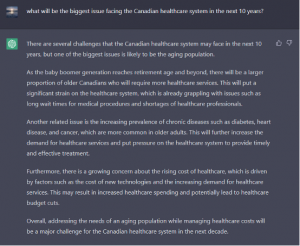
    Could spark innovation: Due to the quickness of the engine and how much information it has access to, this is a good tool to spark a rapid exchange of ideas and potentially propel innovation. I recently used ChatGPT when I was prepping for some interviews and wanted to get different perspectives on ethical dilemmas or world issues. I can also see this working well in wanting to gather different sides to a controversial topic or debate quickly. Although the accuracy of the engine might be questioned in conversational scenarios where there might not be a correct answer and you are just trying to spark discussion, ChatGPT could be a very useful tool. Here is an example of a question I asked ChatGPT about a world issue and how it responded:

    Cons

    Inaccurate: This is a relatively new tool, and thus, it is still learning. There are many topics on which it makes mistakes. It also doesn’t do very well with obtaining information after 2021. One area in which it makes a lot of mistakes is in math. I have tried to input math questions into it, and it sometimes completely makes up information and defies mathematical principles.

    Ethical Issues/Plagiarism: Particularly within the academic sphere, this is a large reason why there is distrust regarding the use of ChatGPT. Many times, students attempt to use ChatGPT to cheat on exams or written assignments. This is an obvious breach of academic integrity. Nowadays, institutions have to make extra efforts to surveil work and ensure it isn’t done using AI. Additionally, ChatGPT does not do a good job of crediting or citing people’s work. This means using the engine to do work is often unethical. This, in addition to the inaccuracy, it could spread misinformation to vulnerable populations, which could be extremely problematic.

    World Domination: I know this might be dramatic wording, but this is one of the biggest fears with AI, especially with one as advanced as ChatGPT. The worry is that the engine would take over many jobs and remove the need for human employees. Even with the customer service example I gave above, allowing ChatGPT to take over rote customer answering calls replaces thousands of employees who do the job currently. Content creators online are fighting back against this by incorporating ChatGPT into their work. For example, chefs are using the engine to generate viral recipes and testing them out. Right now, they are finding that the tool is not very good for these jobs, but many believe it is only a short time before it will be.

    All in all, ChatGPT is a rapidly learning and highly advanced tool that currently has a wide variety of uses. It is a very exciting development in this technological revolution, but not everyone is convinced that it is a good thing. There are a lot of ways in which the engine could be used to increase productivity and support current jobs, but there is a lot of fear about its current inaccuracy and future ability to affect jobs done by humans. I would urge all of you to try it out for fun, be mindful of its limitations and keep a watch out for how it will develop in the future.

  • Daylight Saving Time: Should We Keep It or Toss It?

    Daylight Saving Time: Should We Keep It or Toss It?

    For many Canadians, autumn means the mesmerizing colour changes of leaves, but also Daylight Saving Time or DST. DST is the practice of moving the clocks forward one hour from Standard Time in the spring and turning them back again in the fall. Thus, the famous adage, “Spring forward, fall back.” The goal of this practice is to maximize the natural daylight we receive during the days when they are shorter and the nights are longer, which typically happens during the winter months.

    We have Englishman William Willett to thank for the idea of DST. Willet was inspired to lead the first-ever campaign for DST while on an early morning horseback ride in London in 1905. Thinking that UK people should have more time for sunlight during the months of April until October, he published a brochure titled “The Waste of Daylight” and made an effort for the rest of the UK to embrace the adoption of “summer time.” Unfortunately, the British Parliament never got on board, and even upon Willet’s death in 1915, the idea never came to fruition.

    While it was an Englishman who had thought of DST first, it was actually in Germany when it was first implemented. In an effort to conserve electricity, Germany embraced DST in 1916, just a year shy of Willet’s death.

    Today, fewer than 40 per cent of countries maintain the practice of DST, though at least 140 countries have tried to implement it at some point. However, it’s safe to say that people are torn whether to continue practicing DST or scrap it. Below is a look at the pros and cons of DST.

    Pros

    You get more natural sunlight.

    With DST in place, you have a bigger chance of basking in the sunlight since by the time of sunrise, it usually means you start getting ready for your school or work. Thus, when you’re on your way, whether you’re driving, walking, or taking transit, you get a much-needed dose of Vitamin D.

    It keeps us in line with the U.S. and Europe.

    Because these countries practice DST, we are in good company. If Canada opts out, then most likely it will have a negative effect on our social and economic ties with them.

    Cons

    It’s confusing.

    Not all provinces and territories practice DST in Canada. For instance, the Yukon territories have completely abandoned the idea. Thus, time differences coupled with time changes can lead to confusion.

    It causes many accidents.

    When the clock has to spring forward, a lot of people end up being sleep-deprived, and thus, overall affecting their attention span. As a result, there is an uptick in car accidents.

    It affects religious observations.

    In some religions, prayers are dependent on the times of sunrise and sunset and changing the clocks twice a year can definitely have an effect on how they do their prayers.

    The debate over whether to keep or toss DST may continue for a while, and until that time when it is abandoned or made permanent, we all have to remember when to spring forward and fall back.


    Sources

    https://www.macleans.ca/society/life/debating-the-pros-and-cons-of-daylight-savings-time/

    https://globalnews.ca/news/5885735/pros-cons-daylight-saving/

    https://www.cnet.com/news/politics/when-does-daylight-saving-time-end/

    https://www.statista.com/chart/24473/countries-changing-clock-daylight-savings

    https://www.history.com/news/8-things-you-may-not-know-about-daylight-saving-time

    https://www.almanac.com/content/when-daylight-saving-time

  • Taking Out a Loan? Boons and Banes of Different Ways to Get Financing

    Taking Out a Loan? Boons and Banes of Different Ways to Get Financing

    According to a Statistics Canada article, there was a decline of 18.3 per cent in credit card debt between February 2020 (prior to the pandemic) and January 2021 (during the pandemic). This means Canadians applied more financial savviness to their budget. However, the fact that there weren’t many opportunities to spend money, as the country was in a lockdown and under restrictions, also helped Canadians to limit their expenses.

    Now, most Canadians are keen on getting their lives back on track. This could mean going back to school, opening a small business, or buying a car. If you’ve got your mind set on a big-ticket item purchase soon and have limited spending money, taking out a loan could be an ideal next step. Let’s look at the different ways to get financing.

    Banks

    When obtaining a loan from a bank, you would need a good credit score to get approved. If you’ve had problems in the past paying your credit card debt, the bank would most likely take that into consideration, and it will affect your chances of getting a loan. You need to prove that you can pay your loans on time, and a high credit score is the best gauge for that. With a bank, you can specify exactly what type of loan you need, whether a student loan or an auto loan, and they can set up a payment plan that works best with your financial situation. Be wary though that if you don’t pay your dues on time, you’ll likely end up paying a high interest rate.

    Payday lenders

    As the name suggests, payday loans are financing you can get that’s equivalent to what you’d normally receive in your paycheque. They are meant to be short-term loans but with high interest rates, and because of these, they are best used when dealing with an emergency and you don’t have any other option – but not when you’re aiming to buy a high-ticket item. An advantage of payday loans, though, is that it’s easy and quick to get approved for one because they won’t need to do a credit score check on you. Since it’s highly accessible, payday loans can easily make one fall into the debt trap because of the high interest rates that come with them, but lately, the government has launched efforts to clamp down on these to protect consumers.

    Pawnshop loans

    This is another type of loan that’s easy to obtain but may have costly consequences, especially if the item you’ve pawned has great value to you n,ot just financially speaking but also emotionally speaking. Getting money from a pawnshop means you have to part with a valuable item so you can get the cash you need. The loan typically amounts to about 25 per cent to 60 per cent of the value of the item. To get it back, you can pay in installments, nd unfortunately, if you’re not able to do so, you may have to get ready to lose that item forever.

    Loans from family or friends

    You may have a family member or a friend who has available money to lend you, and as they are close to you, it’s more than likely they will say yes once you tell them of your need. And since they’re aware of your situation, it will be easy to work out a payment plan that truly works for you. However, as the adage goes, going into business with friends or family could lead to dire consequences, and it may ring true as well when it comes to borrowing money. If you’re unable to pay within the agreed timeline, then it may cause a strain on your relationship.

    If you’re eyeing something that comes with a hefty price tag but don’t have the finances readily available, it’s not the end of the world. There are several ways you can obtain the budget you’d need. However, be careful as they all come with their own set of advantages and disadvantages. Go through them thoroughly to work out the best one for you.


    Sources

    Pritchard, Justin. “How to Get a Bank Loan.” The Balance. https://www.thebalance.com/how-to-get-a-loan-315510

    Statistics Canada. “Study: Trends in household non-mortgage loans: The evolution of Canadian household debt before and during COVID-19.” https://www150.statcan.gc.ca/n1/daily-quotidien/210823/dq210823c-eng.htm

    VanSomeren, Lindsay, and Jordan Tarver. “16 Types of Loans to Help You Make Necessary Purchases.” Forbes. https://www.forbes.com/advisor/loans/types-of-loans/

    Webber, Matt Ryan. “Payday Loan.” Investopedia. https://www.investopedia.com/terms/p/payday-loans.asp

  • When Being Let Go Is a Good Thing: 5 Reasons to Hold Your Head Up High

    When Being Let Go Is a Good Thing: 5 Reasons to Hold Your Head Up High

    A man being fired from his job goes on a rampage. We’ve seen this premise in movies and TV shows one time too many that it’s become almost a trope now, like the ugly duckling turning into a swan or the underdog guy winning the manic pixie dream girl of his dreams.

    Being let go of a job that one loves can be a devastating experience, especially when the news comes out of nowhere and you’ve put in a lot of time and effort into your work. However, it’s not as dramatic as it has been depicted in pop culture.

    If you’ve recently lost your job, remember that it’s not the end of the world. Read below on how you can turn this negative into a positive.

    Let’s get started!

    1. You have freedom.

    It’s normal to get attached to a job you’ve had for years, which you feel you’ve been amazing at, especially if you’re the type who prefers routine. However, maybe you’ve stuck with the job for as long as you can because of fear of change, which may be something that has held you back from searching for one that’s truly in line with your career goals. Now, the opportunity falls into your lap, and you’re free, and the door’s wide open for you to explore what else is out there.

    1. You get to do a self-evaluation.

    When you have your work commitments and your time is spent keeping up with deadlines, it’s challenging to find the time to step back and evaluate where your career is at even though perhaps you had meant to do it for a while. Now that you aren’t thinking of work-related tasks anymore, this is a perfect time to reflect and analyze your career and whether you’re truly on the path that’s aligned with your career goals. This doesn’t happen overnight, so give yourself time to figure things out.

    1. You can find your inner strength.

    Being dismissed from a job can be emotionally taxing, but it’s during these gruelling times that we discover we’re stronger than we perceive ourselves to be. Maybe the thought of you losing your job has plagued you for a while, and now that it has happened, you realize that it wasn’t exactly the monster that you thought it would be. It’s something you’re able to deal with, and therefore, you condition yourself to be ready for whatever challenge comes your way next.

    1. You make use of your creativity.

    Being fired doesn’t mean one can take it easy, especially when they have loads of financial obligations to fulfill: student loans, rent, credit card debt, and others. True, these financial commitments can be overwhelming, but they can also serve as an opportunity for you to reach out to your creative side and discover ways to make money to at least tide you over until the next job comes along. This can be a passion project like designing websites or baking custom cakes. These or anything that fancies your interest can help you earn money until things get better. If you truly love doing it, maybe you can even retain it as a side gig when you’re back to work full-time.

    1. You turn into a better version of yourself.

    Losing a job will motivate you to up your game, so to speak. Maybe you’ve always known that additional training or courses could be an advantage, and now’s a good time to catch up on those. You set your mind to being a better version of your previous self and work on yourself. This way, when you start the job search process, you’ve built enough confidence to project that you’re the best candidate for the job and nothing will get in the way.

    Being let go can be heartbreaking, but there’s always a way to turn things around. As the saying goes, there’s always a silver lining in a grey cloud.


    Sources

    Ryan, Liz. “The Ten Best Things About Getting Fired.” Forbes. https://www.forbes.com/sites/lizryan/2016/12/27/the-ten-best-things-about-getting-fired/?sh=3d1ac9bf77e5

  • October 2025 Scholarships – Apply now!

    October 2025 Scholarships – Apply now!

    AmericanMuscle Student Scholarship Program
    Scholarship Value: $2,500
    Awards Available: 2
    Award Deadline: October 15, 2025

    Stantec Future Leaders Scholarship
    Scholarship Value: $10,000
    Awards Available: 46
    Award Deadline: October 15, 2025

    P.E.O. STAR Scholarship
    Scholarship Value: $2,500
    Awards Available: 100
    Award Deadline: October 15, 2025

    The Brandon Langhjelm Essay Contest
    Scholarship Value: $2,000
    Awards Available: 3
    Award Deadline: October 26, 2025

    Taking Flight Scholarships
    Scholarship Value: $5,000
    Awards Available: 7
    Award Deadline: October 30, 2025

    Excellence in Ag Scholarship Program
    Scholarship Value: $16,000
    Awards Available: 4
    Award Deadline: October 31, 2025

    Wolf Scholars
    Scholarship Value: $80,000
    Awards Available: N/A
    Award Deadline: November 10, 2025

    Maryknoll Scholarships
    Scholarship Value: $1,000
    Awards Available: 6
    Award Deadline: November 17, 2025

    Seymour Schulich Scholarships and Awards
    Scholarship Value: $15,200
    Awards Available: 24
    Award Deadline: December 1, 2025

    Walsh / Di Tolla / Spivak Scholarship
    Scholarship Value: $10,000
    Awards Available: 10
    Award Deadline: December 31, 2025

    Schulich Leader Scholarships
    Scholarship Value: $120,000
    Awards Available: 100
    Award Deadline: January 28, 2026

    Jake Weitz Memorial Scholarship
    Scholarship Value: $1,000
    Awards Available: 10
    Award Deadline: March 1, 2026

    Western Continuing Admission Scholarship of Excellence for Black Students
    Scholarship Value: $6,000
    Awards Available: 30
    Award Deadline: Ongoing

    Western Continuing Admission Scholarship of Excellence for Indigenous Students
    Scholarship Value: $6,000
    Awards Available: 30
    Award Deadline: Ongoing

  • Indigenous Student Scholarships for October 2025

    Indigenous Student Scholarships for October 2025

    Dr. & Mrs. G.B. Gowd Bursary for First Nations Women
    Scholarship Value: $1,000
    Awards Available: 1
    Award Deadline: October 15, 2025

    Taking Flight Scholarships
    Scholarship Value: $5,000
    Awards Available: 7
    Award Deadline: October 30, 2025

    TD Scholarship for Indigenous Peoples
    Scholarship Value: $60,000
    Awards Available: 25
    Award Deadline: October 31, 2025

    Indspire Building Brighter Futures Bursaries & Scholarships
    Scholarship Value: N/A
    Awards Available: N/A
    Award Deadline: November 1, 2025

    Western Continuing Admission Scholarship of Excellence for Indigenous Students
    Scholarship Value: $6,000
    Awards Available: 30
    Award Deadline: Ongoing

  • Career Profile: Botanist

    Career Profile: Botanist

    Botanists are critical to environmental conservation, as their research helps to determine how different plants can and will react to climate change. The job of many botanists is to supply the research for protecting native species from invasive species. Meanwhile, agricultural botanists offer extremely important research in food concerns, medicines, timber supply and fibres. In short, the field is widespread and crucial; that means that the job market is large and high-paying.

    Getting educated

    Botanists must first have a Bachelor’s degree in science—they take courses in biology, chemistry, genetics, taxonomy, plant anatomy and physics. Those with Master’s degrees can pursue higher-paying opportunities, and most botanists indeed have this credential. Botanists do not have necessary apprenticeships, although they will often work as assistants to full-fledged botanists. Volunteer work and university work-learn positions are key to competing in the field. Like any science degree, the more experience, the more valuable you are to potential employers.

    Salary

    Botanists with a bachelor’s degree and those starting out can make about $61,000 per year, whereas those with a graduate degree or many years of experience can make up to $77,000 per year. Salaries tend to be pretty high, and work can happen almost anywhere because, anywhere you go, there is an environment to study. This is extremely attractive to those who want an easily transferable job, and one that will provide for a family and a comfortable lifestyle. Above-average growth is expected in the field of botany—the need for plant biologists increased by around 20% by the year 2022. Because there are so many jobs, competition isn’t terribly high. But even though that is the case, talented and well-educated botanists are the ones that are able to innovate within the field. While botany has so many pros, a large con is that research positions nearly always require a PhD, and therefore being successful as a botanist requires a great deal of education, and thus, a great deal of money. But it pays off and then some. Pressures are high, but the rewards are great.

    Room to grow

    Plant biologists’ careers are always evolving. Opportunities to change niche specialties happen often. A botanist’s currency is plants—everything plants. They study their physiological processes—like molecular-level photosynthesis—the evolutionary history and relationships of plants, and plants’ relationships with their environments. Botanists study plants’ responses to stresses from disease, pests and climate change and variations. Botany is a very active field, and one that becomes all the more important with the current growing concern of climate change. Improving ecosystems is at the core of botany, and it can therefore be an extremely rewarding yet demanding field. Many botanists work to develop safe ways to control weeds and diseases, and experimentation is a large part of that. Many botanists choose to focus on plants’ molecular level—researching uses for medicines, raw materials, fabrics and biofuels. What all of this means is that those in botany never have to be bored. They can constantly change specialties and take on jobs that span a wide landscape of research and practical application.

    Sources: www.eco.ca, www.healthresearchfunding.org, www.environmentalscience.org, www.payscale.com/research/CA/Job=Botanist/Salary