Category: Jobs and Apprenticeships

  • Co-Opportunities

    Co-Opportunities

    With Canada’s unemployment rate at an estimated 7.6 per cent and the youth unemployment rate almost double that at approximately 14 per cent, it is becoming evident that one of the greatest tolls of the global economic downturn in this country is not necessarily job loss, but a lack of entry-level positions. Statistics suggest that higher education is key to improving the standard of living. University degrees are often not useful in predicting a person’s career prospects, particularly in regard to the types of employment a graduate may be best suited to undertake.

    In many instances, individuals will not directly use their degrees in their future professions. There are varying reasons for this, including the fact that individuals may change their minds or circumstances, or select a field of study that does not have a corresponding profession. However, to a large extent, the reason is the same as the cause of high youth unemployment: most degrees do not offer practical experience in a particular field of employment.

    There’s a saying about employment: you can’t get hired without job experience, but you can’t get job experience without being hired. This is the bind in which many university students are caught under our current system.

    So, how can it be remedied? How can students be free to pursue their desired degrees while at the same time gaining a leg up in the job market? Well, we don’t need to look far to see how it is done. Canada’s own University of Waterloo offers the country’s largest co-operative education program. Waterloo’s co-op system offers a combination of study and work semesters in which each student has access to an administrator who helps students find placements during work terms. This has the added bonus of providing students with paid employment during the school year, which means that, in many instances, students in the co-op program can graduate with a lower level of student debt than their non-co-op counterparts.

    But it is not just Waterloo that uses a co-op system. U of T’s Scarborough campus also has a program. And recently, the country of Singapore announced that it is adopting co-op programs in all of its public universities in order to address the concerns voiced by employers about graduates having insufficient work experience to do their jobs properly. This was putting a drag on the economy as businesses had to invest in costly training programs for new hires — making them less likely to hire recent grads.

    The biggest concern regarding implementing a plan like this on a wide-scale basis, as Singapore has done, is that not every degree program has a corresponding list of potential jobs. However, co-op programs are voluntary and it should also be noted that every student has some idea of the types of jobs that might interest them — which leads to another advantage of the co-op program: instead of graduating and jumping into a career only to realize that it isn’t the right fit, students have four years in which to try out different career options.

    Say you are studying political science in university and have a desire to work in journalism. You get a co-op job at a newspaper and suddenly you find it isn’t as much like All the President’s Men as you had initially thought. If you had already graduated you would be in some serious trouble. Instead, in a co-op program you get to return to a semester of school and think about all the different placements that might mesh with your major. You could work at a polling company, a political advisory firm, or find a job in a government department. You can try each of them out and, after your time at university, you have a better understanding of what career you want to pursue, while also having an impressive resume to help you get the job you want.

    Students need jobs. If a generation is saddled with unemployment, it harms everyone, causing a lack of dignity, lower standards of living, strained public services, and employers who cannot find the necessary talent to fill positions. Instead, Ontario can respond to youth unemployment with a plan that will not only help young people, but will also ensure that the province leaves the recession in a stronger position than when it first entered it. The way forward is to adopt a co-op program to ensure that students have the option of practical work experience to complement their traditional degree program when attending university.


  • Looking for An Ideal Employer

    Looking for An Ideal Employer

    People expect a lot of you. Your family probably expects you to work hard at school or to help out at home. Your teachers expect you to finish your homework, write your tests, and to follow the rules at school. When you get a job, your employer will expect you to try hard and to do your job. All of these people have expectations of what you are supposed to do, but do you also have expectations of them? You might not be able to change your family or teachers, no matter what you expect of them. However, knowing what to look for in an employer could help you find a good job that you can enjoy for many years.

    As you get closer to finishing your school years and start to look for a job, you might hear a lot about what employers expect of employees. You might hear about how employers expect you to get to work on time, to work hard, and to take your lunch and breaks only at the scheduled times. You might hear about how honesty, a positive attitude, flexibility, and dedication to work (a strong work ethic) are very important in finding and keeping a job. However, these qualities often also make the difference between good and bad employers.

    The qualities of good employers can vary according to the needs of the job and of their employees. In a high-pressure job with a lot of important deadlines, for example, the employer might have to be stricter about people coming to work late than in a place where people have more time to finish their tasks. However, a good boss knows when to enforce the rules and when to relax them. Good employers are effective managers who know what needs to be done and how much they can expect from the people who work for them.

    Telling people what to do is part of employers’ work, but it should not be everything. Good employers should be leaders with a vision for what they want the workplace to be, but they should also be open to new ideas from employees and others. They should take care of their employees’ needs and try to be fair to everyone. If employers tend to hire their own friends and relatives instead of more skilled people, they might not be good for outsiders. On the other hand, if they always hire new people instead of promoting their own employees to better jobs, employees might find themselves stuck at a low level for years.

    How can you tell which employers are good until you work for them? The best way might be to talk to employees of the company and find out what they think. You can also find out how long people usually stay in their jobs, since that can often show how well the employer understands employees. Finding an employer who supports you and helps you grow can be difficult, but the effort can make a big difference in your working life.

  • Career Profile: Family Lawyer

    Career Profile: Family Lawyer

    When you think “lawyer,” you might think of high-profile cases against notorious lawbreakers. It seems glamorous and exciting. But, just as there are many aspects of the law itself, so there are many types of lawyers to practice different kinds of law.

    Each type of law practice comes with its own job description. Family lawyers, for instance, represent clients in divorce cases, child custody disputes, and ensuring that other family members fulfill their legal obligations. They also handle matters such as wills and estates, setting up trust funds, and working with adoptions, among other matters. Family lawyers prefer to work efficiently. Court battles are time-consuming and costly. Family lawyers strive to settle disputes out of court by mediation, arbitration, or other forms of problem-solving. They will meet frequently with clients to discuss their options, advising them on the best course of action. But that is not all- attorneys have responsibilities within their own firm as well. Often, a newly-graduated lawyer will supervise office staff. These include paralegals, legal secretaries, office assistants, and interns. But getting into a law firm in the first place takes a lot of schooling.

    Before you even attend law school, you must complete two to four years of schooling in other areas. Some law schools prefer that you have an undergraduate degree before they accept you. Once this prerequisite schooling is complete, the aspiring law student will study for and pass their LSATs- Law School Admission Tests. Then, at law school, they acquire their Bachelor of Laws. This qualifies them for their first year of training, called articling. While many students take their articling year in a law firm, some choose to work as a clerk for a judge.

    Once this term of articling is complete, the next step is to take a bar admission course and the accompanying exams. This qualifies you for practicing law in the province where the exams were taken. If you want to practice law in other provinces, you may have to meet other requirements.

    Once all of these requirements have been met, you are eligible to practice any type of law you desire. Family lawyers often specialize even further: some do only estates and wills, caring for the property of a large variety of clients. Others may do pro bono work, offering their services for free to those in desperate need of representation but who cannot hope to afford it. Some may choose only to work custody cases, support arrangements, and adoptions.

    Client confidentiality is of utmost importance to all lawyers, but especially to family lawyers. Because of the often turbulent nature of cases involving family disputes, sometimes it is required that each party have a separate lawyer to avoid a conflict of interest. This means that often, a husband and wife seeking divorce would not have the same lawyer, nor would the mother and father each seeking custody of their children. This means that if a case is to be settled quickly, family lawyers must have a good working relationship with lawyers in other firms.

    Working as a family lawyer takes a lot of preparation. Schooling alone takes a commitment of six to eight years, but making a difference in other people’s lives makes all that hard work worth it.

  • Astronauts and Chris Hadfield

    Astronauts and Chris Hadfield

    Retirement is a good time for people for look back at what they have done over their lives and in their work. Some people’s careers never go beyond their own town or city. For other people, however, a job can take them far away, even beyond the earth. When Chris Hadfield retired from his career as an astronaut on July 3rd, 2013, he had a chance to look back on a long career in space. His most famous success was being the leader of the International Space Station. The education he received and the work he did in his early years all helped him to do well in his career as an astronaut.

    Chris Hadfield grew up on a farm in Ontario. He became interested in flying and joined the Air Cadets at a young age. During this time, he learned to operate first gliders and then regular powered airplanes. By the time he retired, he had flown over seventy different types of planes and other aircraft.

    After he finished his basic schooling, Chris Hadfield went to study at the Royal Military College in Kingston, Ontario. He completed a degree in mechanical engineering there before going on to do research at the University of Waterloo. Next, he studied at the University of Tennessee and received a Master of Science. Early in his career, he became a fighter pilot in the Canadian Armed Forces. In 1983, he received an award for best pilot in the Basic Jet Training in Moose Jaw, Saskatchewan.

    In 1992, Chris Hadfield became one of four astronauts working at the Johnson Space Center in Houston, Texas. He traveled into space several times and even helped to install a tool called the Canadarm onto the International Space Station. He worked with the Russian space program between 2001 and 2003 and later used his research skills to test the possibilities of underwater life at a station near the coast of Florida.

    In 2012, Chris Hadfield was chosen to work as the head of the International Space Station. He worked there for five months, conducting scientific experiments in areas such as gravity’s effects on humans. All the way through, he used social media sites like Twitter to tell people on earth what he was doing. He returned to earth in May 2013 and announced his retirement a month later. His official retirement began on July 3rd, 2013.

    Not all astronauts train in the same way as Chris Hadfield did, and some might never actually work in space. However, an education in one of the sciences or engineering, and also work experience, is necessary for most jobs in this field. Some knowledge of medicine is necessary since astronauts have no access to hospitals in space. Astronauts need to be in fairly good health and to be able to move to different locations for work. The pay is good, and astronauts can often have extremely varied careers. Not too mention that you get to go where few other people have ever gone before!

  • Career Profile: Fire Investigator/Inspector

    Career Profile: Fire Investigator/Inspector

    Imagine a fire flickering and sparking as the logs burn and settle down. Would you enjoy watching it? Many people find fires calming and fascinating to watch, at least ones that stay controlled. However, a fire nicely contained in a fireplace at home or the cooking area of a campsite is not like a fire that burns down a house. Dealing with the fires that happen in buildings and cause destruction are the work of fire inspectors, who try to prevent
    fires, and fire investigators, who try to find out why fires happen. Together, they try to reduce the damage that fire causes to property and people.

    Fire inspectors and investigators work on different parts of the same problem. Fire inspectors check buildings to make sure that the rules about fire safety are being followed. They check to make sure that buildings have enough working fire extinguishers. They might check for proper storage of dangerous substances like gasoline. In some cases, they might check the electric wiring in a building to make sure that everything is working and that there are no frayed wires that might cause a spark. When they can, fire inspectors also teach people about how to keep fires from starting, and they work with insurance companies to try to maintain high safety standards. If they do their job well, they can help prevent many accidental fires from ever starting.

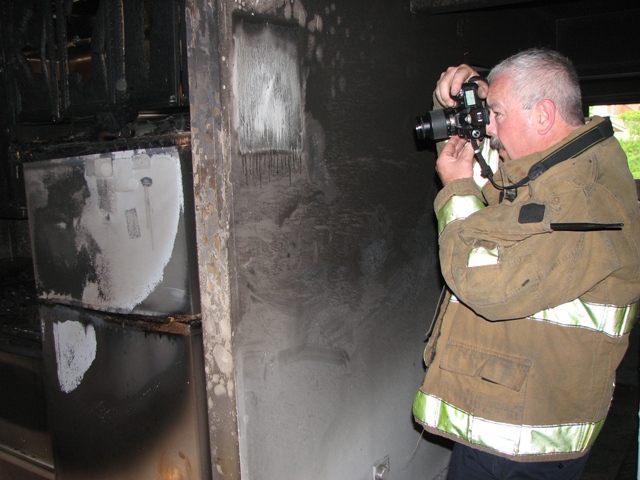
    Fire investigators work from a somewhat different angle, but they deal with many of the same things. Like fire inspectors, they check buildings for dangerous substances and faulty wiring. They might check to make sure that the fire extinguishers are working. However, fire investigators do their work after a fire instead of before. When a building has burned, even partially, fire investigators go in to find out what happened. They work with the police and insurance companies to find out what started each fire. What they find helps them decide what started a fire and if it was accidental or set on purpose.

    Becoming a fire inspector takes a basic education, such as a high school diploma, but a lot of experience. Most people who get into this work start as firefighters, learning the principles of safety and detection on the job. Taking several courses on fire prevention is usually enough to qualify experienced firefighters for the work of fire inspector. Many fire investigators have a bachelor’s degree or more. Salaries for fire inspectors and investigators can vary widely, depending on the person’s experience, the size of the fire department, and other factors. Generally, however, fire inspectors’ salaries start at over $50,000.00 and investigators’ pay starts even higher. Many investigators receive $80,000 per year or more.

    Fire inspectors and investigators generally have fairly good working conditions and face few dangers in the job, although looking through a burned-out building can be unpleasant. They job has a high level of responsibility, but it can be both challenging and rewarding. Does the job of fire inspector or investigator appeal to you?

  • Why Red Seal Trades Might Work For You

    Why Red Seal Trades Might Work For You

    You may have heard the advice, “learn a trade – it’s an important skill to have.” That’s good advice: there will always be a need for carpenters, electricians, plumbers, mechanics, and welders. But what exactly is a Red Seal trade? What financial assistance is there for a person interested in becoming a tradesperson? How do you find out which trade is right for you? Read on to find out.

    In short, a Red Seal trade is one where you may work as a tradesperson in any province without having to take extra qualifications. The training and certifications of Red Seal trades are not individualized to each province; rather, they are standardized on a national level. Although each province is responsible for educating and training apprentices, or those who are at an entry level in their industry of choice, the Red Seal Program promotes the coordination of standards across the country. But in order to qualify as a journeyperson with a Red Seal, apprentices need a mix of classroom instruction and on-the-job training. Although they earn money while training on the job, acquiring necessary tools and classroom instruction is expensive.

    The government recognizes the necessity to fund tradespeople. There is a provision called the Apprenticeship Incentive Grant, which is a $1000-$2000 per year taxable cash grant for apprentices once they have successfully completed their first or second year or level of their program in one of the Red Seal trades. Another is the Apprenticeship Completion Grant, which is available to an apprentice who completes their training and acquires their journeyperson certification in a Red Seal trade. But tools are expensive, too. The government provides the Tradesperson’s Tools Deduction of up to $500 yearly to assist in the purchase of new tools necessary for the trade in question. That leaves one final question: which trade to choose?

    In Ontario, there are forty seven trades of the Program’s available 55 that you may choose from. These range from Automotive Service Technician to Baker to Hairstylist to Welder. The official website, www.red-seal.ca, contains a detailed job description of each. For instance, its page on carpentry tells us that “Carpenters construct, renovate and repair residential, institutional, commercial, and industrial … structures made of wood, steel, concrete and other materials.” We read about the risks involved, knowledge that a carpenter ought to have, and other skills that are useful. It tells us the career path a carpenter may be interested in taking. Further down the page, there is a chart that tells us that there is a provincial certification in all thirteen provinces and territories. Beyond that is additional information with links to relevant documents. You can also find this information on any of the other Red Seal trade pages. Read them over and decide which one may fit you best. Do you have an affinity for working in the kitchen? Bakers and Chefs can become Red Seal certified. Like tinkering with engines and other machines? A wide variety of trades will let you do just that: Automotive Service Technicians and Heavy Duty Equipment Technicians are among those who may acquire their Red Seal.

    The opportunities are numerous, and you can work anywhere in the country. Why not look into qualifying for a Red Seal trade?

  • I’m an Apprentice – How Do I Find an Employer?

    I’m an Apprentice – How Do I Find an Employer?

    Finding an employer is the first and often most difficult step in an apprenticeship. If the employer you’re interested in approaching doesn’t employ apprentices, check out our list of resources for employers and know your facts when you go meet with them. They might be willing to consider hiring an apprentice, once they are aware of the business case that supports apprenticeship training.

    Network
    Just like any job seeker, talking with people who are already employed in the trade for a good source of information about becoming a skilled tradesperson. Some apprentices find employers through family and friends. Another good place to meet potential contacts is through organizations such as trade unions, professional association or training institutions. Don’t forget to consider local employment offices, programs and agencies, especially those that specialize in trades-related training and employment. You may also want to consider approaching an employer or training instructor to ask for an informational interview. This is a great way to learn about job opportunities and connect with potential employers.

    Upgrade your job
    Some skilled tradespeople start working for an employer in a different capacity, then apply for a trades position when one becomes available. For example, one man began working as a general delivery person for a construction company. After a year or two, he decided to approach his employer about hiring him as a plumbing apprentice. Today, several years later, he is a fully qualified journeyperson plumber working for the same construction company and earning more than twice the pay.

    Search job boards/internet
    Job leads can also be found on major job boards, such as Monster.ca, Workopolis and working.canada.com. Search using terms such as “trades,” “construction” and “manufacturing” or go to sections designed for jobs in these fields. While you’re there, check out their resources for résumé and interview tips.

    Don’t forget – once you’ve found an employer, you still have to:
    – Register at your local apprenticeship office
    – Apply for grants and supports

  • What Does an Environmental Engineer Do?

    What Does an Environmental Engineer Do?

    Environmental engineers are the technical professionals who identify and design solutions for environmental problems. Environmental engineers provide safe drinking water, treat and properly dispose of wastes, maintain air quality, control water pollution, and remediate sites contaminated due to spills or improper disposal of hazardous substances. They monitor the quality of the air, water and land. They also develop new and improved means to protect the environment.

    Although many people are concerned about the state of our environment, environmental engineers are the people who do things to protect it from damage and to correct existing problems. Environmental engineers possess the scientific and technical knowledge to identify, design, build, and operate systems that make modern society possible.

    The environmental engineering field and environmental engineering education are multi-disciplinary. They involve traditional engineering components such as mathematics, physics, chemistry, and engineering design. But environmental engineering education and practice also includes a range of other disciplines, such as biology, microbiology, ecology, public health, geology, meteorology, economics, political science, and computer science. To address the spectrum of issues facing the environment, environmental engineers are broadly educated, as well as technically trained.

    Where do Environmental Engineers Work?

    Environmental engineers work in many places.

    • Engineering consulting firms that design and construct water pollution-control systems
    • Industries that need to treat their air or waste-water discharges
    • Private and municipal agencies that supply drinking water
    • Companies that treat and dispose of hazardous chemicals
    • Companies that operate treatment facilities for municipalities or industries
    • Government agencies that monitor and regulate waste discharges
    • Universities that teach and conduct research on environmental control
    • Private and government laboratories that develop the new generations of pollution-control systems
    • International agencies that transfer knowledge and technology to the developing world
    • Public-interest groups that advocate environmental protection

    What do Environmental Engineers Know?

    Like most engineers, environmental engineers must have a strong background in mathematics, physics, and chemistry. They learn engineering problem-solving and how to work in teams to accomplish goals. They develop the ability to apply scientific principles as part of making engineering decisions. Environmental engineers are skilled at analysis and design, and they apply their knowledge to protect the environment and human health.

    The breadth and multi-disciplinary nature of environmental issues requires that environmental engineers expand their skills beyond the range normally associated with any single engineering field. Depending upon their specific career goals, environmental engineers gain knowledge and skills in areas such as chemical technology, geology, water and atmospheric chemistry, microbiology, toxicology, hydrology, soil science, computers, economics, and law.

    What is Required to be Licensed as an Environmental Engineer?

    Engineering licensure is a prestigious step in professional growth and development. Licensure is a way for engineers to demonstrate to their employer and clients their commitment to the profession. Licensure is a four-step process. It requires graduation from an accredited civil engineering program, passing the Fundamentals of Engineering exam, having four years of work experience, and passing the professional engineering examination.

    How do You Become an Environmental Engineer?

    You can pursue environmental engineering as part of a Bachelor’s degree program in civil engineering.

    Graduate education, leading to a Master of Science or to a Doctor of Philosophy degree, is an important part of environmental engineering. Graduate programs are open to students who do not have a Bachelors degree in civil or environmental engineering, as well as to those students who study environmental engineering as undergraduates. This openness to students with a wide range of backgrounds is a hallmark of environmental engineering and continually brings fresh ideas to the environmental engineering field.

  • Career Profile: Marine Biologist

    Career Profile: Marine Biologist

    Every year, humpback whales travel 4000 kilometres from the ocean around Alaska and British Columbia to the water near Hawaii. Soon afterwards, they turn around and make the return journey. Throughout the entire journey, they eat little or nothing until they return to their northern feeding grounds. While they swim, they make musical sounds that sound like singing. Sometimes, humpback whales can stay underwater for half an hour or more without breathing. When they swim near the surface, they often throw themselves out of the water and then crash back into the depths.

    Do facts like these or about other ocean animals interest you? If so, you might want to consider becoming a marine biologist. These scientists work to understand the fish, birds, and other animals that live in the world’s water, especially saltwater animals like whales or crabs.

    If you choose to become a marine biologist, you will need to take as many science courses as you can in high school and university. These courses could be in chemistry, biology, conservation, or oceanography (the study of oceans). Later on, you can to choose a specialty like the life cycle of crabs or the effects of pollution on sea turtles. Your work might end up being much very general, but having a specialty will help you find work. Volunteering at an aquarium or pet shop now might help you choose a field.

    Most marine biologists have at least a Bachelor’s degree, and many have Master’s or PhD degrees as well. If you prefer not to study for such a long time, you can decide to get a technical certificate instead and then work mainly with the daily care of animals instead of conducting studies and writing academic papers. As a biologist, you might collect and analyze samples of various animals. As a technician, you might clean fish tanks or feed the animals. Depending on what you do, you might make anywhere from $30,000 to $100,000 as you work to help people understand the world in which they live.

    Besides helping people understand the world, marine biologists help alert others to problems in the natural world. As they watch the animals in the world’s oceans and seas, for example, they can tell how water and soil quality affects these animals and humans. They see the connections between people’s health and the world around them.

    Do you love to explore streams and lakes to find out what lives in them? Do you have an interest in preserving the natural world? Maybe a career as a marine biologist is right for you.

  • STEM Jobs: Petroleum Engineer

    STEM Jobs: Petroleum Engineer

    What is a Petroleum Engineer?
    Oil and gas are two of the most crucial energy resources we rely upon in the modern world. Oil and gas companies extract the deposits of these resources from the earth and facilitate their distribution as an energy source. But how do they know where to dig? This is where a petroleum engineer enters the picture. Petroleum engineers are tasked with finding oil and gas deposits as well as developing ways to extract those deposits from the ground. They design, plan and execute drilling projects to ensure the safest, most effective way of implementing oil and gas wells.

    On-the-Job Duties
    The day-to-day duties of a petroleum engineer include designing and implementing ideal methods of drilling. Often they are responsible for monitoring the drilling area (including the ground, the rocks and the equipment) to ensure optimal conditions for drilling operations that harvest the maximum amount of oil and gas deposits.

    Who do they work for?
    Petroleum engineers are most often hired by companies who produced petroleum, but they can also find employment as consultants, researchers, and policymakers with the government. In some sectors petroleum engineers can also be called oil and gas reservoir engineers, well logging engineers, mud engineers, sub-sea engineers and drilling engineers.

    Salary
    Petroleum engineers can earn a yearly salary of anywhere from $35,000 to over $130,000, depending on seniority.

    Required Education
    The educational background of petroleum engineers can vary, but all are rooted in engineering. Attaining a bachelor’s degree in either petroleum engineering or a related program like biochemical engineering is the best way start off. Next, earn a master’s degree in petroleum engineering followed by a PhD to maximize career opportunities. For some aspects of the job, like approving drilling designs, a professional engineering license will be required.

    Other Skills
    Leadership, time management, critical thinking, logic, creativity, team work, and communication are crucial to the success of a petroleum engineer.