Category: Jobs and Apprenticeships

  • Career Profile: Journalist

    Career Profile: Journalist

    Journalists can have a specialty.  In large organizations, the journalists may specialize in only one task. In small organizations, each journalist may have to do many different tasks. Here are some of the jobs journalists do:

    Reporters gather information and present it in a written or spoken form in news stories, feature articles or documentaries. Reporters may work on the staff of news organizations, but may also work freelance, writing stories for whoever pays them.

    General reporters cover all sorts of news stories, but some journalists specialize in certain areas such as reporting sport, politics or agriculture.

    Sub-editors take reporter written stories and put them into a form which suits the special needs of their particular newspaper, magazine, bulletin or web page. Sub-editors don’t usually gather information themselves. Their job is to concentrate on how the story can best be presented to their audience. They are often called subs. The person in charge of them is called the chief sub-editor, usually shortened to chief sub.

    Photojournalists use photographs to tell the new. They ether cover events with a reporter, taking photographs to illustrate the written story, or attend news events on their own, presenting both the pictures and a story or caption.

    The editor is usually the person who makes the final decision about what is included in the newspaper, magazine or news bulletins. He or she is responsible for all the content and all the journalists. Editors may have deputies and assistants to help them.

    The news editor is the person in charge of the news journalists. In small organizations, the news editor may make all the decisions about what stories to cover and who will do the work. In larger organizations, the news editor may have a deputy, often called the chief of staff, whose special job is to assign reporters to the stories selected.

    Feature writers work for newspapers and magazines, writing longer stories which usually give background to the news. In small organizations the reporters themselves will write feature articles. The person in charge of features is usually called the features editor. Larger radio or television stations may have specialist staff producing current affairs programs – the broadcasting equivalent of the feature article. The person in charge of producing a particular current affairs program is usually called the producer and the person in charge of all the programs in that series is called the executive producer or EP.

    There are many other jobs which can be done by journalists. It is a career with many opportunities.


  • Career Profile: Baker

    Career Profile: Baker

    We’ve all been unsure about where we want to go in life, and some of us don’t figure it out for years. The trick is that you can’t sit around, and expect it to come to you. You have to get out there and give things a try, explore all of your options. Let me help you, and introduce you to the world of culinary arts, where you can really Bake Your Cake and Eat it Too.

    The culinary industry is really something different, designed for special individuals with various talents. If you’re saying to yourself “Oh, I know how to cook, I can do this,” that’s simply not enough. However, on the other side of this you don’t have to know how to cook, or bake to be successful. I find that the real keys to be successful in the culinary arts are to have passion, and creativity. The industry is always growing and taking in new restaurant and bakery owners, but there is a trick to becoming successful at it.

    I find that the culinary industry is taking a turn in a new direction. Sure you can run a successful restaurant serving the same old basic dishes that another restaurant has up the street from you, but why not try to achieve something different? If you’re into science, let that combine with the culinary arts- you’ll be whipping up dishes that will be the talk of the town. Or if you’re more into baking, science is already a key role in making successful recipes.

    Most of you have seen movies like Willy Wonka and The Chocolate Factory, and I’m sure some of you have dreamed of having your own chocolate wonderland. Well guess what, if you put forth passion, dedication, and outstanding creativity- you can! The culinary industry leads to extraordinary career paths and dreams. You can take a simple concept of a cake, and create a whole new culinary business that will have people travelling for miles, just for your creations.

    No one wants a job that they don’t enjoy. Working is soon going to be one of the most important aspects of your life. Why not do something you’re going to love, and get paid for it! Let the joy of creativity flow with the feel of accomplishment and pride when you serve customers your delightful creations. The look of amazement on people’s faces when they check out your products is something that will keep you motivated, positive, and ready for more.

    The culinary arts have such a rewarding career path- you can do anything you dream of. Become a food scientist, a food taster, or a famous TV Chef. Design your own bakery or restaurant that becomes internationally famous. Or let’s live the dream here, and create a candy workshop or chocolate wonderland where you get paid to design, make, experiment with and eat candy! Let your ultimate dreams guide you to be wherever you want, and become whatever you want. With a step into the career path of culinary arts, there are no limitations- just your imagination.

  • Career Profile: Aviation Inspector

    Career Profile: Aviation Inspector

    Job Summary
    An aviation inspector is responsible for making sure that an aircraft is ready to fly. He or she performs safety checks, testing and carefully inspects all components of a plane before it is cleared for takeoff. Any repairs or maintenance work is also checked by an aviation inspector, who will report any damage or request further repairs if necessary. He or she is ultimately one of the last lines of defense in preventing aircraft malfunctions and accidents.

    A typical day for an aviation inspector is focused on inspecting aircrafts. There are several safety regulations that a plane must pass in order to be allowed to fly and aviation inspectors ensure aircrafts pass these measures. Much of an inspector’s responsibility lies in diagnosing mechanical issues and providing a recommendation for repairs. He or she may also observe an aircraft’s inflight performance as well as the pilot’s ability to fly with respect to flight regulations. If an inspector believes changes should be made to flight regulations, he or she is expected to make recommendations for amendments to the board of flight safety.

    Education
    If aviation inspection is a career that interests you, it’s best to get on the right track as soon as you can. In high school the best courses to take are physics, computer science, algebra and geometry. Technology and mechanic courses are also good options. Even if you decide aviation inspection isn’t for you, these courses will give you a good start in any other STEM (Science Technology Engineering Math) career you might want to pursue.

    After high school there are a few different options available to you. A Bachelor’s degree in engineering followed by vocational training specific to aviation inspection and maintenance will give you a good educational base to begin your career. In some cases, going right to the vocational training from high school may also be an option. Most inspectors start out as aircraft mechanics which is likely to require a 2-4 year degree.

    Skills Required
    There are some basic skills that every aviation inspector should possess. Interpersonal skills and the ability to effectively communicate with different kinds of people is essential. Problem solving, thinking critically, mechanical aptitude and a keen eye for detail are also crucial skills to cultivate. As the job title suggests, aviation inspection relies heavily on the inspection aspect. Well-developed skills of observation are paramount.

    Salary
    Most aviation inspectors make anywhere from $40,000- 60,000 a year.

    For anyone with mechanical talent, keen observation skills and knack for staying organized, ‘aviation inspector’ is a career path worth considering.

  • Career Profile: Horticulturist

    Career Profile: Horticulturist

    Many people like to grow flowers and vegetables in their houses and yards. They take care of the grass on their lawns, water their plants in dry weather, and pull weeds from among the plants. Sometimes, they put special fertilizer on the plants to help them grow better. When they take care of plants in this way, they do some of the work of a horticulturalist.

    The work of a horticulturalist can take many different forms. Some horticulturalists do very basic labour, such as digging up the soil in gardens to prepare them for planting or mowing and trimming lawns. They also prune trees by cutting off extra branches and prune smaller plants by removing dead leaves and flowers.

    These horticulturalists need only a basic education, such as a high school diploma. They do all of the basic jobs that keep the plants healthy and growing. Horticulturalists at this level are normally not paid very well, and usually they work only in the growing season from late spring until early fall. However, this kind of job can be good for students or for people who prefer not to spend years studying.

    Some horticultural work requires much more knowledge than a basic labourer needs. People working at this level often have degrees in agriculture, botany, or related fields. They research new plant species for different climates or try to find ways of making plants stronger and easier to care for. Some horticulturalists at this level also help design gardens or advise people on the best methods of plant care. Others become crop inspectors for large farms or work with small, local groups. Still others become professors and teachers in colleges and universities. These horticulturalists are generally fairly well paid, although the salary can vary according to what kind of work is available.

    Either of the two levels of horticultural work could be good choices for anyone who enjoys working with plants. They can work in edible horticulture, growing plants for food. Employment in this area is generally quite secure since people always need food. However, the low pay and seasonal work for some horticultural workers are disadvantages, as well as exposure to dangerous chemicals. Some of the work, such as digging up flower beds, can also be physically difficult. Another option is to work in ornamental horticulture, growing plants like flowers or shrubs for show rather than for food. Work in this area is often less physically difficult, although dealing with chemicals is still a problem.

    Do you love to work with plants and to see them grow? If so, maybe a career as a horticulturalist is right for you.

  • Trick of the Trade

    Trick of the Trade

    With so much attention brought to the business and management industries during Canadaʼs rekindling economic climate, many core fields of work are being overlooked by the students; one of these being the trades.

    The skilled trades are a growing field of work that is in constant need of well-trained workers.

    What exactly is a skilled trade? It can be defined as an expertness of a specific skill, usually attained through years of training and commonly related to construction and repair. The skills that are considered “trades skills” range broadly from carpenter, electrician, automotive technician, plumber, pipe fitter, welder and much more.

    There is a common misconception that the trades are considered “blue collar” jobs done through informal training. In reality there are a plentitude of academic institutions that provide education and preparation in the trades.

    Although it is common to get into the trades through practical training, it doesnʼt mean you will be making less money than someone who attended university. Tradespeople are some of the highest paid employees in Canada.  Not only is a customer paying for your knowledge about a trade, but they are also paying for expert performance.

    If you enjoy learning new lessons everyday and arenʼt afraid to be challenged, a career in the trades might suit you. Trades jobs are considered demanding and will put your mind and body to the test daily. If you enjoy a hands-on work environment, and are interested in how things work, this field may be what you want to look at.

    There is an increasing shortage in the skilled trades. According to careersintrades.ca, 67% of young adults choose university over a college education in the trades because it was encouraged more by friends and family. There were also instances in which a lack of information about the trades swayed students away from the sector.

    So, what exactly are the steps to take to become a tradespeople? The most efficient and reputable manner to becoming certified in the trades is an apprenticeship. This way, you are getting one-on-one experience with a master in the trade who can help you further your knowledge and skills. Many college programs that deal with the trades have their own apprenticeship training programs. So go and check out your local college to see what they offer, or look on Jobs People Do to see what colleges offer certain apprenticeships.

    The best thing to do in your early years of education is to look at high schools that provide introductory training of a trades skill you are interested in. Julian Finbow Westlane graduate, claims that:

    “Taking the refrigeration course at such a young age was extremely beneficial for the jobs I am interested in.”

    Julian is looking to develop his trade skills in refrigeration, and is planning on either taking a apprenticeship or going to college.

    Become involved and research trade skills you think will peak your interest. It may be beneficial to shaping your career path! So put on that thinking cap (or hardhat for this situation) and immerse yourself in the trades.

  • Careers with Animals: Horse Groomer

    Careers with Animals: Horse Groomer

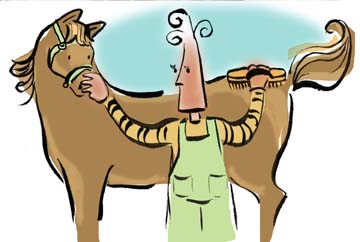
    If you’ve spent any time at all around stables, you’ll know horses require a lot of care to keep them groomed, healthy and happy. Looking after a horse’s needs can sometimes be a full-time job – and, in fact, it is! Horse groomers or equine grooms are the people who maintain a horse’s nutrition, grooming and overall health. If you love horses, the great outdoors, and working with your hands, this could be the job for you.

    Skill Requirements
    First and foremost, a horse groomer should be very comfortable with touching horses and being in their vicinity for extend periods of times. Horse grooming involves a lot of time spent with the horses tending to their needs. Brushing, feeding, watering, tacking, untacking, cleaning the stalls, and exercising the horses is all part of a groomer’s daily routine. Rain, shine, or snow, groomers are expected to perform these tasks. A groomer should also be able to read and understand horse documentation and take care of prescriptions and medications a horse may need at the instruction of a veterinarian.

    Groomers also require patience and strong observation skills. Changes in behaviour or signs of physical injury can only be detected through maintaining a strong bond with the horses and a watchful eye.

    Qualifications and Apprenticeships
    The qualifications needed for grooming can vary and entirely depends on the employer. Some employers won’t require an entry level groomer or an apprentice groomer to have official qualifications. That said, previous experience with horses is almost always a must. Volunteer experience in a stable or barn can help your chances when applying for paid work.

    If you are looking to get certifiable experience, look into basic horse care programs at colleges in your area. There are also universities in Ontario, Nova Scotia and Alberta that offer undergraduate programs in equine studies suitable for those looking for a more technical career in the same field.

    Hours and Salary
    Horse grooming typically involves early mornings and a 40-hour work week. Entry level groomers will earn minimum wage at first, gradually earning raises as they gain more experience. More experienced groomers will earn a starting rate at anywhere from $15-$20 dollars an hour. Depending on the employer, there may also be benefits provided.

  • Facts on Apprenticeships

    Facts on Apprenticeships

    Are you young and still in high school? Maybe you’re finished school and are looking for a new direction? Or, you are already working and looking for a career that suits you better?

    If any of this applies to you, an apprenticeship could be what you’ve been looking for. Thousands of people like you register as apprentices every year. Why? It’s simple. An apprenticeship is your ticket to a challenging and rewarding career in skilled trades.

    RESPECT
    Skilled trades play an important role in Canada’s knowledge-based economy. Think about it. They touch almost every aspect of our lives from the homes we live in, to the cars we drive, to the food we eat.

    OPPORTUNITY
    With over 200 careers to choose from, there is a skilled trade for everyone. The demand is high, you get to travel, and you could become your own boss!

    GOOD PAY
    Tradespeople are rewarded with great pay – often better than average!

    The BARE FACTS on Apprenticeship Training
    Apprenticeship is a form of post-secondary education like university or college. But there’s a big difference. Apprentices not only learn skills in
    a classroom, but receive paid on-the-job training with an employer.

    • Depending on the trade, an apprenticeship can take two to five years to complete.
    • Apprentices usually spend 40 to 44 weeks a year on the job and go to school for six to eight weeks.
    • Apprentices must find an employer and may need to pay tuition fees for in-school training.
    • Apprentices earn a salary on the job from their first day.
    • Apprentices receive a Certificate of Qualification in a designated trade.

    Did You Know?
    Pre-apprenticeship training is available in some regions. These work placements allow students who are still in high school to get a running start on their careers in skilled trades – not to mention earn school credits at the same time!

    Work Anywhere in Canada!
    Depending on their trade, apprentices who have obtained their certificate can write an inter-provincial exam to obtain a Red Seal endorsement and practice their trade across the country.

    • The “Red Seal” allows qualified tradespersons to practice the trade in any province or territory in Canada where the trade is designated without having to write further examinations.
    • To date, there are forty-five trades included in the Red Seal Program on a national basis.

  • Women in Trades

    Women in Trades

    In the past, asking a girl what she wanted to do when she grew up probably would have resulted in a blank stare. Most girls got married and raised families. Even if they worked, they had only a few choices for the kinds of work they could do, and they were discouraged from getting into other types of work. If they chose another kind of work, they would probably face all kinds of barriers and problems. Many things have changed over the years and women now find it much easier to get into professions like law and medicine. They can work as editors, scientists, and computer analysts. Women are also entering traditionally male-dominated trades and are becoming electricians, plumbers, construction workers, and more.

    The history of women in the trades really began during the Second World War (1939-1945), when many of the men from North America and Europe were away fighting in the war. Their jobs as welders, ship-builders and painters still needed to be done, and women took over and learned to work in job fields that included electricians, insulators, and pipe-fitters. When men returned after the war, many women went back to their regular work while men took over the trades again. However, women had discovered that they could do much more than their traditional work. Slowly, they began to get back into the trades that they had left at the end of the war.

    Getting women back into the trades after so long has not been easy. Teachers and parents have had to encourage girls to consider the trades instead of getting into more traditional fields like teaching or nursing. Training schools have had to make their programs appealing to women so that they would consider trades as possible careers. Even the government has become involved by funding support programs for women entering the trades or lending students the money they need to pay their tuition fees. Other groups have had to help, as well.

    One way that organizations can help is by guiding women into the right training program. Canada has over two hundred different trades, and making a decision about which trade is best can be difficult. The next stage is finding a good training program. Training is important for anyone who wants to be a skilled tradesperson rather than a labourer. Even if no job is available for people after they graduate, their skills are always valuable.

    Most training programs in the trades involve a combination of classroom work and practical training, often ending with a work-placement segment. This is when students get to work at an actual job but still learn at the same time. A typical program might include about seven or eight months of instruction, followed by four or five months of work on the job to gain experience. Sometimes, a full-time job can be the result of the work placement.

    Women are entering the trades in greater numbers than they have in years. If you’re a girl, maybe you should consider being one of these trendsetters!

  • Five Surprising Careers

    Five Surprising Careers

    The following are five careers that you probably did not know existed – or, at the very least, you didn’t realize they were real options for you.. When choosing a career, the first thing that people usually do is to start with “conventional” ideas – doctor, lawyer, that sort of thing. But the objective isn’t to choose the most popular career; instead, you’re looking for something that you would enjoy doing. It’s your life, and sometimes it pays to think outside the box.

    1. Underwater Construction Worker / Salvager
    Have you ever wondered how companies fix their structures once they’ve been put underwater? Here’s your answer. These professionals work on projects building and repairing structures like bridges, docks, pipelines, cables – the list is endless. The training involves completing a program, like Seneca College’s 34-week “Underwater Skills” at King Campus – and, of course, becoming a certified diver. If this sounds like something that might interest you, take a look at http://www.senecac.on.ca/uws and www.mcmarine.ca.

    2. Public Health Inspector
    Have you ever considered what a Public Health Inspector actually does? Health and public safety professionals solve problems, communicate with people, and keep the public safe from food-borne illnesses. Their tasks may involve conducting on-site inspections of food processing plants (or even day care centres, schools, etc.), responding to written complaints on behalf of a company, or conducting workshops educating people about proper food handling. For more information, take a look at http://www.uoguelph.ca/oac/academics/food.

    3. Aviation Technician
    “Aviation technician” is a title given to someone who performs aircraft repair and maintenance. Technicians learn to inspect aircraft, diagnose problems, repair the components of an aircraft, and perform tests to ensure that planes operate according to industry standards. If you have always loved both planes and mechanics, you might look into one of the following programs: http://goo.gl/HmVko. You can read more about this career option this month on our Trades page!

    4. Video Game Artist
    As the video game industry expands, so does the amount of digital artwork to be done. Video game artists design and create the visual elements in games, from environments to moveable objects to characters. Aspiring artists learn skills like 3D modeling, life drawing, texturing, and game engine production. Programs are offered at Seneca College http://www.senecac.on.ca/fulltime/GAA.html as well as Centennial College http://goo.gl/GMeQB.

    5. Chef
    If you enjoy cooking and think you might like to become a professional chef, you can take courses which will take you from baker to culinary creator. Every restaurant, every hotel, every catering company and spa has a chef; if this is your passion, there is certainly great potential for employment. Take a look at George Brown’s 1-year program in Culinary Skills: http://www.georgebrown.ca/H112-2012-2013.

  • Career Profile: Cartographer

    Career Profile: Cartographer

    What is a Cartographer?
    When was the last time you looked at a map? Though you may not realize it, it probably wasn’t that long ago. Cartographers (or map makers) are usually associated with the paper incarnation of the navigation tool – the professional has learned to adapt to rapidly developing technologies. If you’ve looked up directions online, chances are a cartographer is responsible for building and updating the digital map you used.

    Traditionally, a cartographer would draw the lay of the land on paper. Depending on the nature of the map and what its intended use was, maps would typically depict important markers like major landmarks and cities. Aerial photography, computer programming and worldwide networks have forever changed how members of this profession complete their work. For instance, have you ever seen the Google Maps car or used the ‘street view’ function? Using onsite photographs, cartographers are able to reconstruct locations around the world. Another crucial tool is satellite imagery; Aerial pictures taken by satellites allow cartographers to keep maps up-to-date, preserving accuracy.

    Education and Skills
    There are a variety of ways to become a cartographer, but a having an interest in geography, math and science is key. Cartographers usually have a bachelor’s degree in cartography, geography, surveying, engineering, forestry, computer science, or earth sciences. With the advent of digital information sources, a strong aptitude for computer programming is highly desirable.
    Cartographers must be technically-minded and able to easily solve discrepancies in logic. Creating and maintaining geological and statistical data can be tedious work, making patience and endurance invaluable skills.

    Salary
    Most cartographers earn between $50,000-$60,000 annually.

    Day-To-Day
    Cartographers tend to spend the bulk of their time in offices working on computers. Much of their time is spent collecting, analyzing, interpreting and publishing data. Most of their work involves interpreting multiple factors, including but not limited to: landscape, law, climate conditions and changes in population and cultures. Mechanical drawing and map composition remains a fundamental part of the job, but these tasks are usually completed in a digital capacity.