Category: Nature Watch

  • Students Go Green!

    Students Go Green!

    Environmental friendliness in your student life and how it can help you in the “real world”.

    Focusing on the sustainable environment as a student can help you reduce your ecological footprint while at the same time stepping in the right direction for your future career path.

    As the global warming debate increases its heat in society, universities are picking up on the need to teach students the importance of being environmentally friendly in their future places of work.   The Calgary Herald recently stated that “so-called “green jobs” are growing at more than twice the rate of traditional jobs in Canada–9.1 per cent over the last decade compared with the average of 3.7 per cent”(Sankey, 2009). Starting to incorporate sustainable thinking into your student life not only does the obvious, which is to help the environment, but can give you a competitive edge in a job market that is increasingly catering to environmentally friendly applicants.

    Many colleges and universities are offering programs that are entirely environmentally focused.  If you are passionate about the environment, this is a great route to take, as it will allow you to not only embrace your passion, but enter a growing and dynamic industry.  Some examples of environmentally focused programs are:

    • Trent University’s degree in Environmental and Resource Studies
    • York University’s Faculty of Environment offers a wide variety of environmentally focused programs ranging from environmental design to ecofeminist politics.
    • Seneca College’s Environmental Technician program

    This is just a small sampling, and most post secondary institutions offer similar programs.  If a program entirely devoted to the environment is not for you, try to take some sustainability focused course along your educational path.

    Incorporating environmentally friendly thinking into your everyday campus life will not only contribute to improving the natural environment, but can help you to obtain skills and knowledge that will give added value to your employers in the work place.  Here are some great ways to be environmentally friendly in your university life:

    • Walk, bike, bus to school.  Many schools offer bus passes included in tuition or a discount on monthly passes.  As well, Bixi Bikes, available in places like Toronto and Montreal, is a great way to get around (Bixi Bikes, 2010).  Bixi Bikes provides the ability to rent a bike from one location, and drop it off at another.  On campus parking can be expensive and scarce, so alternative transportation is not only great for the environment, but also great on your wallet.
    • By used text books instead of new ones, which is also a wallet-friendly environmental move.
    • Save paper! If your professor allows it, email in assignments instead of hard copies.  If you are required to hand in hard copies, print on both sides!
    • Bring a travel mug to school for your coffee – most coffee places will offer you a discount.  When you think of all the time spent at school, and all the coffees you will drink, the savings can actually add up! The same goes for reusable bottles for water.
    • If you are doing your own groceries, bring a backpack and reusable bags to the grocery store.  If you are eating in the cafeteria, bring a container for leftovers so you do not waste food, and get a snack for later.

    A pro-environmental attitude in university can be a spring board for a lifetime focus on sustainable living, which will only become increasingly important in years to come.


  • Vertical Farming for the Future

    Vertical Farming for the Future

    What do you think about when you hear about farms or farming? You probably imagine huge fields planted with wheat or corn and a farmer driving a tractor, combine, or other farm machine. People have farmed the land for thousands of years, but that way of producing food might soon end due to increasing populations and limited land. Experts believe that by 2050, the world’s population could reach about nine billion people, with about 80% of them living in cities. All of those people will need up to 70% more food than the world currently produces. However, much of the world is covered by areas unsuitable for farming, such as oceans and deserts, and about 80% of the good, arable land is already in use. How will farmers ever produce enough for everyone to eat?

    One possible solution is vertical farming. Dickson Despommier, a professor at Columbia University in New York, believes that growing food and even raising animals inside buildings could help solve the food problem in the future. On a small scale, the roofs of buildings could become gardens where a few people could grow what they need to feed their families. On a larger scale, buildings the size of apartment blocks could become farms, with each floor used to grow a different type of food. Some of the space could even be used for raising animals such as fish. Eventually, traditional farms could be a thing of the past.

    Growing food indoors is not a new idea. Many people already use greenhouses to produce food when the growing conditions outdoors are unsuitable for farming, such as in winter or in small spaces. Indoor farming could solve many of the problems farmers currently face, including bad weather, insects, and the loss of soil due to drought or overfarming. An indoor farm would be climate-controlled and mostly insect-free, making it easier to grow large crops with less waste. A sample vertical farm in Dover, England, has already been very successful; the crop yields from this space have been twenty times as large as on traditional farms. The techniques for indoor farming would be new for many people, but there are already university programs in place for teaching them.

    Vertical farming has many benefits, but it also has drawbacks. The biggest barrier is the cost. Setting up a vertical farm could cost about fifty or sixty million dollars with all of the cost of developing technology to keep the place running. Providing heat, light, and air for the plants could be a very complicated and expensive process, likely making food more expensive than it is now. Vertical farming would also decrease the types of food that are available, since some are not suitable for growing in small spaces. Cattle and pigs, for example, would likely be unsuitable for life in vertical farms. However, the quality of the food would likely be greater.

    Is vertical farming the way farmers will grow food in the future? If it helps feed the world’s growing population, it could be part of the solution for helping people everywhere.

    Bibliography:

    Climate.org. “Vertical Farming.” http://www.climate.org/climatelab/Vertical_Farming.

    Parsons, Paul. “Vertical Farming Takes Agriculture to New Heights.” http://www.thenational.ae/business/energy/vertical-farming-takes-agriculture-to-new-heights

    University of Lancaster. Exploiting vertical growing strategies for sustainable crop production.”

    http://www.lec.lancs.ac.uk/postgraduate/pgresearch/research-degree-opportunities.php?phd_id=97.

    Vertical Farm.com. “The Vertical Farm.” http://www.verticalfarm.com/more.

    Walsh, Bryan. “Vertical Farming.” http://www.time.com/time/magazine/article/0,9171,1865974,00.html.


  • Co-opportunities

    Co-opportunities

    With Canada’s unemployment rate at an estimated 7.6 per cent and the youth unemployment rate almost double that at approximately 14 per cent, it is becoming evident that one of the greatest tolls of the global economic downturn in this country is not necessarily job loss, but a lack of entry-level positions. Statistics suggest that higher education is key to improving the standard of living. University degrees are often not useful in predicting a person’s career prospects, particularly in regard to the types of employment a graduate may be best suited to undertake.

    In many instances, individuals will not directly use their degrees in their future professions. There are varying reasons for this, including the fact that individuals may change their minds or circumstances, or select a field of study that does not have a corresponding profession. However, to a large extent, the reason is the same as the cause of high youth unemployment: most degrees do not offer practical experience in a particular field of employment.

    There’s a saying about employment: you can’t get hired without job experience, but you can’t get job experience without being hired. This is the bind in which many university students are caught under our current system.

    So, how can it be remedied? How can students be free to pursue their desired degrees while at the same time gaining a leg up in the job market? Well, we don’t need to look far to see how it is done. Canada’s own University of Waterloo offers the country’s largest co-operative education program. Waterloo’s co-op system offers a combination of study and work semesters in which each student has access to an administrator who helps students find placements during work terms. This has the added bonus of providing students with paid employment during the school year, which means that, in many instances, students in the co-op program can graduate with a lower level of student debt than their non-co-op counterparts.

    But it is not just Waterloo that uses a co-op system. U of T’s Scarborough campus also has a program. And recently, the country of Singapore announced that it is adopting co-op programs in all of its public universities in order to address the concerns voiced by employers about graduates having insufficient work experience to do their jobs properly. This was putting a drag on the economy as businesses had to invest in costly training programs for new hires — making them less likely to hire recent grads.

    The biggest concern regarding implementing a plan like this on a wide-scale basis, as Singapore has done, is that not every degree program has a corresponding list of potential jobs. However, co-op programs are voluntary and it should also be noted that every student has some idea of the types of jobs that might interest them — which leads to another advantage of the co-op program: instead of graduating and jumping into a career only to realize that it isn’t the right fit, students have four years in which to try out different career options.

    Say you are studying political science in university and have a desire to work in journalism. You get a co-op job at a newspaper and suddenly you find it isn’t as much like All the President’s Men as you had initially thought. If you had already graduated you would be in some serious trouble. Instead, in a co-op program you get to return to a semester of school and think about all the different placements that might mesh with your major. You could work at a polling company, a political advisory firm, or find a job in a government department. You can try each of them out and, after your time at university, you have a better understanding of what career you want to pursue, while also having an impressive resume to help you get the job you want.

    Students need jobs. If a generation is saddled with unemployment, it harms everyone, causing a lack of dignity, lower standards of living, strained public services, and employers who cannot find the necessary talent to fill positions. Instead, Ontario can respond to youth unemployment with a plan that will not only help young people, but will also ensure that the province leaves the recession in a stronger position than when it first entered it. The way forward is to adopt a co-op program to ensure that students have the option of practical work experience to complement their traditional degree program when attending university.

  • Getting Your Volunteer Hours the Old-Fashioned Way

    Getting Your Volunteer Hours the Old-Fashioned Way

    Getting Your Volunteer Hours The Old-Fashioned Way

    In order to graduate high school, students must complete 40 hours of volunteer work. Rather than dragging it out over the course of an entire high school career, why not get them all done at once? And for that matter, even learn something while you are at it? If you’re interested thus far, you should look into volunteering with your local history museum.

    You will often find that any city’s museum would welcome student volunteers, especially those who have a vested interest in history or plans to continue historical studies into university.

    Maja Bannerman, Public Programmer for the Niagara Falls History Museum said that the museum accepts volunteers aged 10 to 80. Bannerman commented that their graveyard tour program in specific attracts many student volunteers, “a lot of the high school students are doing their hours and getting beyond what they need,” she added.

    The graveyard tour has students dress up in period clothing and imitate those buried in the Lundy’s Lane Battle of 1814 graveyard.  These students put on three shows per night, every Friday and Saturday for the last three weeks in October. Beyond the official shows, there are numerous dress rehearsals and technical rehearsals throughout September in preparation for the show. Though it is a large time commitment, you could easily complete your volunteer hours by the end of October, and you’d have some great stories to tell from the experience.

    Though the Graveyard Tour is only one program at one museum, it is a fine example of an unconventional way to complete your volunteer hours quickly. Beyond getting your required volunteering done, there is enormous opportunity to learn something new about the place you live.

    However, your involvement does not have to stop there. By volunteering to the best of your abilities, you can show yourself to be a very useful asset to the museum. If you are particularly talented, it is possible to turn your volunteer position into a future job or career.

    “There have been students in the past who have attained paid positions here,” Bannerman said. Making such connections through volunteering can lead to a job, a career, or even just an excellent reference for your resume. It is very important to begin making connections like this while you are still in high school, as they will carry you through your college or university years and into the real world.

  • Stop Bullying ! You’ll have more friends !

    Stop Bullying ! You’ll have more friends !

    BULLYING – THE CHANGE IS WITHIN YOU

    The issue of bullying has been talked about a lot over the past year in the media and in schools. In particular, the bullying of LGBT youth has led to many unfortunate cases where suicide felt like the only way out. Are you or someone you know being bullied? Are you a bully? Ask yourself these important questions and you can make a difference in by taking steps to change your behaviour or helping those who you see being bullied by others.

    If you have bullied others, think of the reasons why you did it. Did you want to look cool in front of your friends? How did it make you feel after you bullied the person? One of the best ways to stop this behaviour is to put yourself in the shoes of the person being bullied. If you were called those names, reflect on how you would feel. Often, realizing the power of your words is the best medicine to stop such actions.

    Don’t put yourself into a box – just because you may have bullied people before, it does not mean you still have to do it now. The power to change is within all of us! By changing your behaviour, you will positively impact everyone around you. Be the person in your school who sets an example and says no to being a bully. Change starts with one person and grows larger from there.

    If you have been bullied, or are currently being bullied, reach out to someone you care about. If you feel like they would not understand, or you don’t feel comfortable talking to them, there are many anonymous and free services where people are ready to help you at any time of the day. Kids Help Phone is a great example. Even though it may seem futile, talking with someone and having a human connection with someone who wants to listen to you and help you is extremely beneficial to your mental health. Someone who is “outside” of your situation can give you advice that you may not hear from someone that is close to you. The anonymity of a service like Kids Help Phone allows you to be completely honest about your thoughts and feelings without the fear of being judged.

    You can also volunteer to help with programs that raise awareness about the effects of bullying, or create your own campaign in your school. Awareness of the issue will give others the confidence to speak up when they see someone being bullied.

    If you need help, please do not hesitate to reach out to someone. There is strength in numbers, and you will get through this.

  • Food Not Bombs serving up solutions

    Food Not Bombs serving up solutions

    In the late 1970s and 1980s, a movement called FNB began, which was geared towards feeding society, while at the same time, providing a critique of how much money was being spent on war when a significant portion of the population was starving. The food used was reclaimed and/or donated, so corporate interests were in no way favoured. Throughout the years, Food Not Bombs (FNB) has grown internationally with chapters being established all over the World.

    FNB Niagara is our local sector, and works hand in hand with Brock University’s own Ontario Public Interest Research Group (O.P.I.R.G.), which offers a wide variety of services and resources to the Brock community in regards to anti-oppression work and social justice.

    “I got involved with FNB Niagara because I am interested in several of the social justice issues that the movement attempts to address, like the military industrial complex, poverty in the face of abundance, animal rights and environmental issues,” said Jaimie Godard, FNB volunteer and local community activist. “FNB provides students with free meals, volunteer opportunities, information, catering events/fundraisers/protests and support from a network of people striving for positive social change on a local and global level.”

    Students, former students, community activists and members make up the volunteers who support FNB Niagara from year to year. Contributions can be made in many ways, as some volunteer duties include food pick-up, cooking, serving, clean-up, advertising and helping to plan events. For example, once a month, a few FNB members volunteer with the Live Free Collective at The Raft, a local youth shelter, cooking and serving vegan food to those in need. No matter how individuals choose to help, their efforts never go unacknowledged or unappreciated.

    Also, the individuals and groups who generously donate the food cannot be forgotten. This list includes The St. Catharines Farmers Market, The Peanut Mill, De la Terre, Brock’s Develop. Integrate. Grow. (D.I.G.) and a handful of supportive locals who often give from their own gardens. When produce, bread and other food cannot be sold by these outlets, a collection is arranged so that FNB can pick them up at a scheduled time. In doing this, more personal relationships are formed between local providers and FNB, which leads to larger amounts donated, better quality food on a more regular basis.

    This year, FNB Niagara has been lucky enough to have more students sign up to volunteer through a course that runs at Brock called Foundations in Service Learning (SOCI 1F99), which examines philosophies, social histories and politics of community service, combined with experiential learning and practices of self-reflection on community engagement.

    “I think FNB holds a valuable role at Brock because it raises awareness about issues that can sometimes be overlooked in an academic setting,” said Godard. “It provides a means of putting theory into practice. Students not only learn the reasons why we do what we do, but also have the chance to take action. I hope others will get more involved, because our individual choices can have a profound effect on the lives of others.”

    The involvement within FNB Niagara this year has resulted in many accomplishments. Since April, healthy vegan meals have been cooked and served in Montebello Park in St. Catharines every Sunday, which generates a sense of unity. As well, FNB Niagara has catered several events, including Take Back the Night, Vegan Super Friends and numerous O.P.I.R.G. fundraisers.

    Ensuring that the meals provided by FNB are vegan is of huge importance, which makes them different from other organizations that aim to feed the hungry. The treatment of animals is something that FNB feels very passionately about.

    “It is important that the food is vegan because it is non-violent, inclusive and recognizes the oppression and suffering of non-human animals, as well as the inefficiency of raising animals for food (you can feed more people with the grain that is used for raising animals). The negative impact that animal products have on human health and the environment are also a big part of it,” said Godard.

    More recently, FNB Niagara has been in contact with the Ontario Coalition Against Poverty (O.C.A.P.) and the Canadian Union of Public Employees (C.U.P.E.) in regards to the possibility of organizing an event that will allow them to serve more people than they are used to catering to. FNB Niagara is also working with the Toronto and London sectors to assist in providing food and volunteers for the occupation of Bay St. in Toronto in solidarity with the Occupy Wall Street movement.

    Aside from the larger societal accomplishments, being involved with such a charitable organization provides one with personal gratification as well, as relationships are formed and people are drawn together.

    “On a personal level, it means a great deal. I have met and connected with so many wonderful people while sharing much needed meals with some of the less fortunate members of our community,” Godard said.

    Through the aims of FNB, one can see that as a whole, the public needs to focus resources on solving problems like hunger, homelessness and poverty while seeking an end to war. The volunteer angle suggests that society is more than capable of coming together out of their own freewill to make positive changes in our communities.

    “I have found, along with many others, that FNB is a great outlet for the frustration that stems from living in a society that values building weapons over feeding, sheltering and educating its own people,” Godard said.

    To learn more about FNB, upcoming events and how you can get involved by volunteering your time, please check out foodnotbombs-niagara.weebly.com. Even the slightest contribution makes a great difference

    Amanda Mihaljev/Brock University


  • Carbon scrubbers to clean up emissions

    Carbon scrubbers to clean up emissions

    Research into methods of reducing carbon emissions is a continually advancing field, and a team of researchers developed an improved way to remove emissions directly from sources like smokestacks.

    The team recently had an article published in the Journal of the American Chemical Society detailing their findings, which focused on using substances based on a material called polyethylenimine to remove carbon dioxide (CO2) from sources. According to the article, these substances whoed some of the greatest results in removing CO2 from the air when compared to alternatives. The substances also proved capable of effectively capturing the CO2, and could either be re-used or isolated, so it wouldn’t contribute to global climate change.

    The team, which consisted of researchers from the Loker Hydrocarbon Research Institute and Department of Chemistry from the University of Southern California, explained in their article that the materials used are uniquely effective largely due to their low cost and reusability. The material is relatively inexpensive when compared to other options, and can be reused numerous times without losing its ability to capture CO2.

    The article also explains that materials manage to remain effective in real-world conditions. This means that the materials were observed as being able to accommodate for exceptionally humid, moist or dry environments, something that is important when considering practical application of scientific research such as this.

    Other options for CO2 reduction are more expensive, less effective or durable and use large amounts of energy than the processes being researched by this team. If the researchers are able to effectively implement these polyethylene materials, they will have created a valuable resource that is much easier to use. Considering the cost-effectiveness and stability of the polyethylenimine materials, the application of them will make sustainability much more accessible, and therefore potentially more widespread.

    The material’s main target for carbon reduction is smokestacks; however the research could also potentially be used to reduce CO2 emissions from car exhaust, submarines, and even the open atmosphere itself. Cleaning of the upper atmosphere would hopefully reduce the greenhouse effects of the CO2.

    CO2 is one of the greatest threats to the environment in recent years. The amount of CO2 emissions produced by humans is of great concern to the population due to its effects on climate change,rising sea levels and air pollution. Research on ways to reduce emissions of CO2 is an area of international concern.

    According to the World Health Organization, high levels of greenhouse gases — of which CO2 is a prominent part of — affect necessities to health like clean air and water and increase the incidence rates of climate-sensitive diseases.

    Up until now, finding ways to reduce these emissions has proven challenging and unpromising. However, if this research team is successful in implementing polyethylenimine as a way to reduce emissions, the levels of CO2 in the atmosphere may be significantly reduced. This would help reduce concerns of climate change, and result in cleaner air in an effective and affordable way.


  • Atmospheric Science

    Atmospheric Science

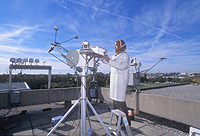
    Environment Canada is a key Canadian focal point for the advancement of atmospheric science, providing the research needed to improve Canada’s air quality, respond to climate change and increase the accuracy of weather forecasts.

    Human activities are changing the atmosphere, and the work of Environment Canada’s atmospheric scientists is focused on observing, understanding and predicting these changes. These scientists are tracking changes in the atmosphere through monitoring networks, analyzing and maintaining long-term data records, studying atmospheric processes, and developing complex computer models. This modeling work enables Environment Canada scientists to predict future change, from tomorrow’s weather and air quality, to climate conditions over the coming decades.

    Environment Canada atmospheric research provides valuable advice and guidance to decision-makers working to reduce air pollution, protect the ozone layer, respond to climate change and safeguard Canadians from hazardous weather. Atmospheric research also provides the scientific basis for many services to Canadians, including the air quality, health index and UV index  and increasingly accurate forecasts of severe weather.

    Working in collaboration with Canadian universities and the international science community, Environment Canada’s scientists generate new knowledge about the atmosphere. Departmental scientists also take an active role in development of national and global scientific assessments that provide authoritative compilations of the current state of the science on atmospheric issues.

  • Why should I volunteer?

    Why should I volunteer?

    People volunteer their time for lots of different reasons. You can pick your own reasons, but here’s our top ten:

    1. You have to!

      You have to complete 40 hours of volunteer work to graduate high school in Ontario

    2. Forty hours! Sound like a long time? Over four years, you probably spend way more time than that watching TV, standing in front of the mirror or riding the bus.So, the fact you have to do 40 hours of volunteer work to graduate high school in Ontario really shouldn’t be such a big deal.Your school calls this requirement ‘community involvement’. The Ministry of Education has some rules about it, like:
      • You can’t be paid for your volunteer work.
      • You can’t skip class! You can volunteer during the summer, after school, weekends or even on your lunch or during your spare.
      • Chores you already do around the house don’t count. Unfortunately, cleaning your room isn’t volunteer work!

      Your school board has a list of pre-approved volunteer activities. Ask a teacher or guidance counsellor for the list and for the full set of rules. If what you want to do isn’t on the list, make sure you talk to your teacher first to see if your school principal will agree to it.

    3. Pump up your resume.

      When you’re looking for a job, volunteer experience helps. It shows you’re responsible and gives you references who can prove you do good work.

    4. It feels good to help people.

      Try helping somebody and see how you feel – you just might become addicted!

    5. Make the world a better place.

      Making the world better, safer, happier, healthier or cleaner starts with small projects so get in there and get your hands dirty.

    6. Learn something about yourself.

      You might be a great leader or more outgoing than you ever thought – only one way to find out – try new things!

    7. Figure out what kind of career you want.

      Thinking about becoming a doctor? Volunteer at a hospital!

    8. Activism is hot!

      If you’re passionate about causes like the environment or human rights, there are lots of charities and groups you can join.

    9. Meet new people.

      Your best friends might be the coolest, but volunteering is a chance to meet a whole new circle of people.

    10. It’s fun.

      If you volunteer doing something you love and are interested in, the work you do won’t feel like work at all.

    11. Prove adults wrong.

      If you think adults don’t give teens any respect, here’s your chance to prove you care about your community and are ready to lend a hand.

  • Volunteer Tears

    Volunteer Tears

    Second semester is creeping its way into your life, pressure from exams have fled, and you are starting as fresh as an untouched blanket of winter snow (depending on your geographic climate, substitute snow for a bed of grass). This may be an opportune time to begin those volunteer hours you have put off “for next year” since grade 9.

    So where do you start volunteering? The first place to look is within your school community. Volunteering your time to benefit the environment of your school is a great way to establish a substantial rapport with teachers and peers alike. This does not mean you should ask your automotive teacher if he needs any work done on his front lawn! Try and find things that help the community as whole, and not just individuals you know personally. For example, you can help out with school events that may include, but are not limited to: environmental/horticultural projects, school plays, events, and fundraisers. Helping out in scenarios like the ones mentioned will not only get you some community hours, but can also foster connections with people you may have never thought about talking to! There are also clubs and teams that need assistance every once in a while. The school football team will always need a field marker for their home games! However, if you can not find anything remotely close to these examples at your school, talk to you guidance counselor and they will be happy to aid you in your quest to
    support your community!

    Letʼs not forget the great world outside of your school! Helping your own neighbourhood is also a beneficial way to not only get the hours you need for that diploma, but you can also tailor your time volunteering to gain skills you can put on a resume or use in an interview. For example, if you want to become a teacher, tutoring students after school will allow you to explore some aspects of the career. If you are thinking about nursing or becoming a doctor, helping at your local hospital may give you more of an understanding and appreciation for those professions. On the other hand, it may lead you toward never wanting to catch a cold again! Nevertheless, donʼt just volunteer for the sake of getting those hours out of the way, think about what potential careers you might want to investigate and use the volunteer hours as an opportunity to explore! Also, do not be afraid to check out universities around your neighborhood to see if they want help as well. The harder you search, the more rewarding the experience will be!