Category: Nature Watch

  • Are plastic bags really necessary?

    Are plastic bags really necessary?

    A national newspaper columnist wrote that “banning plastic bags will do exactly nothing to save the planet.” She went on to argue that they’re even environmentally friendly. Outright bans may not be the best solution, but plastic bags pose a big problem that must be addressed. The columnist appeared to be more interested in contrarianism for its own sake than in acknowledging the environmental harm these products cause.

    Plastic bags are bad and for the most part unnecessary. Many of us older folks remember a time, only a few decades ago, when we didn’t have them. Sure, they’re convenient, but is that an excuse to damage the environment and the life it supports?
    Subscribe to Science Matters

    A University of British Columbia study found that 93 per cent of beached northern fulmars (migratory seabirds related to the albatross) had bellies full of plastic — a substantial increase from the last time they were tested, in 1980. Head researcher Stephanie Avery-Gomm told the Globe and Mail that one bird had 454 pieces of plastic in its stomach. Eating plastic can severely harm or kill birds, as well as the 260 other marine species, including turtles and fish, that we know eat or get entangled in the stuff.

    It’s not just bags, of course. We humans have become dependent on plastic for a range of uses, from packaging to products. Reducing our use of plastic bags is an easy place to start getting our addiction under control.

    Canadians use between nine- and 15-billion plastic bags a year, enough to circle the Earth more than 55 times, according to the Greener Footprints website. (U.S. citizens use about 100 billion a year!) Few plastic bags are recycled. Most are used for a short time to carry groceries, and then maybe re-used as garbage bags or to wrap dog poop before ending up in the landfill or the ocean. Some people argue that, because they make up about one per cent of the volume of waste in landfills, we shouldn’t worry. But one per cent of the massive amounts of what’s in landfills is a lot, especially since plastic doesn’t biodegrade.

    Because they’re lightweight, plastic bags are easily carried by wind and water. Besides accumulating in the ocean, they litter our streets and natural areas, often clogging drainage systems and contributing to flooding. They take at least 1,000 years to break down, and even then, they don’t biodegrade; rather, they fragment into smaller and smaller pieces, making them more likely to be eaten by marine and land animals.

    Plastic is also a petroleum product, so continued and increasing use of it accelerates the depletion of valuable fossil fuels. According to Greener Footprint, 8.7 plastic shopping bags contain enough embodied petroleum energy to drive a car one kilometre.

    Finding something to carry your groceries in is easy; inexpensive re-usable bags come in a variety of materials and sizes. Many are small and light and can be carried in a purse or daypack. I carry one in my back pocket and have refused dozens of plastic bags as a result. Some people worry about bacteria and other contaminants that may accumulate in the bags, but you just need to wash them regularly.

    One of the bigger issues is what to put garbage in. Before the 1980s, no one used plastic bags for groceries or garbage, nor did we have composting or recycling programs, so we know that plastic garbage bags aren’t entirely necessary. The first step is to reduce the amount of garbage we produce. In fact, there’s really no such thing as garbage. It’s all resources, so we should more accurately refer to it as “waste”.

    Buying products with less packaging and reducing overall consumption of unnecessary goods is a start. Re-using, recycling, and composting also help you cut down what you send to the landfill. For the unavoidable waste, and the dog poop, use bio-compostable bags.

    Outright bans on plastic bags may not be the best solution, but education and incentives to get people to stop using them are necessary. If we have any hope of finding ways for seven billion people to live well on planet with finite resources, we have to learn to use our resources efficiently. Plastic bags are neither efficient nor environmentally friendly.


  • Benefits of Volunteerism in High School

    Benefits of Volunteerism in High School

    High school students, it’s time to get motivated! Volunteering while still in high school provides you with the framework for your future career path, as well as instills in you the importance of giving back to others. It may seem difficult to fit in volunteer hours with such a busy schedule of classes, studying and extracurricular activities, but with a little planning you can achieve your volunteer goals. Many not-for-profit organizations only require a few hours a week of your time. For example, the Ottawa Humane Society has a dog walking program that requires a commitment of 2 hours per week. If you love dogs, that is a very easy commitment to make! Even though you may not be reimbursed financially for your time, volunteering is something that can be put on your resume that will help impress future employers and university admissions officials alike. Below, a list of just some of the benefits that volunteerism can provide you:

    Impress Admissions Officials
    You’ve got the great GPA and amazing standardized test scores. But what makes you stand out from students with similar grades? The answer is what you do in your spare time. Volunteer hours and part-time jobs listed on your application will really make you shine. Volunteerism is a great way to show admissions officials that you not only care about the community, but are able to manage your time well enough to balance a volunteer job with your other commitments. By all means, don’t spend every spare minute working on your volunteer hours – you need to balance volunteerism with your personal life, too. But a sustained commitment to one particular cause over a year or two shows that you are willing to stick to something that you care about. This will be very impressive to admissions officials and work in your favour.

    Get Involved Outside of School
    Volunteering allows you to meet people you may not have had the opportunity to meet otherwise, especially if you are volunteering outside of school. If you have heard the term “networking”, that is essentially what you will be doing! You are forming a network of contacts that can help you get to where you want to be. If you already have a good idea of what you want to study in college or university, you can volunteer your time in that field. For example, if you want to study psychology, why not volunteer your time with the Canadian Mental Health Association? You can find volunteer opportunities for almost anything that interests you, so spread your wings outside of your school and gain immeasurable benefits!

    Earn Academic Credit and Scholarships
    Some high schools require you to put in volunteer hours in order to graduate. Others offer extra credits or scholarship opportunities if you do volunteer your time. Check with your high school’s administration office to see if any of these opportunities are available to you. If they are, take advantage of them! A scholarship will help you to cut down on your student loans when you reach university, and extra credits will look great on your transcript to help you land the university placement of your dreams. Check out studentawards.ca to find all of the different community service scholarships that are available – your volunteerism won’t only impress your university of choice, but also the officials who will be deciding whether or not you obtain your scholarship!

    Above are the curricular advantages to volunteerism. But let’s not forget the personal advantages that come from it, too. Giving back to your community and contributing positive energy to the world will do wonders for your self-esteem and self-worth. Volunteering is the way to go!

  • Corporate Social Responsibility

    Corporate Social Responsibility

    Corporate Social Responsibility

    Suppose that you are an owner or manager of a large company, and you have a choice to make. Your company has the option of working on one of two projects. One would make a lot of money for your company but could harm the environment or destroy a community. The other one would make much less money for you but would protect the local people. Which one should you choose?

    If you chose the second of the two options, you would be part of a movement called Corporate Social Responsibility, which says that businesses are responsible for how their actions affect others. For many years, people around the world have believed that businesses are not just about making money. They believe that it is the duty of business owners to try to improve life for everyone their company affects, not just themselves.

    Although the idea has been around for a long time, the term “corporate social responsibility” started to become popular in the 1960s and 1970s. The idea is that every business, large or small, affects many more people than just the owners, employees, and people who have invested money in the company.

    The people who are affected directly or indirectly by a business are known as “stakeholders.” They might be people in the community whose small business failed because a big business moved in or who become sick because of the pollution from a factory. They might also be people who have better hospitals and schools because of the wealth a business has brought to the region. Whether the effect on the community is good or bad, every business affects more than just the people who work there.

    The idea behind corporate social responsibility is to increase the good effects a business has on the community and to decrease the bad ones. Some companies help the environment by reducing their energy use. Others give their employees good benefits such as free university education and a generous retirement income. Some companies also raise money to help with special projects like protecting a rainforest or buying Fair Trade products that ensure employees producing the products are paid a fair wage for their work.

    Not everyone agrees with the principle of corporate social responsibility. Many people think that the main purpose of business is to make money, not to work at community development.  Often, the amount of time and money needed to be socially responsible deters employers from investing in socially responsible programs.

    For corporate social responsibility to work, businesses often need the government or social agencies to advise them. Industry Canada is one government agency that works with corporations and the public to try to ensure social responsibility, while the media, the public, and non-profit organizations like Greenpeace can also hold corporations responsible for their actions. Together, the different groups can help companies to benefit as many people as possible and to protect the environment.

    (how can people get involved, how can a student make a change to a company they think should be more responsible, or how can they nominate a company they think is doing a good job…give me more info and contact information, be as specific as possible)


  • Map app helps bring nature into the equation

    Map app helps bring nature into the equation

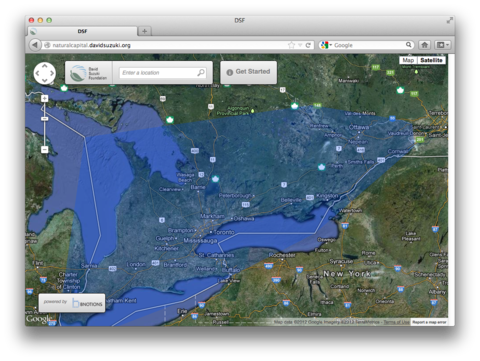
    The David Suzuki Foundation and Google Earth Outreach are launching an online map that will allow residents and decision-makers to zoom in to their community and calculate the economic value of natural capital assets.

    Imagine a sleek contraption for your backyard so powerful it has the cooling effect of 10 air conditioners, quietly filters dust, allergens, and pollutants, runs for free on solar power, and its only byproduct is oxygen.

    Dream no longer. This elegant machine is a healthy, mature tree.

    Using energy from sunlight, a tree can soak up almost 400 litres of water from the ground each day, and cool the surrounding air through transpiration. Trees absorb airborne contaminants and breathe out clean oxygen. They’re such efficient air filters that Columbia University researchers estimate that for every 343 trees added to a square kilometre asthma rates in young people drop by about 25 per cent.

    What else can these handy natural contraptions do for us? The U.S. Forest Service says trees near buildings reduce air-conditioning needs by a third and, because they break the wind, save up to half the energy used for heating. According to the University of Washington’s Center for Urban Horticulture, mature tree canopies reduce the air temperature of urban areas between five and 10 degrees Celsius.

    Imagine replacing these ecological services with human-built substitutes. While we can handle cooling a building, creating city-sized air conditioning that could reduce the temperature of an urban area by 10 degrees is an engineering feat that would require massive amounts of energy.

    The sophisticated services that nature provides are not only misunderstood and underappreciated; they tend to be ignored in modern economics and urban planning. When a forest or wetland is converted to another use, municipal decision-makers focus on infrastructure costs, property values, and future contributions to the tax roll.

    We continue to deplete natural resources and degrade nature in and around urban areas, failing to recognize the contribution of ecosystem services — like clean air, fresh water, and cooling — to the economy and health of communities. As The Economics of Ecosystems and Biodiversity initiative notes, this ecological damage is the “perfect crime”, a theft barely noticed. We wouldn’t let a bank get away with losing our life savings. We shouldn’t let decision-makers off the hook when they allow our natural wealth to be squandered.

    Encouragingly, a growing chorus of economists and policy-makers has begun advocating for a smarter way of accounting for the true value of nature — something called natural capital economics.

    Most people understand the concept of financial capital. We pay for things we find valuable. Natural capital extends that perspective to ecological goods and services. It would be expensive to develop and build facilities to replace the things nature does. So we calculate the dollar value we would have to pay if we had to provide them ourselves.

    How much is our natural capital worth? According to the David Suzuki Foundation’s research, the 7,000-square-kilometre Ontario Greenbelt provides at least $2.6 billion in non-market benefits each year. British Columbia’s Lower Mainland region is estimated to be worth at least $5.4 billion annually. Global studies have estimated the total value of the world’s ecosystem goods and services to be on par with the value of the entire global economy. In short, our natural capital is a source of staggering wealth.

    Why do we continue to fritter away these amazing assets, despite their immense value? Unfortunately most people don’t have a clear picture of what stocks of natural capital exist in their communities, let alone the true cost of converting natural areas for industrial, commercial, or residential development.

    That’s why the David Suzuki Foundation and Google Earth Outreach are launching an online map that will allow residents and decision-makers to zoom in to their community and calculate the economic value of natural capital assets. The interactive Putting Natural Capital on the Map application allows users to select a parcel of land and find out what types of natural ecosystems it contains and what economic benefits it provides.

    While economists, ecologists, and decision-makers grapple with how to estimate an appropriate economic value for nature’s benefits, I am hopeful that the field will spur communities to consider the true value of their natural riches. In the meantime, I encourage you to beat the heat and keep your community cool by investing in your own bit of natural capital — a tree for your yard or park.

  • Community Service: Top 10 Reasons to Volunteer

    Community Service: Top 10 Reasons to Volunteer

    Thinking of becoming a volunteer?

    #10: It’s good for you.

    Volunteering provides physical and mental rewards. It:

    • Reduces stress: Experts report that when you focus on someone other than yourself, it interrupts usual tension-producing patterns.
    • Makes you healthier: Moods and emotions, like optimism, joy, and control over one’s fate, strengthen the immune system.

    #9: It saves resources.

    Volunteering provides valuable community services so more money can be spent on local improvements.

    • The estimated value of a volunteer’s time is $15.39 per hour.

    #8: Volunteers gain professional experience.

    You can test out a career.

    #7: It brings people together.

    As a volunteer you assist in:

    • Uniting people from diverse backgrounds to work toward a common goal
    • Building camaraderie and teamwork

    #6: It promotes personal growth and self esteem.

    Understanding community needs helps foster empathy and self-efficacy.

    #5: Volunteering strengthens your community.

    As a volunteer you help:

    • Support families (daycare and eldercare)
    • Improve schools (tutoring, literacy)
    • Support youth (mentoring and after-school programs)
    • Beautify the community (beach and park cleanups)

    #4: You learn a lot.

    Volunteers learn things like these:

    • Self: Volunteers discover hidden talents that may change your view on your self worth.
    • Government: Through working with local non-profit agencies, volunteers learn about the functions and operation of our government.
    • Community: Volunteers gain knowledge of local resources available to solve community needs.

    #3: You get a chance to give back.

    People like to support community resources that they use themselves or that benefit people they care about.

    #2: Volunteering encourages civic responsibility.

    Community service and volunteerism are an investment in our community and the people who live in it.

    #1: You make a difference.

    Every person counts!

  • Sports and Volunteer Hours

    Sports and Volunteer Hours

    Jobs People Do | JobsPeopleDo.comFinishing Your Community Hours in the Summer with Sports.

    When youʼre loving the summer, the last thing you want to think about is school especially completing those mandatory volunteer hours so you can get your high school diploma. Not to worry though, you can still have plenty of fun in the sun while completing those volunteer hours.

    How do I know that you can do this? Well, I know from personal experience of course. Just like all of you readers, I had to manage my time in the summer so I could complete my volunteer hours. I decided that since I have to do them, I would want to volunteer for something that I would enjoy. In my case, I liked sports, so I phoned some local sport clubs and asked if any were offering volunteer hours for students.

    After some sport searching, I discovered that I could coach for a junior league soccer team. As intimidating as coaching sounded, I was up to the challenge, and it turned out to be one of the best parts of my summer. I signed up, along with my brother, and we coached a soccer team for 8 year-olds soccer  for two months.

    We practiced once a week and played a game every weekend, putting in over 3 hours a week. It was a very small amount of time we had to take out of our normal summer, and it wasnʼt agonizing to do. In fact, I looked forward to seeing my kids learn and develop soccer skills through mine and my brotherʼs coaching. It was very rewarding, especially when we made it all the way to the finals and won the
    championship!

    Jamie Willett, a recent resident at Western University, had a similar experience with her high school volunteer hours. Jamie did her volunteer hours spending her summer assisting a junior gymnastic team. She spent hours every week planning and executing lessons for a group of young gymnasts.

    “It was really thrilling to teach the kids during the summer. Although it brought new challenges everyday, it allowed me to test my skills as a gymnast and as a teacher. It definitely helped me discover what I wanted to do after high school as well!”

    This fall term Jamie will be studying at teacher’s college at Western University for a year so she can teach students at the high school level.

    As you can see, there are plenty of ways to finish up those volunteer hours during your high school years and we have only covered the realm of sports! Be sure to check out the Jobs People Do Volunteer section to check out where you can lend a hand in your
    community!

  • Rotary Clubs Sponsor Exchange Students

    Rotary Clubs Sponsor Exchange Students

    Very few clubs can claim to span the entire planet Earth, with members from Iceland to Antarctica. Few non-governmental organizations can hold a seat in the United Nations, too. So which club does? Which club is commonly recognized as having the impact and value of an entire nation while spanning nearly all?

    Rotary International (RI) is the world’s first service club organization, with more than 1.2 million members in 33,000 clubs worldwide. Rotary members are “volunteers and humanitarians who work locally, regionally, and internationally to combat hunger, improve health and sanitation, provide education and job training, and promote peace,” according to RI President John Kenny. Some of their main focuses include eradicating the Polio virus, promoting literacy, and engaging youth through exchange programs and educational opportunities. Sounds awesome! Want to join?

    As students, we’re actually too young to be Rotarians however, for us, Rotary offers something even better.

    RI funds Rotaract clubs. Rotaract has the same values and goals as Rotary but is meant for students and young professionals between the ages of 18 and 30. It also partners with Interact clubs, Rotary for high school students, and RYLA, Rotary Youth Leadership Award programs. Rotaract, Interact, and RYLA;  all are fantastic ways to get involved in your community and your world. If you haven’t looked into these clubs yet, now is the time.

    Until this year, RI had four official avenues of service: club, vocational, community, and international. This year, for the first time in a century, Rotary announced a fifth avenue of service: “New Generations”. Rotarians are sponsoring youth on more frequent, new exchange trips, and focusing their community efforts toward our futures and well-being. They’re all about us now, so let’s take full advantage and give back as much as we can.

    This month, Rotary hosted their 101st Annual International Convention Meeting in Montreal, Quebec, and I am one of over 20, 000 members who attended. It was awesome. They had meetings, workshops, guest speakers, social events, and special performances for all the Rotarians and Rotaractors. We were given speeches on global awareness by Queen Noor of Jordan, current Nobel Peace Prize nominee Greg Mortenson, country music star Dolly Parton, and more. We were also part of a mass volunteer effort that cleaned up some of Montreal’s most beautiful agricultural areas and donated both time and pocket-change to support many charitable initiatives.

    The convention provided great opportunities both professionally and personally. Professionally, Rotary is a great way to build networks of contacts and build leadership skills that can help you reach your school and work-related goals. On a personal level, you can enjoy friendships with hundreds of people from around the world.

    Kelly Mills, a neuroscience major from Alberta’sLethbridge University, said that Rotary was a great way to bring people together. “It’s a connection,” she explained, “you can go up to anyone and everyone. Just smile and you’re friends.”

    If you want to get involved by finding a Rotaract or Interact club in your community, visit:

    Rotaract
    http://www.rotary.org/en/StudentsAndYouth/YouthPrograms/Rotaract/Pages/GetInvolved.aspx or

    Interact
    http://www.rotary.org/en/StudentsAndYouth/YouthPrograms/Interact/Pages/GetInvolved.aspx.

    Contact your local Rotary club if you are interested in starting your own, and helping your city or high school add to the worldwide service network that is Rotary International.

  • Stand up , Speak up , Get Involved

    Stand up , Speak up , Get Involved

    Another day, another pipeline spill


    A recent pipeline leak sent 475,000 litres of oil into Alberta’s Red Deer River. It could have been worse; nothing was being pumped at the time. The company, Plains Midstream, claims the light sour crude may smell bad but poses no risk to humans!

    It happened as crews were cleaning a larger spill from last year at another of the company’s pipelines. That one dumped 4.5 million litres of oil into the surrounding forest and wetlands. The recent Red Deer River spill was also the site of a leak in 2008. Industry figures show that more than 3.4 million litres of fossil fuels have been accidentally released from pipelines every year in Alberta since 2006. One litre of spilled oil can contaminate a million litres of groundwater.

    Enbridge, the company that wants to build a dual pipeline from the tar sands to the B.C. coast, has had more than 800 leaks and spills on its pipelines since 1999, sending close to 27 million litres of oil into the environment. That included a 2010 spill in Michigan that dumped 3.8 million litres of diluted tar sands bitumen into the Kalamazoo River. Cleanup costs for that are already $765 million, and the river is still contaminated.

    Of course, the Enbridge Northern Gateway pipeline, which will carry heavy bitumen 1,200 kilometres one way and Middle Eastern condensate the other way across close to 1,000 streams and rivers, will be different, we are assured: world-class safety standards, safety control valves, 24/7 monitoring, emergency responders… Where have these world-class standards been hiding until now?

    Enbridge only carries enough insurance to cover $575 million in damages, far less than incurred by the Kalamazoo spill. Who pays the rest if a spill happens after the company and its Chinese state-owned backers get their way in Northern B.C.?

    Bitumen is riskier than regular oil or gas. It’s heavier and sinks in water, making cleanup difficult with longer-lasting negative environmental impacts. But, thanks to changes brought in under the federal government’s Bill C-38, we’ll no longer have to think about potential damage to the waterways and land along the pipeline route, unless they’re home to “fish that are part of a commercial, recreational, or Aboriginal fisheries.”

    These are just issues with spills. Even the other possible catastrophic environmental impacts of Northern Gateway — such as accidents involving more than 200 supertankers a year carrying the bitumen through the narrow and hazardous Douglas Channel and across the Pacific and down the coast to China and California for refining — pale in comparison to the larger issue: rapid exploitation of fossil fuel deposits and the associated impacts of climate change, pollution, and economic short-sightedness.

    The goal of our government and industry leaders appears to be to dig up as much oil as possible, as quickly as possible, and sell it overseas, and damn the economic and environmental consequences. If that means selling entire tar sands operations and the bitumen to companies owned by a government known for human rights abuses and environmental destruction; if it means polluting water and putting people’s health at risk; if it means killing birds, caribou, and wolves; if it means putting our manufacturing industry at risk and not joining the green-energy economy, all for the sake of a few short-term and even fewer long-term jobs, who cares? There’s a quick buck to be made. And the economy will appear to chug along until the next election and maybe the one after that. And that’s surely enough time to dismantle many of the laws, policies, and institutions that have made Canada the great country it is!

    Whether or not we smarten up and start switching to cleaner energy, we’re going to need oil for some time. Rather than rushing headlong into this and putting our environment, health, and economy at risk, it would make more sense to step back, develop a national energy plan, and figure out how we can use this valuable and diminishing resource efficiently and in a way that provides long-term benefits for all Canadians rather than a few industrialists and China’s totalitarian government. We also need to start monitoring the long-term impacts of the never-ending spills from leaky pipelines.


  • What Is Homeopathic Medicine ?

    What Is Homeopathic Medicine ?

    Homeopathic Medicine is the coordination of scientific and natural of healing that has been in existence for over 200 years. It treats the whole person by using natural remedies that boost the body’s own ability to heal itself and correct any imbalances.

    The homeopath seeks a substance which, in overdose, would mimic symptoms similar to those experienced by the sick person. When the match is made, that substance is given to the patient in minute, safe doses.

    The man who pioneered homeopathic medicine is Dr Samuel Hahnemann. He was the first to notice that plant, animal and herb substances capable of causing disease in healthy people can be used in diluted form to treat people with similar symptoms.

    Based on this observation, he developed a process of dilution to form homeopathic remedies. A plant substance is diluted with 99 parts distilled water or ethyl alcohol.

    This process of dilution is repeated many times and is accompanied by a shaking procedure that imprints the energy signature of the plant on the water molecules.

    The water retains a memory, or inscription of certain characteristics of the tincture.

    It is this autograph that gets carried through and made more potent. As the plant molecules decrease with continued dilution, the traces of the plant disappear but the autograph gets stronger.

    This makes the homeopathic remedy potent but completely non-toxic. My research has shown me that natural herbal remedies are not always safe, whereas homeopathic remedies are 100% safe. Homeopathic Doctors tell me that although some of the substances used to make homeopathic remedies are toxic in their undiluted state, once they have been diluted they are completely safe and have few side effects when administered correctly. They believe homeopathy can treat most conditions like illnesses such as recurring colds, chest infections, ear infections, tonsillitis, fever, diarrhea and vomiting.

    Homeopathy is growing in awareness and usage around the world that is because conventional medicine should not necessarily be the first thing that one jumps at. There are gentler ways, and homeopathy is one of them.

  • A Soft Spot for the Spiny Softshell Turtle

    A Soft Spot for the Spiny Softshell Turtle

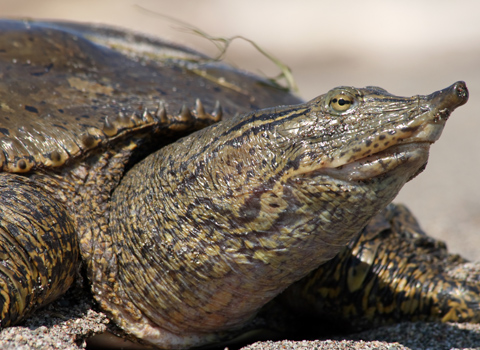
    With only two subpopulations in Canada, habitat for the spiny softshell turtle (Apalone spinifera) is crucial to its survival. However, this reptile has a long must-have list before it moves into its habitat and human impacts can leave it homeless. As it stands, the spiny softshell turtle has been listed as threatened by the Committee on the Status of Endangered Wildlife in Canada (COSEWIC) since 1991.

    The Canadian Wildlife Federation’s Endangered Species Program is giving $20,000 to Patrick Paré, a biologist and Director of Education, Research and Environment at the Granby Zoo to locate, monitor and protect the nesting sites of the spiny softshell turtle.

    Prime Real Estate

    While the square footage might seem endless, these turtles have a check-list that their new home must fulfill before they commit to a location. Their home sweet home will have a sand or gravel area for nesting that’s close to the water and free of vegetation, shallow sandy areas to bury in, deep pools (one metre deep at the very least) to hibernate in and areas to bask in the sun. Of course their habitat also needs to be welcoming for their favourite prey—crayfish, tadpoles, minnows and aquatic insects.

    But with a laundry list of must-haves comes a laundry list of roadblocks. Urban and agricultural development along shorelines and bank stabilization can restrict the turtle’s ability to move from basking hotspots to nesting nooks or deep pools to sandy spots. With limited access, turtles would be forced to migrate long distances every day, and eventually the habitat is rendered useless and they’re forced to move.

    Nest Egg

    Since spiny softshell turtles have a hard time locating the perfect spot to create their home and nesting area, they often have to lay their eggs in the same area. Once the locale has been decided upon, usually on sandy beaches, they lay approximately 20 eggs a clutch. However, beaches also happen to be sought after for recreation, and since this turtle can be easily disrupted, this can put a damper on nesting. The eggs have also got other glitches to contend with, including egg infertility, fluctuating water levels, sewage and predators like raccoons, foxes and sarcophagid flies.

    Where Paré’s Research Fits In

    Quebec’s spiny softshell turtle populations are located in two areas: Lake Champlain and Pike River. Patrick Paré of the Granby Zoo is targeting the Pike River population in order to assess and monitor the health of this population. In April, May and June, Paré and his research team will capture two females en route to Pike River in order to install transmitters to track the females as they scout out nesting spots. From June to October, the team will locate the nesting areas and protect them from predators with wire netting. They’ll also visit the sites frequently to check on flooding, predation and vegetation growth in the area. In the fall, researchers will visit the nesting sites again to determine the ratio of hatched to undeveloped eggs.