
The trades sector in Canada is constantly growing and changing. So how do you know which career path is right for you? Here at Jobs People Do, we’ve assembled a list of some of the hottest jobs in the trades industry that will be in high demand for years to come. Take a look at just some of your options and then click on the link to be taken directly to career information. Find out what kind of education you will need and how much you can expect to be paid.
Category: Trades
-
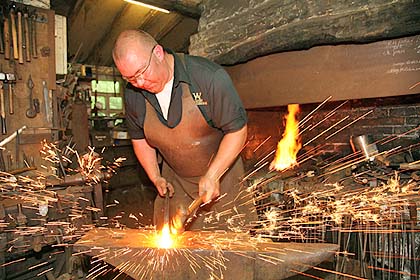
Career Profile: Blacksmith
Some jobs never go out of style. Doctors, for example, are always necessary because people continue to get sick. Teaching methods might change a lot over the years, but students will always need people to help them gain the knowledge and skills they need for life. Other jobs seem to disappear over time, but they might still be important, even if they change a lot. For example, blacksmiths used to be essential in the days before factories produced all kinds of metal and plastic goods, but their work is almost unknown now. However, blacksmiths still have an important role in society.
In the past, blacksmiths worked mainly in small shops, using hot fires in forges to soften metal enough so that they could pound it into horseshoes, fence posts and much more. These days, very few people ride horses, and the discovery of steel has made metals like iron much less popular than they once were. However, blacksmiths still work in making all kinds of things, such as ornamental metal railings and plastic parts for larger objects. Many blacksmiths work in factories rather than in their own shops, but many of the basic techniques are similar to what they used to do.
Basically, blacksmith work involves shaping metal and other materials into different shapes. Often, the material has to be heated up before the blacksmith can work with it. When metal is hot enough, the blacksmith can pound it with hammers or bend it using strong tools until it becomes something new. In factories where machines do much of the work of shaping and molding objects, blacksmiths might spend much of their time setting up and maintaining the machines to make sure that they are working properly. In small businesses, like those that produce souvenirs for tourists or ornamental metalwork, the job might resemble the traditional blacksmith’s role.
No special education is necessary for becoming a blacksmith, but a high school diploma is helpful. Good mathematical skills are important for being able to calculate amounts, weights and prices. For ornamental blacksmiths, an education or training in the fine arts is helpful, but not always necessary. The most important training for blacksmiths is learning from others in their field. Official apprenticeships are good options, but informal training can also help. If you are interested in blacksmith work, you can already try to find mentors who can guide you through the process of learning what you need to know.
If you want to become a blacksmith, you can already talk with people who are working at the kind of job that you want to do. You might even be able to work at a small blacksmith shop on Saturdays or help out in the summer. Depending on where you end up working, you might make the standard blacksmith’s salary of about $29,000 per year or you might have an irregular wage, depending on tourism and other factors. Does a career as a blacksmith sound good to you? Why not start to prepare for your career now?
-

Career Profile: Florist
One of the very nice parts of spring is the time when the flowers begin to bloom again. When the snow melts, the return of crocuses and daffodils is a sign that spring has finally arrived and that the cold weather is almost over. During the short summer season, many people grow gardens with daisies, roses, and many other kinds of flowers to enjoy before the winter comes again. Do you like the spring and summer flowers? What if you could work with flowers all year? As a florist, you could work at arranging and selling flowers to people for all kinds of occasions.
If you ever buy flowers, you probably know a bit about what florists do. Many florists work in shops where they sell flowers to customers and advise them about what kinds of plants look nice together. However, being a florist can involve much more than that.
Many people who want to work with flowers attend classes at a place like the International Florist Academy and School in Montreal. Students learn how to put together flower arrangements and learn about topics like European floral design and balloon art. They learn the basic techniques of wrapping flowers but also work with colour and design to produce the best possible arrangement, and also learn about basic care of flowers. Having a natural ability with flowers is good, but a program like this helps students to gain a broader knowledge of their work.
Even for people with formal training, working as a florist often means beginning with sales and learning on the job. Contacting various flower shops and grocery stores is a good way to find work. Pay for jobs in florist shops often starts at minimum wage and can go up to about $17.00 per hour.
At first, the job might involve tasks like talking to customers in person or on the phone, wrapping up flowers and sweeping up fallen leaves and branches from the floor. As employees learn more about the work, they might progress to flower arranging and later to ordering flower shipments from other countries. Many of the flowers that people in Canada buy come from warm countries in the Middle East or Africa. Learning to arrange shipments of flowers is an important part of working as a florist.
Special occasions are important times for florists. Weddings, graduations, funerals and Mother’s Day traditionally involve flowers, and florists have to be ready to fill their customers’ orders. Different occasions require different types of flower arrangements, and florists need to be prepared for whatever customers want. Knowing what people normally like for these occasions is helpful, since then florists can have the right flowers ready to arrange.
Creativity is often very helpful. Florists who can produce unusual and beautiful arrangements, using flowers that people rarely buy, might find it easier to attract customers than florists who stay with the traditional arrangements and colour combinations. If you love flowers and can combine tradition and innovation, a career as a florist might be right for you.
-

Transmission Technician
Transmission technicians specialize in the maintenance and repair of automatic transmissions. They must be skilled at examining a vehicle and estimating the repair costs, using computerized diagnostic equipment, taking apart the transmission and replacing damaged parts, and testing the vehicle’s performance. Transmission technicians also perform routine inspections and preventative maintenance.
Certification Requirements- The Transmission Technician apprenticeship consists of 6,000 hours of on-the-job training.
- Apprentices must also complete two 8-week in-class technical training sessions.
- Once you have successfully completed the apprenticeship requirements, you receive a Certificate of Apprenticeship and are considered a journeyperson candidate. You must challenge the Certificate of Qualification exam and pass to become certified as a journeyperson and be legally allowed to work in the trade in Ontario.
- A person with at least 6,480 hours of related work experience is eligible to apply for a Trade Equivalency Assessment (TEA) and challenge the Certificate of Qualification exam to become certified as a journeyperson in this trade.
Educational PrerequisitesGrade 12 or equivalent.
-

Roofer
Roofers install, repair and replace flat and sloped roofs. They work with membrane roofing systems that consist of a variety of materials with different application methods. They also install, replace and repair shingles, slate, shakes, roofing tiles, sheet metal and other preformed sheeting on sloped roofs.
Before the work begins, roofers may inspect existing roof systems and determine the extent and procedure for repair of the substrate or removal and replacement of roofing materials. Some roofers may be involved in the estimating of material and installation costs.
As part of the job preparation, roofers may set up scaffolding to provide safe access to the work area and may install fall protection systems. They also weatherproof, waterproof and damp-proof roofing surfaces, foundation walls, floor slabs and bridge decks. They install roofing accessories such as sheet metal flashings, roof vent flashings, anchor bolt flashings, drain inserts and clamps.
Roofers may be employed by roofing companies, general contractors or they may be self-employed. They may work on all types of roofs or may specialize in the flat or low sloped roofs of commercial and industrial buildings or on the steep sloped roofs found in most residential buildings.
Key attributes for people in this trade are mechanical aptitude, manual dexterity and the ability to work as a team. Roofers work primarily outdoors and work may be seasonal. The work environment is exposed and may vary from extreme cold to extreme heat. Roofing is physically demanding work and requires considerable effort in lifting, climbing, bending, kneeling and balancing on high, sloped and sometimes slippery surfaces.
Roofers work in conjunction with other tradespeople in the construction trades. With additional training, roofers may transfer their skills to related occupations such as carpenter or sheet metal worker. With experience, they may advance to positions such as supervisors, contractors or inspectors.
-

Hazardous Materials Worker
Hazardous materials workers identify and safely remove any dangerous materials from a site. These materials sometimes include asbestos, radioactive and nuclear waste, arsenic, lead, mercury, or other dangerous substances. Workers may have to stay calm and work quickly when responding to emergency situations where hazardous substances are endangering other people.
Certification Requirements- The Hazardous Materials Worker apprenticeship consists of 2,898 hours of on-the-job training.
- Apprentices must also complete 102 hours of in-class technical training.
- Once you have successfully completed the apprenticeship requirements, you receive a Certificate of Apprenticeship and are considered a journeyperson candidate. If you choose to challenge the Certificate of Qualification exam and pass, you become certified as a journeyperson in the trade.
- A person with at least 3,000 hours of related work experience is eligible to apply for a Trade Equivalency Assessment (TEA) and challenge the Certificate of Qualification exam to become certified as a journeyperson in this trade.
Educational PrerequisitesGrade 12 or equivalent.
-

Hot Jobs: Careers in Trades
The trades sector in Canada is constantly growing and changing. So how do you know which career path is right for you? Here at Jobs People Do, we’ve assembled a list of some of the hottest jobs in the trades industry that will be in high demand for years to come. Take a look at just some of your options and then click on the link to be taken directly to career information. Find out what kind of education you will need and how much you can expect to be paid.
-

Why Canada Needs More STEM Students
As a wealthy, diverse and constantly growing nation, Canada needs students and workers going into the valuable fields of engineering, technology, science and mathematics. While these can be some of the most challenging career paths, they can also be some of the most rewarding. The acronym STEM stands for science, technology, engineering, and mathematics.
There are many other subcategories within the STEM fields like biology, geology, psychology, robotic engineering, aerospace engineering, industrial engineering, software design, computer hardware design, anthropology, sociology and a whole lot more! STEM fields are the backbone of society and new students are always needed to design, improve, innovate and create.
Graduates of STEM programs are extremely valuable to Canada and make great contributions to the Canadian economy and culture. The achievements of Canadians in STEM fields are known worldwide and it’s up to the next generation of students to continue that legacy of greatness. Engineers are responsible for buildings and structures and are required for just about any major project, from bridges to houses to high rise condominiums. Scientists and mathematicians are needed for a huge variety of jobs, from biologists and chemists to the robotics experts that created the world famous Canadarm or some of our leading bio medical doctors and researchers.
STEM graduates are needed in almost every field, be it politics, conservation, law enforcement, architecture or military. Former STEM graduates create and plan the roads we drive on, the planes in the sky, the computer programs we use, and they even helped to design your home or school. This wide variety of STEM-based careers is integral to the functioning of society. Simply put, if there were no more STEM students the world would be a much more chaotic place to live!
Not only do STEM graduates benefit their country, they also benefit themselves. They can open the doors to a wide variety of jobs and careers that put your intellect and creativity to the test as well as paying out steady incomes. Unfortunately, Canada currently isn’t producing as many STEM students as it once did, according to data from the Conference Board of Canada’s website.
Now more than ever, Canada needs students to step up and study STEM programs and career paths. Take a look at STEM today!
-

Why Should Girls Get Involved with STEM?
In our society, girls seem to be underrepresented in fields related to science, technology, engineering, and mathematics. Even more interesting is that in contrast to girls, boys seem to be actively involved in all of these fields. So what’s the deal? Why are girls not participating in these fields as much as boys? These are questions that are stumping researchers and other experts.
There is a stereotype that has been circulating around, that maybe girls just aren’t as good at these subjects as their male counterparts. However, research suggests that there isn’t any evidence to support this claim. We all know girls are just as capable and smart as boys. Researchers have found that, when tested, girls are equally as successful in any of these subjects as boys. However, as long as this negative stereotype continues to persist it can cause real harm. It can actually cause girls to believe that they aren’t good at these subjects before even trying them. There is a natural bias for people to assume that science and math are fields best suited to males and that the arts are better suited to females. Why not disprove this theory?
People also believe that maybe girls aren’t involved in STEM because there aren’t enough female role models in these fields to look up to. Seeing women who are thriving and successful in these fields could make them more enticing to younger females. People like Bill Gates and Mark Zuckerberg have made their fortunes in fields related to STEM. However, there still seems to be lacking female equivalents. It would be great to see females who have invented or developed ideas related to STEM in our society. The women that are contributing and involved in STEM should be given more visibility in order to promote these fields.
There are many reasons why girls should get involved in STEM. Firstly, positions related to these fields are abundant. Why not make contributions to them and stand out from others? Scientists are trying to solve some of the most difficult questions in our time. Engineers are designing different things that we can use to better our lives and make things easier. With the internet and other forms of communication becoming more popular, there are a wide variety of job opportunities relating to technology. People in these professions are doing creative and innovative things. In addition to this, these positions provide a person with a really great income (who doesn’t like money?). Helping the world and making great money doesn’t sound like a bad thing to me!
-
Career Profile: Locksmith
When people need help, they have to call the right person. If they need to go somewhere, they might call a taxi service or get a ride from a friend. When they lose their keys or lock themselves out of the house, they call a locksmith for help. Locksmiths or lock technicians are tradespeople who are experts on everything related to locks, keys, and security. Becoming a locksmith is a good career choice for people who enjoy puzzles and working with their hands.
Have you ever thought about the many different skills that go into working with locks? Becoming a locksmith involves learning about how to make keys that fit only one lock and how to repair broken locks or doors. Sometimes this might also mean that people have to learn how to replace doors and hinges as well as installing new locks. These days, working as a locksmith also requires some knowledge of electronic and keyless locks that use number or letter codes. As technology changes, locksmiths need to learn new techniques to keep up with what customers might want.
Learning all of these techniques takes a combination of education and experience. Some people attend classes at locksmith academies, where they learn about key cutting, lock types, and other topics related to their work. Others go straight to an apprenticeship for the trade. Being an apprentice allows them to learn from people who are experienced in the work while also practicing their skills. Locksmith work can require a lot of delicate manipulation of small metal parts, and being able to practice this work is essential for learning the necessary skills. Many locksmiths also need to know basic accounting or bookkeeping skills and learn how to run a business. Receiving a certificate in the trade is also necessary in many parts of Canada.
Keeping up with the latest locksmithing information is important, and many working locksmiths participate in workshops and seminars, as well as reading magazines related to their trade. Some locksmiths work as employees of companies, but many of them have their own businesses or work together with one or two other people. Generally, they work regular hours, but they might need to work evenings or weekends in case of emergency.
Depending on where and how much they work, locksmiths make between about $24,000 and $55,000 per year. Most locksmiths stay in the job for under twenty years. Locksmiths work in a wide variety of conditions, often in small, confined spaces. The ability to use tools to work with very small moving parts of a lock is important, and good vision (with or without glasses) for close-up work is helpful.
Almost every building has locks that need the services of a locksmith at some point. Jobs availability can depend on many factors, such as the number of older workers who are retiring and the size of the town or city where the locksmith lives. If you have the patience and skills to work with locks, you might eventually become part of this trade.