Tag: dream job

  • When It Comes to Choosing Your Career, Just Follow Your Heart

    When It Comes to Choosing Your Career, Just Follow Your Heart

    If you’re in high school, you are probably facing the pressure of choosing a career path that you would like to pursue, especially if you’re in your final year. You are at a point where you have to pick a major or program that you want to take in University or College, so it is important to make the right choices now.

    But what if you have you no idea what you want be? How do you make such an important lifelong decision? It seems like a lot of stress choosing your career path at such a young age. But it doesn’t have to be that difficult.  It’s a lot easier than you think.  Just follow your heart – the answer is there.

    Sure, maybe your parents have other ideas for you. Maybe they want you to be a doctor or lawyer. But what is it that makes you happy? What is your dream? What do you see yourself doing for the rest of your life? These are all important questions to ask yourself because, at the end of the day, it’s your life and you want to do what’s best for you.

    Start off by thinking of the courses you excel at in school. Maybe you excel more in the arts. Maybe you enjoy music or writing. Maybe you love working with numbers and excel in math. Narrowing down your strengths will help you make a better decision. Also spend time thinking about your hobbies. Do you enjoy sports? Painting? Maybe you can turn your hobby into a career. These are all indicators that you can’t ignore.

    Start off by making a list of your strengths. Then write down your dreams and goals. Seeing your thoughts on paper will allow you to think more clearly and is a great reference point. It would also help to sit down with your guidance counsellor in school to help figure out what you want to do. They are there to help you, so take advantage of it.

    Now you might have a better idea as to what career path you want to pursue. Why not get first-hand experience in it through volunteering or interning? Maybe do some job shadowing in the industry that you’re interested in. Your guidance office at school can assist you with your options.

    Chances are, you will most likely be successful in a career that you are passionate about. Sure, job prospects and opportunities in your chosen career path are important to consider, but following your heart should be given equal consideration as well. Doing something that makes you happy will make a world of a difference for you. You’ll find out that the answer is with you all along.

  • Dream Job: Sports Coach

    Dream Job: Sports Coach

    Many people dream of becoming great hockey players or tennis stars. A few of them manage to fulfill their dreams and to play in the sport they love. However, the career of an athlete is usually fairly short. Depending on the sport, athletes might be finished by the time they are twenty-five or thirty years old. What can they do after that?  Some of them get into an entirely different type of work, like teaching or accounting. Others, however, stay in their sports through becoming coaches. That was the case for Michel Therrien, coach of the Montreal Canadiens hockey team.

    If you play on a sports team at school or a community centre, you probably know a bit about what coaches do. Basically, they help the athletes in the sport to play better than before. They might help players improve a certain part of their style, such as how they hold a hockey stick, or they might just generally encourage them to keep on practicing. Often, being a coach involves making decisions about who will play and for how long. Being a coach involves an ability to deal with people calmly and to make good decisions quickly.

    Normally, coaches work in sports that they also have played in the past. Michel Therrien, for example, used to be a player for the Montreal Canadiens hockey team. Now he is the team’s coach. His experience as a player is useful in helping him understand how players can improve their hockey skills. He also knows how to advise the players on the best way to play their game. For example, he might see how a really fast skater can help someone who is slower but very good at getting goals. He can see when a player is working well with the others and when someone needs help. Michel Therrien has experience with both the Montreal Canadiens and the Pittsburgh Penguins, and everything he has learned has helped him to become a better coach.

    The requirements for being a coach can vary a lot. Coaches for school teams are usually teachers with degrees in education, and many coaches take courses to become certified in their area. Through these programs, they learn different coaching techniques and ways of dealing with people. Experience, however, is often the most important way to learn the work. Many people start out as assistant coaches and learn from someone who has been doing the job for a long time. Michel Therrien started his coaching career in the Quebec Major Junior Hockey League, where he coached two teams before becoming a professional hockey player.

    If you love sports and dream of playing them for the rest of your life, becoming a coach just might be the job of a lifetime!

  • Dream Jobs: Ballerina

    Dream Jobs: Ballerina

    Brooke Nagy is an 18 year old on a fast-track to becoming Canada’s next prima ballerina. Becoming a professional ballet dancer was not a decision Brooke made on a whim. It has taken a lifetime of preparation and focus. Since age three she has been classically trained in Ceccetti ballet, and has developed an advanced knowledge of both classical ballet and modern dance.

    Brooke has had the opportunity to dance professionally at many points throughout her career, but decided that it was important for her to complete her high school education before devoting herself entirely to the art. “I’ve already trained with the CanadianNational Ballet School and the Quinte Ballet School,” Brooke explains.

    “For two summers I was accepted to study as a part of the Canadian National Ballet School’s ballet-intensive summer school program, which led to the opportunity to be a part of their full-time program. I’ve also been accepted to (and attended) the Quinte Ballet School’s Summer School Program, which led to an acceptance into their full-time program” she continued.

    Ballet may well be in her blood, as her mother is a classical ballet teacher and former professional ballerina for the Miami Cityballet. Brooke intends to one day take over her mother’s dance studio, after travelling and performing as much as possible. She applied to the National Ballet of Canada’s Teacher Training program, New York’s Adelphi College and Suny Purchase College’s Conservatories of Dance and George Brown College’s prestigious dance program, garnering preliminary acceptance to all, but choosing to accept George Brown’s offer.

    The Toronto-based program will prepare her for an intensive Bachelor of Fine Arts transfer after earning her two year diploma, and set her up for work with Canada’s Ballet Jörgen, a renowned Canadian classical ballet company that selects dancers from George Brown program alumnus.

    Among the highlights of Brooke’s auditioning process was when famed Canadian dancer Frank Augustyn called her out from a class of second and third year Adelphi ballet students she was placed with, praising her grace and skill above those of professional dancers with many more years of training. She was then offered a ten thousand dollar dance scholarship for Adelphi, a tempting offer that she may return to later in her career.

    For Brooke, the choice of dance over other more job-stable programs was quite simple. “I want to be a dancer over everything else. I know that the field of dance is where I excel and where I belong.” Whether it be the National Ballet School or Frank Augustyn himself, the ballet world agrees.

  • I Want to Be Like Lady Gaga!

    I Want to Be Like Lady Gaga!

    Imagine what it would be like to be a famous musical star, walking up onto stages around the world to sing to your cheering fans. You could be like Lady Gaga, recording music and giving live concerts for a living. You might become famous all over the world for the songs that you compose and sing. If you love music and have the talent to develop your own musical style, a career as a singer and songwriter might be right for you.

    Many careers in entertainment require talent. This is especially true of singing. The person later called Lady Gaga discovered her talent early in life. She was born as Stefani Joanne Angelina Germanotta in New York City in 1986. She was already learning to play the piano by the time she was four years old. Over the next years, she practiced a lot and learned more about her craft. By the time Stefani was eleven years old, she was good enough to be accepted as a student at a famous music school called Julliard. However, she decided to study at a private Catholic school instead. Three years later, she was ready for her first performance.

    When Stefani was twenty years old, she went to study at the Tisch Scool of the Arts at New York University. She ended her studies before she graduated to develop her own style. In 2005, she began working with Def Jam Records. Two years later, she began recording songs with Interscope Records, where many other famous singers record their music. In 2008, she received awards for her album, The Fame. One of the songs from this album, “Poker Face,” made the singer even better known. By this time, she called herself Lady Gaga.

    Being a singer like Lady Gaga involves much more than just singing songs. After writing their songs, singers perform at concerts in parks, concert halls, and other places. Often, they go on tours of different cities to give concerts for their fans there and to promote their recordings. They record songs and make music videos. They visit music stores and attend award shows and parties. The talk to fans and sign autographs. While they are doing all of these things, they still need to keep on composing songs and practicing their skills.

    If this kind of job appeals to you, the first step is to decide what kind of music you like to sing. Some singers perform many different types of music, but most of them find a style that suits them and then stay with it. What kind of music do you like? Every type of music has a different way of using the notes that make up songs. Some use pianos and others use drums and guitars. Learning the rules of music theory is an important step in becoming a singer and songwriter.

    If you enjoy composing music and performing your songs in front of other people, a career as a singer and songwriter might be right for you.

  • Dream Job: Hockey Player

    Dream Job: Hockey Player

    Many people dream of being a famous sports star when they grow up, but not everyone achieves that dream. Have you ever wanted to become a star in a sport like hockey? A Canadian athlete named Hayley Wickenheiser has become well known for her amazing athletic abilities and for her work in helping others. Like other hockey players, she has worked hard at her sport while also balancing it with the rest of her life.

    Becoming a professional hockey player takes a combination of talent and hard work. Hayley Wickenheiser discovered her athletic abilities early. She grew up in Shaunavon, Saskatchewan, where she became skillful at several different sports, including hockey and softball. When she was fifteen years old she started playing hockey at the Women’s World Championships as part of the Canadian National Women’s Team. The team won seven gold medals over the next years. Hayley later played on men’s teams in Finland and Sweden, and she has won gold and silver medals at several Olympic Games. She is now known as one of the best athletes in the world.

    For most athletes, the time they spend on playing their sport every year is fairly short because the work is seasonal. However, they spend a lot of time during the rest of the year on training and keeping themselves healthy. They run, lift weights, swim, cycle, and continue to practice their skills. They try to keep themselves healthy by eating good food and avoiding anything that might make them sick. They keep themselves strong so that they can play well.

    A career in sports is not usually very long, and most athletes move on to other jobs by the time they are about thirty years old. Some athletes have to leave sports because of injuries, but most of them leave because of age, when they no longer have the energy to keep up with the demands of the sport. Hayley Wickenheiser has continued in professional sports longer than many other athletes, but she is also preparing for a different career after she finishes playing hockey. In 2013, she received a science degree in kinesiology from the University of Calgary, which will help her if she works to help other athletes play better.

    Besides her sports and her studies, Hayley has been working in several other areas. She works with several groups that encourage girls to get into sports, and she also works with a group that buys mosquito nets for people in countries that have trouble with a deadly disease called malaria. Hayley has traveled to Africa to work with the charity that she started, Right to Play. Her personal life is also busy, since she is looking after her son in addition to everything else that she does. She is already well known for her hockey skills, but people also recognize her for this charitable work.

    Are you good at playing hockey?  If you practice your skills and become part of local teams, you might someday be able to make hockey your career.

  • Dream Jobs: Chef

    Dream Jobs: Chef

    We all eat, usually several times a day. In your home, who does most of the cooking? Do you ever help out, at least with easy meals? Some meals are very quick to make and require little or no knowledge about spices, cooking times and mixing flavours. Others are more complicated and need a skilled cook to prepare them properly. When people want a meal like that, they usually have to understand the basics of food preparations that cooks and chefs know. Professional cooks and chefs work in all kinds of restaurants and cafeterias, preparing many different types of meals for the people who come to eat.

    Do you know the difference between a cook and a chef? Usually, the difference is where they work. In expensive restaurants, the cooks are chefs who have experience and training in cooking steak, lobster, and other fancy types of food. Cooks might work in cafeterias or other restaurants serving everyday food like hamburgers and pizza. Some cooks prepare entire meals, but others prepare only certain parts, such as salads or soups. Others might work on an even smaller part of the meal, such as cooking hamburgers on a grill. Many young restaurant workers begin with this kind of work, and about 20% of food preparation workers are between sixteen and nineteen years old.

    As young workers gain experience and knowledge in restaurant work, they can move up to more complicated levels of cooking. Some people become short-order cooks in fast food restaurants, making food for people who want quick meals. Whether they work in fast food or in regular restaurants, however, cooks and chefs need to know many of the same things. They have to be able to follow recipes and to be able to use pots, pans, knives, mixers, and other equipment. They have to be able to cook several different meals at once and to make both main meals and desserts. Knowledge of safety, hygiene, meal planning, and ordering supplies is often part of a cook’s or chef’s job. An apprenticeship and a certificate in food preparation are required for many people working in high levels of food preparation.

    Do you love to cook? If you enjoy work with preparing all kinds of food, the job of cook or chef might be a good choice. You can start learning new skills right away.

  • I Want to Be an Inventor!

    I Want to Be an Inventor!

    Every day, you use other people’s inventions. You probably know that Thomas Edison invented the light bulb and that Alexander Graham Bell invented the telephone. Did you know that the Chinese were the first people to use sunglasses, which were made of stones called quartz? History is full of all kinds of amazing stories about creative people making something new out of what they already had. Creative and patient people can build good careers as inventors.

    Creativity is very important for inventors. Often, the work involves finding new uses for familiar materials in order to solve a problem. For Thomas Edison, the problem was finding a better way to light people’s homes and buildings. The gas lamps and candles that people normally used gave only limited light and could cause fires. People needed something better, and Thomas Edison had an idea. He decided to invent something that could turn electricity into power.

    Edison was not the only person working on the idea of light bulbs. However, he brought the idea to North America. He was also the first person to show a movie when he projected a moving picture in 1896. Thomas Edison’s many inventions are still useful for people today. What many people don’t know is how long the process of inventing can take, even for people like Thomas Edison. Some ideas can work out quickly, but most of them take a long time. Inventors need to have enough patience to try different things until they find something that works.

    Becoming an inventor usually involves knowing about technology and how the world works. An education in science or engineering is a good background for becoming an inventor. Chemistry can help inventors know how to combine different liquids or solids to make something new. Biology helps people understand plants and animals, and principles of physics show how things move and work together. Engineering studies help to give an idea of how to apply scientific principles to everyday life. Together with creativity and patience, a good knowledge of science is useful for inventors.

    Look for places or activities where a machine might help people or find a problem that needs a solution. Even something very small will help you to think like an inventor. In the future, you might be as famous as Thomas Edison. 

  • Dream Jobs: Ballet Dancer

    Dream Jobs: Ballet Dancer

    Imagine being a delicate butterfly one day and an elegant swan the next day, all in front of an audience. How is that possible?  For ballet dancers, playing a lot of different parts is part of everyday life. For dancers and audience members, the ballet can be a wonderful experience of movement, music, and interesting stories. If you like to watch the ballet on television or in live performances, you might want to become a ballet dancer as well. You might even become famous, like the dancer Anna Pavlova of Russia.

    Becoming a ballet dancer is not something that people start late in life. It involves skills that people need to learn when they are teenagers or even younger. Anna Pavlova was only ten years old when she began to study at the Imperial Ballet School in St. Petersburg, Russia. She joined the Mariinsky Theatre Company in 1899 and was already the main ballerina in 1906. Later, she started her own dance company, which toured around the world. For some people, seeing Anna Pavlova and her company was their first experience of ballet. Even now, people still think of Anna Pavlova as one of the best ballet dancers ever.

    If you have gone to the ballet, you know that the dancers often stand on the tips of their toes and twirl around.  Ballet requires an ability to balance on one foot or on toes, to twirl around without getting dizzy, and sometimes to leap into the air and land lightly on one foot. All of this movement also needs to be graceful and to appear easy and natural. Through practice, dancers can learn to be graceful and elegant. Ballet dancers are usually slim and strong, with a good sense of balance and flexible arms and legs. Maintaining good health is essential for all ballet dancers.

    Understanding of the art of ballet is also important for success. Anna Pavlova’s ability to understand and interpret music in dance helped to make her famous, just as much as her physical abilities. If you want to become a dancer, you will need to understand music as well. Ballet companies in large cities often offer short courses or seminars that can help students understand what dancing is all about and what it requires. If you decide to continue as a ballet dancer, the next step is to take formal lessons. Through these lessons, you can learn the techniques of ballet and continue to practice your skills throughout your career. Many professional dancers train at the National Ballet School of Canada.


  • Interview with a Dog Groomer

    Interview with a Dog Groomer

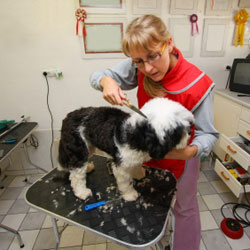
    I interviewed Kelly Booth, a local dog groomer. We talked about dog grooming as a career, some challenges she faces at work, and what she enjoys about her job.

    M: Being a dog groomer isn’t a typical occupation. When and how did you decide to pursue it as a career?

    K: I knew I wanted to work with animals, so I just started applying to pet stores and veterinary clinics. I dropped off my resume at PetSmart where the manager explained the process of becoming a groomer. I would start as a bather and, if I showed potential, they would send me to the grooming “academy” which is run by PetSmart. So this is what I did, and I’ve been doing it for about three years now.

    M: What kind of schooling is required, and how long does it take?

    K: The training I received was pretty basic. I just went to an “academy certified” PetSmart store where I was trained how to groom. This lasted about a month and we learned how to do the different cuts on the main breeds of dogs.

    M: What are some typical challenges that you face at work?

    K: As you can imagine, working with dogs is not always easy. They can be temperamental and unpredictable. The most common challenge I face is grooming dogs that are just generally uncooperative, i.e.: pulling their legs when I’m trying to brush them or groom them, not standing, squirming when I’m trying to do their nails, etc. I get bit and scratched quite a lot. It can be frustrating and scary because I’m dealing with sharp objects and it can be dangerous.

    It’s also really hard on your body. A lot of groomers end up getting carpal tunnel and back and leg problems.

    M: What is the career path for someone who has just completed their schooling?

    K: I started as a bather/brusher, which is basically just bathing and brushing out the dogs, clipping their toenails, and cleaning their ears. After about six months, I started my training. After that, I had to do a 100-dog “apprenticeship”, in which I had to groom twenty shave-downs, twenty sporting dogs, twenty short-legged terriers, twenty long-legged terriers, and twenty hand-scissor cuts. When I was finished that, I became a commissioned groomer.

    M: What are the typical earnings per dog?

    K: The earnings vary depending on the cut that the pet parent wants. For example, a simple shave down ranges from $55-$65 or $80-$90 for a hand-scissored poodle. Some larger dogs, like a Newfoundlander or an Old English Sheepdog, can be $100-$120. Commissions are typically 50-70%.

    M: What is your favourite thing about your job?

    K: I love working with animals. Sometimes we get dogs that like to give hugs and kisses. And the little puppies are always so much fun! I also really like being able to use my hands to create something. Helping the dogs feel better after being all matted is really rewarding.

  • I Want to Be a Ballerina

    I Want to Be a Ballerina

    Brooke Nagy is an 18 year old on a fast-track to becoming Canada’s next prima ballerina. Becoming a professional ballet dancer was not a decision Brooke made on a whim. It has taken a lifetime of preparation and focus. Since age three she has been classically trained in Ceccetti ballet, and has developed an advanced knowledge of both classical ballet and modern dance.

     Brooke has had the opportunity to dance professionally at many points throughout her career, but decided that it was important for her to complete her high school education before devoting herself entirely to the art. “I’ve already trained with the CanadianNational Ballet School and the Quinte Ballet School,” Brooke explains.

    “For two summers I was accepted to study as a part of the Canadian National Ballet School’s ballet-intensive summer school program, which led to the opportunity to be a part of their full-time program. I’ve also been accepted to (and attended) the Quinte Ballet School’s Summer School Program, which led to an acceptance into their full-time program” she continued.

     Ballet may well be in her blood, as her mother is a classical ballet teacher and former professional ballerina for the Miami Cityballet. Brooke intends to one day take over her mother’s dance studio, after travelling and performing as much as possible. She applied to the National Ballet of Canada’s Teacher Training program, New York’s Adelphi College and Suny Purchase College’s Conservatories of Dance and George Brown College’s prestigious dance program, garnering preliminary acceptance to all, but choosing to accept George Brown’s offer.

    The Toronto-based program will prepare her for an intensive Bachelor of Fine Arts transfer after earning her two year diploma, and set her up for work with Canada’s Ballet Jörgen, a renowned Canadian classical ballet company that selects dancers from George Brown program alumnus.

    Among the highlights of Brooke’s auditioning process was when famed Canadian dancer Frank Augustyn called her out from a class of second and third year Adelphi ballet students she was placed with, praising her grace and skill above those of professional dancers with many more years of training. She was then offered a ten thousand dollar dance scholarship for Adelphi, a tempting offer that she may return to later in her career.

    For Brooke, the choice of dance over other more job-stable programs was quite simple. “I want to be a dancer over everything else. I know that the field of dance is where I excel and where I belong.” Whether it be the National Ballet School or Frank Augustyn himself, the ballet world agrees.