Tag: dream job

  • Joining the Circus – Cirque du Soleil

    Joining the Circus – Cirque du Soleil

    Some people, such as miners, work underground. Most other people work above ground in buildings like schools, offices, and hospitals. One group of people, however, works on the ground and in the air, quickly moving from one to another. Can you think of what that job is? Acrobats are known for their skills in flying through the air and for performing great feats of balance and flexibility. Acrobats work as street performers and in circuses around the world, including the famous Cirque du Soleil.

    Becoming an acrobat starts early. The physical ability to bend over backwards or to jump high into the air can take years to develop. Joining a gymnastics club or practicing with friends is a good way to learn the skills necessary to become an acrobat. Many people also attend lessons at the National Circus School in Montreal, Quebec, where they learn how to jump, bend, and do many other tricks. Montreal is also the home of the Cirque du Soleil, one of the world’s most famous circuses.

    The Cirque du Soleil started in 1984 in Montreal with two street acrobats. Guy Laliberté and Gilles Ste-Croix were trying to earn a living by performing their acrobatic feats on the streets and at special occasions. However, making enough money was difficult, and they decided to join together with other acrobats to start a circus. The group called itself the Cirque du Soleil.

    The Cirque du Soleil is famous for being unlike any other circus. Each Cirque du Soleil performance tells a story instead of having a series of acts like other circuses. Over 1300 performers and another 3700 employees work in the Cirque du Soleil around the world. Some of them help prepare for performances or help with some of the other tasks like selling tickets. Every job helps to make the circus experience good for performers and the audience.

    Being in a circus can involve a lot of travel with mostly evening and weekend work. Salaries vary, but they are usually between $40,000 and $70,000 per year. Experience and special skills can help performers rise to the higher income level. Even at the lower levels, however, this money can go far. During the months when people are on the job, they receive free food and a place to stay. Being part of a regular circus troupe like the Cirque du Soleil can be a very career for people with the right skills.

    Not all acrobats work in a circus. Some prefer to be street performers, making a living by setting up their acts as part of outdoor festivals. This type of work gives acrobats a lot of freedom to test and try to improve their skills, at least when the weather is warm and dry enough to work. Street performance is a good way to start if you think that a career as an acrobat is right for you. Eventually, you might be able to show your skills by performing in some of the world’s greatest circuses.


  • What Should I Be?

    What Should I Be?

    With countless options available, the pool of career options may seem frightening.

    There are many ways to figure out what you want to be and many things to consider along the way.

    Firstly, what do you enjoy doing? Even if your hobbies or interests don’t seem like they would provide careers for your future, it’s a great starting point to identify the types of jobs and fields you may be interested in. Some hobbies or interests may have clear career options, like an animal lover pursuing a career as a vet or zoologist, or an artistic person becoming a graphic designer or book illustrator. Other hobbies or interests might require some additional thought. For example, if you like hockey and don’t foresee the NHL in your future, you could work in Sport Management or Sport Marketing. If you enjoy being outdoors with nature you could be an environmental technologist. The options are endless.

    It’s also important to think about what you’ll want from a career. For some people, the goal is to make as much money as possible, for others to work a job that they enjoy, and for many people a bit of both. Identifying your priorities when thinking about the future is important. For example, if you like storytelling but want to make a lot of money and work steady hours, writing novels may not be the best option. A job as a news editor or reporter may prove more fruitful, or perhaps a career in public relations. By combining what you like to do with what you want from life, you’ve made great progress toward figuring out what you want to be.

    Most importantly, remember that you don’t have to settle on a specific career right away. You may know that you want to work toward a future that will fulfill your love of history, perhaps working in a museum or teaching history, or something else. It’s important to always account for change and be open to exploring other options as your knowledge and experience grow. Your career choice is never set in stone.

    No matter what you’re going to be, you’re sure to find a future of happiness if you take the time to know what you like and what’s important to you. You don’t have to choose your career right now – just follow your heart and do what makes you happy!

  • A Trip to the Vet

    A Trip to the Vet

    Just like people, sometimes animals get sick or injured and need to see a doctor. A doctor that specializes in taking care of animals is called a veterinarian, or a vet for short.

    Most vets work in clinical practices, meaning they work directly with animals. However, some vets work doing research, teaching or work for the government.

    Dr. Jaime Buchanan is a veterinarian at the Kingston Veterinary Clinic in Kingston, Ontario. Her job is to treat animals for diseases and injuries and to inform owners of how to prevent their animals from getting sick.

    Doctor Buchanan says animals go to the vet most often because they are sick or injured. She says, “the most common problems are vomiting, diarrhea and skin problems. And some of the common injuries include: lameness (limping) and wounds or cuts.” She also says, like people, many animals have regular check-ups to make sure they are healthy. They have vaccinations, which are needles with medicine that help prevent diseases, flea treatments and de-worming.

    However, unlike people, animals can’t tell someone when they aren’t feeling well. Doctor Buchanan says, “it can be very difficult to diagnose animals because they can’t tell you how they are feeling or where they are hurt.”

    In order to figure out exactly what the problem is, she says the vet, “starts by taking a thorough history of the problem from the owner. They do a physical exam, checking the animal from head to tail. This includes looking at their teeth and gums, listening to their heart, taking their temperature and feeling their abdomen, among other things.” If the problem is not obvious, the vet may need to do further tests like blood work or X-rays to determine why the patient is sick.

    Depending on what is wrong, treatment for the animal may include going home and taking medication, like pain pills or antibiotics. Or, if they are very sick, they may need to stay in the hospital and have an IV (intravenous fluids) and be closely watched to ensure the treatment is working.
    Doctor Buchanan says some of the symptoms pet owners should watch out for are, “vomiting, diarrhea, breathing problems, skin and ear problems, and changes in water intake or urination.” She says if your animal is not eating or drinking or if they seem to have less energy than usual, call your veterinarian.

    When you take your pet to the vet, Doctor Buchanan says you can expect to see “other animals and people in the clinic. You may also see the receptionist and veterinary technician in the waiting room. In the exam room, you can watch while your pet is examined. And you may even get to listen to the animals’ heart with the stethoscope or help hold and comfort your pet.”

    The vet will explain everything step by step while they are completing your animals check-up, and Dr. Buchanan says don’t be afraid to ask questions because the Doctor will be more than happy to answer them.

    If you love animals, maybe becoming a veterinarian would be your dream job!

  • Astronauts and Chris Hadfield

    Astronauts and Chris Hadfield

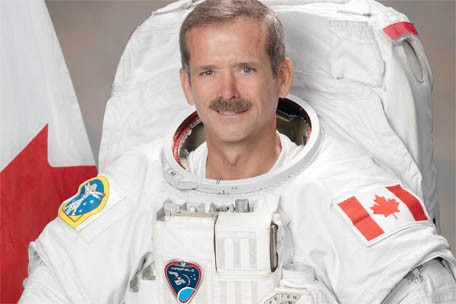
    Retirement is a good time for people for look back at what they have done over their lives and in their work. Some people’s careers never go beyond their own town or city. For other people, however, a job can take them far away, even beyond the earth. When Chris Hadfield retired from his career as an astronaut on July 3rd, 2013, he had a chance to look back on a long career in space. His most famous success was being the leader of the International Space Station. The education he received and the work he did in his early years all helped him to do well in his career as an astronaut.

    Chris Hadfield grew up on a farm in Ontario. He became interested in flying and joined the Air Cadets at a young age. During this time, he learned to operate first gliders and then regular powered airplanes. By the time he retired, he had flown over seventy different types of planes and other aircraft.

    After he finished his basic schooling, Chris Hadfield went to study at the Royal Military College in Kingston, Ontario. He completed a degree in mechanical engineering there before going on to do research at the University of Waterloo. Next, he studied at the University of Tennessee and received a Master of Science. Early in his career, he became a fighter pilot in the Canadian Armed Forces. In 1983, he received an award for best pilot in the Basic Jet Training in Moose Jaw, Saskatchewan.

    In 1992, Chris Hadfield became one of four astronauts working at the Johnson Space Center in Houston, Texas. He traveled into space several times and even helped to install a tool called the Canadarm onto the International Space Station. He worked with the Russian space program between 2001 and 2003 and later used his research skills to test the possibilities of underwater life at a station near the coast of Florida.

    In 2012, Chris Hadfield was chosen to work as the head of the International Space Station. He worked there for five months, conducting scientific experiments in areas such as gravity’s effects on humans. All the way through, he used social media sites like Twitter to tell people on earth what he was doing. He returned to earth in May 2013 and announced his retirement a month later. His official retirement began on July 3rd, 2013.

    Not all astronauts train in the same way as Chris Hadfield did, and some might never actually work in space. However, an education in one of the sciences or engineering, and also work experience, is necessary for most jobs in this field. Some knowledge of medicine is necessary since astronauts have no access to hospitals in space. Astronauts need to be in fairly good health and to be able to move to different locations for work. The pay is good, and astronauts can often have extremely varied careers. Not too mention that you get to go where few other people have ever gone before!

  • How Do I Know What to Be?

    How Do I Know What to Be?

    This is a question that you might ask yourself as a student. How do you know what to be? To figure that out, you need to think about what you like to do and what you’re good at. Maybe you’re good at painting so you might want to become an artist. Maybe you enjoy science so you might be interested in becoming a doctor. Maybe you like to play sports so you join the soccer or basketball team because you want to become an athlete as your career.

    The best part about school is that you have the opportunity to find out what you enjoy and what you are good at. Maybe you do better at certain subjects than others. This is something to keep in mind. Also join clubs. There are so many available like the art club, drama club, math club, join any you think that you would enjoy.

    Towards the end of high school is when you will really start to figure out what you want to do because you have gone through all these experiences. The best thing to do is to pursue a career that you would enjoy and will do well at so make sure you take advantage of all the opportunities that are available to you in elementary school and high school. This is your time to explore. Also if you’re not really sure what you want to go, ask your teachers and guidance counsellors. They can assist you and help guide you to the right career path.

  • I Want to Be A Robot!

    I Want to Be A Robot!

    Miss Inglis’ kindergarten class at Parliament Oak elementary school had to answer a special question this week. The question: what do you want to be when you grow up?

    The study of childhood occupation aspirations has been going on for decades and approached from many different angles. From the psychological transition of fantasy to realistic choices, to gendered influences on the traditional roles children choose.

    In a 1952 Ginzberg study, it was noted that children go through three stages in choosing occupations: “fantasy choices (before age 11); tentative choices (ages 11 to 17); and realistic choices (ages 17 to young adulthood).”

    Parliament Oak kindergartener Jack wants to be a robot. Maddie wants to be a rock star and James wants to be a spy.

    These children’s choices are fantastical. But as the workforce in Canada shifts towards the service industry and technological occupations, even a mail carrier may soon be considered a fantasy career choice.

    However, some career choices will stand the test of time. For example, kindergartener Ciaran wants to be an animal scientist, and Alexander wants to be a doctor. Career choices in science are likely to continue to be in high demand despite rapid changes in technology.

    Gender influences noted by scientists Levy, Sadovsky, Troseth, and Stroeher determined that early in life, especially from ages four to seven, young boys and girls are likely to choose traditionally male or female careers.

    This was a very common theme in Mrs. Inglis’ class; Oskar wanted to be a soccer player, Brian a policeman, Sophie a hair stylist, and Katherine a bride. However, social psychologists Garrett and Tremaine reported, “as children get older, they tend to be more flexible in choosing non-stereotyped careers”.

    An interesting aspect of these studies done in the 1970s is that boys reported to have double the amount of fantastical career choices than young girls. Garrett and Tremaine’s research noted, “girls learn early on that few adult vocations are open to them.”

    Today, we are living in the crossover effect of male/female college enrolment rates. According to the Population Reference Bureau organization, it officially occurred in 1993 and now leaves males seven percentage points behind females when it comes to college populations.  This change improves the likelihood of female success in the workplace and increases their vocational opportunities.

    Mrs. Inglis’ class did not reflect that change, with boys and girls averaging at very similar amounts of choices. The students are set to graduate this week, and it will be neat to see what they will become, and who will find success in the workforce of the future. My money is on the robot kid, but only time will tell.