Author: author below

  • University: The Online Learning Edition

    University: The Online Learning Edition

    By Maryam Sheikh

    Earlier this year, many universities made the difficult decision to close campuses and opt for online learning for the Fall 2020 semester. Students across the province had to scramble in order  to make arrangements; some, like international students, flying back home for the semester, and others, managing leases and leaving student homes.

    These decisions have been received differently by students. For most, distance learning is not an ideal; some areas have limited access to the Internet, a tool that schools are heavily depending on for these upcoming semesters. Furthermore, the pandemic has caused a significant decrease in job opportunities, especially for students, so financing post-secondary education has come up as a large concern. Lastly, many students fear that the quality of their education will be impacted; with no office hours, in person study groups, or extracurricular activities running, the school year will look drastically different from most others. For these reasons, some students have chosen to take a gap year and start their university journeys when a more conventional experience is possible. Others have braced themselves for the journey.

    Schools across the country are coping differently. Some small classes, such as specialized upper year courses, are being held in person while upholding social distancing and safety precautions. Other classes are being offered through online platforms such as Zoom, with hundreds of students tuning in for their lectures. On the flip side, some courses are being offered without any synchronous components- instead, students are required to complete courses at their own pace.

    This has been an interesting and difficult time to navigate. Online forums, social media accounts, and news articles have shed light on the hectic and busy experience the first week has brought. Incoming students have gone from a virtual welcome week full of upper year mentors to being thrust into full course loads of classes, attempting to navigate their online university learning platforms.

    Now that the year has started and these plans have been put into place, faculty members and educators can get a real glimpse of how students are coping with this new reality. In talking to peers, I’ve heard mixed responses. Some students are grateful for the extra time they have gained (with commuting no longer in the picture), access to their professors through online meetings, and more time to study without distractions. Others have said that they’ve struggled to find social groups, maintain focus on long Zoom calls, and keep up with a study schedule at home. It has also been difficult for students to get used to university life and expectations with no in-person guidance. However, many professors have been helpful and understanding. They have acknowledged that this semester will be successful only if everyone is cooperative and supportive.

    Throughout this time, I advise everyone- first year students and upper years alike- to use support networks, reach out for help, and remember that we are all in this together. It will definitely be a unique transition, but with planning in advance, prioritizing wellbeing and safety, and trying our best to remain steadfast in the face of obstacles, we will triumph through this year. I’m rooting for you all!


  • Switching Gears and Changing Careers

    Switching Gears and Changing Careers

    By Erin Rebello

    With all the uncertainty that COVID-19 has brought within the past few months, students have been rethinking the careers they want to pursue. If this sounds anything like you, rest assured that you’re not alone! It is very natural for students to have second thoughts about their potential career paths, especially during something as impactful as a pandemic!

    With the wide scope of COVID’s impact, many families have been financially hurt by the country-wide lockdowns put in place to stop the spread of the virus. Whether a family business went out of business, or a parent lost their job, some students are reconsidering how stable their future careers are. Although it might have been a student’s dream to study hairstyling and cosmetology, it’s difficult to ignore how hairdressers were unable to earn income during the pandemic. For many people, job security and stability is a top priority, which might be just enough to influence students to change careers.

    Another reason someone might change careers is due to the technological switch. Although it has been happening gradually over the past few years, the pandemic caused many companies to switch to online and technology-based models in only a couple of months. As a result, many jobs are popping up that require technological proficiency, meaning that studying technology is more important than ever! There is a huge demand in the workforce for science and technology workers, meaning more jobs and higher-paying jobs! This industry also shows promise of expanding rapidly over the next decades, meaning that it would be a very safe and secure industry to pursue a career.

    This pandemic might also cause students to consider whether or not their potential career would be something they enjoy pursuing. After seeing so many people work from home, including their own parents, a student might realize that a corporate job isn’t for them, and that they would instead prefer to become an entrepreneur and work for themselves. Coupled with the fact that many students have seen their friends and families let go from their jobs, students may realize that working for themselves gives them more autonomy, flexibility, and even security.

    Although the thought of choosing a career may strike fear in a student’s heart, it’s important to remember that jobs and careers don’t have to be permanent. Over the course of a lifetime, people change and grow, resulting in career changes that range anywhere from a simple promotion to a complete industry switch. This is perfectly normal. Although it’s important to think long and hard about the field you would like to pursue, don’t beat yourself up about it! If you realize that you’re not as satisfied with your careers as you thought you would be, you can always go back to school to grow your skillset. In fact, with the instability in the current job market, many workers are going back to school to study and start in a new industry! Jobs and careers can change in an instant, and it’s completely up to you!

    Overall, the pandemic and closure of schools have allowed many students the opportunity to ponder deeply about whether their ‘dream career’ is actually something that they would want to pursue. With rapid changes in the economic climate in the past months, it’s important to really analyze if a career is stable, in-demand, and fulfilling. Although it can be scary to consider changing your mind on something as important as a career, it’s important to remember that if you choose a career it’s not set in stone and that you can always change your mind!

  • The Benefits of Online Learning

    The Benefits of Online Learning

    By Erin Rebello

    Although at first the switch to e-learning can be daunting and difficult, when you really think about it, there are a lot of benefits of learning from home! Below is a list of just a few benefits that you can expect when taking an online class!

    1. You can learn in the comfort of your own home: Of all the benefits on this list, the privilege of studying in one’s own home is perhaps the greatest advantage for students- especially those in high school! Instead of sitting on a stiff plastic chair and watching a blackboard for six hours, you can bundle up in blankets and keep up with Zoom meetings from your couch, or bed, or kitchen, or anywhere! As an added bonus for students who attend schools with uniforms, you probably don’t need uniforms for e-learning. That’s right, you can take a video call in sweats and a t-shirt and not get in trouble!
    2. You don’t have to commute anywhere: Another huge benefit of e-learning for students who live far away from school is the fact that you don’t have to spend time commuting. This is especially true for students who take public transit or have a long drive to school. As someone who lives over an hour away from school, I have to say that I absolutely love this benefit! It gives me back over two hours daily and prevents me from coming into close contact with strangers on crowded TTC busses, which is a huge priority for me during these times.
    3. E-Learning is far more flexible than a normal school: For students who like to work independently and at their own pace, e-learning is extremely convenient! Many e-learning classes, especially those which are purely asynchronous, allow for students to complete tasks and modules at a pace that works for them. If you tend to work at a faster pace, you might find that this sort of learning allows you to work faster and more efficiently. Many students strive when given a sense of independence of their work, and if this describes you, you’ll probably love the way distance learning is coordinated.
    4. Gaining valuable computer skills: A final benefit of e-learning would have to be the fact that it teaches you how to utilize various computer applications. We currently live in the pinnacle of the technological era, meaning that technological literacy is as important as ever! Learning to use applications such as Zoom, Google Meet, Brightspace, etc will help you both in post-secondary studies and the workplace. The ability to work with new applications makes you a more employable worker and is also very helpful in general!


  • My Online Learning Experience: Erin Rebello

    My Online Learning Experience: Erin Rebello

    By Erin Rebello

    On Friday, March 13, millions of students across Canada left schools for an extended March break. Like many others, I was excited about the 3-week break, and couldn’t wait to kick back and lounge around my house. What I certainly didn’t expect was to leave school for half a year, only to be tossed into the unfamiliar waters known as “e-learning”. While in theory, online learning seemed easy and fun, I had a very mixed experience.

    The Good

    I’d like to start on a positive note and discuss my good experiences with e-learning in the past year. For starters, I liked that I was able to work in the comfort of my own home. My school board also didn’t use Zoom or any synchronous learning platforms which meant no meetings or in-person classes. As an introvert and someone who likes to sleep in, this was quite the treat… at least at first, but more on that later!

    My school is a part of a Catholic school board meaning that we usually follow a strict uniform, which can be stuffy and uncomfortable. Without daily meetings, there was no need for a restrictive uniform, and I was able to complete my schoolwork in clothing that I liked. This was definitely a game-changer and made studying feel less stiff and boring.

    Another huge advantage of e-learning was the fact that I didn’t have to commute to school! As someone who lives over an hour away from school, the daily bus rides can quickly add up, eating into my free time. By subtracting over 2 hours from my daily commute, I was left with more time to complete assignments, relax, and even pursue my extra-curricular interests.

    Finally, the last benefit of the switch to e-learning was the lightened workload. As declared by the government of Ontario, secondary school teachers could not assign more than 1.5 hours of work per course per week for non-semestered students. As a student taking 7 courses, this meant that I only had to complete 10.5 hours of work a week, which is quite manageable when you think about it. My school board also cancelled all exams, replacing them with cumulative projects instead. As someone who stresses excessively over tests and exams, this change was certainly a relief.

    The Bad

    While some of my experience with e-learning was very positive, it would be dishonest if I didn’t also disclose my negative experiences. Considering how little time teachers were given to prepare e-learning material for students, it’s understandable that there were more than a few flaws.

    As mentioned earlier, although it was fun to work from home initially, I found it to be very problematic over time. As someone who has trouble focusing on schoolwork, the comfort of working at home soon melted into an inability to complete assignments. Without the physical environment and structure of school, e-learning simply didn’t feel real. I felt lost, and it was as though my assignments had no meaning or importance. As a result, I fell behind in my work at first.

    Another huge issue was being suffocated by family while simultaneously feeling disconnected from my friends. Although I love my family and can usually tolerate my little sister’s antics, being cooped up with them 24/7 for the past few months has definitely been draining, and I miss my friends. School used to be a way for me to connect with my friends, however, e-learning has shifted most of my communications online, removing the daily social interactions that typically brought me immense joy. Coupled with several other factors, this has definitely taken quite a toll on my mental health.

    Finally, although the course material was adapted to be more digestible, switching to e-learning meant that many key topics were cut out to meet with official guidelines and be manageable for students. Although I am thankful for such consideration, I’m already worrying that I won’t know enough material from grade 11 to thrive in my grade 12 courses.

    Looking Forward

    In conclusion, my experience with e-learning over the past few months has been very mixed, with both positive and negative aspects. Although I do have some worries when going back to school, I’m optimistic for a better learning experience in these next few months. During the summer the school board (along with teachers) have had the much needed time to adapt the curriculum for both e-learning and hybrid learning. On a more personal level, I have also grown more familiar with e-learning platforms and have developed an ability to focus better in e-learning classes. All things considered, I’m excited to start the new school year and continue my e-learning experience.

  • My Online Learning Experience: Elora Pharai

    My Online Learning Experience: Elora Pharai

    It is that time of year again: back to school.  During this time, I would usually find myself picking out a new backpack, restocking my pencil case, and organizing my binders. However, this year preparing for back to school looks drastically different. In March, it was announced that schools would be closing across the world to diminish the number of cases in the ongoing Covid-19 pandemic. Finally, after 4 months of doing online schooling, the summer arrived. I spent 2 months bored out of my mind as I was mostly limited to the four walls of my bedroom.  At one point I would have given anything to have something to do, including schoolwork. However, as I find back to school approaching with each passing day, I am growing more and more apprehensive. As stated before, back to school this year looks most unlike any other year, since we must adjust to the pandemic. This time, students are being given the option to return to school or not. If not, they will do full-time online learning.

    I have chosen to do online school this year. Based on the 4 months that I did online schooling, I noticed that I work a lot harder and put more effort into my work. When I am at home, I tend to feel more confident in myself and my work for I feel less anxious. Each week, my teachers would assign the work at the beginning of the week and place deadlines within the week for certain assignments to be due. This suited me better as a student because it gave me time to plan out when I am doing which assignment. I also noticed that being in my home allowed me to become a lot more inventive and prolific with my work. While my online schooling experience did have many positive aspects, there were also some that I found to be challenging. Some days I found it difficult to focus on my work as I would easily get distracted by my phone or background noises. Sometimes, I also found myself feeling unmotivated and drained. Long story short, it is never an easy task to convert your kitchen into a classroom. However, there were many mechanisms and techniques that I followed to help make the negative parts of my online schooling slightly easier. I have included the ones that I found to be the most efficient below.

    Create a Comfortable yet Appropriate Workspace: One of the most important parts of home-schooling is finding a spot in your home that is quiet and non-distracting, yet enjoyable. As students, we have become so accustomed to doing work in our usual school settings. In my experience, I worked at the kitchen table because there was a lot of room on the table for me to spread my work, and it was like working at a desk. Personally, I have never been able to do my homework in my bedroom because I get too easily distracted by everything in it.

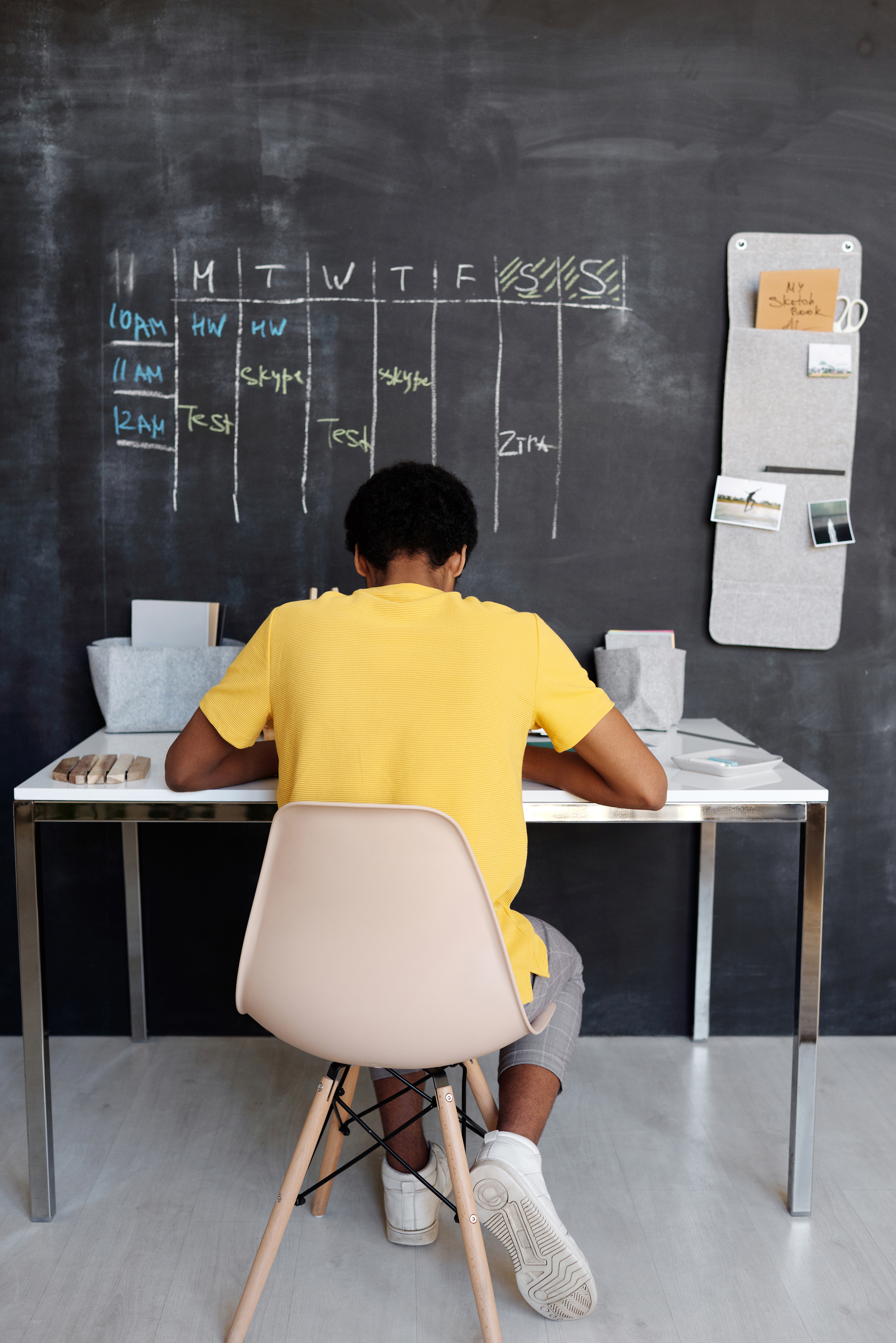
    Construct a Schedule: Homeschooling is also difficult as it is harder to make yourself follow a routine/schedule. Sometimes, everyday feels like it is the weekend when you have been home for so long. To train myself, I started by creating a daily to-do list of all the assignments that I planned to have finished by the end of the day.  I would set my alarm in the morning depending on how much work I had to do that day so that I would not be too cranky. Sometimes I would set time deadlines for myself so that I did not pay too much attention to one assignment and forgot about the other. I also found that creating a calendar to help me keep up with all my work and remember all my due dates was very helpful.

    Take Breaks! I have never been much of a person to take breaks. Before quarantine, I used to come home from school, shower, and then do my homework. After that was done, then I relaxed. I never felt the need to take a break, I became so accustomed to having that same routine. However, during quarantine, I noticed how important taking breaks was. I would do work for hours, and I felt hesitant to take breaks because I was so used to just doing hours of work straight. Taking breaks is extremely important as they allow you to relax a little and recharge for the rest of the work that you must do. They can also be helpful in allowing you to clear your head or even take a small nap.

    Take Care of Your Mental Health: From an outside perspective, home-schooling may look easy. Regardless, sometimes it can be challenging to keep up with everything and you start to feel overwhelmed. We tend to think that because all we must do is stay home; everything will just be easier. Nonetheless, we must remember that bad days are not just going to stop happening because we are staying in the same spot. Sometimes, things just feel bad even when they seem perfect. It is perfectly normal to have a bad day and to not always feel 100% like yourself. Remember that you must be gentle and patient with yourself.

  • A Changing World Online and Offline

    A Changing World Online and Offline

    Welcome back, Everyone!

    You might be reading this right now, still, from your kitchen or living room, or nicely done-up school office. Maybe you have chosen to do half of your school time in person and the other, at home. These are the very likely scenarios faced by most students in Canada right now. You have all been through so much change, it is hard to believe! But, you are in it and serve as living proof that change and adaptation is possible in any circumstance. In this JPD issue, we have a series of other students sharing their ONLINE LEARNING experiences and what it is like for them, personally. Those articles discuss important things like what we might be missing out on if we only stick to online learning. There are many pros and cons to online learning, and some students and teachers are still trying to get the hang of it. We’ll all get there!

    Some Articles of Note:

     Campus Life: How to Form and Online Study Group- Maria Cruz

    Featured Articles: My Online Learning Experience- Elora Pharai

    Campus Life: What We Loose if We Only Do Online Learning– Alona Fiandaca

    Campus Life: Switching Gears and Changing Careers– Erin Rebello

     Community: Job Market Challenges and Opportunities for the Differently Abled in the COVID 19 Era– Anthony Teles


    Stay Safe,

    Erin Kelly

    Content Editor

  • Les raisons pour lesquelles nous sommes tous importants pendant ce temps de COVID-19 et au-delà

    Le confinement, les morts et le désastre économique de la COVID-19 peuvent être écrasants. Au cœur d’une crise gigantesque planétaire qui a amené le monde à genoux, ça peut être difficile de savoir quoi faire. Tant d’entre nous se sentent négligeables. C’est surtout le cas de ceux qui souffrent d’incapacités physiques et mentales. Et pourtant, c’est dans cette lutte commune que vous et moi trouvons un but. Vous êtes important parce que tout le monde est important et dans ce moment où l’on nous demande de rester séparés, nous ne pouvons traverser cette crise qu’ensemble.

    La compassion pour soi-même est toujours importante, surtout pour ceux qui combattent l’anxiété et la dépression. C’est encore plus essentiel maintenant. La fondation Recherche en santé mentale Canada a indiqué que le nombre de Canadiens ayant un haut niveau d’anxiété a quadruplé de 5 % à 20 % à cause de la pandémie. Les cas de dépression que les personnes rapportent ont augmenté de 4 % à 10 %. Vous êtes loin d’être seul. Pensez aux mots que vous avez besoin d’entendre tout de suite pour vous rassurer de votre importance. Dans un endroit calme et réconfortant, placez une main sur votre poitrine et prenez de lentes respirations. Pratiquez la pleine conscience en vous rendant très conscient du moment présent et méditez pour calmer votre esprit. Vos pensées négatives sont normales. En les abordant honnêtement et avec de la compassion pour vous-même, vous pouvez, à votre tour, aider les autres dans le besoin.

    Même dans ces temps de distanciation sociale, vous avez une influence considérable sur les gens autour de vous. Les conditions physiques et mentales ne changent rien. De plus en plus de gens renoncent au matérialisme et font des randonnées auxquelles les personnes ayant des incapacités ne peuvent prendre part, au bénéfice d’appels téléphoniques à des amis et des visites à la famille en étant séparés de deux mètres. Dans ces moments difficiles, ces contacts se révèlent précieux, quelle que soit votre condition mentale ou physique. Appelez ou envoyez un texte aux personnes de votre vie, qui seront contentes que vous leur donniez des nouvelles. Parlez ensemble de ce que vous éprouvez ; au lieu de discuter principalement de la COVID-19, comme tous les gros titres, concentrez-vous sur les émotions et les défis personnels. Ce sont de petites démarches que nous pouvons tous prendre pour aider le monde en ce moment difficile.

    Il y a, mondialement, environ 15 % de personnes qui vivent avec une incapacité. Beaucoup d’entre elles ont des problèmes médicaux qui augmentent leur fragilité face à la COVID-19. Le manque de politiques gouvernementales rend difficile l’accès au soutien dont elles ont besoin. Lorsque vous vous rendez compte de votre importance et tendez la main aux autres, vous nous aidez à promouvoir une plus grande inclusion dans les mesures prises par le gouvernement. Les gens se portent volontaires dans des condos ou dans leur voisinage pour tenir compagnie aux autres et les aider à obtenir les soins médicaux dont ils ont besoin. Rien de tout cela n’est possible avec une seule personne. Que vous offriez du soutien émotionnel, de l’aide à ceux qui ont une incapacité ou que vous receviez de l’aide pour votre situation physique ou mentale, vous apportez votre contribution pour promouvoir une plus grande inclusion et de meilleurs programmes gouvernementaux qui nous aident tous.

    Beaucoup d’entre nous se battent avec notre estime de soi. Une incapacité physique ou mentale rend plus difficile le sentiment que vous êtes important. Mais, la réponse à la pandémie de la COVID-19 a prouvé la valeur des mots et les actions individuelles. De nos familles à ceux qui vivent seuls, nous avons tous besoin les uns des autres pour traverser cette crise. Soit, nous avons tous de l’importance soit, personne d’entre nous n’importe. Vous devez faire un effort conscient de choisir la première option. Prenez conscience de votre importance, gardez le contact avec vos amis et votre famille et apportez votre part à la construction d’un monde meilleur.

    Sources

    Ferreira, Jennifer. “Valuing people and slowing down: Lessons learned during the COVID-19 pandemic.” CTV News. https://www.ctvnews.ca/health/coronavirus/valuing-people-and-slowing-down-lessons-learned-during-the-covid-19-pandemic-1.4945522

    Kinder, Michelle. “You Matter: Self-Compassion During COVID-19.” Thrive Global. https://thriveglobal.com/stories/you-matter-self-compassion-during-covid-19/

    Root, Rebecca. “How to ensure a disability-inclusive response to COVID-19.” Devex. https://www.devex.com/news/how-to-ensure-a-disability-inclusive-response-to-covid-19-97134

    Slaughter, Graham. “Anxiety and depression have spiked among Canadians: survey.” CTV News. https://www.ctvnews.ca/health/coronavirus/anxiety-and-depression-have-spiked-among-canadians-survey-1.4919741

  • Qui est le plus touché par la COVID-19 ?

    Avec toutes ces fausses informations qui circulent sur la COVID-19, c’est facile d’être embrouillé. Certains sont paniqués alors que d’autres pensent que c’est une supercherie et ne s’en soucient pas. Cependant, si nous prenons un peu de recul et vérifions les statistiques et les faits, nous avons une meilleure idée de la situation.

    Une question que beaucoup de gens se posent est de savoir s’ils vont attraper ou non le coronavirus et quels en sont les effets. Les prévisions approximatives datant de la mi-mars indiquent qu’entre 30 et 70 % de la population attraperont le coronavirus à un moment donné. Mais, avant de paniquer et d’avoir peur pour votre vie, c’est important de se souvenir que la plupart des cas de coronavirus sont très modérés. En fait, il se pourrait que vous ne sachiez même pas que vous l’ayez parce qu’il y a peu ou pas de symptômes. Même si vous soupirez sans doute de soulagement, le virus est invisible, plus difficile à détecter et c’est plus compliqué de protéger les personnes vulnérables. Donc, nous DEVONS faire attention et respecter les mesures émises par les dirigeants des professionnels de la santé du pays. Vous devez comprendre que ce qui est bon pour vous ne l’est pas forcément pour les autres.

    Qui sont les personnes les plus susceptibles d’attraper la COVID-19 ? Eh bien, il y a deux groupes : les malades et les personnes âgées. Pourtant, ce n’est pas si simple ; par exemple, les personnes dont le système immunitaire est affaibli, qui ont de l’asthme ou des complications des poumons, ont plus de risques d’être touchées par le virus. Nous en apprenons davantage tous les jours sur ce virus. Si vous vous tenez au courant des dernières nouvelles, vous savez probablement que ceux qui deviennent les plus malades ont tendance à être plus âgés. En fait, le gouvernement canadien place les personnes plus âgées parmi les plus vulnérables. Comme la COVID-19 est un type de virus, un système immunitaire affaibli par des maladies comme le cancer, les maladies cardiaques ou les problèmes respiratoires fait que le corps ne peut pas se battre contre le virus aussi bien qu’une personne en bonne santé. Par conséquent, ces deux groupes sont très fragiles par rapport à la COVID-19 et nous devons veiller sur eux et les garder en sécurité. Cependant, tout le monde, quelle que soit son origine et même les personnes en bonne santé peuvent attraper le virus qui est imprévisible.

    Deux autres groupes qui sont très exposés sont les spécialistes de la santé et les travailleurs essentiels. Avec les hôpitaux qui débordent et le nombre croissant de cas, c’est certain que les travailleurs des soins de santé sont le groupe le plus à risque. En outre, vu les préparations et les fournitures insuffisantes, beaucoup de médecins et d’infirmières doivent traiter les patients avec de l’ÉPP inadapté. En conséquence, les médecins sont forcés de mettre leur vie en danger chaque fois qu’ils soignent un patient atteint du coronavirus. Un autre groupe souvent oublié est celui des travailleurs essentiels y compris les caissiers, les serveurs, les livreurs de repas, les facteurs, les conducteurs de bus et d’autres encore. Bien que nous négligions ces employés, nous ne pourrions sans doute pas vivre sans eux. C’est pourquoi ils continuent de travailler dans leurs communautés et sont bien plus exposés au virus que la population générale.

    Si vous ne vous trouvez pas dans ces groupes à risque, vous vous demandez probablement ce que vous pourriez faire pour aider. La meilleure façon d’aider à arrêter la progression du virus est de rester chez vous et pratiquer la distanciation sociale et l’hygiène personnelle. Ne sortez que si vous en avez absolument besoin et même à ce moment-là, faire attention à vos actions. Avec quelques mesures et précautions simples, vous pouvez contribuer à éviter que les personnes vulnérables ne deviennent malades. Restez à la maison. Sauvez des vies.

    Sources :

    https://www.canada.ca/en/public-health/services/publications/diseases-conditions/vulnerable-populations-covid-19.html

    https://www.theglobeandmail.com/canada/article-between-30-and-70-per-cent-of-canadians-could-be-infected-with/

  • Le secteur du pétrole et la COVID-19

    La pandémie de la COVID-19 est un moment charnière dans notre histoire. L’une des plus grandes conséquences a été et sera dans le domaine de l’énergie. Beaucoup de gens remettent en question le futur du pétrole et du gaz, ainsi que l’émergence des énergies renouvelables et la COVID-19 pourrait être un accélérateur pour la révolution énergétique. Mais, le futur de l’énergie est loin d’être clair. Il y a beaucoup d’aspects économiques, politiques et environnementaux en jeu dans le monde du pétrole et des énergies renouvelables.

    Le déclenchement de la pandémie a fait chuter les prix du pétrole et les économies se sont immobilisées. De nombreux emplois sont en télétravail, mais la Dallas Fed a indiqué que plus de 60 % de la main-d’œuvre ne peut pas travailler à distance. Beaucoup de personnes ont été mises à pied ou en congé et ne savent ce qu’il se passera pour elles par la suite. Il existe de nombreux exemples d’entreprises, y compris la Royal Dutch Shell, qui ont réduit leurs activités de raffinement de 40 %. Les investisseurs ont dû réévaluer le risque de financer le pétrole et le gaz. Cela pourrait provoquer des changements considérables pour le futur du secteur.

    Les compagnies de pétrole et les autres marchés se préparent à un ralentissement économique important et à une réduction des activités qui ne se redresseront pas avant 2021 ou après. Les entreprises vont se réorganiser en fermant des sites et en licenciant des employés. On prévoit que la pandémie aidera la transition vers des énergies vertes. Comme plus d’entreprises choisissent de mettre leurs employés en télétravail, la demande en carburant diminue. Dans les années à venir, les gouvernements fourniront des incitations pour aider les entreprises ; beaucoup de financement pourrait être détourné du pétrole vers les énergies renouvelables.

    Le passage du pétrole vers les énergies renouvelables se fait depuis des années quoique très lentement. Néanmoins, le monde est très loin des objectifs de l’Accord de Paris sur le climat, nécessaires pour diminuer les dommages causés par la crise climatique. La COVID-19 pourrait aider à dynamiser les progrès vers ces cibles. D’un côté, avec les économies qui commencent à rouvrir, les gouvernements fourniront des incitations pour aider les entreprises à se maintenir à flot. Beaucoup de ces incitations pourraient être détournées du pétrole vers les énergies renouvelables.

    En revanche, le pétrole et le gaz restent les sources d’énergie principales pour les véhicules, le chauffage et d’autres aspects de la vie quotidienne. Lorsque le transport ordinaire, les vols commerciaux et d’autres activités reprendront, les faibles coûts du pétrole pourraient encourager les entreprises à avoir recours aux sources d’énergie qu’elles connaissent. Le secteur de l’énergie propre affronte aussi des difficultés économiques et ces organismes ont des coûts importants pour monter et entretenir des éoliennes, des panneaux solaires et d’autres. Comme la récession économique entraîne une augmentation des dettes, ça sera plus dur d’investir dans ces projets.

    Même avec la diminution des émissions de carbone, causée par la pandémie de la COVID-19, le monde est encore loin des réductions nécessaires pour éviter une catastrophe. On a besoin de changements majeurs et le secteur des hydrocarbures ne peut pas continuer à long terme. Avec la conscientisation grandissante de l’urgence d’avoir des énergies renouvelables, c’est le moment d’investir dans des énergies vertes et de rechercher des emplois verts. L’humanité ne peut pas se permettre de faire autrement. En fin de compte, la pandémie de la COVID-19 pâlira en comparaison de la crise du climat.

    Sources:

    Bakx, Kyle. “COVID-19 wipes out demand for fossil fuels – will they bounce back?” CBC. https://www.cbc.ca/news/business/covid-19-oil-gas-energy-transition-1.5552794

    Clemente, Jude. “Why U.S. And Natural Gas Demand Will Rebound From Coronavirus.” Forbes. https://www.forbes.com/sites/judeclemente/2020/05/17/why-us-oil-and-natural-gas-demand-will-rebound-from-covid-19/#77663156a065

    Lorinc, Jacob. “COVID-19 brought the oil business to its knees. Is it time for investors to turn to clean energy?” The Star. https://www.thestar.com/business/personal_finance/2020/04/27/covid-19-brought-the-oil-business-to-its-knees-is-it-time-for-investors-to-turn-to-clean-energy.html

  • Les métiers Survivre à la COVID-19 – le secteur canadien de la construction va de l’avant

    On ne peut pas nier que la construction est un acteur important dans l’économie canadienne, employant plus de 1,2 million d’hommes et de femmes. En plus, c’est un secteur qui peut résister aux défis économiques, comme il l’a démontré en 2008, lorsque le taux d’emplois a diminué au Canada et dans d’autres parties du monde, à cause de la récession. Même quand il a été touché, chutant de 5,7 %, il a continué et s’est redressé en 2010.

    Selon Statistiques Canada, les industries canadiennes de la construction — résidentielles, non-résidentielles, l’ingénierie, la réparation et d’autres services de la construction — représentent 6,0 % du produit intérieur brut (PIB), rapportant la somme énorme de 73,8 milliards $. Parallèlement, ceux qui sont employés dans ce secteur font partie des mieux payés dans l’industrie des métiers spécialisés, avec les responsables de projets qui reçoivent la plus grande part, gagnant en moyenne de 74 883 $ par année, avec des possibilités de boni, d’intéressements et des commissions.

    Récemment, au Canada, des mesures visant à construire des infrastructures plus écologiques et augmenter la préparation du pays aux effets des changements climatiques ont été engagées. En plus, le gouvernement du Canada a fait part de son intention de développer des améliorations écoénergétiques et des systèmes de sentiers polyvalents dans tout le pays. Tous ces aménagements permettent au secteur de la construction d’être un élément essentiel pour maintenir l’économie canadienne en vie pendant la pandémie.

    Cependant, le domaine de la construction n’est pas totalement imbattable face aux effets de la COVID-19. Comme n’importe quelle autre industrie, il a fallu faire des ajustements nécessaires pour s’assurer que les travailleurs restent en sécurité et en santé pendant qu’ils terminent les projets de construction selon les dates limites et le cahier des charges.

    Des retards

    Après que le nouveau coronavirus ait été déclaré une pandémie et que des restrictions physiques aient été implantées à travers tout le pays, de nombreux employés qui travaillent dans les secteurs jugés essentiels ont fait part de leurs inquiétudes pour garder leur santé et leur sécurité au travail. Cela inclut les travailleurs de la construction qui s’alarmaient de la possible transmission de la maladie puisque les chantiers de construction ne fournissent pas toujours le choix de distanciation physique en raison de la nature même des tâches à effectuer.

    En conséquence, certaines entreprises de construction ont mis leur travail en suspens, puisque la santé et la sécurité des travailleurs sont une priorité. Lorsque les restrictions de distanciation physiques ont été progressivement levées, les entreprises ont repris leurs chantiers tout en s’assurant que leurs employés sont protégés et loin du danger causé par le virus en leur fournissant un équipement de protection physique (ÉPP).

    Les risques du travail

    Bien sûr, le secteur de la construction n’a pas exactement un environnement exempt de risques et de dangers. En fait, selon Statistiques Canada, les travailleurs de la construction subissent trois à quatre fois plus d’accidents que les travailleurs de n’importe quel autre domaine.

    Les travailleurs de la construction sont exposés à une longue liste de risques quotidiennement, y compris un accès confiné, le travail en hauteur, l’insécurité électrique, le travail dans des conditions extrêmes, l’utilisation d’outils et d’équipement et autres. Maintenant, il faut ajouter un autre danger, la COVD-19.

    Cela rend les mesures de sécurité encore plus importantes tout en y incorporant de nouvelles instructions pour des méthodes exemplaires. En plus, les entrepreneurs devront se tenir au courant des instructions liées à la COVID-19 émises par les autorités locales de santé.

    Il n’y a pas de doute que le travail de la construction est physiquement épuisant. Maintenant, avec la menace de la COVID-19, les entrepreneurs devront être conscients de la grosse charge de l’encadrement des habitudes de santé et de sécurité pour s’assurer que les ouvriers évitent les dangers, les blessures du travail et le virus. D’après ce qui se fait jusqu’à présent, il semble qu’ils soient bien préparés et prêts. S’ils ne le sont pas, les travailleurs en subiront les conséquences et les projets seront encore plus retardés ou pourraient même disparaître. Si vous décidez de travailler comme apprenti dans les métiers, cet été, assurez-vous de tenir compte des risques sanitaires et signalez-les si vous en voyez.

    SOURCES

     https://www.spi-s.com/en/blog/ohs-leadership/construction-workers-3-or-4-times-more-accidents

    https://canada.constructconnect.com/dcn/news/economic/2020/05/horrendous-april-labor-market-stats-for-u-s-canada

    https://www.mondaq.com/canada/construction-planning/935110/legal-update-covid-19-construction

    https://www.payscale.com/research/CA/Job=Project_Manager%2C_Construction/Salary

    https://www150.statcan.gc.ca/n1/pub/11-402-x/2011000/chap/construction/construction-eng.htm