
Author: Laura Sciarpelletti

  • Getting Rid of Toxic People for your Health

    Getting Rid of Toxic People for your Health

    For some reason, we all end up spending time with people we shouldn’t. Some would consider these people “toxic” to our mental health. Or maybe you are that toxic person for some people. But for the time being let’s focus on those in your life who mess with your bliss. Toxic individuals can distract you from your wants and needs, goals and ambitions, and challenge your health. This keeps you in a cycle of unhappiness and stress and that can have serious mental, emotional and physical ramifications. So how do we kick those toxic folks to the curb?

    Narrow down who is actually toxic in your life

    Toxic people are not those who are simply a bit of a drag and depressive. These people may just be generally undesirable to you. You may want to create a bit of distance with those people too, but there isn’t an urgency to cut them out of your life, exactly. In general, truly toxic people exhibit the following: they try to control and manipulate you, disregard and disrespect your boundaries, take a lot and give very little or not at all, insist that they are always right no matter what, have a general air of dishonesty, enjoy and even savor being the victim, and they never take responsibility for their actions.

    Why getting rid of toxic people is so important

    Have a few people popped up in your mind now that you have gone through the above list? If so, these people are draining you and are making it difficult for you to focus on what you need. In truth, very rarely do toxic people totally ruin your chances for self-improvement. But they make it so hard and no one likes to progress slowly. In the end, you want someone who is going to make your life better not harder. Toxicity is contagious; that kind of mentality and behaviour can spread and you do not want to catch it. Negativity is way more infectious than positivity. Therefore removing toxic people from your life is crucial.

    How to remove toxic people

    This should always be done with a lot of thought and finesse. Accept that it might be a process and understand that distancing yourself from a toxic person is a gradual process. Never feel like you owe them a big explanation. Keep it simple and tell them kindly how you feel and why you are doing what you’re doing. Talk to them in a public place so that they do not get physically angry or act out and block them on social media. This last part might seem harsh, but it is necessary for you to clean out the toxins in your life and be able to think more freely. Try not to argue and simply restate your boundaries and distance your self from the person. In the end, distance instead of separation may be all you need, but trust your feelings (as the Jedi would say), and go with what you know your heart and mind need.

  • The Mental Illness Fight

    The Mental Illness Fight

    As it diminishes in its status as a taboo topic, the conversation surrounding mental health is gaining momentum. Struggles faced by people of all ages are in the spotlight. The ever-increasing pressures and troubles of teenagers and young adults are more and more apparent. Anxiety and depression are on the rise. Thoughts of suicide abound. Futures appear increasingly dire. Yet as mental health becomes an alarming concern, so too has the response become a more powerful force.

    Many disorders first become apparent for youth aged 18 to 24, and approximately 80 percent of Ontario residents in that age bracket are enrolled in universities or colleges. A recent study by the Ontario University and College Health Association (OUCHA) found that 65 percent of students felt overwhelmed by anxiety and 46 percent were so depressed that they had difficulty functioning. These numbers are noticeably higher from 2013, when there were at 57 and 40 percent respectively. More alarmingly, there were three percent and 0.7 percent increases in suicidal thoughts and suicide attempts.

    Increasing tuition costs and tougher job markets have created mounting pressures on teenagers embarking on their post-secondary journeys. There have been additional calls to increase the number of therapists and psychiatrists on campuses. Ontario provided a significant investment to aid post-secondary institutions in 2013. The OUCHA is also looking to work with campuses to improve mental health services.

    Institutions are finding more and more ways to provide help. Carleton University houses the Bounce Back program, which provides mentors to undergrads struggling with their grades. The Carleton University Students’ Association is investing in programs such as a mental health awareness week and a health and wellness program that includes peer-counselling. The University of Ontario Institute of Technology features an “Are You Okay” link on their website for struggling students.

    In addition, mental health programs operated by students are a valuable resource. King’s Mental Health Awareness Collective, part of the University of King’s College in Halifax, uses posters featuring real students afflicted with mental health issues along with the statement “I am not my mental illness.” The goal is to encourage those with similar afflictions to be open with others about it and take steps to receive help.

    For teens and students with anxiety and depression, it is crucial to balance external aides with internal steps to cope and improve. Anxiety and depression can often be exacerbated by specific factors, such as stress over grades or employment. Being able to pinpoint these triggers in your own situation is an important step. Yet mental illness also often appears seemingly without rhyme or reason, and in those cases it takes even more self-initiative to realize it and take steps to fight it.

    Accepting the harsher employment and school conditions compared to the previous generation can be difficult for many teenagers and young adults. These factors, coupled with increasing acceptance of mental illness concerns, have brought mental health to the forefront of many conversations. The increase in stressors comes at a time where there is also an increase in help. Focusing on the latter is extremely important in overcoming your own situation. Fighting back against mental health is never easy, but it is always possible.

    Sources:

    Lunau, Kate. “The mental health crisis on campus.” Maclean’s. http://www.macleans.ca/education/uniandcollege/the-mental-health-crisis-on-campus/

    Pfeffer, Amanda. “Ontario campus counsellors say they’re drowning in mental health needs.” CBC News. http://www.cbc.ca/news/canada/ottawa/mental-health-ontario-campus-crisis-1.3771682

  • Uncover the Tricks for an Outstanding Cover Letter

    Uncover the Tricks for an Outstanding Cover Letter

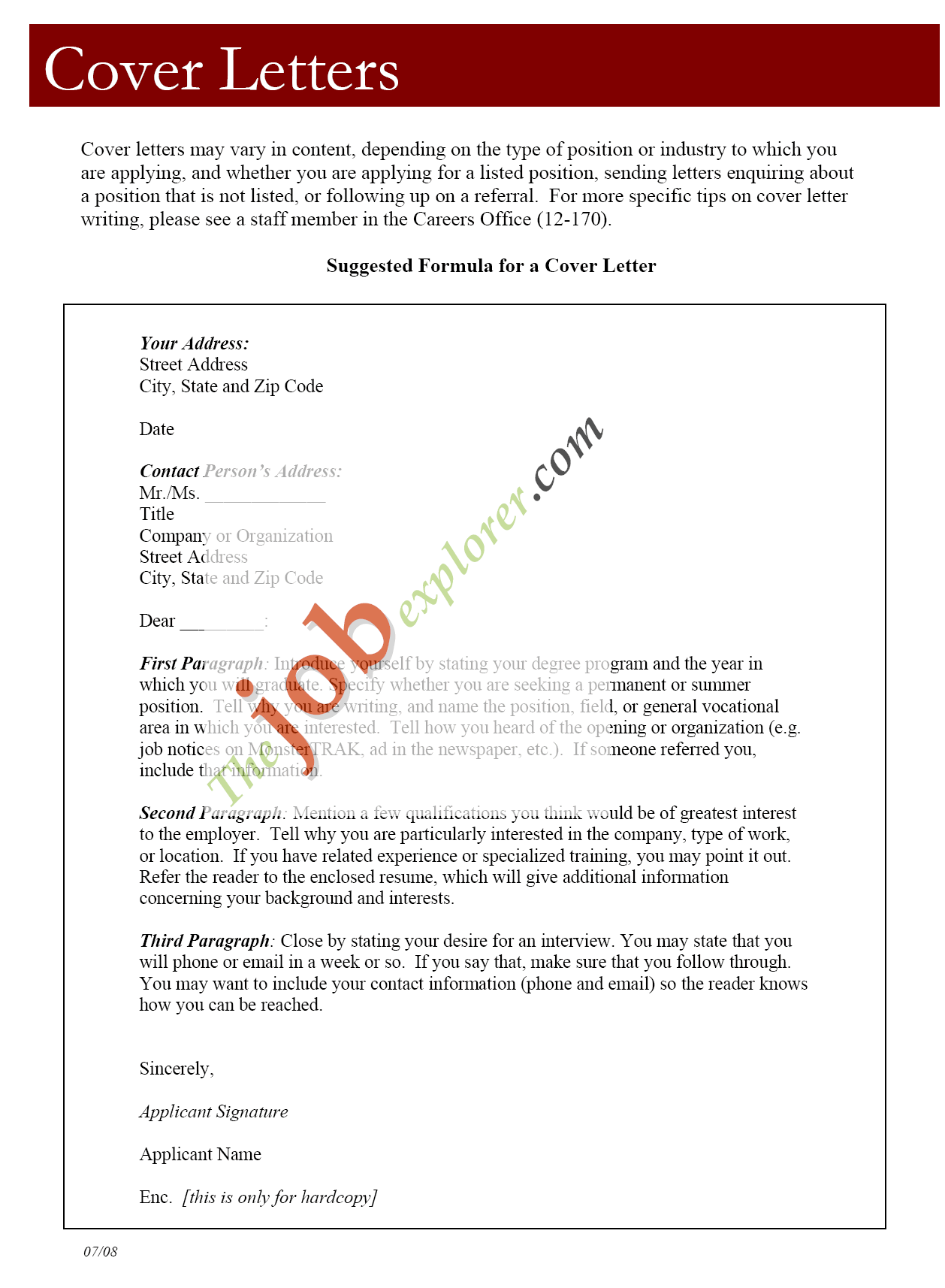
    We all know that a resume is a necessary tool when you set off to go job hunting. However, not a lot of people are aware that they should submit a cover letter along with their resume.

    Writing a cover letter though requires patience and attention to detail. However, once you have prepared a good resume for yourself, a cover letter will be manageable to craft within a few hours. The thing to remember about a cover letter is that a generic one is a no-no; you should always tailor it according to your target job. To do this, here are the tricks to keep in mind:

    Understand what your target position needs

    However, sometimes it will take you two or three passes to process what the essentials are. As such, when you see a job posting you are interested in , don’t be keyboard-happy and send your resume right away. Take the time to read the qualifications and skills required for the position and be sure to note a commonality. The most common thing you find out about them will be the one to highlight in your cover letter.

    Summarize your qualifications

    This is similar to the qualifications summary in your resume where you detail your job positions, core competencies, industry, length of experience, strengths, accomplishments, and educational experience. In this part, ensure that you are providing information that is relevant to the position you are applying for. For example, say you take pride in your email communication skills, but you are applying to a direct sales representative role. In this instance, you can play up your interpersonal skills and outgoing personality and mention your persuasive skills, but your writing skills may have to take a backseat.

    Align your strengths with the prioritized requirement

    If you are looking to apply as a shift supervisor at a busy café, what do you think is the most important quality that the hiring manager or recruiter will look for? The first thing an employer might look for in this role is a candidate who can provide efficient service and a positive environment. Once you know that, you can do a self-evaluation and look for your skill that best fits this necessity. For example, you worked as a supervisor at a clothing store at a busy mall during Christmas time; this will catch the attention of a prospective employer of a busy commercial establishment.

    Research the company

    A cover letter is essentially about you, but hiring managers and recruiters will also want to know how you fit into their team. This is the part when you have to take the time and do research on the company you are applying to. Find out about their mission and vision. Research their company values. Discover what foundations or organizations they support. Once you have researched these aspects, you can find something that speaks to you.

    A cover letter complements your resume, and it should not be taken for granted. It gives the hiring manager or recruiter a glimpse of what you can offer them. A cover letter can also distinguish whether they should have a look at your resume or throw it away. Follow the tips above and you will be on your way to having a cover letter that grabs attention.

    SOURCES:

    https://blog.livecareer.com/how-to-tailor-your-cover-letter-the-easy-way/

    http://careers.workopolis.com/advice/how-to-tailor-your-resume-to-any-job-posting/

    http://www.bubble-jobs.co.uk/blog/b2c/tailor-write-cover-letter/

  • Dressing Up Your Resume: Knowing the Essentials

    Dressing Up Your Resume: Knowing the Essentials

    Job hunting is a grueling process so you would like to have the right tools to make it a less grueling task, and the best way to do that is to have a well-written resume. A resume reflects what you have to offer, and if it does not succeed in doing that, it will end up in the bin (harsh, I know).

    As such, Think of preparing a resume to dressing up for the job interview itself:  Wear your best suit or dress, your best hairstyle, your best pair of shoes, and your best accessories. Below is a short guide on how your resume should be dressed for success:

    Objective

    If you are meeting a friend you have not seen for a long time at an unfamiliar restaurant or café, the first thing you do is research for directions to get there. If you don’t, you might end up at the wrong place; this applies when you are preparing your resume. . The objective should clearly state to the Hiring Manager or Recruiter what position or job title you are applying to. Otherwise, you will end up going through the application process for a job you are not interested in or might not like at all. Or because your objective is unclear, the recruiter may pass on your resume altogether.

    As such, when writing your objective, keep in mind the position you are aiming for, the key skills that make you qualified for the position, and the benefits or values that you bring to the table. If you are an aspiring digital marketing freelance writer, for example, a good objective is “Well-versed digital marketing specialist who aims to be part of an online marketing team to craft strategic copies and campaigns which focus on brand establishment and loyalty.”

    Qualifications Summary

    We all want to put our best foot forward in a resume, but you do not want to give away too much information that will give your readers a difficult time. Thus, instead of listing down all your qualifications, be sure to condense them coherently so it is readily apparent what you can offerthe company.

    To summarize your qualifications, the key points to include are: Title, core competencies, industry, length of experience, strengths, combination of accomplishment highlights, and academic experience. You can also mention language skills, technical skills, and personal profile. Some examples are:

    • Self-motivated and customer service-focused supervisor with two years of experience in retail and customer service industries providing exceptional frontline assistance.
    • Demonstrates outstanding time management skills and prioritization skills.
    • A Journalism graduate at Ryerson University who is a well-articulate communicator fluent in English and French and proficient in Microsoft Office Suite, Customer Relationship Management systems, and Sales Force.

    Professional Experience

    When noting your professional experience, conciseness is key since you would not want too many details which might make your resume longer than necessary. To start on a good note, remember this simple format: company name, city and state, month and year of employment, and position title.

    A rather easy part of putting your professional experience on paper is that you do not necessarily have to be creative as the primary focus is to list your job descriptions. You can refer to your contract. If that is not available, you can refer to internet postings or detailed classified ads in newspapers.  Do not merely copy or paste, though. You have to relay how you performed on those respective responsibilities. Highlight your accomplishments and provide statistics when you can. For example, we all know what a customer service representative does, but what made you different from the rest? Write “Achieved 95% quality score in the first year” or “Increased sales performance for the campaign by 5% in the first quarter.”

    Educational Attainment

    As high school or college or university graduates, you are not expected to have a lot of information under educational attainment like an MBA or Ph.D. as compared to those who have been working for several years. However, realize that job search is truly competitive and you would like to stand out from the rest by highlighting your skills as a student.

    So apart from noting down your degree or coursework, you can also mention your extra-curricular activities like sports or participation in the school newspaper. You can also mention your leadership skills and say you were elected as Treasurer in Senior Year or you represented your class in school board meetings.

    Readying a resume is overwhelming for newcomers and old-timers to the job search process. However, once you take note of those essentials above, you can get the hang of it and you will have your resume all dressed up to get the job.

    SOURCES:

    Resume Magic – Trade Secrets of a Professional Resume Writer by Susan Britton Whitcomb (Book)

    https://www.thebalance.com/what-do-employers-look-for-in-a-resume-4050949

    https://www.glassdoor.com/blog/4-employers-resumes/

  • Five Examples of Non-Physical Skilled Trades

    Five Examples of Non-Physical Skilled Trades

    The Ontario College of Trades recognizes 156 distinct skilled trades. One of the persistent myths surrounding careers in the skilled trades is that these jobs are physically demanding. While most trades require hands-on work, there are 156 skilled trades. You can choose a less physically demanding one.

    The following are just five examples of non-physical skilled trades:

    Child Development Practitioner

    Child Development Practitioners are trained to design and provide programs that help children develop physically, socially, emotionally, and cognitively. You will work as part of an interdisciplinary team, skilled in communicating with children, colleagues, and families. You will have opportunities to work in childcare facilities, preschools, and Ontario Early Year Centres.

    Child and Youth Worker

    Child and Youth Workers support vulnerable children and youth and their families by building healthy relationships, promoting healthy physical, social, emotional, and cognitive development. They are trained to identify childhood and adolescence disorders and to provide counselling and aggressive behaviour management. This is also a career where you will work in a multidisciplinary team.

    Developmental Services Worker

    Developmental Services Workers support individuals with developmental disabilities, including children. Your training in behavioural intervention strategies, safety, abuse prevention, and wellness allows you to create and maintain a safe, healthy environment for your clients.

    Educational Assistant

    Educational Assistants support students with special education needs. You work in a multidisciplinary educational team that designs and implements individual learning plans. Your training will involve learning introductory and development psychology, child education, and classroom skills.

    Hairstylist

    Hairstylists are trained to cut and style hair, as well as perform colour services and chemical treatments that wave, relax, and straighten hair. You may also work with wigs, hairpieces, and extensions.

    These are just five examples of non-physical skilled trades. Given the many possibilities, you may do further research and find more. It is also important to keep in mind that while your career may start off more physical, you may move up to a more managerial or supervisory role. If you consider it like that, then all the skilled trades are potentially non-physical!

    References

    http://www.earnwhileyoulearn.ca/156trades

    http://www.youth.gc.ca/eng/media/video_centre/ts_skilledtrades.shtml

    http://www.collegeoftrades.ca/wp-content/uploads/TFS_CDP_Nov2015.pdf

    http://www.collegeoftrades.ca/wp-content/uploads/TFS_CYW_Nov2015.pdf

    http://www.collegeoftrades.ca/wp-content/uploads/TFS_DSW_June2015.pdf.pdf

    http://www.collegeoftrades.ca/wp-content/uploads/TFS_Educatoinal_Assistant_Nov2015.pdf

    http://www.collegeoftrades.ca/wp-content/uploads/TFS_Hairstylist_Oct2015.pdf

  • Challenges for Women Working in the Trades

    Challenges for Women Working in the Trades

    Are you the creative and hands-on type? Do you welcome a challenge? Does the idea of travelling for work appeal to you? If so, you might consider a career in the skilled trades.

    There are many options available, from construction and transportation to manufacturing and service. Trades pay well, the average salary being double that of a retail position. Not to mention, there is a shortage of skilled workers in Canada, meaning plenty of employment opportunities.

    Skilled workers are the backbone of society and the economy. What can be more satisfying than that? That said, like any career, the trade industries are not without obstacles, especially if you’re a woman entering the field.
    These days more women are pursuing skilled trades more commonly associated with men. There are also bursaries, apprenticeships, and training programs geared to women. Companies are even encouraged by the government to hire female workers.

    Nevertheless, women are still underrepresented in the trades, making up less than 10 percent of the workforce according to Statistics Canada. Being a visible minority on a job site often comes with feelings of isolation and alienation. Hypatia, a Nova Scotia women’s organization conducted several focus groups with female skilled workers (Working It Out, 2008).

    Here are some of the issues that were raised:

    • Lack of accessible washrooms for women.

    • Ill fitting work attire and safety equipment.

    • Inappropriate images of women displayed on work premises.

    • Being downright ignored by male co-workers.

    One of the more obvious challenges a woman might face is discrimination. Remember, the skilled trade industries are male dominated.

    Several women have reported discrimination from male co-workers, supervisors and even clients who are more used to dealing with male workers. According to the Hypatia study, discrimination can range from passive criticism, like a male co-worker telling a female co-worker she should pursue a more traditional line of work, to being denied the same rights and privileges given to male workers (i.e. Equal pay). Other women have reported harassment from male co-workers. This can range from insults and intimidation to catcalling and even sexual assault. Remember that under no circumstances are any of these behaviours to be tolerated. It is important to speak up and get help if this happens.

    A company should have a strong policy in dealing with discrimination and harassment. It is their duty and responsibility, by law to provide a safe and supportive environment for all employees. This is a basic human right.
    Of course, many female workers have also reported positive experiences on the jobsite. Before accepting a position, it’s always a good idea to find out about a company’s policies to ensure that they accommodate the needs of a female worker and that they promote safe and supportive work practices.

    It’s important to remember that, with these challenges, comes great support. Female workers can reach out to one another through professional associations, annual conferences, mentorship programs, and even social networking platforms. By taking advantage of these resources you can and will succeed!

  • March 2017 Scholarships: Apply Now!

    March 2017 Scholarships: Apply Now!

    Retail As A Career Scholarship Program

    Amount: $1,000

    Provided by: Retail Council of Canada

    Deadline: March 31, 2017

    Donor: Retail Council

    Renewable: No

    Number Available: 20

    Type of Award: Scholarship

    Automatic Consideration: No

    Website: http://www.retailcouncil.org/memberservices/retail-education/retail-as-a-career-scholarship-program

    Application Address http://www.retailcouncil.org/sites/default/files/documents/2017-RAAC-Application-Guidelines.pdf


    The Joyce Foundation Access Bursary

    Amount: $3,000

    Provided by: Cambrian Foundation

    Deadline: March 31, 2017

    Renewable : Yes, 3 year(s)

    Number Available: 1  Type of Award Bursary

    Automatic Consideration: No

    Website: http://cambriancollege.ca/scholarships

    Application Address https://student.ftlams.com/result.aspx?surl=1a4248ad-333d-4384-a410-5dd892bbd545&sa=JOYC


    Aveda Institute Vancouver Spring Scholarship Contest! Win 1 of 7 scholarships!

    Amount $12,500  Provided by Aveda Institute Vancouver Deadline March 31, 2017  Donor Aveda Institute Vancouver Renewable No  Number Available 7 Type of Award Scholarship  Automatic Consideration No

    Website: http://www.avedainstitute.ca/

    Application Address: http://avedainstitute.ca/scholarship


    The Aboriginal Entrance Scholarship

    Amount: $5,000

    Provided by: Kwantlen Polytechnic University

    Renewable: No

    Number Available: 3

    Type of Award Scholarship  Automatic Consideration No

    Website: http://www.kwantlen.ca/awards.html

    Application Address: http://www.kpu.ca/awards/entrance-scholarship


    Full Ride Career Scholarship

    Amount: $22,759

    Provided by: Canadian Tourism College

    Deadline: March 27, 2017

    Renewable: No

    Number Available: 1

    Type of Award: Scholarship Automatic

    Consideration: No

    Website: http://www.tourismcollege.com

    Application Address: http://www.tourismcollege.com/admissions/scholarship/


    Colonel Douglas H. Gunter History Awards

    Scholarship Value: $1,000

    Awards Available: 5

    Award Deadline: March 31, 2017

    Application: http://www.warmuseum.ca/learn/school-programs/the-colonel-douglas-h-gunter-history-awards/#tabs


    Automotive Aftermarket Scholarships

    Scholarship Value: $5,000

    Awards Available: 125

    Award Deadline: March 31, 2017

    Application : http://www.automotivescholarships.com/index.cfm


    The Cara Brown Scholarship

    Scholarship Value: $1,000

    Awards Available: 2

    Award Deadline: March 31, 2017

    Application: http://www.ringette.ca/athletes/scholarships/the-cara-brown-ringette-sch


    The Wiesenthal Scholarship

    Scholarship Value: $1,800

    Awards Available: 8

    Award Deadline: March 31, 2017

    Application: https://www.friendsofsimonwiesenthalcenter.com/student_workshops.aspx#scholarship


    GRHS Scholarship Essay Contest

    Scholarship Value: $1,000

    Awards Available: 5

    Award Deadline: March 31, 2017

    Application: http://www.grhs.org/youthn/current/current.html

  • March Madness!

    March break is around the corner; right about now you might be thinking that you really need a break. You’ve been working hard through all these winter months and it has been trying. March break is a time to regenerate and rejuvenate! Take that time to read a book you haven’t had time for; learn about a topic or subject you haven’t got a chance to explore.

    March’s issue of JPD is really special; we have a a few Medical Science career profiles

    you may have never heard or thought about, including Bioinfomatics Scientist and Cardiovascular Profusionist! We also want to tell you about how to get over a bad day, how to learn an instrument and how to prepare for post-secondary Frosh Week.

    JPD is still opening its doors to any students that want to write, contribute and share their experiences. Don’t be shy! Submit your inquiry and you might see it in next month’s JPD issue!

    Email us at JPDeditor@magiclanternmedia.com

    Stay safe!

    Erin Lynne Bouman

    Content Editor

  • How to Stay Safe at Work: The Trades

    How to Stay Safe at Work: The Trades

    If you’re a young person working in the trades, you deserve to be safe. However, every day someone like you gets injured on the job. In fact, hundreds of young workers are injured every year; and sometimes their lives are altered forever. All injuries are preventable so getting injured should never be a normal part of going to work. By being observant and using common sense, you can be safe on your job. Every. Single. Day.

    Know Your Rights

    If you think your work is unsafe for you or someone else, you can refuse to do it. Your supervisor cannot fire or punish you. That is the law.

    You have the right to know the risks of doing a job that can hurt you. The company is obligated to tell you all the hazards and how to protect your safety and health.

    You have the right to protect yourself by asking questions on safety, reporting unsafe conditions, following safety rules and participating in safety activities.

    Don’t Consume Alcohol or Drugs

    Number 1, you can get fired. And, number 2, they can alter your sense of perception and judgement and cause you to seriously injure yourself or someone else. Alcohol and drugs contribute to 3% of workplace deaths. Don’t be a statistic.

    Make Sure You’re Properly Trained

    Ask your supervisor what training you need to perform your job safely. Attend all the training sessions and always arrive on time. Take lots of notes and be very attentive to the company’s safety rules, standards, procedures and policies. If you’re given reading material, review it carefully and make sure you understand everything. When doing a task for the first time – especially a complex task – ask your supervisor to check if you’re doing it properly and safely. If your supervisor will be away, find out who you can turn to if you have any questions.

    Ask Questions

    There are no “dumb” questions. Don’t be embarrassed to ask your supervisor to explain something you don’t understand. Never assume you can do a task without proper instruction, guidance or supervision. And, if a task is over your head, say so! Don’t attempt a task that you can’t handle or never done before.

    Report Hazards and Risks

    Learn to spot hazards and risks. If you notice anything that can hurt you or a co-worker, report it to your supervisor immediately. Similarly, speak up if you notice a co-worker breaking the safety rules. You may feel like a snitch, but the few minutes you take to talk to your supervisor is nothing compared to the impact of a devastating injury. Besides, your supervisor will thank you for it.

    Wear Proper Personal Protection Equipment (PPE)

    PPE includes steel toe boots, hard hats, hair nets, gloves, aprons, safety glasses, masks, ear plugs, etc. It will protect you from injury and can even save your life. Ask your supervisor about the required PPE and learn to use it properly. Make sure it’s the right size and comfortable to work in.

    Lift Heavy Objects Carefully

    Always protect your back when lifting heavy objects. Keep heavy loads close to your body, avoid twisting your body and use your thigh muscles when carrying or lifting heavy loads. Take advantage of mechanical aids like a forklift or conveyor belt to help you move or lift heavy objects.

    Many companies have work safety programs and are vigilant in protecting their employees. By obeying their rules and keeping the safety conversation going, you’ll do your part in maintaining a safe workplace.

    Giselle Mazurat received her designation as a Certified Resume Strategist from the Career Professionals of Canada. She also writes technical and business content for government and private companies.

  • Had a Bad Day?

    Had a Bad Day?

    Have you had a lousy, everything-just-keeps-going-wrong kind of bad day?

    We’ve all been there. Sometimes things just don’t go the way they should, but it doesn’t necessarily have to be an over-all bad day. There are lots of ways to help change that bad day to a slightly better one. And if those fail, you can always start over with a brand-new day tomorrow.

    You can always restart the day. Not the clock on the wall, of course, but you can consider it like this: That last hour was not a great start to the day. How about we discard that hour from our memory and try to have a great rest-of-the-day? Sometimes this can work: you have a lousy morning, but a great afternoon – and by focusing on the afternoon of awesomeness, the morning will feel like it was pretty good, and you don’t remember it anymore.

    There’s also other ways to make that bad day better; drop in on your best friend who happens to be in the neighbourhood.  If you’re not in the mood for company right now, treat yourself to something you really enjoy – such as a chocolate bar (not too many, though) or that really fantastic meal from your favourite restaurant. Read a book that always makes you happy, or even a movie that makes you fill up with happy tears. A favourite soap opera, cat videos, or even watching people making fools of themselves. Laughter really is the best way to make yourself feel better.

    You’re allowed to have a bad day. Shut out the world. Turn off the computer and the phone, and log out of social media. Take some time for yourself, particularly if you’re feeling stressed around people. Surround yourself around things that help make you happy and calm, if possible, for fifteen minutes. It is also good for your mental health, but by allowing yourself to take some time to “reset” the clock, you can also change your day around.   Think of it as a mental stretch break.

    Just remember, there’s always a chance that bad day was just a blip in the radar – there’s better days ahead, and good and bad luck have a way of evening out. A bad day now and then is normal – it happens to the best of us. However, too many of them in such a short period of time can be as a result of several factors. It can help to talk it out with someone else, and there are several strategies available to you to lessen the streak of bad days – which is good for your mental health.

    A bad day can be better with someone supporting you and listening. There’s no shame in seeking help.  Sometimes it takes a lot of help to stand on your own.