Author: Susan Huebert

  • Get a Move On!

    Get a Move On!

    Most people move at some point in their lives, either from a house to an apartment or the other way around. Some people also move from one office building to another or need new furniture or other equipment. Often, moving companies help these people to move their belongings from one place to another. If you are physically strong and enjoy working with a lot of different people, it might be a good job for you.

    Almost anyone who is physically capable of lifting heavy objects can be a mover. However, some people make that their specialty and learn methods of doing their job quickly and efficiently. Professional movers often work in companies that offer these services, but some movers work alone or in small groups.

    When people move from one home to another, they usually have furniture like tables and chairs, as well as boxes full of dishes, books and other objects which might require special care. People in offices might have computers, photocopiers and other large and breakable machines. Movers have to be strong but also very careful as they move objects that could easily be ruined if they fall onto the ground. Being able to pack a truck efficiently is also useful so that the movers have to make as few trips as possible.

    Becoming a mover does not normally require any special education, but gaining experience is useful. Learning special techniques from other movers is a good way to become an efficient mover. Some companies also provide training for their employees, especially for people who want to drive the moving trucks or perform other parts of the job. Most movers work in pairs or small groups, but it is also possible to work alone with the right equipment.

    Although much of the work is physical, movers should be able to talk to customers and to discuss what they need. Employees of moving companies might also need to fill out forms and to complete inventories to make sure that everything has arrived safely. They might accept payments and write out receipts, and they might also work in the offices of small companies. Sometimes, movers might have to put furniture back together and possibly work with electronic equipment to make sure that it is connected properly.

    Wages for movers depend a lot on experience. Most movers start at about minimum wage, but they can move up to about $35 an hour after they have worked in the job for several years. One of the challenges for movers is that the work tends to be seasonal. Although people can move at any time of the year, many of them prefer not to move in winter when the weather is very cold. Movers can be very busy in the warmer months and have little work to do during the winter.

    Moving is a hard job, but it can be good for strong people who like to work with their hands and to meet new people. Why not consider being a mover either full-time or part-time?


  • Making a Living in Poetry

    Making a Living in Poetry

    If you read about the lives of famous poets like John Milton and William Shakespeare, you might notice something they had in common. They wrote great poetry which is still popular hundreds of years later, but they also had other jobs. William Shakespeare made only eight pounds for writing each of his plays and even less for his sonnets. He had to work as an actor to make a living. John Milton wrote political pamphlets to help pay his bills. Marianne Moore, a twentieth-century poet, worked as a librarian. Making a living as a poet has never been easy, but is it possible?

    Working as any kind of writer can be difficult. Novelists often have to go through many rejections before they can get their books published. Even then, making a living through writing can be hard to make much money. It can be even harder for poets. Their work is often less popular than novels and other types of writing, and they are often unable to sell many copies of their work. Often, they must teach classes or find some other way to make a living while writing poetry on the side. The Manitoba poet Sarah Klassen, for example, taught English for many years while she was writing and publishing.

    Being flexible and inventive can help poets make money through their writing. The traditional method of publishing books of poetry is likely to be difficult, but poets can make money in other ways. Magazines in print or online often include a few poems, and literary contests can also be good places for new poets to get their work published. In some cases, poets can even get fulltime work in advertising, producing greeting cards, or other fields where the skills of a poet are useful.

    Being able to communicate is an important part of being a poet. Some poets are good at telling stories and others are better at showing emotions. However, all poets learn to use language in new ways. Poetry is a very brief and sparse way of communicating. Often, a few words have to communicate complete thoughts in poetry, and poets have to choose their words carefully.  Even in narrative poems that tell stories, using the fewest words possible can be the most effective. Developing good writing skills is an essential part of becoming a poet. The first step is often to read a lot, learning from poets of the past and present. Courses in English literature or in writing techniques can help new writers develop their skills.

    Poets also need to develop their own styles. Some poets like to use complete sentences in their work. Others like to use as few words as possible to say what they mean. Another important factor is what publishers and readers want. Different styles of poetry appeal to different types of people, and publishers’ guidelines can give you a good idea of what works best in each situation. Learning to adapt your writing style will help you become successful as a poet.

  • Why Do We Want to Protect the Environment?

    Why Do We Want to Protect the Environment?

    Protecting the environment, natural resources and wildlife is something that is not only supported by people who are environmentalists. Everyone can take part in helping to improve the health of the planet.

    When you walk outside, you may not realize it, but you are depending on fresh air to survive. In Canada, we are fairly lucky as our levels of air pollution are not nearly as high as those in more heavily populated countries like China or India. The health effects of bad air quality have been researched and it is proven to cause a number of diseases and illnesses. Improving the quality of the air is something that can be accomplished via grassroots efforts; That is, through individual efforts to emit less carbon into the atmosphere. Reducing carbon emissions can also be accomplished through the efforts of large companies and corporations, who emit the most carbon of all.

    The quality of the water is also something that is important to consider since we all depend on clean water to survive. Maintaining clean water is something that can be accomplished through individual efforts like not flushing hazardous chemicals down the drain or toilet and trying to conserve water to reduce the demand on the water treatment facilities – an operation that requires a lot of water to conduct. Big businesses could also pitch in to conserve water by investing in water saving initiatives and partaking in water conservation efforts.

    Wildlife also needs our protection. With more and more urbanization, spaces where wildlife are safe is decreasing at alarming rates. Deer, moose, cougars and bears are all often reported in the news as having caused car accidents due to the decline in their natural habitat and their subsequent wandering out onto developed land transformed into highways or suburban neighborhoods. In order to protect wildlife, we must invest in protecting Canada’s natural spaces.

    If you support clean air, water and having a wide range of wildlife in Canada, see if there is a way you can get involved in your community. Help to clean up your local park or visit a wildlife sanctuary to see how they take care of animals.

  • Stress Management for Youth with Learning Disabilities

    Stress Management for Youth with Learning Disabilities

    Stress is a normal part of everyday life. Sometimes a little stress can be a good thing. Like when you are nervous before a big test or a first date, stress can give you a needed burst of energy. Everyone wants to do well and be successful, and stress in small doses can even help you achieve your goals. There are also times when school or social situations can be overwhelming and the stress can paralyze you rather than push you into action. Be aware of how you feel, because this type of stress can be harmful to your health and emotional well-being.

    Understanding your stress and the things that make you feel “stressed out” can help you navigate through life better. Below are ten easy tips to help you reduce stress when you are feeling overwhelmed, emotionally exhausted, or more nervous and worried than usual.

    1)     What’s on your schedule?
    If you are feeling overwhelmed because you have many responsibilities, review your commitments and activities and decide if you want to do less. Choosing to do less may actually give you the opportunity to do what is left on your list even better than before. You may also want to alternate activities, choosing music lessons one semester at school and drama the next, allowing you to experience, learn and enjoy both activities.

    2)     Be proud of a job well done.
    Aiming for perfection is normal but not the most practical. Learn to feel good about doing a competent job rather than demanding perfection from yourself and others.

    3)     Hey, it’s okay to ask for help.
    If you require help in schoolwork, completing chores at home or at a job, ask someone for assistance. Asking for help is much better than not completing a job because you are not sure what to do.

    4)    Everybody loves sleep! Keep a bedtime schedule.
    Try going to bed at the same time every night. Getting enough sleep can help you both emotionally and physically, and can help you to better cope with any stressful moments that may come up during the day (at school, at work, with friends or parents.) Although it is tempting to stay up late and you don’t really feel tired, it’s important to stay on a schedule and make sure you get enough sleep each night.

    5) Get active and exercise every day.
    It’s true, exercise has been shown to reduce stress and depression. Making sure you get some exercise each day can help you to remain alert and help you focus on your schoolwork–this can help you have more energy for your extra-curricular activities too.

    6)    Eat right (healthy food is good for stress)
    Would you eat pizza every night if you could? That’s pretty normal for most teens, and while pizza is okay sometimes, it’s important that you eat healthy foods as part of a balanced diet. Salads, fresh veggies, fruits and whole grains are good for you! And just like thinking positively, eating healthy food can take some practice. Eating healthy foods can even help you to function better, especially in stressful situations.

    7)    Slow down; try relaxation techniques
    Deep breathing exercises, meditation or visualization techniques to help cope with daily stresses. These type of techniques can be used every day to help your mind stay balanced and can be used in highly stressful situations to help you cope immediately.

    8)    Good friends & family–develop your support network.
    Having people to talk to or people you can connect with when you need support is helpful. If you don’t already have a support system, think about who of your friends and family you can call on when you feel stressed and ask them if you can call them the next time you feel overwhelmed.

    9)    And don’t forget to have fun.
    So often our life can be filled with schoolwork, jobs, chores and tons of other things we “have to do.” Make sure to include activities in your day that you enjoy–being happy can help you relax.

  • Learning Disabilities and Work

    Learning Disabilities and Work

    We most often think of learning disabilities that impact a student in school, however, LDs are lifelong and don’t magically disappear once a student has graduated and entered the workforce. The National Center for Learning Disabilities lists five areas where people with LDs may experience difficulties:

    Inefficiency – this could be working at a slower pace than coworkers, having organizational challenges or needing additional time to complete tasks

    High error rate – this could be errors resulting from poor reading or math skills or could be because someone takes longer to process information and react to situations.

    Problems with sequencing – this could cause problems with completing tasks requiring multiple steps or following directions

    Time management – this could be poor planning, tardiness or having problems with meeting deadlines

    Social skills – this could be problems with interactions between coworkers, customers or vendors or in verbalizing the impact of a LD to the employer to receive needed accommodations/modifications

    The Americans with Disabilities Act protects people with LDs, but only if the person has requested protection, identified their LD, and provided documentation to his or her employer and with needed specific accommodations included. In addition, a person must be able to complete the job, with modifications. Any company employing more than 15 employees is required to provide reasonable accommodations to those with disabilities that interfere with the ability to complete the job.

    Accommodations/modifications should be specific to the individual needs of the employee, therefore, there is no single list of acceptable accommodations. A person requesting protection under the Americans with Disabilities Act will benefit from understanding the job description and duties and knowing what accommodations/modifications will help him or her perform the job duties.

    The following list of examples is to provide ideas only. Please adapt to your specific situation:

    • Written instruction cards, laminated to help with performing multi-step job duties
    • Adjusting the font or background color on the computer screen to help people with dyslexia
    • Receiving company communications in written form, such as via email or memos. Written communication can be provided either before a company meeting to provide the person time to process information or after the meeting to allow the person to have a written copy of what was discussed.
    • Use of spell-check software or having a coworker edit written work.
    • Use of assistive technology, such as software that translates the spoken word into the written word
    • Using a tape recorder during company meetings or when given instruction.

    Again, these are ideas to help people with learning disabilities think about what may help them perform their job duties. By thinking about how you learn, how you work and problems you have had in the past, you will be able to determine what accommodations or modifications you may need in your job.

  • Six Tips For Getting A Scholarship

    Six Tips For Getting A Scholarship

    A lot of college students end up with nothing but debt even before they graduate. The option of a scholarship has always been a number two priority when it comes to college students. Most think that they can just pay off their student loans after they graduate and get a job, but many find it too overwhelming. With a scholarship, not only will you study for free but some scholarship plans will even give you money just to stay in school or even provide you with an “allowance”.

    Here are a few tips to help you get a scholarship and avoid debt in college.

    Look for one as soon as possible
    Start looking for a scholarship even if you haven’t graduated yet. Start during your junior year of high school and take advantage of having less competition. This way, you can still renew your efforts and take additional opportunities.

    Look for scholarships elsewhere
    Don’t just limit yourself to online sources. Check with religious organizations, local clubs, your school guidance counselor and employers. Local scholarships are less competitive compared to the national ones and you can find corporations and businesses that award free education to their loyal customers.

    Don’t become intimidated just because you’re not on the top
    So your grades aren’t really made for the honor roll, but many scholarships don’t measure or base their decisions on your grades. Many scholarships would prefer someone who shows volunteerism and leadership.

    Search all year round
    You can find scholarships that are only available for a limited season. For example, some major department stores actually give out scholarships during the holidays as a prize. Treat it like getting a part-time job. You can get different opportunities throughout the whole year.

    Be honest
    Never exaggerate your memberships, skills, qualifications or grades. Better focus on a scholarship that you know you’re eligible for.

    Avoid scams
    There are scholarship scams out there that promise you a full scholarship if you give them a certain amount of money. If someone emails you and asks you if you’re interested in a “discounted” tuition fee, it’s best to avoid these emails so you don’t get into a debt collection lawsuit. These scammers are only after your money and they’ll make a run for it after you give your credit card number to them.

  • Dream Jobs: Ballerina

    Dream Jobs: Ballerina

    Brooke Nagy is an 18 year old on a fast-track to becoming Canada’s next prima ballerina. Becoming a professional ballet dancer was not a decision Brooke made on a whim. It has taken a lifetime of preparation and focus. Since age three she has been classically trained in Ceccetti ballet, and has developed an advanced knowledge of both classical ballet and modern dance.

    Brooke has had the opportunity to dance professionally at many points throughout her career, but decided that it was important for her to complete her high school education before devoting herself entirely to the art. “I’ve already trained with the CanadianNational Ballet School and the Quinte Ballet School,” Brooke explains.

    “For two summers I was accepted to study as a part of the Canadian National Ballet School’s ballet-intensive summer school program, which led to the opportunity to be a part of their full-time program. I’ve also been accepted to (and attended) the Quinte Ballet School’s Summer School Program, which led to an acceptance into their full-time program” she continued.

    Ballet may well be in her blood, as her mother is a classical ballet teacher and former professional ballerina for the Miami Cityballet. Brooke intends to one day take over her mother’s dance studio, after travelling and performing as much as possible. She applied to the National Ballet of Canada’s Teacher Training program, New York’s Adelphi College and Suny Purchase College’s Conservatories of Dance and George Brown College’s prestigious dance program, garnering preliminary acceptance to all, but choosing to accept George Brown’s offer.

    The Toronto-based program will prepare her for an intensive Bachelor of Fine Arts transfer after earning her two year diploma, and set her up for work with Canada’s Ballet Jörgen, a renowned Canadian classical ballet company that selects dancers from George Brown program alumnus.

    Among the highlights of Brooke’s auditioning process was when famed Canadian dancer Frank Augustyn called her out from a class of second and third year Adelphi ballet students she was placed with, praising her grace and skill above those of professional dancers with many more years of training. She was then offered a ten thousand dollar dance scholarship for Adelphi, a tempting offer that she may return to later in her career.

    For Brooke, the choice of dance over other more job-stable programs was quite simple. “I want to be a dancer over everything else. I know that the field of dance is where I excel and where I belong.” Whether it be the National Ballet School or Frank Augustyn himself, the ballet world agrees.

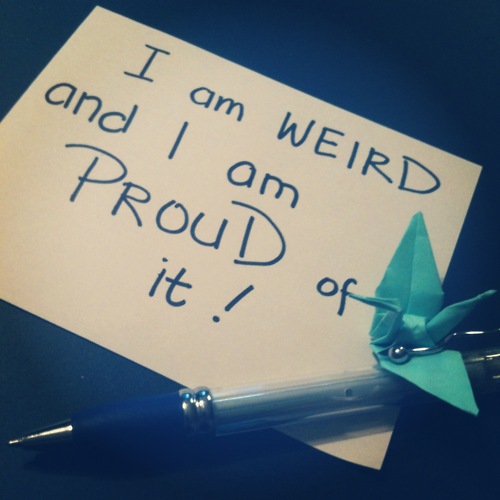
  • Embrace Your Weirdness

    Embrace Your Weirdness

    A lot of people spend time trying to fit in. They don’t want to stand out or be considered different, weird, awkward or strange. Having the same clothes, interests and ideas seems like the most important thing in the world. Everyone just wants to fit in.

    But who established what is normal ?  And what exactly is considered weird? For most people, normal is what they are used to and weird is what they are not used to.

    The word weird is defined by www.dictionary.com in three ways, one of which is fantastic and bizarre. Interesting, isn’t it, how we took a word meaning fantastic and bizarre and created a label for people with an unflattering connotation? When you look at it like that, being “weird” really doesn’t seem that bad. In fact, some of the most successful people in the world were considered strange, different or weird growing up.

    Take Justin Timberlake, for example. He was once quoted as saying, “I grew up in Tennessee, and if you didn’t play football, you were a sissy. I got slurs all the time because I was in music and art.” He also suffers from Attention Deficit Disorder (ADD) and Obsessive Compulsive Disorder (OCD), both of which haven’t stopped him from succeeding.

    Prince Harry was ridiculed and bullied for being a redhead. He was quoted as saying he was teased “for being ginger.” However, not everyone made fun of him. His fellow soldiers in the British Army all wore red wigs to make him stand out less in combat.

    Michael Phelps is one of the most successful Olympians of all time, but as a kid his long limbs, large ears, and lisp caused him to be bullied and teased by his classmates. He also has ADD, and was told he’d “never be able to focus on anything.” Yet he didn’t let that stop him. He used all of his feelings, both good and bad, as motivation to win and as a result became the most decorated Olympian of all-time (winning 22 medals, 18 gold, 2 silver and 2 bronze).

    Chris Colfer, who plays Kurt on Glee, was called a “freak” growing up. He said, “I was teased daily, mainly because of my voice. They said I sounded like a chipmunk! Now everyone likes to remind me how they used to be my best friend, but I have a very good memory- that wasn’t always the case.”

    Lady Gaga has said she didn’t have the best high school experience. She said she didn’t fit in as a teen. “I wanted to be like Boy George and I felt like a freak. So I like to create this atmosphere for my fans where they feel like they have a freak in me to hang out with, and they don’t feel alone.”

    The list of differences goes on and on…

    Albert Einstein, whose name is pretty much synonymous with genius, was a theoretical physicist, and one of the most renowned scientists of all time. However, he didn’t talk until he was four and he didn’t learn to read until he was seven. It is now believed he had Asperger’s Syndrome, which is a form of Autism. Sir Isaac Newton is also believed to have had Asperger’s, and he too was a mathematical and scientific genius.

    Jay Leno, Orlando Bloom, Vince Vaughan, Alexander Graham Bell, John Lennon and Muhammad Ali all had dyslexia.

    Christopher Columbus, Karina Smirnoff, Eleanor Roosevelt, JFK, Walt Disney, Will Smith, Jim Carey and Ernest Hemingway and Bill Gates had ADD.

    Mozart, Daryl Hannah, Tim Burton, Andy Warhol and Susan Boyle all had or have forms of Autism.

    All of these people were considered weird for how they behaved, what they felt and what made them different. They all experienced obstacles they needed to overcome, and they did so by embracing their weirdness. They didn’t let others define who they were and what their limits would be.  They used their uniqueness to their advantage and succeeded. So don’t be afraid to embrace your weirdness too. As Lady Gaga has said, “let your teenage freak flag fly.”

  • The Road to Self-Acceptance

    The Road to Self-Acceptance

    How’s your self-esteem doing? If you’re like me, you tend to see the best in others—and the absolute worst in yourself. Self-acceptance can be a difficult concept to wrap your head around when you’re constantly beating yourself up for every little mistake. There’s good news, though; you aren’t alone by a long shot. By considering your lapses in self-acceptance, you might start to find that the people around you are in the exact same predicament.

    Maybe you’re hung up over your poor marks in Spanish, or you think you look “fat” today. Maybe you couldn’t run the ten-minute mile, or your shirt doesn’t match your shoes. Well, odds are – and it’s kind of funny if you think about it – the people around you probably won’t even notice. It’s not that people don’t care. But did you ever stop to wonder that you aren’t the only one who’s preoccupied with your own flaws? Just as you can’t stop thinking about what you’ve done wrong, the people around you are too busy wrapped up in their own shortcomings to really identify yours. Here’s what ends up happening: each individual person sees themselves as the odd one out, when in actuality, everyone is in the same boat.

    You’ve probably heard the (albeit cliché) phrase, “Nobody’s perfect.” Everyone has flaws, weaknesses, spots for improvement—but there’s no need to focus on those. The next time you find yourself hung up over your lesser traits, try redirecting your thoughts to something you actually like about yourself. “Maybe I’m not great at sports, but I have straight A’s in math.” “Maybe I’m a little shy, but I’m excellent at reading people.” It is important to acknowledge your shortcomings, but it is much more important to remember all the great things you have to offer. And when you’re trying out this little mental compromise, your good traits should always win out.

    You must realize, by this point, how damaging it is to sell yourself short. Time passes, things change, life goes on—basically, you are the only constant force in your life. Why not respect yourself for who you are? It’s normal to feel conflicted at times, but you should never feel like you don’t matter, and by obsessing over every little flaw, you’re doing yourself a serious disservice. The next time something goes wrong, instead of attacking yourself, focus on what you’re doing right. If you start to wean yourself off self-criticism, slowly but surely, those negative feelings will start to go away.

    As for myself? Well, I’m a work-in-progress too. But I know that I deserve more than to be constantly criticized and mistreated – even if it’s coming from my own head. The road to self-acceptance is a rewarding process, and in order to become stronger people we all have to overcome our insecurities. The self-hate stops now.

  • Bullying Is Everyone’s Problem

    Bullying Is Everyone’s Problem

    There is no doubt that bullying is a problem which has been around for a long time – within all forms of human interaction, there have always been those that not only feel superior to others but feel the need to demonstrate this at any cost. Where bullying was once mostly confined to the schoolyard, now more and more children are plugged in to the internet. This has made the problem significantly worse, becoming more insidious, dangerous and sometimes even fatal.

    By now, most people will have heard about the B.C. girl who, having been relentlessly bullied for a number of years online, combined with her allegedly fragile state of mental health, felt it was necessary to end her own life. Sadly, she is certainly not the first to do this and will not be the last. While it is impossible to find any shred of positivity in the current situation, the fact is that social media allows more people to become aware of the severity of the problem. Although bullying will likely never be completely eliminated, this may lead to concrete measures being taken to severely diminish it over time.

    While it is obvious that the bully and the bullied are the central players, the problem of bullying is far-reaching, affecting family, friends, entire schools and workplaces. It is no surprise that the majority of people who are aware that some form of bullying is taking place are more likely to ignore it rather than take action. However, it is a fact that by becoming involved, whether simply standing up to the bully on behalf of the victim or making friends with the victim (who are often in great need of friends), the bully will think twice about his or her actions. Of course, this is not always the case and sometimes a greater degree of intervention is needed.

    The first step for anyone being bullied, or for those that suspect it is happening to someone, is to speak up. It is widely believed, particularly among kids, that ‘telling’ is akin to ‘tattling’ which is just not the case. The fear also may be that by telling someone they may inadvertently make the problem worse by angering the bully. While this is a genuine concern, it certainly should not be a reason to remain silent. Making bullying known through Facebook or some other form of social media may not always be the best idea as this can leave the victim open to even more abuse and torment from anonymous comments made by online bullies and ‘trolls’. Even if the victim is reluctant to speak up, they can still get support through one of the many anti-bullying organizations that exist online such as www.kidshelpphone.ca, www.pinkshirtday.ca and www.antibullying.net.

    While it is obviously the victim of bullying that requires the most immediate help, one shouldn’t forget that by letting them continue their behaviour, the bully’s future can also be put in jeopardy. It is rare that a bully simply bullies for the sake of it and by getting help early on they can avoid problems later in life. According to Free From Bullies, 60% of adults aged 18-24 who once bullied end up with criminal convictions, a fact that can have an effect on society and the economy as a whole.

    There is no simple solution to the problem of bullying and it is very sad that even adults who should know better can be just as guilty as children. The problem will not be stamped out overnight, but through talking, understanding and, most importantly, taking action, we can make small steps to fight back.