Author: Amanda Desouza

  • How Does Social Media Impact You?

    How Does Social Media Impact You?

    Whether it is Twitter, Facebook, Instagram or LinkedIn, social media is a great way to connect with people around the world. These networks allow you to meet new people as well as re-connect with people you haven’t talked to in a while. Sharing pictures and updates can even make you feel closer to people near and far. These networks also allow for a venue of discussion about recent hot topics and news stories. As social beings, social media allows us to fulfill our natural desire to connect with people despite our busy schedules. While all of these things may seem positive, there is also quite a bit of negativity associated with social media. It is therefore important to be aware of these aspects in both your professional and personal lives.

    What a lot of people don’t realize is how social media can affect you and your job search. Any type of social media profile you create is a direct reflection of yourself. You are choosing to show people who you are and anything you post affects the way people are going to view you. These social media profiles can contribute to your reputation. They either help you maintain a good one or create a bad one. If you decide to maintain a professional social media account then it can be used in a positive way by you promoting yourself and your skill set. If you are trying to start a business, you could use social media outlets as free marketing venues.

    A practice that a lot of companies have been involved in recently is searching the social media profiles of potential employees to get a better idea of who they are. This is especially important to keep in mind when you are searching and applying for jobs. You don’t want employers to see pictures of you partying or doing inappropriate things. It may be hard to believe, but employers may view you as a liability to their company and that your behaviour on these social media websites could compromise their public image. This is why it is extremely important to maintain professional social media profiles. Despite social media having privacy settings there are still ways for companies to get around these, so proceed with caution.

    However, social media also has the ability to help you network with future employers. It gives you the opportunity to learn about different opportunities. It can even help you learn about these opportunities before the greater public learns about them, giving you an edge above the competition. An important website that many people use in order to expand their network of employers is LinkedIn. LinkedIn allows you to post your resume online and connect with employers in your field. It is a great resource for finding job opportunities.

    So make sure you think twice about the things you decide to post on your social media profiles. It could be the difference between landing a job you really want or missing out on an opportunity!


     

  • Why Do Employers Hire Recent Grads?

    Why Do Employers Hire Recent Grads?

    Often one of the most frustrating things for high school and university/college students is finding a job. We fill out so many applications and go for so many interviews but sometimes we still don’t get a call back. You may be racking your brain wondering if you could have done something better, if you bombed the interview, or if the interviewer didn’t like you. However, one of the reasons you may not be getting called back may have nothing to do with any of these reasons and more to do with the stage of education you are in. It is a well-known fact that employers often prefer hiring recent graduates.  There are a number of reasons why they do this. When you are searching for jobs you may see the term “entry level.” This means that an employer is looking for someone who has completed a program and is trying to enter the job market.

    Although having an academic background is a great thing to have under your belt, employers sometimes view students as having a very busy schedule. Between homework, assignments and exams, students may have to take time off work in order to balance their busy academic schedules. If employers feel like they can’t rely on you or that you don’t have a flexible schedule for them to work with, they may not hire you. Employers often want to hire people with open availability rather than limited availability. Also important to note is that employers sometimes want to wait until these students are no longer students and have completed their programs before hiring them. This could be because they will have less of an academic responsibility and can therefore work more hours.

    Another reason employers like hiring recent grads is because they have developed a skill set through their academic programs. They learn skills and gain knowledge that will help them become better employees. Through school, students learn how to manage their time and become more responsible. They also become better communicators both in written and oral forms. They also won’t have to spend as much time training you because you will have gained a lot of skills and knowledge about that particular field from your program. These are all things that employers look for and want in ideal candidates.

    This does not mean that someone who hasn’t graduated yet has a zero chance of being hired. What it means is that graduates tend to have a better chance because they have completed their education and employers appreciate that. They like to see that you have taken initiative to further your education and expand your skill set. So be patient and instead of getting frustrated try to understand why employers may hire recent grads.

  • Dream Job: Detective/Private Investigator

    Dream Job: Detective/Private Investigator

    Suppose that you lost something very important and you wanted to get it back. What would you do? You might look around and ask your friends and family if they had seen what you were looking for. Searching for things that are lost is only one of the many things that private investigators do. Working as a private investigator involves solving mysteries, finding information, and much more.

    You might have heard of fictional detectives like Sherlock Holmes and Hercule Poirot. Do you know any names of real-life private investigators? One of the most famous detectives was Allan Pinkerton. He was born in Glasgow, Scotland in 1819 and moved to the United States in 1842. In 1847, he joined the Chicago police department in 1847 and became the city’s first police detective in 1849. The next year, in 1850, he formed the Pinkerton Detective Agency in Chicago. The Pinkerton Agency worked together with the police in solving crimes and arresting criminals. By 1855, the agency had also started to work in security, guarding shipments that went by railway. Since then, security has been a large part of what Pinkerton agents do.

    Private investigators work in all kinds of areas. They might be hired by businesses to help deal with problems between bosses and workers or by the government to help investigate crimes. Some private investigators specialize in finding people who are missing or in store security. Other investigators do a variety of work, depending on who hires them and what skills they have. If you decide to become a private investigator, you might already want to start thinking about what area of work interests you the most.

    Except for security work, the most important part of a career in private investigation is the ability to find information. Investigators often need to ask people questions or to search online and print sources for information, and they have to be able to analyze what they learn to find a solution to their problem. Searching for information might also include surveillance, where the investigator watches to see what people are doing. Investigators often need to be able to use cameras and other equipment to be able to record what they discover. They have to learn different techniques for finding and interpreting information.

    Often, investigators learn these techniques through career colleges and other training schools. Investigators need to know the law well, and a degree in criminology or corporate law can be very helpful. In most parts of Canada, private investigators also need to get licenses to practice their work. The Canadian Private Investigators’ Resource Centre is a good place to check for specific information on these requirements.

    Want to help solve mysteries? Maybe a detective/private investigator will be your future job!

  • Becoming A Dancing Choreographer

    Becoming A Dancing Choreographer

    If you ever watch the ballet or any other kind of dance, you might think that the dancers’ movements come naturally. They might seem to flow out of what the dancers are thinking or feeling as they try to tell a story or show emotion with how they bend their arms or move their legs. If you take dance lessons, however, you know better. You know that in most dance performances, choreographers have carefully planned each movement that the dancers make. A good choreographer works in the background to make sure that the combination of dancing and music create an experience that the audience, musicians, and dancers will all enjoy and appreciate.

    Many people can probably name at least one or two famous dancers they have seen or at least heard about through newspapers or television. Very few of them, however, are likely to be able to name even one choreographer. That’s because choreography is not really supposed to be seen. Choreographers who do their jobs well and who work with good dancers produce a performance where the dance seems to flow out of the music naturally and doesn’t seem forced or awkward. Whether the dancers leap into the air or stand on their toes and twirl around, the movements have to seem to come out of the story they are trying to tell, with music as the unifying background.

    Being able to tie movement, story, and music together takes a lot of skill and practice. One of the best-known choreographers of the twentieth century, Martha Graham, was able to make music and dance work together. She had many chances to practice her skills in her seventy-year career. Her father was a doctor who believed that the body and mind were closely connected. He recommended physical movement as a cure for nervous diseases for his patients. However, he would not allow his daughter to learn how to dance.

    Later on, Martha studied and then taught at the Denishawn School of Dancing and Related Arts in California. She was especially interested in modern dance, and she choreographed many performances over the next years. Like most other people in her field, Martha Graham learned choreography through a combination of education and experience.

    Choreographers usually start out as dancers, learning the basics of movement from other people in the group. When they know enough about dancing and the limits of what dancers are able to do, often after about five years, they can start choreographing dances. Many people also get an education in the fine arts, music, or related subjects before they begin on their careers. Others gain experience through working with dance companies and learning from other choreographers.

    Dancing is a physically demanding job, and most dancers stop quite young. However, working as a choreographer is a good way for people who love dancing to continue to work in their chosen field.

  • Resume Writing Tips

    Resume Writing Tips

    Whenever you are writing your resume, you want to be sure to have five important points accounted for. 1) Include relevant information,  2) Always have up-to-date information, 3) Stay consistent with your formatting, 4) Never put references right on your resume and,  5) Tailor your resume to the job you are applying for.

    1) Start with recounting your work and volunteer experience. You want to be sure to have bullet points outlining what skills you learned from the job and what responsibilities you had at the job/volunteer activity. On your master copy, keep the skills you learned fairly general, and you can tailor the skills to the particular job you are applying to on a subsequent copy (see number 5). When you have nailed down your past experience in terms of volunteering and working, create a section about your education, going back as far as you think is relevant (putting in a line in about which daycare you went to is going back too far). Include a skills and interests section, trying to cover skills that are useful in most jobs. These will be adapted for each of the jobs you apply for. Your interests can include anything that you feel is worthwhile to put down, often choosing something that you want to talk more about is a good idea as employers may use this to see how you spend your time outside of work.

    2) Always have up-to-date information. This means that the name and address, telephone number and email that you have as the very first piece of information on your resume will be up-to-date, not your address from three years ago. You want to be sure that an employer will have no trouble reaching you. Also, try to avoid having unprofessional email addresses (like sexy_chick@hotmail.com). You want to project an image of responsibility and trustworthiness, so you want to avoid having an unprofessional email address. Simply create a new account if you need to.

    3) Staying consistent with your formatting is especially important for facilitating information gathering by the employer. If they are so distracted by the fancy bullet points you have, or the changing styles of font that you added for extra style, they won’t be able to see how you are the right candidate for the job. You want to be sure to pick a style and stick to it. Choosing a generic style is also recommended to avoid any distractions from your suitability for the job. This means regular margins, size 12 font, regular bullet points and the same style of indentation the whole way through the resume. Also, be sure to have a consistent way of documenting the year and the location of your work or volunteer experience. Your goal is to create an easy to read resume where the employer can get the information they want quickly.

    4) Never put references right on your resume. This is especially important because you don’t want to clutter up your resume or have too much information. Hopefully the employer will want to contact your references, but when you are handing in a resume you are not quite there yet. Avoid having that information right on your resume. You can put a line like “references available upon request”, as a way of indicating that you do have references (which you should get now if you don’t have any already).

    5) Tailor your resume to the job you are applying for. This is the most important thing that you can do to secure yourself a job. In the same line of reasoning as keeping your resume consistent, you want to be sure that the employer can read your resume quickly and easily, so they are able to see that you are the right candidate for the job right away. Avoid having one generic copy of your resume or handing out your master copy. Read the job posting and identify what it is that the employer is looking for. Highlight any skills or work experience that they require, any certifications or education, and create a section at the top of your resume outlining exactly how you fit their requirements. You can title this section “Qualifications” or “Professional Qualifications” . This section comes first before listing off your work and volunteer experience, skills and even education.

    Good luck!

  • What Exactly Is a Sculptor?

    What Exactly Is a Sculptor?

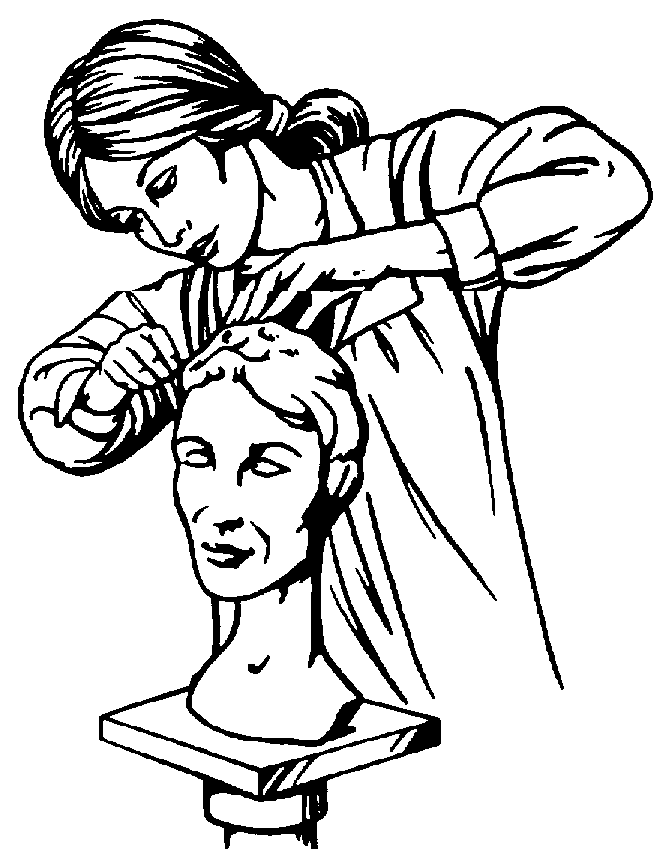
    People come from all over the world to see artwork such as sculptures at places like the Vatican in Rome and Parliament Hill in Ottawa. You might expect to see only work by world famous artists from Paris or New York. However, if you visit these places, you might find the work of a Winnipeg sculptor named Leo Mol. He was born as Leonid Molodozhanyn in Ukraine in 1915 but spent much of his life in Canada. He worked as a sculptor in Manitoba but sold his art to people around the world.

    Sculptors are artists who work with materials like bronze, clay, and stone to make statues of animals, people, or objects. Some sculptors are self-taught and learn their art from books or from many hours of practice. Others work as apprentices with more experienced artists who teach them what they need to know. Some sculptors attend university or art school. One important area of study is art history, which helps people understand the different styles of artwork that people have used in the past. The Canadian Art Foundation also had educational programs for students at many different levels.

    Like many other artists, Leo Mol studied art before he began his career. He first attended classes at the Kunst Akademie in Berlin, Germany, and at the Academy of Art in The Hague, Netherlands. He moved to Canada in 1948 and settled in Winnipeg, where he lived for the rest of his life. Some of his most famous sculptures are busts, which are carvings of people’s heads and necks. He made busts of several popes and cardinals in the Catholic Church and also of a former Canadian Prime Minister, John Diefenbaker. In 1989, he donated much of his artwork to the City of Winnipeg, and the Leo Mol Sculpture Garden opened in Assiniboine Park in 1992.

    Sculptors like Leo Mol can earn a lot of money by selling their work around the world, but their income depends on how much people like the statues. Some sculptors work in museums, schools, or advertising agencies, where they receive a regular salary. Even if they work in the same place as other people, sculptors generally work alone until the piece of art is ready to display. Then they need to work with others to find a place to put the sculptures. Often, sculptors work with commercial or non-profit galleries to display their work. They might sell some pieces to museums or art galleries or they might have art shows where people come to look at their work.

    Art shows are often a large part of a sculptor’s life. These shows give the artist a chance to meet others and to talk about the process of creating art. They also give people the chance to see the artistic works and possibly to buy some pieces. Are you artistic? Do you like to work with clay and other materials? If you are good with your hands and you enjoy creating art, you could consider becoming a sculptor.

  • Choosing To Work In A Trade

    Choosing To Work In A Trade

    Times have changed in the world of jobs. You might have heard from your parents or teachers that the best way to get a high-paid, reliable job is through a university education. Sometimes that still holds true. These days, however, a better choice for both men and women might be a skilled trade, where there are many opportunities for a rewarding career.

    What comes to your mind when you hear the term “trade”? Do you think of low-paid labourers, barely making enough money to pay their bills and never sure how much longer their jobs will last? Many unskilled labourers work under these conditions, but the situation is different for skilled tradespeople. They are often well-educated, with diplomas or certificates in their fields.

    Tradespeople might have as much education as university graduates. Unlike many university programs, however, training in the trades is geared specifically to learning the practical skills needed on the job. Tradespeople might be trained as carpenters, auto mechanics, electricians or any of the other trades. Through practical work and classroom studies, they learn everything they need to know to work in their trades. Another important part of the training process in the trades is an apprenticeship, in which students work together with an experienced person to learn practical skills for the job. For some trades they might also need to get an official license or certificate.

    Becoming qualified in a trade can take from one to three years of classroom education, between two and four years of apprenticeship, and two or three years of on-the-job training. Many university programs are just as long or even longer and more expensive. Graduates can also have trouble finding work in their field. In contrast, tradespeople can usually find work soon after they finish their studies and can easily pay off any loans they received for their school tuition.

    Almost anyone can become qualified to work in a trade. Most tradespeople, about 97 % in 2007, are men. However, more women are joining the trades and becoming qualified to work in carpentry, welding and other skilled trades. Possibly up to 320,000 people in Canada currently working in construction alone will be retiring in the next few years and that could open up good opportunities for both men and women. Becoming a journeyperson (someone with official qualifications in a skilled trade) could be a wise career move.

    How do you know if you could be successful in skilled trade? Natural ability and interest are important places to start. If you love to take things apart to see how they work, you might want to choose to be a mechanic or electrician. If you have a fear of heights, on the other hand, you might not want to choose the construction industry. The best way to decide whether or not a trade would suit you is to research it and to talk with people about it. Then, if you decide to pursue a trade, you’ll have a good basis for a stable and rewarding lifelong career.

  • Career Profile: Horticulturist

    Career Profile: Horticulturist

    Horticulture. What is it? In its simplest form we can define it as the cultivation of plants. But there’s a lot more to it than that.

    An individual who works in the horticulture field is called a horticulturist. Their duties consist of managing and coordinating anything that involves cultivating and breeding plant life. From working with landscape companies, to advising provincial ministries on proper techniques and maintenance of plants and landscapes; a horticulturist’s job often takes them from one job site to another and seldom leaves them standing in the same place.

    An ideal candidate for the horticulturist career path is an individual who enjoys working outdoors, nature, travelling and, well, getting dirty!
    Horticulturists may act as technicians or advisors for agriculture companies and provide information on techniques to yield a higher crop growth and impart pesticide-related info to both commercial and independent farmers. They may also work with landscaping companies to help them determine which plants will grow the most plentifully based on its required needs, like climate and precipitation.

    Horticulturists may choose to work as independent contractors or work directly for natural resource ministries to ensure soil levels are not contaminated and pose no threat to its vegetation or animals in the area.

    The career path of a horticulturist typically only requires some post secondary education as an apprentice. The individual could start out as a landscaper and gradually make their way to a horticulturist. If desired, university degrees are offered in the field of horticulture. These degrees may lead into other agricultural fields such as forestry and biology.

    So if you have always loved learning about plant life and even planting your own garden or flowerbeds at home, a career in horticulture could be perfect for you!

  • Energy Drink Dangers

    Energy Drink Dangers

    You know the feeling –it’s the early afternoon and you are feeling tired and sluggish. It’s easy to go to a convenience store and grab a Red Bull for a quick pick-me-up. But did you know that so-called energy drinks can be doing you more harm than good?

    Most energy drinks come with a warning label that you should not consume more than 1 per day. The reason is the high caffeine content, which is responsible for the quick boost you receive immediately after drinking it. While you may feel good for a short period, you will inevitably have a “caffeine crash” as your body gets back to normal. This can lead to headaches, irritability and decreased focus.

    Recent studies have concluded that some energy drinks contain 4 to 5 times more caffeine than a regular can of soda. For most people, the increase in caffeine will cause unpleasant side-effects such as nausea and diarrhea. However, the larger dangers of consuming too much caffeine run the gamut from heart palpitations, seizures, strokes and even sudden death.

    The best thing you can do is to stay away from these drinks entirely and instead focus on getting more energy by getting enough sleep and exercising regularly. On those days where you simply must have a caffeinated beverage, drink something with a lower caffeine content such as tea.

    Even worse than consuming energy drinks alone is mixing them with alcohol. Alcohol is a depressant while caffeine gives you a short-lived shot of energy. Putting these two chemicals into your body together is playing with fire. It is absolutely imperative that these two beverages never be consumed at the same time, as they have been linked to deaths in teenagers and young adults. Be safe and smart about what you consume!

    On top of the health risks, energy drinks are some of the most expensive drinks on the market. At around $2.50 per can, you could spend almost $75 per month if you drink one per day. Imagine what you could spend that money on instead!

    Go for a walk or run, drink some water and go to bed at a regular time each night. Taking these steps will prevent you from being tempted to purchase an energy drink in the future.

    Remember – treat your body well and it will treat you well in turn!

  • Succeeding In High School

    Succeeding In High School

    Whenever we are facing a life change, we are worried that there may be new challenges that we may have difficulty with. This is natural and is actually adaptive for your survival as a human being. By thinking about what high school might be like, you are helping yourself to be prepared for what may lie ahead. Try thinking of yourself as an explorer entering the jungle on an expedition. Would it be smart for that explorer to enter the jungle without first having thought through the possible outcomes of their expedition? The answer is no. The explorer must prepare themselves for what lies ahead in order to stay out of danger and ensure their success on their expedition. As you enter high school, you are like the explorer – in need of some preparation for what lies ahead. Be sure to think through some of the challenges you may encounter and try as best you can to prepare for these, such as buying appropriate school supplies and being open to learning new things.

    It’s important to keep in mind that a positive attitude is your best friend wherever you go, especially when you are facing new challenges that may intimidate you and challenge you to change yourself in some ways. Being positive will help you to overcome situations that are unpleasant or uncomfortable and to help you remember what it is that you do have, as opposed to focusing on what you don’t have, what you lack, or what is negative.

    That being said, it is equally important to have your own goals and ambitions that surpass your desire and need to be better than others. Remember that you are your highest competitor, and that you can most satisfactorily achieve your goals by competing with YOUR goals and only YOUR goals. Set goals for yourself using the SMART formula: Specific, Measurable, Achievable, Realistic, Timed (Wikipedia, 2013) and make your own success. You will have more work in high school than you’ve had before, so it’s important to set your goals and work to achieve them!

    Overall, being prepared, having a positive attitude, believing in yourself and setting goals for yourself is the way to success in high school. Good luck and, above all, have fun!